
BuddhistCatholicContemplativeEvangelicalGeneral ChristianHinduJewishLatter-day SaintMuslimNew VisionsProgressive Christian
Beliefs
- Buddhist
- Catholic
- Contemplative
- Evangelical
- General Christian
- Hindu
- Jewish
- Latter-day Saint
- More Voices
- Muslim
- New Visions
- Pagan
- Progressive Christian
Topics
- Religion News
- Food and Religion
- Sports and Religion
- Religious Art
- Religious Music and Entertainment
- Religious Events
- History and Religion
- Style and Religion
- Politics and Religion
- Women in Religion
- Recreation Outdoors and Religion
- Business Finance and Religion
- Careers Workplace and Religion
- Education and Religion
- Family Parenting and Religion
- Health Fitness and Religion
- Home and Religion
- Relationships and Religion
- Technology and Religion
- Travel and Religion
Columnists
- Buddhist Columnists
- Business Finance and Religion Columnists
- Careers Workplace and Religion Columnists
- Catholic Columnists
- Contemplative Columnists
- Education and Religion Columnists
- Evangelists Columnists
- Family Parenting and Religion Columnists
- General Christian Columnists
- Health Fitness and Religion Columnists
- Hindu Columnists
- History and Religion Columnists
- Home and Religion Columnists
- Jewish Columnists
- More Voices Columnists
- Latter Day Columnists
- Muslim Columnists
- New Visions Columnists
- Nonreligious Columnists
- Pagan Columnists
- Politics and Religion Columnists
- Progressive Columnists
- Recreation Outdoors and Religion Columnists
- Relationships and Religion Columnists
- Religion News Columnists
- Religious Art Columnists
- Religious Events Columnists
- Religious Music and Entertainment Columnists
- Sports and Religion Columnists
- Style and Religion Columnists
- Technology and Religion Columnists
- Travel and Religion Columnists
- Women in Religion Columnists
Resource Library
- 2026 Calendar
- Library of World Religions
- The 100 Most Holy Places on Earth
- Patheos Answers
- Podcasts
- Videos
- Faith Leaders Database
- Anglican Episcopalian
- Bahai
- Baptist
- Buddhism
- Christianity
- Confucianism
- Eastern Orthodoxy
- Hinduism
- Holiness and Pentecostal
- ISKCON
- Islam
- Judaism
- Lutheran
- Methodist
- The Church of Jesus Christ of Latter-day Saints
- New Age
- Paganism
- Presbytarian and Reformed
- Protestantism
- Religion Behind the Scenes
- Roman Catholic
- Scientology
- Shia Islam
- Sikhism
- Sufism
- Sunni Islam
- Taoism
- Zen
- See all religions
Research Tools
 Ad-Free & Subscriber Log-In Subscription Support
Ad-Free & Subscriber Log-In Subscription Support
Follow Patheos 

- Trending:
- Forgiveness
- |
- Marriage
- |
- Consciousness
- |
- Death Penalty
- |
- Election
- |
- Halloween

- Home
- Evangelical
- Politics and Religion
- The Intrinsic Limits of Science
The Intrinsic Limits of Science
Last updated on: May 14, 2020 at 6:00 am by Gene Veith
The Intrinsic Limits of Science 2020-05-11T16:02:55-04:00 Gene Veith
Patheos Explore the world's faith through different perspectives on religion and spirituality! Patheos has the views of the prevalent religions and spiritualities of the world.
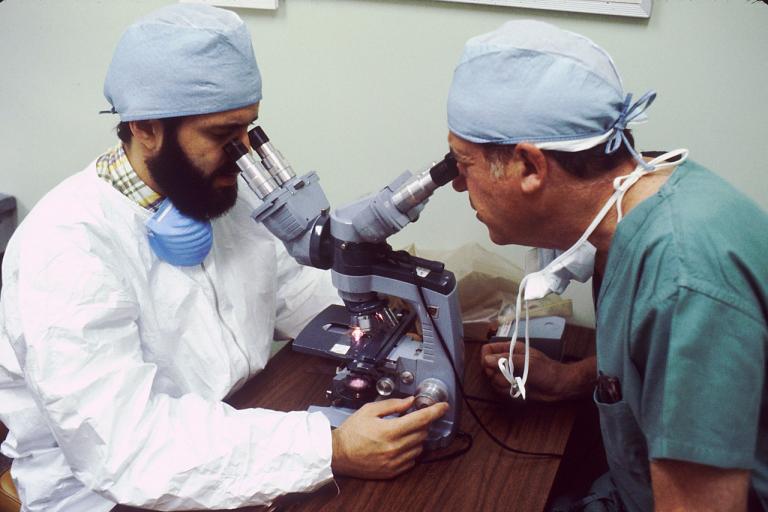
During the modernist era, from the Enlightenment through most of the 20th century, it was thought that science would answer all of our questions and dispel all of the mysteries of life. In the words of the pioneering sociologist Max Weber, the effect of science would be to “disenchant” nature, reality, and our lives.
But as I discuss in my book Post-Christian: A Guide to Contemporary Thought and Culture, science has come so far that it is “re-enchanting” nature. The more science discovers, the more mysterious nature becomes. The more we know, the more there is to know.
In 1894, the physicist Albert Michelson said that “it seems probable that most of the grand underlying principles” of physics “have been firmly established and that further advances are to be sought chiefly in the rigorous application of these principles.” Then came the mind-blowing discoveries of Albert Einstein. Then came the even more mind-blowing discoveries of Quantum Physics.
The coronavirus epidemic is showing the public’s enormous faith in and yet misunderstanding of science. We are not used to being so vulnerable to a dread disease. We expect science to protect us and are confused when it does not. We expect treatments and a vaccine now, or in the immediate future. All of the conflicting models, contradictory data, and unknowns about the virus are disillusioning. We forget that science is a laborious process, necessitating long and complicated experimentation, involving the falsification as well as the confirmation of hypotheses. It takes time and working through uncertainties to do science.
I came across an article in Commentary entitled They Blinded Us With Science: The History of a Delusion by Sohrab Ahmari, who stirred up that controversy about conservatism with David French. It’s about “scientism,” the blind faith in science, and he shows that science, for all of its great accomplishments, cannot be the sole arbiter of all truth.
The essay is worth reading in its entirety. What I found especially interesting is his point that science has intrinsic limits. He draws on Marcelo Gleiser, a Dartmouth professor of physics and astronomy, an expert in particle physics and cosmology, who explains why science can never arrive at an “ultimate truth.”
For one thing, scientific observation depends upon our technological instruments–the telescope, the Hubble telescope, the radio telescope, the particle accelerator, etc., etc.–which reveal more and more, and, yet, as the technology improves, continuously force us to revise what we thought we knew.
Then there are limitations built into nature itself:
Nature foists a second set of limits on scientific inquiry. “Nature itself—at least as we humans perceive it—operates within certain limits,” Gleiser says. To cite one of many examples: Our universe’s finite age, coupled with the finite speed of light, places an absolute, and permanent, obstacle on the road to any “ultimate” scientific account of the cosmos.
There are cosmic limits beyond which we simply can’t “see,” because the distances involved are too vast, and the fastest speed in nature, that of light, all too finite. Even objects we do see, the stars and galaxies that sparkle in our night sky, are only “there” in a provisional way. Particles of light from the “nearby” Andromeda galaxy that telescopes detect today left their point of origin 2 million years ago; we can only infer that Andromeda is still there.
The limits on our knowledge of the cosmos become still more daunting when we take into account the expansion of the universe. Gleiser explains: “The farthest point from which light could have reached us in 13.8 billion years, the age of the universe. Even if space extends beyond it, we cannot receive signals from behind this wall.” And as the expansion of the universe accelerates, our cosmic bubble shrinks, relatively speaking, as more and more of the universe recedes beyond our measuring grasp.
Our universe might be closed. It might stretch out infinitely. Or it might be one of a multitude of universes floating in some incomprehensibly gigantic “multiverse.” We can’t be sure, and, Gleiser insists, we can never be sure.
Ahmari also draws on the French thinker Michel Henry. In his book Barbarism (1987), he says that science rigorously excludes everything that is “subjective.” And yet, that excludes most of life, since our actual experience of living is largely subjective.
The scientific outlook, Henry argues, subtracts our subjective experience of life from our understanding of life. Since much of life doesn’t lend itself to objective apprehension and expression, the scientific outlook simply removes what it can’t apprehend from the realm of what is knowable or even worth knowing. But this brute privileging of one form of knowing above all others ultimately ends up erasing the truly human subject as such. Warned Henry: “To separate the reality of objects from their sensible qualities is also to terminate our senses, all of our impressions, emotions, desires, passions, and thoughts; in short, all of our subjectivity that makes the substance of life”. . . .
[Science] tears down all traditional knowledge, including the subjective knowledge embedded in human life itself; it rejects communion with the past, except, that is, on scientific-technical terms. This, even though life itself long predates science as we know it. Life should, in a rightly ordered cultural scheme, enjoy primacy over what is merely one branch of knowledge, one way of knowing. By life, Henry doesn’t mean “biological life,” which is another scientific category, but something closer to being-humanness. Life, in this sense, entails religion, spirituality, art, culture, folkways, and, more fundamentally, the knowledge embedded in our daily experience.”
Again, to recognize the limits of science is not to denigrate science in any way. It is simply to acknowledge what science is.
Image by Welcome to all and thank you for your visit ! ツ from Pixabay
Previous Post

May 13, 2020
Give Us All $2000 per Month, Pay 80% of Our Salary, or Pay our Housing?
Next Post

May 15, 2020 Weird Christianity
Recent Comments
"I know wired earbuds are making a comeback (I never stopped using them as I ..."
"VCRs, tape decks, and cassette players are all having a revival among a segment of ..."
"As a (retired) lawyer I see potential liability from sharing things like power or sharp ..."
"I am not sure the items you mentioned, though disused, discontinued, discarded, could be considered ..."
Browse Our Archives
Select a Category America Apologetics Art baseball Bible Blog Christ Church crime Culture Economics Education Ethics Family Food Football Government History Holidays Holy Week Humor International Islam Language Law Life Issues Literature Media Medicine Movies Music Nature News Personal Philosophy Politics psychology Reformation Religions Sacraments Science sex Social Science Sports technology television terrorism Theology Uncategorized Vocation war
Select a Month October 2026 September 2026 August 2026 July 2026 June 2026 May 2026 April 2026 March 2026 February 2026 January 2026 December 2025 November 2025 October 2025 September 2025 August 2025 July 2025 June 2025 May 2025 April 2025 March 2025 February 2025 January 2025 December 2024 November 2024 October 2024 September 2024 August 2024 July 2024 June 2024 May 2024 April 2024 March 2024 February 2024 January 2024 December 2023 November 2023 October 2023 September 2023 August 2023 July 2023 June 2023 May 2023 April 2023 March 2023 February 2023 January 2023 December 2022 November 2022 October 2022 September 2022 August 2022 July 2022 June 2022 May 2022 April 2022 March 2022 February 2022 January 2022 December 2021 November 2021 October 2021 September 2021 August 2021 July 2021 June 2021 May 2021 April 2021 March 2021 February 2021 January 2021 December 2020 November 2020 October 2020 September 2020 August 2020 July 2020 June 2020 May 2020 April 2020 March 2020 February 2020 January 2020 December 2019 November 2019 October 2019 September 2019 August 2019 July 2019 June 2019 May 2019 April 2019 March 2019 February 2019 January 2019 December 2018 November 2018 October 2018 September 2018 August 2018 July 2018 June 2018 May 2018 April 2018 March 2018 February 2018 January 2018 December 2017 November 2017 October 2017 September 2017 August 2017 July 2017 June 2017 May 2017 April 2017 March 2017 February 2017 January 2017 December 2016 November 2016 October 2016 September 2016 August 2016 July 2016 June 2016 May 2016 April 2016 March 2016 February 2016 January 2016 December 2015 November 2015 October 2015 September 2015 August 2015 July 2015 June 2015 May 2015 April 2015 March 2015 February 2015 January 2015 December 2014 November 2014 October 2014 September 2014 August 2014 July 2014 June 2014 May 2014 April 2014 March 2014 February 2014 January 2014 December 2013 November 2013 October 2013 September 2013 August 2013 July 2013 June 2013 May 2013 April 2013 March 2013 February 2013 January 2013 December 2012 November 2012 October 2012 September 2012 August 2012 July 2012 June 2012 May 2012 April 2012 March 2012 February 2012 January 2012 December 2011 November 2011 October 2011 September 2011 August 2011 July 2011 June 2011 May 2011 April 2011 March 2011 February 2011 January 2011 December 2010 November 2010 October 2010 September 2010 August 2010 July 2010 June 2010 May 2010 April 2010 March 2010 February 2010 January 2010 December 2009 November 2009 October 2009 September 2009 August 2009 July 2009 June 2009 May 2009 April 2009 March 2009 February 2009 January 2009 December 2008 November 2008 October 2008 September 2008 August 2008 July 2008 June 2008 May 2008 April 2008 March 2008 February 2008 January 2008 December 2007 November 2007 October 2007
Follow Us!
TAKE THE
Religious Wisdom Quiz
Blessed are the pure in heart, the peacemakers, and the meek. Where was this sermon delivered?
Select your answer to see how you score.
On a mountain In the temple By the sea In a synagogue
Books by This Author Books by Gene Veith
Related posts from Cranach



Our New Book on Technology & Vocation

Why AI Bots Don't Really Have Emotions
TRENDING AT PATHEOS Evangelical

When Halloween Unmasks Married Hearts
Written by Dr. David K. Ewen from Eternal Truth Bible College Behind...

Aristotle. He’s been called the father of logic, the father of the...

Methodist Central Hall and Westminster Abbey
Situated on the same square is Methodist Central Hall and Westminster Abbey. ...

57th Dove Awards Honor Dolly Parton, Crown New...
On gospel music’s biggest night, the 57th annual GMA Dove Awards honored...

The First Eucharistic Controversy: Christ’s Real Presence
For Catholics, the Eucharist is the source and summit of the Christian...

What a Stop Sign Can Teach Us About...
How to Make a Decision When You Can't Hear God Main point:...
view all Evangelical blogs
What Are Your Thoughts?leave a comment
Ad-Free & Subscriber Log-In Subscription Support
- About Us
- 2026 Calendar
- Videos
- Podcasts
- Library of World Religions
- Faith In Media Tracker
- Advertise With Us
- Write for Us
- Privacy Policy
- Terms of Service
- Do Not Sell My Data
- Contact Us
- Radiant Digital
- Manage Newsletter Subscriptions
- Unsubscribe From Notifications
- Sitemap
Copyright 2008-2026, Patheos. All rights reserved.
Subscription Support Ad-Free & Subscriber Log-In
Follow Patheos