
BuddhistCatholicContemplativeEvangelicalGeneral ChristianHinduJewishLatter-day SaintMuslimNew VisionsProgressive Christian
Beliefs
- Buddhist
- Catholic
- Contemplative
- Evangelical
- General Christian
- Hindu
- Jewish
- Latter-day Saint
- More Voices
- Muslim
- New Visions
- Pagan
- Progressive Christian
Topics
- Religion News
- Food and Religion
- Sports and Religion
- Religious Art
- Religious Music and Entertainment
- Religious Events
- History and Religion
- Style and Religion
- Politics and Religion
- Women in Religion
- Recreation Outdoors and Religion
- Business Finance and Religion
- Careers Workplace and Religion
- Education and Religion
- Family Parenting and Religion
- Health Fitness and Religion
- Home and Religion
- Relationships and Religion
- Technology and Religion
- Travel and Religion
Columnists
- Buddhist Columnists
- Business Finance and Religion Columnists
- Careers Workplace and Religion Columnists
- Catholic Columnists
- Contemplative Columnists
- Education and Religion Columnists
- Evangelists Columnists
- Family Parenting and Religion Columnists
- General Christian Columnists
- Health Fitness and Religion Columnists
- Hindu Columnists
- History and Religion Columnists
- Home and Religion Columnists
- Jewish Columnists
- More Voices Columnists
- Latter Day Columnists
- Muslim Columnists
- New Visions Columnists
- Nonreligious Columnists
- Pagan Columnists
- Politics and Religion Columnists
- Progressive Columnists
- Recreation Outdoors and Religion Columnists
- Relationships and Religion Columnists
- Religion News Columnists
- Religious Art Columnists
- Religious Events Columnists
- Religious Music and Entertainment Columnists
- Sports and Religion Columnists
- Style and Religion Columnists
- Technology and Religion Columnists
- Travel and Religion Columnists
- Women in Religion Columnists
Resource Library
- 2026 Calendar
- Library of World Religions
- The 100 Most Holy Places on Earth
- Patheos Answers
- Podcasts
- Videos
- Faith Leaders Database
- Anglican Episcopalian
- Bahai
- Baptist
- Buddhism
- Christianity
- Confucianism
- Eastern Orthodoxy
- Hinduism
- Holiness and Pentecostal
- ISKCON
- Islam
- Judaism
- Lutheran
- Methodist
- The Church of Jesus Christ of Latter-day Saints
- New Age
- Paganism
- Presbytarian and Reformed
- Protestantism
- Religion Behind the Scenes
- Roman Catholic
- Scientology
- Shia Islam
- Sikhism
- Sufism
- Sunni Islam
- Taoism
- Zen
- See all religions
Research Tools
 Ad-Free & Subscriber Log-In Subscription Support
Ad-Free & Subscriber Log-In Subscription Support
Follow Patheos 

- Trending:
- Forgiveness
- |
- Marriage
- |
- Consciousness
- |
- Death Penalty
- |
- Election
- |
- Halloween

- Home
- Evangelical
- Politics and Religion
- Our Virus-Infected Economy
Our Virus-Infected Economy
Last updated on: April 27, 2020 at 6:00 am by Gene Veith
Our Virus-Infected Economy 2020-04-26T14:03:47-04:00 Gene Veith
Patheos Explore the world's faith through different perspectives on religion and spirituality! Patheos has the views of the prevalent religions and spiritualities of the world.
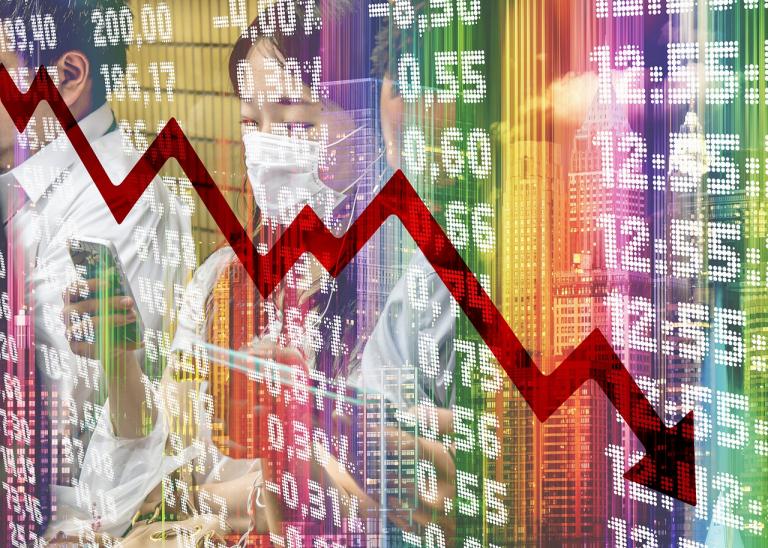
The coronavirus infects and threatens the lives of individuals. It has also infected and threatens the life of our economy. The symptoms of the economic infection include not only massive unemployment and the shutdown of entire industries, but also bizarre economic distortions.
The biggest impact, of course, is unemployment. One out of six Americans is now out of work, the highest level since the Depression. This is due to the government-mandated shutdown of much of the nation’s businesses. This has been described, to continue the medical metaphor, as putting the entire economy into an induced coma, in hopes that it will recover when we can cure the epidemic. But entire sectors of the economy–restaurants, hotels, airlines, travel, retail–are in critical condition and many businesses are dead or dying.
I would like to focus here, though, on the strange symptoms of our virus-infected economy.
Both Oversupply and Shortages
Supermarkets are doing well, but shoppers are finding empty shelves or “one-to-a-customer” limits on perishable staples such as milk, eggs, and meat. At the same time, farmers are pouring milk onto the ground, breaking their eggs, and euthanizing livestock.
How can we have both too much supply, to the point that farmers cannot sell what they produce, AND shortages in the face of growing consumer demand?
Well, to show just how prosperous we had been just a few weeks ago, 54.4% of what Americans spent for food has been for eating out. On average, Americans have been eating out 4.2 times a week, or 18.2 times per month. Some affluent people eat virtually all of their meals at restaurants, just as some low income folks eat virtually all of their meals at fast food joints.
All of a sudden, thanks to the coronavirus measures, restaurants have shut their doors. Now everyone who has been eating at restaurants must shift to eating at home. This means not only learning to cook in some cases but buying their food from grocery stores.
Grocery stores thus have more customers buying more food, a sharp increase in demand. Regular customers too are buying more, not simply to hoard, though there is some of that, but because stay-at-home requirements mean going shopping less frequently–according to some guidelines just once every two weeks–so that when customers do venture out in their masks and social distancing, they buy more per trip. So food keeps flying off the shelves.
As this is happening on the demand side, from the supply side, there is another disruption. The food industry is divided into suppliers of the retail market and suppliers of the restaurant market. So much of America’s food production is geared to restaurants and other large-scale buyers, such as schools and other institutions.
Thanks to the coronavirus measures, those larger-scale buyers are mostly closed. That means that their food-service suppliers have products that no one is buying.
Those suppliers could transition into the retail market, and some are, to the extent they can, but that is not easy. Companies used to selling flour in 50 pound bags or milk in individual serving for school lunches must change their packaging to sell in supermarkets. The processing, warehousing, and delivery systems must all be changed. And companies are reluctant to go through all of this, not knowing how long the restrictions will last. It would not be feasible to make all of the necessary changes if, in a couple of months, they would have to change them all back again.
Further complicating matters is that many food processing factories–particularly, meat-packing operations–are being shut down because their workers, who must labor in close proximity to each other, are either getting the coronavirus or are afraid of getting it or can’t come to work because they have to stay home with their kids because the schools are closed. Or in many cases preferring to file for unemployment so they can make more money than they would by working (see below).
And, as usual, the farmer who produces our food supply is especially hurt. When meat processing plants shut down, there is no one to buy farmers’ hogs and cattle. When milk companies no longer have the school lunch market, dairy farmers cannot sell all of their milk. When there are no more restaurants serving breakfast, the market for eggs, 30% of which are sold in bulk to restaurants, dries up. And since milk and eggs are highly perishable and since livestock that can’t be sold have to be fed and feed is expensive, farmers have no choice but to destroy what they produce.
A Labor Shortage at the Same Time as Soaring Unemployment
The CARES act designed to keep the economy on life support tacks on $600 per week to unemployment benefits. Say a factory worker gets a fairly decent wage at $20 per hour. That would come to $800 per week. In most states, the unemployment benefit comes to about half a worker’s weekly wage. That would be in this case $400 per week. But with the $600 per week supplement from the federal government, that would come to $1000 per week. Which is more than what the individual would get working!
The effect is even greater in other jobs that pay an hourly wage, most of which pay far less than $20 per hour. This has become a huge problem for the food industry, in addition to the ones we just discussed. This will be another hurdle for restaurants and small businesses in general once they can re-open. Typically, unemployment benefits last for six months.
The disincentive to work is very large. According to this article on restaurants, some laid off employees are doubling income by not working. In accord with the rational self-interest that is supposed to govern economic behavior, why would they go back to work until after their unemployment benefits are exhausted?
This is also impacting other “essential” businesses, such as retailers like WalMart, manufacturers of masks and other medical equipment, nursing home employees, etc., etc. All of these industries are hiring. But they are having trouble re-hiring workers they had to lay off earlier and hiring new workers to meet the soaring demand.
So at a time when six out of ten Americans are unemployed, the companies that are hiring are trying to deal with a labor shortage!
Paying Customers to Take What You Are Selling
Last week, oil sold for a minus $40 per barrel. That is, sellers were paying buyers $40 a barrel to take the oil off their hands.
Already there was a glut of oil on the world market. Saudi Arabia and Russia had been feuding with each other, with the Saudis increasing production to hurt the price that the Russians could get. And both of them wanted to hurt the United States, where fracking and other technological innovations have resulted in vastly increased oil production, making the U.S. a net exporter of oil.
That was the supply side. On the demand side, the coronavirus shutdown hit. Travel came to a halt. Airlines no longer needed to buy fuel. Workers from home no longer needed to commute. Meetings and vacations were cancelled. States imposed travel restrictions. Factories and other businesses that used petroleum as a fuel or raw material closed. So the demand for oil plummeted.
That the price of oil went negative was largely a quirk of the futures market, in which dealers try to lock in prices with contracts to buy and deliver months in advance. Commitments to deliver in May came due, but because of the glut from both the supply and the demand side, which no one predicted, vast amounts of oil came on the market. And there was no place to put it.
All of a sudden, the oil world’s attention was fixated on Cushing, Oklahoma–population 7,800–where the oil pipelines meet and where much of the nation’s oil storage facilities are located. Cushing is just an hour and a half or so from where we live! But now Cushing was full!
So the desperate traders had to give their oil away. When that didn’t work, they had to pay people to take it. And since there were few takers, they had to pay more and more.
The actual price of oil is $17.18, which is low enough. Not that long ago it was $88.
Gasoline is selling for $1.35 per gallon or less, but since driving has dropped off so much, consumers can’t take full advantage of that price, the lowest in decades. Meanwhile, states like Oklahoma, which depend on tax revenue from the oil fields and as thousands of jobs that have now evaporated, are in further trouble.
Europe has seen similar negative pricing for electricity and–with negative interest rates–for money in savings accounts and other investments.
Medical Layoffs in Time of Medical Need
In this time of pandemic, medical professionals–physicians, nurses, researchers, hospital workers–are the heroes, bravely risking and sometimes giving their lives to care for coronavirus victims.
And yet, medical workers are getting laid off, hospitals are going broke, and doctors’ practices are in jeopardy.
This is because the coronavirus measures have practically shut down the health care industry except for the coronavirus.
Hospitals and surgeons are not allowed to perform “non-essential surgery,” which includes hip-replacements, cataract removals, and other procedures that, while they do not have to be performed immediately, are still important to patients. And such operations are the major revenue-producers for the health-care industry.
Also, hospitals have had to reserve their intensive care units and bed space for COVID-19 patients. But, except for a few places, these are not being used! The hospital rooms are empty, as infections fall short of the models’ projections, which means expense without revenue and the necessity to lay off staff.
Thus, hospitals in rural and small towns are going bankrupt and closing permanently. They aren’t allowed to perform elective and non-emergency surgeries or other treatments in order to keep facilities open for COVID-19 patients. But in many of these cases, there are no COVID-19 patients.
Our economy is not just experiencing a downturn, as regularly happens in economic cycles. Because of this virus and our nation’s reaction to it, our economy, like a coronavirus patient, is sick.
Image by Gerd Altmann from Pixabay
Previous Post

April 24, 2020
Exterminating Christians in Nigeria
Next Post

April 28, 2020 The Last Time We Had a Pandemic Like This
Recent Comments
"I know wired earbuds are making a comeback (I never stopped using them as I ..."
"VCRs, tape decks, and cassette players are all having a revival among a segment of ..."
"As a (retired) lawyer I see potential liability from sharing things like power or sharp ..."
"I am not sure the items you mentioned, though disused, discontinued, discarded, could be considered ..."
Browse Our Archives
Select a Category America Apologetics Art baseball Bible Blog Christ Church crime Culture Economics Education Ethics Family Food Football Government History Holidays Holy Week Humor International Islam Language Law Life Issues Literature Media Medicine Movies Music Nature News Personal Philosophy Politics psychology Reformation Religions Sacraments Science sex Social Science Sports technology television terrorism Theology Uncategorized Vocation war
Select a Month October 2026 September 2026 August 2026 July 2026 June 2026 May 2026 April 2026 March 2026 February 2026 January 2026 December 2025 November 2025 October 2025 September 2025 August 2025 July 2025 June 2025 May 2025 April 2025 March 2025 February 2025 January 2025 December 2024 November 2024 October 2024 September 2024 August 2024 July 2024 June 2024 May 2024 April 2024 March 2024 February 2024 January 2024 December 2023 November 2023 October 2023 September 2023 August 2023 July 2023 June 2023 May 2023 April 2023 March 2023 February 2023 January 2023 December 2022 November 2022 October 2022 September 2022 August 2022 July 2022 June 2022 May 2022 April 2022 March 2022 February 2022 January 2022 December 2021 November 2021 October 2021 September 2021 August 2021 July 2021 June 2021 May 2021 April 2021 March 2021 February 2021 January 2021 December 2020 November 2020 October 2020 September 2020 August 2020 July 2020 June 2020 May 2020 April 2020 March 2020 February 2020 January 2020 December 2019 November 2019 October 2019 September 2019 August 2019 July 2019 June 2019 May 2019 April 2019 March 2019 February 2019 January 2019 December 2018 November 2018 October 2018 September 2018 August 2018 July 2018 June 2018 May 2018 April 2018 March 2018 February 2018 January 2018 December 2017 November 2017 October 2017 September 2017 August 2017 July 2017 June 2017 May 2017 April 2017 March 2017 February 2017 January 2017 December 2016 November 2016 October 2016 September 2016 August 2016 July 2016 June 2016 May 2016 April 2016 March 2016 February 2016 January 2016 December 2015 November 2015 October 2015 September 2015 August 2015 July 2015 June 2015 May 2015 April 2015 March 2015 February 2015 January 2015 December 2014 November 2014 October 2014 September 2014 August 2014 July 2014 June 2014 May 2014 April 2014 March 2014 February 2014 January 2014 December 2013 November 2013 October 2013 September 2013 August 2013 July 2013 June 2013 May 2013 April 2013 March 2013 February 2013 January 2013 December 2012 November 2012 October 2012 September 2012 August 2012 July 2012 June 2012 May 2012 April 2012 March 2012 February 2012 January 2012 December 2011 November 2011 October 2011 September 2011 August 2011 July 2011 June 2011 May 2011 April 2011 March 2011 February 2011 January 2011 December 2010 November 2010 October 2010 September 2010 August 2010 July 2010 June 2010 May 2010 April 2010 March 2010 February 2010 January 2010 December 2009 November 2009 October 2009 September 2009 August 2009 July 2009 June 2009 May 2009 April 2009 March 2009 February 2009 January 2009 December 2008 November 2008 October 2008 September 2008 August 2008 July 2008 June 2008 May 2008 April 2008 March 2008 February 2008 January 2008 December 2007 November 2007 October 2007
Follow Us!
TAKE THE
Religious Wisdom Quiz
True or False: The parable of the Good Samaritan is found in all four Gospels.
Select your answer to see how you score.
FALSE TRUE
Books by This Author Books by Gene Veith
Related posts from Cranach

Childcare Subsidies for Stay-at-home Moms?
TRENDING AT PATHEOS Evangelical

The First Eucharistic Controversy: Christ’s Real Presence
For Catholics, the Eucharist is the source and summit of the Christian...

What a Stop Sign Can Teach Us About...
How to Make a Decision When You Can't Hear God Main point:...

Archdiocese Hosts Military Marriage Retreat in Germany
RASTATT, Germany — The transient military lifestyle, with its frequent deployments and...

Nearly every morning, I make the drive to Detroit with my high-school-age...

The Real AI Story Is Adoption Without Trust
Artificial intelligence has crossed a political threshold. It is no longer a...

A new article, written by Jeff Lindsay and Gale L. Pooley,...
view all Evangelical blogs
What Are Your Thoughts?leave a comment
Ad-Free & Subscriber Log-In Subscription Support
- About Us
- 2026 Calendar
- Videos
- Podcasts
- Library of World Religions
- Faith In Media Tracker
- Advertise With Us
- Write for Us
- Privacy Policy
- Terms of Service
- Do Not Sell My Data
- Contact Us
- Radiant Digital
- Manage Newsletter Subscriptions
- Unsubscribe From Notifications
- Sitemap
Copyright 2008-2026, Patheos. All rights reserved.
Subscription Support Ad-Free & Subscriber Log-In
Follow Patheos