
BuddhistCatholicContemplativeEvangelicalGeneral ChristianHinduJewishLatter-day SaintMuslimNew VisionsProgressive Christian
Beliefs
- Buddhist
- Catholic
- Contemplative
- Evangelical
- General Christian
- Hindu
- Jewish
- Latter-day Saint
- More Voices
- Muslim
- New Visions
- Pagan
- Progressive Christian
Topics
- Religion News
- Food and Religion
- Sports and Religion
- Religious Art
- Religious Music and Entertainment
- Religious Events
- History and Religion
- Style and Religion
- Politics and Religion
- Women in Religion
- Recreation Outdoors and Religion
- Business Finance and Religion
- Careers Workplace and Religion
- Education and Religion
- Family Parenting and Religion
- Health Fitness and Religion
- Home and Religion
- Relationships and Religion
- Technology and Religion
- Travel and Religion
Columnists
- Buddhist Columnists
- Business Finance and Religion Columnists
- Careers Workplace and Religion Columnists
- Catholic Columnists
- Contemplative Columnists
- Education and Religion Columnists
- Evangelists Columnists
- Family Parenting and Religion Columnists
- General Christian Columnists
- Health Fitness and Religion Columnists
- Hindu Columnists
- History and Religion Columnists
- Home and Religion Columnists
- Jewish Columnists
- More Voices Columnists
- Latter Day Columnists
- Muslim Columnists
- New Visions Columnists
- Nonreligious Columnists
- Pagan Columnists
- Politics and Religion Columnists
- Progressive Columnists
- Recreation Outdoors and Religion Columnists
- Relationships and Religion Columnists
- Religion News Columnists
- Religious Art Columnists
- Religious Events Columnists
- Religious Music and Entertainment Columnists
- Sports and Religion Columnists
- Style and Religion Columnists
- Technology and Religion Columnists
- Travel and Religion Columnists
- Women in Religion Columnists
Resource Library
- 2026 Calendar
- Library of World Religions
- The 100 Most Holy Places on Earth
- Patheos Answers
- Podcasts
- Videos
- Faith Leaders Database
- Anglican Episcopalian
- Bahai
- Baptist
- Buddhism
- Christianity
- Confucianism
- Eastern Orthodoxy
- Hinduism
- Holiness and Pentecostal
- ISKCON
- Islam
- Judaism
- Lutheran
- Methodist
- The Church of Jesus Christ of Latter-day Saints
- New Age
- Paganism
- Presbytarian and Reformed
- Protestantism
- Religion Behind the Scenes
- Roman Catholic
- Scientology
- Shia Islam
- Sikhism
- Sufism
- Sunni Islam
- Taoism
- Zen
- See all religions
Research Tools
 Ad-Free & Subscriber Log-In Subscription Support
Ad-Free & Subscriber Log-In Subscription Support
Follow Patheos 

- Trending:
- Forgiveness
- |
- Marriage
- |
- Consciousness
- |
- Death Penalty
- |
- Election
- |
- Halloween

- Home
- Evangelical
- Politics and Religion
- Luther & the Controversy over Liberalism
Luther & the Controversy over Liberalism
Last updated on: December 19, 2019 at 6:00 am by Gene Veith
Luther & the Controversy over Liberalism 2019-12-16T18:35:51-05:00 Gene Veith
Patheos Explore the world's faith through different perspectives on religion and spirituality! Patheos has the views of the prevalent religions and spiritualities of the world.
Our “liberal” system of government (from the Latin word for “free,” not in the sense of the political left) has given us freedom, individual rights, democracy, and free market capitalism. It has also, arguably, promoted individual autonomy, broken up social institutions such as communities and families, and created a climate of moral relativism and religious indifference.
As we’ve blogged about, both the left and the right are having second thoughts about liberal democracy. Prominent conservative thinkers such as Patrick Deneen, author of Why Liberalism Failed, are questioning the whole enterprise. The controversy looms behind the debates, such as that between Sohrab Amari and David French, of whether conservatives should prioritize freedom or the common good.
Roman Catholics are delving into the religious side of these issues. Some conservative Catholics are strongly pro-American (the USA being the quintessential liberal nation) and are defending liberty and capitalism. Others, though, are arguing that liberalism, including religious liberty, is incompatible with Catholicism and with Christianity as a whole, looking instead to apply the ideology of “integralism,” in which all of life, including the government, is integrated under the temporal rule of the Pope.
So where does Lutheranism come down in all of this? Is liberalism compatible with Lutheranism? Many scholars on both sides of the issue say that Luther with the Reformation he initiated was one of the causes of the rise of liberalism, with some praising that contribution and others blaming him for it.
Two recent articles take up the question. The latest Concordia Theological Quarterly includes an article by Hillsdale history professor Korey D. Maas entitled Luther and Liberalism: A Tale of Two Tales (Or, A Lutheran Showdown Worth Having). Texas A&M political scientist James R. Rogers interacts with that article in a Law & Liberty piece entitled Luther and Liberalism. Both scholars, by the way, are members of the Lutheran Church Missouri Synod.
Prof. Maas points out that there are four possibilities, and a substantial amount of scholarship has been written to support each of the first three positions:
Luther was a proto-liberal, and that’s a good thing.
Luther was a proto-liberal, and that’s a bad thing.
Luther was not a proto-liberal, and that’s a bad thing.
Luther was not a proto-liberal, and that’s a good thing.
The fourth also holds some possibilities, though it has not been developed to the extent that the others have been. That Luther’s influence has been found in all of these incompatible positions suggests that his thought is very strange or perhaps very complex. Let’s go through each of them.
1. Luther was a proto-liberal, and that’s a good thing.
This was the dominant view for the past several centuries. In fact, Prof. Maas shows that Luther’s political writings do anticipate those of John Locke, no less, the so-called “Father of Liberalism.” Says Prof. Maas of Luther,
When [Luther] does “clearly describe” temporal government, he regularly does so in what can sound astonishingly like Lockean terms. To note only some of the most obvious examples: As Locke will do in his Second Treatise of Government, Luther would insist that “temporal government has laws which extend no further than to life and property and external affairs.” Therefore, as Locke would do in his published A Letter concerning Toleration, Luther counseled that temporal authorities should “let men believe this or that as they are able and willing,” in part because, just as Locke would argue, it is “impossible to command or compel anyone by force to believe.” Finally, and despite his early and firm rejection of any right of resistance, Luther, like Locke, would eventually acknowledge and advocate a right to resist even duly elected authorities. In this light, it is perhaps not surprising that contemporary scholars regularly conclude that it is “largely right to argue for a connection between Protestant theology and the emergence of political liberalism.”
2. Luther was a proto-liberal, and that’s a bad thing.
Opponents of Liberalism, though, have blamed Luther for his influence. Part of the Catholic polemic against Luther has always been that he started his own church and thus destroyed Christendom (never mind that he was excommunicated against his will) and that his gospel of free forgiveness undermined morality (never mind his crusade against the moral corruption of the medieval church). But lately such charges have been revived by critics of modernity. The Radical Orthodox blame Luther for the dominance of nominalism, which is said to have born fruit in scientism and materialism. Brad Gregory’s The Unintended Reformation: How a Religious Revolution Secularized Society blames Luther and the Reformation for “a hyperpluralism of divergent secular and religious truth claims[,] . . . individuals pursuing their desires whatever they happen to be[,] . . . Highly bureaucratized sovereign states wield[ing] a monopoly of public power[,] . . . The hegemonic cultural glue [. . . of . . .] all-pervasive capitalism and consumerism. . . . There is no shared, substantive common good, nor are there any realistic prospects for devising one” (p. 377).
3. Luther was not a proto-liberal, and that’s a bad thing.
At the very same time that Luther is being both praised and blamed for his liberalism, he has been accused of giving us Hitler’s Germany. This is the “Shirer thesis,” named for the American journalist William Shirer who developed this idea in his popular study The Rise and Fall of the Third Reich. This is the Luther who called for the suppression of the Peasant Revolt and who wrote On the Jews and Their Lies.
When Luther advocated the violent persecution of Jews, he was obviously contradicting his Lockean writings on religious toleration and liberty, as well as his earlier defense of Jews in That Jesus Christ Was Born a Jew. Luther clearly did not always uphold his own stated beliefs, but that personal failure does not invalidate them. (See Uwe Siemon-Netto, The Fabricated Luther for a critical examination of the Shirer thesis.)
But there was certainly a “conservative,” non-liberal side to Luther. He tended to advocate radical submission to the temporal authorities (except as Maas indicates, above); he supported the medieval economic order, including the repudiation of charging interest for loans; he supported the medieval social order, with their sense of community and division of labor. He retained the sacramentalism, the liturgy, the calendar, the creeds, and customs of the historic church.
4. Luther was not a proto-liberal, and that’s a good thing.
Again, Maas says this dimension of Luther is not so developed, but he suggests that it could be. And Prof. Rogers comes close to this view in making the case that nearly everything in Luther’s theology and social writing has its origins in medieval thought and social movements. Luther, he says, is very much a man of his times. He may have been a catalyst, but only because his teachings struck such a chord with people already oriented to them. He was not “original,” nor would he have wanted to be. As such, he was not “modern,” nor could he have been truly “liberal.”
Luther being praised and criticized both for being liberal and for being conservative is reminiscent of what G. K. Chesterton says about Christianity being attacked from all angles for contradictory reasons. “Suppose we heard an unknown man spoken of by many men. Suppose we were puzzled to hear that some men said he was too tall and some too short; some objected to his fatness, some lamented his leanness; some thought him too dark, and some too fair. One explanation (as has been already admitted) would be that he might be an odd shape. But there is another explanation. He might be the right shape” (Orthodoxy, Chapter 6).
Perhaps Luther can show us a way to keep what is good about the past, while “reforming” it to allow for freedom and the other good things of modern life. Maybe he can show us a way towards liberal conservatism, or conservative liberalism.
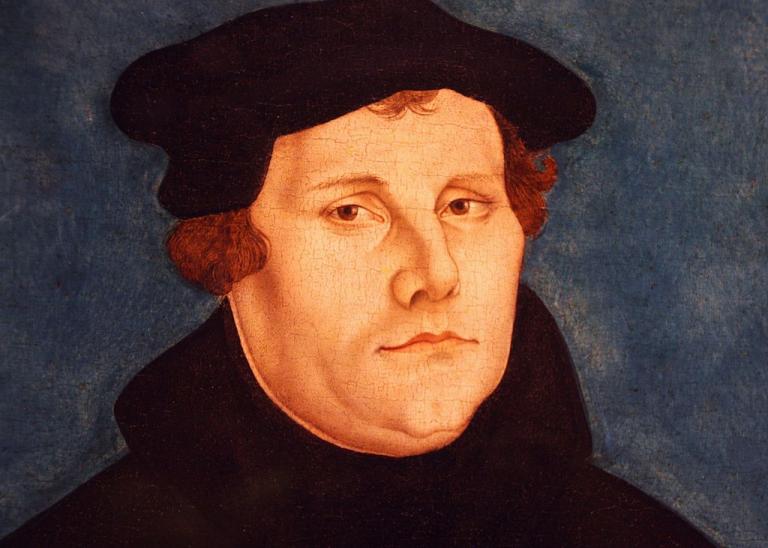
Illustration: Portrait of Luther, workshop of Lucas Cranach the Elder [Public domain] via Wikimedia Commons
Previous Post

December 18, 2019
Donald Trump Is Impeached
Next Post

December 20, 2019 Solving the Debt Problem by Declaring a Jubilee?
Recent Comments
"While she worked for Trump she was a tool's tool!"
"I know wired earbuds are making a comeback (I never stopped using them as I ..."
"VCRs, tape decks, and cassette players are all having a revival among a segment of ..."
"As a (retired) lawyer I see potential liability from sharing things like power or sharp ..."
Browse Our Archives
Select a Category America Apologetics Art baseball Bible Blog Christ Church crime Culture Economics Education Ethics Family Food Football Government History Holidays Holy Week Humor International Islam Language Law Life Issues Literature Media Medicine Movies Music Nature News Personal Philosophy Politics psychology Reformation Religions Sacraments Science sex Social Science Sports technology television terrorism Theology Uncategorized Vocation war
Select a Month October 2026 September 2026 August 2026 July 2026 June 2026 May 2026 April 2026 March 2026 February 2026 January 2026 December 2025 November 2025 October 2025 September 2025 August 2025 July 2025 June 2025 May 2025 April 2025 March 2025 February 2025 January 2025 December 2024 November 2024 October 2024 September 2024 August 2024 July 2024 June 2024 May 2024 April 2024 March 2024 February 2024 January 2024 December 2023 November 2023 October 2023 September 2023 August 2023 July 2023 June 2023 May 2023 April 2023 March 2023 February 2023 January 2023 December 2022 November 2022 October 2022 September 2022 August 2022 July 2022 June 2022 May 2022 April 2022 March 2022 February 2022 January 2022 December 2021 November 2021 October 2021 September 2021 August 2021 July 2021 June 2021 May 2021 April 2021 March 2021 February 2021 January 2021 December 2020 November 2020 October 2020 September 2020 August 2020 July 2020 June 2020 May 2020 April 2020 March 2020 February 2020 January 2020 December 2019 November 2019 October 2019 September 2019 August 2019 July 2019 June 2019 May 2019 April 2019 March 2019 February 2019 January 2019 December 2018 November 2018 October 2018 September 2018 August 2018 July 2018 June 2018 May 2018 April 2018 March 2018 February 2018 January 2018 December 2017 November 2017 October 2017 September 2017 August 2017 July 2017 June 2017 May 2017 April 2017 March 2017 February 2017 January 2017 December 2016 November 2016 October 2016 September 2016 August 2016 July 2016 June 2016 May 2016 April 2016 March 2016 February 2016 January 2016 December 2015 November 2015 October 2015 September 2015 August 2015 July 2015 June 2015 May 2015 April 2015 March 2015 February 2015 January 2015 December 2014 November 2014 October 2014 September 2014 August 2014 July 2014 June 2014 May 2014 April 2014 March 2014 February 2014 January 2014 December 2013 November 2013 October 2013 September 2013 August 2013 July 2013 June 2013 May 2013 April 2013 March 2013 February 2013 January 2013 December 2012 November 2012 October 2012 September 2012 August 2012 July 2012 June 2012 May 2012 April 2012 March 2012 February 2012 January 2012 December 2011 November 2011 October 2011 September 2011 August 2011 July 2011 June 2011 May 2011 April 2011 March 2011 February 2011 January 2011 December 2010 November 2010 October 2010 September 2010 August 2010 July 2010 June 2010 May 2010 April 2010 March 2010 February 2010 January 2010 December 2009 November 2009 October 2009 September 2009 August 2009 July 2009 June 2009 May 2009 April 2009 March 2009 February 2009 January 2009 December 2008 November 2008 October 2008 September 2008 August 2008 July 2008 June 2008 May 2008 April 2008 March 2008 February 2008 January 2008 December 2007 November 2007 October 2007
Follow Us!
TAKE THE
Religious Wisdom Quiz
True or False: King Saul was anointed by the prophet Nathan.
Select your answer to see how you score.
TRUE FALSE
Books by This Author Books by Gene Veith
Related posts from Cranach

Gen Z Wants Evildoers to Be Punished, Not...


The Family Estrangement Epidemic

As Fulton Sheen Is Beatified, Don't Forget Walter...
TRENDING AT PATHEOS Evangelical

Emotion in Early Christianity by Andrew Crislip
Andrew Crislip’s Emotion in Early Christianity examines an often overlooked dimension of...

16 Spiritual Touchstones for a More Grounded Life
After decades of spiritual study, here are 16 principles I try...

Catholic Evangelization: Sharing Your Faith Every Day
Welcome back to the Graceful Awakening mini-series called, “From Faith to Mission.” ...

The Pillar of the Boatmen: the Ancient Monument...
The Pillar of the Boatmen is a Romano-Gaulish sculpture that dates from...

In one sense walking into Westminster Abbey is like walking down the...

'Super Scam Me' Exposes AI Jon Bon Jovi...
Leslie Pickett believed she was in a relationship with Jon Bon Jovi....
view all Evangelical blogs
What Are Your Thoughts?leave a comment
Ad-Free & Subscriber Log-In Subscription Support
- About Us
- 2026 Calendar
- Videos
- Podcasts
- Library of World Religions
- Faith In Media Tracker
- Advertise With Us
- Write for Us
- Privacy Policy
- Terms of Service
- Do Not Sell My Data
- Contact Us
- Radiant Digital
- Manage Newsletter Subscriptions
- Unsubscribe From Notifications
- Sitemap
Copyright 2008-2026, Patheos. All rights reserved.
Subscription Support Ad-Free & Subscriber Log-In
Follow Patheos