
BuddhistCatholicContemplativeEvangelicalGeneral ChristianHinduJewishLatter-day SaintMuslimNew VisionsProgressive Christian
Beliefs
- Buddhist
- Catholic
- Contemplative
- Evangelical
- General Christian
- Hindu
- Jewish
- Latter-day Saint
- More Voices
- Muslim
- New Visions
- Pagan
- Progressive Christian
Topics
- Religion News
- Food and Religion
- Sports and Religion
- Religious Art
- Religious Music and Entertainment
- Religious Events
- History and Religion
- Style and Religion
- Politics and Religion
- Women in Religion
- Recreation Outdoors and Religion
- Business Finance and Religion
- Careers Workplace and Religion
- Education and Religion
- Family Parenting and Religion
- Health Fitness and Religion
- Home and Religion
- Relationships and Religion
- Technology and Religion
- Travel and Religion
Columnists
- Buddhist Columnists
- Business Finance and Religion Columnists
- Careers Workplace and Religion Columnists
- Catholic Columnists
- Contemplative Columnists
- Education and Religion Columnists
- Evangelists Columnists
- Family Parenting and Religion Columnists
- General Christian Columnists
- Health Fitness and Religion Columnists
- Hindu Columnists
- History and Religion Columnists
- Home and Religion Columnists
- Jewish Columnists
- More Voices Columnists
- Latter Day Columnists
- Muslim Columnists
- New Visions Columnists
- Nonreligious Columnists
- Pagan Columnists
- Politics and Religion Columnists
- Progressive Columnists
- Recreation Outdoors and Religion Columnists
- Relationships and Religion Columnists
- Religion News Columnists
- Religious Art Columnists
- Religious Events Columnists
- Religious Music and Entertainment Columnists
- Sports and Religion Columnists
- Style and Religion Columnists
- Technology and Religion Columnists
- Travel and Religion Columnists
- Women in Religion Columnists
Resource Library
- 2026 Calendar
- Library of World Religions
- The 100 Most Holy Places on Earth
- Patheos Answers
- Podcasts
- Videos
- Faith Leaders Database
- Anglican Episcopalian
- Bahai
- Baptist
- Buddhism
- Christianity
- Confucianism
- Eastern Orthodoxy
- Hinduism
- Holiness and Pentecostal
- ISKCON
- Islam
- Judaism
- Lutheran
- Methodist
- The Church of Jesus Christ of Latter-day Saints
- New Age
- Paganism
- Presbytarian and Reformed
- Protestantism
- Religion Behind the Scenes
- Roman Catholic
- Scientology
- Shia Islam
- Sikhism
- Sufism
- Sunni Islam
- Taoism
- Zen
- See all religions
Research Tools
 Ad-Free & Subscriber Log-In Subscription Support
Ad-Free & Subscriber Log-In Subscription Support
Follow Patheos 

- Trending:
- Forgiveness
- |
- Marriage
- |
- Consciousness
- |
- Death Penalty
- |
- Election
- |
- Halloween

- Home
- Evangelical
- Politics and Religion
- Faith in God and Good Works for Your Neighbor
Faith in God and Good Works for Your Neighbor
Last updated on: October 4, 2019 at 8:41 am by Gene Veith
Faith in God and Good Works for Your Neighbor 2019-10-04T08:41:24-04:00 Gene Veith
Patheos Explore the world's faith through different perspectives on religion and spirituality! Patheos has the views of the prevalent religions and spiritualities of the world.
Christians have long struggled with the competing claims of faith and good works. Luther cuts the Gordian knot by making a simple, but profound, distinction: Faith must be directed to God, and good works must be directed to our neighbors.
Luther’ neighbor-centered ethic is foundational to his doctrine of vocation. To summarize: We are not saved by our good works, and works that we think we are doing for God–such as rituals, acts of asceticism, or other attempts to curry favor with Him–are not “good,” strictly speaking, at all, unless they actually help someone. Our salvation is based solely on the grace and forgiveness of God, which we receive by faith in Christ and His atoning sacrifice. Whereupon God sends us into the world and calls us into our vocations, where our faith bears fruit in love and service to our neighbors. In the words of the liturgy, which dismisses us after our faith is strengthened by God’s Word and Sacraments, we go out to live our lives “in faith toward You and in fervent love toward one another.”
Luther explores these teachings, through a number of Biblical texts, in his sermons, particularly the ones collected in his Church Postils, sent throughout the Reformation churches for local pastors to preach themselves, thus spreading the teachings of the evangelical theology. So what Luther teaches here about vocation, ethics, and other topics, had wide currency and became quite influential among ordinary Christians.
Here are some excerpts on this topic from a wonderful online source, Martin Luther’s Writings: Sermons, Commentaries, & Other Writings.
God Does Not Need Your Works, but Your Neighbor Does
Here Luther develops his well-known distinction. He does so in an exposition of the Parable of the Unforgiving Servant, which he relates to the Gospel (how God forgives us) and to the Christian life (how Jesus sends those whom He has loved and forgiven to likewise love and forgive their neighbors).
From Martin Luther’s Sermons, TWENTY-SECOND SUNDAY AFTER TRINITY. [1st series] Text: Matthew 18:23-35. [The Parable of the Unforgiving Servant]:
- This is what we have often said, that we Christians must break forth, and show by our deeds and before the people that we have the true faith.
God does not need your works, he has enough in your faith. Yet he wants you to work that you may show thereby your faith to yourself and all the world. For God indeed sees faith, but you and the people do not yet see it, therefore you should devote the works of faith to the benefit of your neighbor. Thus this servant is an example and picture of all those who should serve their neighbor through faith. . . .
- But you say: Do you still insist that God will have no regard for our good works, and on their account will save no one? Answer: He would have them done freely without any thought of remuneration; not that we thereby obtain something, but that we do them to our neighbor, and thereby show that we have the true faith; for what have you then that you gave him and by which you merit anything, that he should have mercy on you and forgive you all things that you have done against him? Or what profit has he by it? Nothing has he, but that you praise and thank him, and do as he has done, that God may be thanked in thee, then you are in his kingdom and have all things that you should have. This is the other part of the Christian life, which is called love, by which one goes out from God to his neighbor.
You Live to Carry in the Sick Man
In his sermon on those who brought the sick man to Jesus, Luther also develops the notion that an important way we love and serve our neighbors is to bring them to Jesus, so that they too will have faith. This is what we do, Luther says, when we bring an infant to baptism. Luther disagrees with those who teach that an infant is baptised on the basis of his parents’ faith or on a faith that the child will have in the future. He teaches that infants can have faith of their own. Baptism bestows that faith, which must be fed by God’s Word throughout the Christian’s life. “So I do not baptize the child in my own faith or in the faith of Christendom. But my faith and Christendom bring the child to baptism, in order that by rightly bringing it God may give it a faith of its own, that it may believe as I believe and be preserved in the same Word that Christ has given me” (paragraph 27).
From Martin Luther’s Sermons, NINETEENTH SUNDAY AFTER TRINITY. [1st series] Text: Matthew 9:1-8. [The healing of the man sick of the palsy]:
- But the kingdom of Christ consists in this and thereby grows, namely, that the conscience be comforted with the Word. What else takes place through works and laws, all pertains to our neighbor. For I need no works before God, and must only be careful rightly to confess my sins. Then I have forgiveness of sins and am one with God, all which the Holy Spirit works in me. Then I break forth with blessings toward my neighbor, as they did here who brought the man sick with the palsy to the Lord. Those were in the kingdom, or show who are in the kingdom, as the Evangelist says, that the Lord had respect unto their faith. For had they not had any faith, they would not have brought the sick to the Lord. Faith precedes works, works follow faith. Therefore, because they are in the kingdom by faith, they bring in the sick man and thus do the work.
- On this earth man lives not for the sake of works, in order that they may be profitable to him, for he is not in need of them. But if you do good works in order thereby to obtain and merit something from God, all is lost, and you have already fallen from this kingdom. But since you believe and continue to live you ought to know that you live for this very cause, namely, to carry in the sick man. God does not desire the Christian to live for himself. Yea, cursed is the life that lives for self. For all that one lives after he is a Christian, he lives for others. So these also do who bring in the sick man, they no longer live for themselves, but their lives serve others; yes, with their faith they win for the sick man a faith of his own. For this sick man had at first no faith, but after he heard the Word, Christ instills into him a faith of his own, and awakens him with the Gospel; as he is accustomed to instill faith by the Word.
Luther on the Benedict Option
I think highly of Rod Dreher’s Benedict Option, with some reservations, as I say in my review of that book. While I agree about the depravity of contemporary culture and the need for Christians to offer something better, I have problems with Christians withdrawing from the world, following the model of monasticism. In this sermon, Luther discusses Jesus’ prophecy of the destruction of Jerusalem, with an excursus on the papacy and the Last Days. In doing so, he also refers to the fall of Rome and the rise of monasticism, St. Benedict style. He maintains that Christians must not flee to the “wilderness” when tribulation comes, but should “move freely in public society.” To flee to the wilderness, as the monastics do, is to undermine our vocations in the world, deprive the world of our witness, and suggest that some Christians are better than others.
From Martin Luther’s Sermons, TWENTY-FIFTH SUNDAY AFTER TRINITY. [2nd series] Text: Matthew 24:15-28. [On the Destruction of Jerusalem and the Last Days]:
- At the time of the holy fathers, Anthony and others, shortly after the Apostles, the fallacy already arose, of which Christ is speaking here, although Anthony strove against it, that everybody was running to the wilderness by the thousands, and it gained such favor that later Jerome and Augustine almost worshipped custom, and did not know how sufficiently to praise it. Now when we look at it in the right light, this text powerfully opposes that movement, and there were also among them many heretics and many condemned persons, and although there were godly people among them who escaped the deception, nevertheless the example was dangerous and cannot be commended. Also St. Francis was a holy man, but his example and the order he established we are not to follow. But this no one, not even the saints, has recognized; so deeply and with such great display has it taken root. The Christian life is not confined to the wilderness, but moves freely in public society as Christ and the Apostles lived, that we come before and among the world, preach and admonish openly, to bring the people to Christ; but the people who run to the wilderness, do not want to remain in the world where they must suffer so much. They choose for themselves their own strict life, want thereby to be better Christians than others, as also the cloisters do.
HT: Jackie
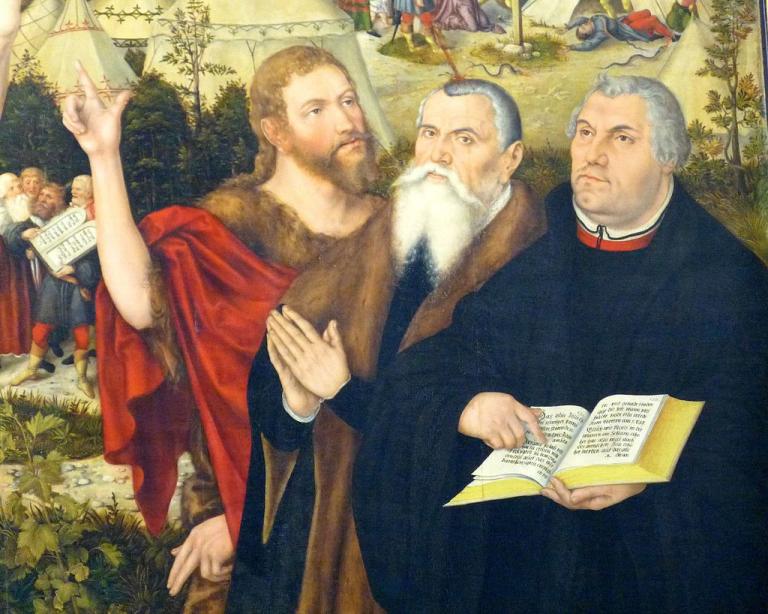
Illustration: Detail from the Weimar Altarpiece by Lucas Cranach (John the Baptist, Cranach, and Luther) via Wikimedia Commons.
Previous Post

October 3, 2019
Whatever Happened to Anti-Communism?
Next Post

October 7, 2019 The White Privilege of the Democratic Left
Recent Comments
"While she worked for Trump she was a tool's tool!"
"I know wired earbuds are making a comeback (I never stopped using them as I ..."
"VCRs, tape decks, and cassette players are all having a revival among a segment of ..."
"As a (retired) lawyer I see potential liability from sharing things like power or sharp ..."
Browse Our Archives
Select a Category America Apologetics Art baseball Bible Blog Christ Church crime Culture Economics Education Ethics Family Food Football Government History Holidays Holy Week Humor International Islam Language Law Life Issues Literature Media Medicine Movies Music Nature News Personal Philosophy Politics psychology Reformation Religions Sacraments Science sex Social Science Sports technology television terrorism Theology Uncategorized Vocation war
Select a Month October 2026 September 2026 August 2026 July 2026 June 2026 May 2026 April 2026 March 2026 February 2026 January 2026 December 2025 November 2025 October 2025 September 2025 August 2025 July 2025 June 2025 May 2025 April 2025 March 2025 February 2025 January 2025 December 2024 November 2024 October 2024 September 2024 August 2024 July 2024 June 2024 May 2024 April 2024 March 2024 February 2024 January 2024 December 2023 November 2023 October 2023 September 2023 August 2023 July 2023 June 2023 May 2023 April 2023 March 2023 February 2023 January 2023 December 2022 November 2022 October 2022 September 2022 August 2022 July 2022 June 2022 May 2022 April 2022 March 2022 February 2022 January 2022 December 2021 November 2021 October 2021 September 2021 August 2021 July 2021 June 2021 May 2021 April 2021 March 2021 February 2021 January 2021 December 2020 November 2020 October 2020 September 2020 August 2020 July 2020 June 2020 May 2020 April 2020 March 2020 February 2020 January 2020 December 2019 November 2019 October 2019 September 2019 August 2019 July 2019 June 2019 May 2019 April 2019 March 2019 February 2019 January 2019 December 2018 November 2018 October 2018 September 2018 August 2018 July 2018 June 2018 May 2018 April 2018 March 2018 February 2018 January 2018 December 2017 November 2017 October 2017 September 2017 August 2017 July 2017 June 2017 May 2017 April 2017 March 2017 February 2017 January 2017 December 2016 November 2016 October 2016 September 2016 August 2016 July 2016 June 2016 May 2016 April 2016 March 2016 February 2016 January 2016 December 2015 November 2015 October 2015 September 2015 August 2015 July 2015 June 2015 May 2015 April 2015 March 2015 February 2015 January 2015 December 2014 November 2014 October 2014 September 2014 August 2014 July 2014 June 2014 May 2014 April 2014 March 2014 February 2014 January 2014 December 2013 November 2013 October 2013 September 2013 August 2013 July 2013 June 2013 May 2013 April 2013 March 2013 February 2013 January 2013 December 2012 November 2012 October 2012 September 2012 August 2012 July 2012 June 2012 May 2012 April 2012 March 2012 February 2012 January 2012 December 2011 November 2011 October 2011 September 2011 August 2011 July 2011 June 2011 May 2011 April 2011 March 2011 February 2011 January 2011 December 2010 November 2010 October 2010 September 2010 August 2010 July 2010 June 2010 May 2010 April 2010 March 2010 February 2010 January 2010 December 2009 November 2009 October 2009 September 2009 August 2009 July 2009 June 2009 May 2009 April 2009 March 2009 February 2009 January 2009 December 2008 November 2008 October 2008 September 2008 August 2008 July 2008 June 2008 May 2008 April 2008 March 2008 February 2008 January 2008 December 2007 November 2007 October 2007
Follow Us!
TAKE THE
Religious Wisdom Quiz
In the Parable of the Sower, what does the seed represent?
Select your answer to see how you score.
Money The Word of God The Law Judgment
Books by This Author Books by Gene Veith
Related posts from Cranach


Our New Book on Technology & Vocation

Gen Z Wants Evildoers to Be Punished, Not...

TRENDING AT PATHEOS Evangelical

Emotion in Early Christianity by Andrew Crislip
Andrew Crislip’s Emotion in Early Christianity examines an often overlooked dimension of...

16 Spiritual Touchstones for a More Grounded Life
After decades of spiritual study, here are 16 principles I try...

Catholic Evangelization: Sharing Your Faith Every Day
Welcome back to the Graceful Awakening mini-series called, “From Faith to Mission.” ...

The Pillar of the Boatmen: the Ancient Monument...
The Pillar of the Boatmen is a Romano-Gaulish sculpture that dates from...

In one sense walking into Westminster Abbey is like walking down the...

'Super Scam Me' Exposes AI Jon Bon Jovi...
Leslie Pickett believed she was in a relationship with Jon Bon Jovi....
view all Evangelical blogs
What Are Your Thoughts?leave a comment
Ad-Free & Subscriber Log-In Subscription Support
- About Us
- 2026 Calendar
- Videos
- Podcasts
- Library of World Religions
- Faith In Media Tracker
- Advertise With Us
- Write for Us
- Privacy Policy
- Terms of Service
- Do Not Sell My Data
- Contact Us
- Radiant Digital
- Manage Newsletter Subscriptions
- Unsubscribe From Notifications
- Sitemap
Copyright 2008-2026, Patheos. All rights reserved.
Subscription Support Ad-Free & Subscriber Log-In
Follow Patheos