
BuddhistCatholicContemplativeEvangelicalGeneral ChristianHinduJewishLatter-day SaintMuslimNew VisionsProgressive Christian
Beliefs
- Buddhist
- Catholic
- Contemplative
- Evangelical
- General Christian
- Hindu
- Jewish
- Latter-day Saint
- More Voices
- Muslim
- New Visions
- Pagan
- Progressive Christian
Topics
- Religion News
- Food and Religion
- Sports and Religion
- Religious Art
- Religious Music and Entertainment
- Religious Events
- History and Religion
- Style and Religion
- Politics and Religion
- Women in Religion
- Recreation Outdoors and Religion
- Business Finance and Religion
- Careers Workplace and Religion
- Education and Religion
- Family Parenting and Religion
- Health Fitness and Religion
- Home and Religion
- Relationships and Religion
- Technology and Religion
- Travel and Religion
Columnists
- Buddhist Columnists
- Business Finance and Religion Columnists
- Careers Workplace and Religion Columnists
- Catholic Columnists
- Contemplative Columnists
- Education and Religion Columnists
- Evangelists Columnists
- Family Parenting and Religion Columnists
- General Christian Columnists
- Health Fitness and Religion Columnists
- Hindu Columnists
- History and Religion Columnists
- Home and Religion Columnists
- Jewish Columnists
- More Voices Columnists
- Latter Day Columnists
- Muslim Columnists
- New Visions Columnists
- Nonreligious Columnists
- Pagan Columnists
- Politics and Religion Columnists
- Progressive Columnists
- Recreation Outdoors and Religion Columnists
- Relationships and Religion Columnists
- Religion News Columnists
- Religious Art Columnists
- Religious Events Columnists
- Religious Music and Entertainment Columnists
- Sports and Religion Columnists
- Style and Religion Columnists
- Technology and Religion Columnists
- Travel and Religion Columnists
- Women in Religion Columnists
Resource Library
- 2026 Calendar
- Library of World Religions
- The 100 Most Holy Places on Earth
- Patheos Answers
- Podcasts
- Videos
- Faith Leaders Database
- Anglican Episcopalian
- Bahai
- Baptist
- Buddhism
- Christianity
- Confucianism
- Eastern Orthodoxy
- Hinduism
- Holiness and Pentecostal
- ISKCON
- Islam
- Judaism
- Lutheran
- Methodist
- The Church of Jesus Christ of Latter-day Saints
- New Age
- Paganism
- Presbytarian and Reformed
- Protestantism
- Religion Behind the Scenes
- Roman Catholic
- Scientology
- Shia Islam
- Sikhism
- Sufism
- Sunni Islam
- Taoism
- Zen
- See all religions
Research Tools
 Ad-Free & Subscriber Log-In Subscription Support
Ad-Free & Subscriber Log-In Subscription Support
Follow Patheos 

- Trending:
- Forgiveness
- |
- Marriage
- |
- Consciousness
- |
- Death Penalty
- |
- Election
- |
- Halloween

- Home
- Evangelical
- Politics and Religion
- How the Reformers Were More Catholic Than the Catholics
How the Reformers Were More Catholic Than the Catholics
Last updated on: September 27, 2019 at 12:26 pm by Gene Veith
How the Reformers Were More Catholic Than the Catholics 2019-09-27T12:26:34-04:00 Gene Veith
Patheos Explore the world's faith through different perspectives on religion and spirituality! Patheos has the views of the prevalent religions and spiritualities of the world.
Onsi Kamel grew up as an evangelical but became highly attracted to Roman Catholicism. In time, though, he discovered that what had attracted him so much about Catholicism could not necessarily be found in the Roman Catholic Church. And that it could be found in the theology of the Protestant Reformation.
He tells his story in an article Catholicism Made Me Protestant, published, somewhat surprisingly, in First Things. He tells about his love for the Church Fathers and then his discovery that the Church of Rome does not necessarily hold to what they said. He greatly appreciated the writings of Cardinal Newman, the Anglican pioneer of Anglo-Catholicism who then took the step of going over to Rome, which made a saint of him. But Kamel became concerned with Newman’s notion of the “development of doctrine,” which teaches that doctrine really can change. But that didn’t fit with the universal revelation that he was looking for in Catholicism. Nor did today’s conflict between liberal and conservative Catholics correspond with his ideal of a single, unified Magisterium. From the article (my bolds):
While I was discovering that Roman Catholicism could not be straightforwardly identified with the catholicism of the first six centuries (nor, in certain respects, with that of the seventh century through the twelfth), and as I was wrestling with Newman, I finally began reading the Reformers. What I found shocked me. Catholicism had, by this time, reoriented my theological concerns around the concerns of the Church catholic. My assumptions, and the issues that animated me, were those of the Church of history. My evangelical upbringing had led me to believe that Protestantism entailed the rejection of these concerns. But this notion exploded upon contact with the Protestantism of history.
Martin Luther, John Calvin, Richard Hooker, Herman Bavinck, Karl Barth—they wrestled with the concerns of the Church catholic and provided answers to the questions Catholicism had taught me to pose. Richard Hooker interpreted the Church’s traditions; Calvin followed Luther’s Augustinianism, proclaimed the visible Church the mother of the faithful, and claimed for the Reformation the Church’s exegetical tradition; Barth convinced me that God’s Word could speak, certainly and surely, from beyond all created realities, to me.
Catholicism had taught me to think like a Protestant, because, as it turned out, the Reformers had thought like catholics. Like their pope-aligned opponents, they had asked questions about justification, the authority of tradition, the mode of Christ’s self-gift in the Eucharist, the nature of apostolic succession, and the Church’s wielding of the keys. Like their opponents, Protestants had appealed to Scripture and tradition. In time, I came to find their answers not only plausible, but more faithful to Scripture than the Catholic answers, and at least as well-represented in the traditions of the Church.
The Protestants did more than out-catholic the Catholics. They also spoke to the deepest needs of sinful souls. I will never forget the moment when, like Luther five hundred years earlier, I discovered justification by faith alone through union with Christ. I was sitting in my dorm room by myself. I had been assigned Luther’s Explanations of the Ninety-Five Theses, and I expected to find it facile. A year or two prior, I had decided that Trent was right about justification: It was entirely a gift of grace consisting of the gradual perfecting of the soul by faith and works—God instigating and me cooperating. For years, I had attempted to live out this model of justification. I had gone to Mass regularly, prayed the rosary with friends, fasted frequently, read the Scriptures daily, prayed earnestly, and sought advice from spiritual directors. I had begun this arduous cooperation with God’s grace full of hope; by the time I sat in that dorm room alone, I was distraught and demoralized. I had learned just how wretched a sinner I was: No good work was unsullied by pride, no repentance unaccompanied by expectations of future sin, no love free from selfishness.
In this state, I picked up my copy of that arch-heretic Luther and read his explanation of Thesis 37: “Any true Christian, whether living or dead, participates in all the blessings of Christ and the church; and this is granted him by God, even without indulgence letters.” With these words, Luther transformed my understanding of justification: Every Christian possesses Christ, and to possess Christ is to possess all of Christ’s righteousness, life, and merits. Christ had joined me to himself.
I had “put on Christ” in baptism and, by faith through the work of the Spirit, all things were mine, and I was Christ’s, and Christ was God’s (Gal. 3:27; 1 Cor. 3:21–23). His was not an uncertain mercy; his was not a grace of parts, which one hoped would become a whole; his was not a salvation to be attained, as though it were not already also a present possession. At that moment, the joy of my salvation poured into my soul. I wept and showed forth God’s praise. I had finally discovered the true ground and power of Protestantism: “My beloved is mine, and I am his” (Song 2:16).
Rome had brought me to Reformation.
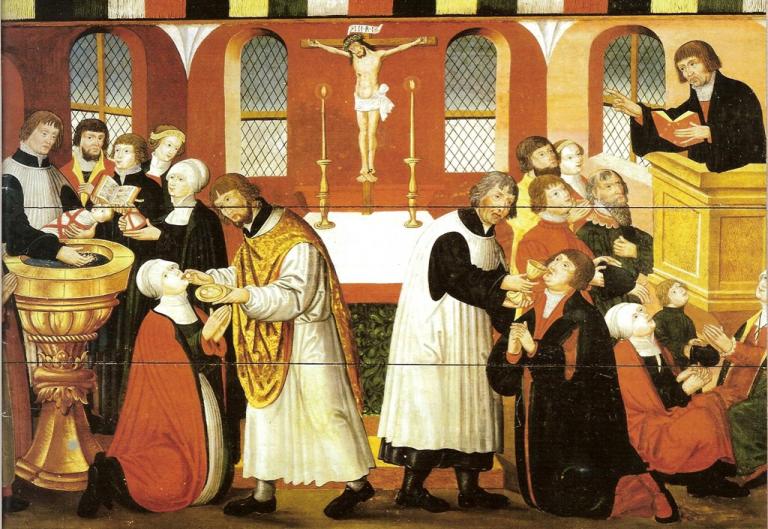
Kamel takes the various Reformers together–I believe he ended up as a confessional Calvinist–but what he says applies particularly well to Lutheranism, which preserves many elements associated with Catholicism but which are actually quite evangelical: the liturgy, the church year, the sign of the cross, crucifixes and other ecclesiastical art.
Perhaps the biggest appeal of Catholicism is its sacramentalism, but it seems to me that Lutheranism is more sacramental than the Church of Rome. Catholicism teaches that Baptism delivers us from Original Sin, after which we must find forgiveness of our post-Baptismal sins through the church’s penitential system. But Lutheranism teaches that Baptism covers all our days.
Catholic priests hear confessions, but their absolutions are highly conditional–contingent upon whether the sinner felt the right amount of contrition and performed sufficient acts of penance with the proper intention–and even confessed and absolved sins are still subject to the “temporal punishment” of Purgatory. But Lutheran pastors absolve sinners by returning them to their Baptisms, so that, in the words of the Catechism, “we receive absolution, that is, forgiveness, from the pastor as from God Himself, not doubting, but firmly believing that by it our sins are forgiven before God in heaven.”
Catholics believe that Christ is present in Holy Communion, but their doctrine of transubstantiation teaches that after consecration the physical elements of bread and wine are only illusions, mere external appearances that mask a complete change of substance. It turns out that the physical realm does not convey God after all, contrary to a common theme in Luther. Transubstantiation is thus docetic and even gnostic, in contrast to the Lutheran teaching of the Sacramental Union (not consubstantiation; not impanation), which accounts for the Biblical teaching that the bread and wine are Christ true body and blood in a much better way.
But for Lutherans, the point of Holy Communion is not just the mode of Christ’s presence–the preoccupation of both Catholics and the Reformed–but the effects of receiving His body and His blood. Catholics are to receive the Sacrament only after they have put themselves in a state of holiness–after confession and penance, in a state of moral purity, while fasting, after being reconciled with one’s neighbor, and other pious preparations–but for Lutherans, receiving Holy Communion is a way of receiving that holiness, as, in the words of the Catechism, “in the Sacrament forgiveness of sins, life, and salvation are given us.”
The Sacraments for Lutherans are not human “works”–neither the meritorious good works that enable us to “merit” salvation, as in Catholicism, nor human actions that other Protestants accuse Lutherans of putting their faith in rather than Christ–rather, they are works of Christ Himself upon us. They are tangible and personal manifestations of the Gospel–Christ’s life, death, and resurrection “for you”–to be received by faith.
I can relate to what Kamel says, as someone who also looked into Catholicism in my efforts to break out of not evangelicalism but the mainline liberal Protestantism I grew up with. I found Lutheranism, which, to me, embodied the best parts of both the Catholic and the Protestant traditions.
Here is another article along these same lines by British scholar Matthew Knell who also found that the Reformation is not what he had assumed it to be. “Much of the unexpected content,” he writes, “reinforces an impression that these men are seeking to be reformers of the church, not opponents of the church.” He has written a book on the topic this entitled Rediscovering the Reformation.
Illustration: from the Altarpiece of the Lutheran Church of Torslunde, 1561, via Wikimedia Commons, Public Domain
Previous Post

September 26, 2019
"When the Culture War Comes for the Kids"
Next Post

September 30, 2019 Fast-Track Impeachment
Recent Comments
"As a (retired) lawyer I see potential liability from sharing things like power or sharp ..."
"I am not sure the items you mentioned, though disused, discontinued, discarded, could be considered ..."
"“Friend, use me in your relations with your neighbor just as you would want your ..."
"Archaeology: It's the case that we don't have to go back very far to discover ..."
Browse Our Archives
Select a Category America Apologetics Art baseball Bible Blog Christ Church crime Culture Economics Education Ethics Family Food Football Government History Holidays Holy Week Humor International Islam Language Law Life Issues Literature Media Medicine Movies Music Nature News Personal Philosophy Politics psychology Reformation Religions Sacraments Science sex Social Science Sports technology television terrorism Theology Uncategorized Vocation war
Select a Month October 2026 September 2026 August 2026 July 2026 June 2026 May 2026 April 2026 March 2026 February 2026 January 2026 December 2025 November 2025 October 2025 September 2025 August 2025 July 2025 June 2025 May 2025 April 2025 March 2025 February 2025 January 2025 December 2024 November 2024 October 2024 September 2024 August 2024 July 2024 June 2024 May 2024 April 2024 March 2024 February 2024 January 2024 December 2023 November 2023 October 2023 September 2023 August 2023 July 2023 June 2023 May 2023 April 2023 March 2023 February 2023 January 2023 December 2022 November 2022 October 2022 September 2022 August 2022 July 2022 June 2022 May 2022 April 2022 March 2022 February 2022 January 2022 December 2021 November 2021 October 2021 September 2021 August 2021 July 2021 June 2021 May 2021 April 2021 March 2021 February 2021 January 2021 December 2020 November 2020 October 2020 September 2020 August 2020 July 2020 June 2020 May 2020 April 2020 March 2020 February 2020 January 2020 December 2019 November 2019 October 2019 September 2019 August 2019 July 2019 June 2019 May 2019 April 2019 March 2019 February 2019 January 2019 December 2018 November 2018 October 2018 September 2018 August 2018 July 2018 June 2018 May 2018 April 2018 March 2018 February 2018 January 2018 December 2017 November 2017 October 2017 September 2017 August 2017 July 2017 June 2017 May 2017 April 2017 March 2017 February 2017 January 2017 December 2016 November 2016 October 2016 September 2016 August 2016 July 2016 June 2016 May 2016 April 2016 March 2016 February 2016 January 2016 December 2015 November 2015 October 2015 September 2015 August 2015 July 2015 June 2015 May 2015 April 2015 March 2015 February 2015 January 2015 December 2014 November 2014 October 2014 September 2014 August 2014 July 2014 June 2014 May 2014 April 2014 March 2014 February 2014 January 2014 December 2013 November 2013 October 2013 September 2013 August 2013 July 2013 June 2013 May 2013 April 2013 March 2013 February 2013 January 2013 December 2012 November 2012 October 2012 September 2012 August 2012 July 2012 June 2012 May 2012 April 2012 March 2012 February 2012 January 2012 December 2011 November 2011 October 2011 September 2011 August 2011 July 2011 June 2011 May 2011 April 2011 March 2011 February 2011 January 2011 December 2010 November 2010 October 2010 September 2010 August 2010 July 2010 June 2010 May 2010 April 2010 March 2010 February 2010 January 2010 December 2009 November 2009 October 2009 September 2009 August 2009 July 2009 June 2009 May 2009 April 2009 March 2009 February 2009 January 2009 December 2008 November 2008 October 2008 September 2008 August 2008 July 2008 June 2008 May 2008 April 2008 March 2008 February 2008 January 2008 December 2007 November 2007 October 2007
Follow Us!
TAKE THE
Religious Wisdom Quiz
Who was healed by touching the hem of Jesus’ garment?
Select your answer to see how you score.
A woman with an issue of blood A leper A blind man A centurion
Books by This Author Books by Gene Veith
Related posts from Cranach


Our New Book on Technology & Vocation

Gen Z Wants Evildoers to Be Punished, Not...

TRENDING AT PATHEOS Evangelical

Nearly every morning, I make the drive to Detroit with my high-school-age...

The Real AI Story Is Adoption Without Trust
Artificial intelligence has crossed a political threshold. It is no longer a...

A new article, written by Jeff Lindsay and Gale L. Pooley,...

Swimfan: Forgotten Aughts Pleasures
This is a recovery effort. In 2002, My Big Fat Greek Wedding...

Top Three Anti-Catholic Lies About Catholicism
This is my initial transcript for the video, "THE 3 WORST...

Pope Leo Celebrates Mass for Nurses & Docs...
I don't have any idea how he did it, but Pope Leo...
view all Evangelical blogs
What Are Your Thoughts?leave a comment
Ad-Free & Subscriber Log-In Subscription Support
- About Us
- 2026 Calendar
- Videos
- Podcasts
- Library of World Religions
- Faith In Media Tracker
- Advertise With Us
- Write for Us
- Privacy Policy
- Terms of Service
- Do Not Sell My Data
- Contact Us
- Radiant Digital
- Manage Newsletter Subscriptions
- Unsubscribe From Notifications
- Sitemap
Copyright 2008-2026, Patheos. All rights reserved.
Subscription Support Ad-Free & Subscriber Log-In
Follow Patheos