
BuddhistCatholicContemplativeEvangelicalGeneral ChristianHinduJewishLatter-day SaintMuslimNew VisionsProgressive Christian
Beliefs
- Buddhist
- Catholic
- Contemplative
- Evangelical
- General Christian
- Hindu
- Jewish
- Latter-day Saint
- More Voices
- Muslim
- New Visions
- Pagan
- Progressive Christian
Topics
- Religion News
- Food and Religion
- Sports and Religion
- Religious Art
- Religious Music and Entertainment
- Religious Events
- History and Religion
- Style and Religion
- Politics and Religion
- Women in Religion
- Recreation Outdoors and Religion
- Business Finance and Religion
- Careers Workplace and Religion
- Education and Religion
- Family Parenting and Religion
- Health Fitness and Religion
- Home and Religion
- Relationships and Religion
- Technology and Religion
- Travel and Religion
Columnists
- Buddhist Columnists
- Business Finance and Religion Columnists
- Careers Workplace and Religion Columnists
- Catholic Columnists
- Contemplative Columnists
- Education and Religion Columnists
- Evangelists Columnists
- Family Parenting and Religion Columnists
- General Christian Columnists
- Health Fitness and Religion Columnists
- Hindu Columnists
- History and Religion Columnists
- Home and Religion Columnists
- Jewish Columnists
- More Voices Columnists
- Latter Day Columnists
- Muslim Columnists
- New Visions Columnists
- Nonreligious Columnists
- Pagan Columnists
- Politics and Religion Columnists
- Progressive Columnists
- Recreation Outdoors and Religion Columnists
- Relationships and Religion Columnists
- Religion News Columnists
- Religious Art Columnists
- Religious Events Columnists
- Religious Music and Entertainment Columnists
- Sports and Religion Columnists
- Style and Religion Columnists
- Technology and Religion Columnists
- Travel and Religion Columnists
- Women in Religion Columnists
Resource Library
- 2026 Calendar
- Library of World Religions
- The 100 Most Holy Places on Earth
- Patheos Answers
- Podcasts
- Videos
- Faith Leaders Database
- Anglican Episcopalian
- Bahai
- Baptist
- Buddhism
- Christianity
- Confucianism
- Eastern Orthodoxy
- Hinduism
- Holiness and Pentecostal
- ISKCON
- Islam
- Judaism
- Lutheran
- Methodist
- The Church of Jesus Christ of Latter-day Saints
- New Age
- Paganism
- Presbytarian and Reformed
- Protestantism
- Religion Behind the Scenes
- Roman Catholic
- Scientology
- Shia Islam
- Sikhism
- Sufism
- Sunni Islam
- Taoism
- Zen
- See all religions
Research Tools
 Ad-Free & Subscriber Log-In Subscription Support
Ad-Free & Subscriber Log-In Subscription Support
Follow Patheos 

- Trending:
- Forgiveness
- |
- Marriage
- |
- Consciousness
- |
- Death Penalty
- |
- Election
- |
- Halloween

- Home
- Evangelical
- Politics and Religion
- Presenting the Augsburg Confession
Presenting the Augsburg Confession
Last updated on: June 25, 2019 at 6:00 am by Gene Veith
Presenting the Augsburg Confession 2019-06-23T06:52:14-04:00 Gene Veith
Patheos Explore the world's faith through different perspectives on religion and spirituality! Patheos has the views of the prevalent religions and spiritualities of the world.
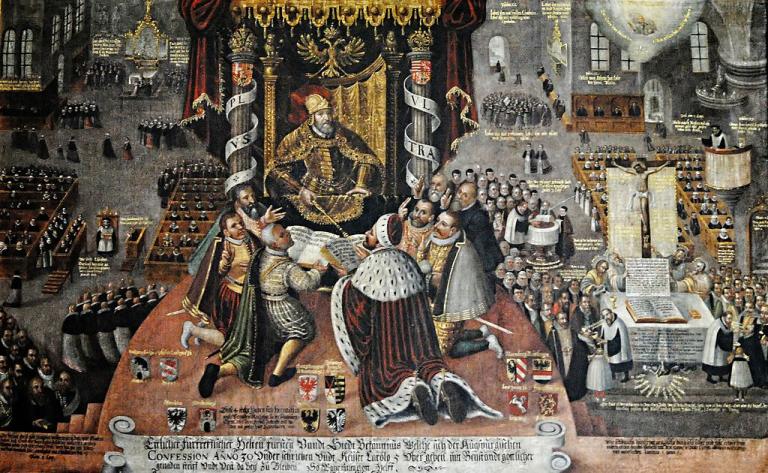
Today, June 25, is the 489th anniversary of the presentation of the Augsburg Confession, which sets forth the definitive teachings of Lutheran theology.
This is very much a lay document, having been written not by Luther but by the great classical Renaissance scholar Philipp Melanchthon, a layman. Furthermore, the presenters were regional rulers and the elected representatives of self-governing cities–laymen all–who were confessing their faith to the Holy Roman Emperor, to whom they owed allegiance and who was concerned about the outbreak of the Reformation in his realm.
The Emperor held a diet–a meeting of all of the rulers and city representatives under his jurisdiction–at Augsburg in Germany. On June 25, 1530, thirteen years after the posting of the 95 Theses, those who held to the Reformation were brought before the assembly to give an account of themselves.]
The confessors wanted to correct misunderstandings about the Reformation and to refute false charges that were being said about it. Many of these misunderstandings and false charges–for example, that these are new teachings, that the Reformation is anti-sacramental, that the Reformation rejects the liturgy, that the Reformation opposes good works, that the Reformation undermines social order–are still common today!
The confessors showed that the so-called Lutherans are in continuity with the church catholic, while clearly stating the elements of the church that had departed from that catholicity and so was in need of reform.
After the document was read to the diet, one of the nobles, George of Brandenburg, put his life on the line, saying, “Rather than deny my God and suffer the Word of God to be taken from me, I will kneel down and have my head struck off.” The Emperor quickly assured him that his head was safe.
But the Augsburg Confession became a defining document for the Reformation, with individuals, churches, rulers, municipalities, and nations deciding whether or not to accept it. And many people did give their lives in the course of confessing this faith.
To be sure, later Protestants rejected the Augsburg Confession because they thought it “too catholic”–that is, too sacramental, too conservative, not radical enough–so that it became a point of contention not only with Roman Catholics but with Reformed Protestants as well, thus setting the parameters of a distinctly Lutheran theology.
Read this detailed account of the historical background of the confession and its presentation, as well as this tribute to the confessors.
So in honor of this anniversary, I will present the Augsburg Confession to you. Those of you who are Lutherans would do well to review what your church stands for. Those of you who are not Lutherans, for whatever reason, may also find it interesting.
I will give the first few articles, then a summary of the others, which you can access at the link. From the Online Book of Concord:
Article I: Of God.
1] Our Churches, with common consent, do teach that the decree of the Council of Nicaea concerning the Unity of the Divine Essence and concerning the Three Persons, is true and to be believed without any doubting; 2] that is to say, there is one Divine Essence which is called and which is God: eternal, without body, without parts, of infinite power, wisdom, and goodness, the Maker and Preserver of all things, visible and invisible; and 3] yet there are three Persons, of the same essence and power, who also are coeternal, the Father, the Son, and the Holy Ghost. And the term “person” 4] they use as the Fathers have used it, to signify, not a part or quality in another, but that which subsists of itself.
5] They condemn all heresies which have sprung up against this article, as the Manichaeans, who assumed two principles, one Good and the other Evil: also the Valentinians, Arians, Eunomians, Mohammedans, and all such. 6] They condemn also the Samosatenes, old and new, who, contending that there is but one Person, sophistically and impiously argue that the Word and the Holy Ghost are not distinct Persons, but that “Word” signifies a spoken word, and “Spirit” signifies motion created in things.
Article II: Of Original Sin.
1] Also they teach that since the fall of Adam all men begotten in the natural way are born with sin, that is, without the fear of God, without trust in God, and with 2] concupiscence; and that this disease, or vice of origin, is truly sin, even now condemning and bringing eternal death upon those not born again through Baptism and the Holy Ghost.
3] They condemn the Pelagians and others who deny that original depravity is sin, and who, to obscure the glory of Christ’s merit and benefits, argue that man can be justified before God by his own strength and reason.
Article III: Of the Son of God.
1] Also they teach that the Word, that is, the Son of God, did assume the human nature in 2] the womb of the blessed Virgin Mary, so that there are two natures, the divine and the human, inseparably enjoined in one Person, one Christ, true God and true man, who was born of the Virgin Mary, truly suffered, was crucified, dead, and 3] buried, that He might reconcile the Father unto us, and be a sacrifice, not only for original guilt, but also for all actual sins of men.
4] He also descended into hell, and truly rose again the third day; afterward He ascended into heaven that He might sit on the right hand of the Father, and forever reign and have dominion over all creatures, and sanctify 5] them that believe in Him, by sending the Holy Ghost into their hearts, to rule, comfort, and quicken them, and to defend them against the devil and the power of sin.
6] The same Christ shall openly come again to judge the quick and the dead, etc., according to the Apostles’ Creed.
Article IV: Of Justification.
1] Also they teach that men cannot be justified before God by their own strength, merits, or works, but are freely justified for 2]Christ’s sake, through faith, when they believe that they are received into favor, and that their sins are forgiven for Christ’s sake, who, by His death, has made satisfaction for our sins. 3] This faith God imputes for righteousness in His sight. Rom. 3 and 4.
Article V: Of the Ministry.
1] That we may obtain this faith, the Ministry of Teaching the Gospel and administering the Sacraments was instituted. For through the Word and Sacraments, as through instruments, 2] the Holy Ghost is given, who works faith; where and when it pleases God, in them that hear 3] the Gospel, to wit, that God, not for our own merits, but for Christ’s sake, justifies those who believe that they are received into grace for Christ’s sake.
4] They condemn the Anabaptists and others who think that the Holy Ghost comes to men without the external Word, through their own preparations and works.
Article VI: Of New Obedience.
1] Also they teach that this faith is bound to bring forth good fruits, and that it is necessary to do good works commanded by God, because of God’s will, but that we should not rely on those works to merit justification 2] before God. For remission of sins and justification is apprehended by faith, as also the voice of Christ attests: When ye shall have done all these things, say: We are unprofitable servants. Luke 17:10. The same is also taught by 3] the Fathers. For Ambrose says: It is ordained of God that he who believes in Christ is saved, freely receiving remission of sins, without works, by faith alone.
Article VII: Of the Church.
1] Also they teach that one holy Church is to continue forever. The Church is the congregation of saints, in which the Gospel is rightly taught and the Sacraments are rightly administered.
2] And to the true unity of the Church it is enough to agree concerning the doctrine of the Gospel and 3] the administration of the Sacraments. Nor is it necessary that human traditions, that is, rites or ceremonies, instituted by men, should be everywhere alike. 4]As Paul says: One faith, one Baptism, one God and Father of all, etc. Eph. 4:5-6.
Article VIII: What the Church Is.
1] Although the Church properly is the congregation of saints and true believers, nevertheless, since in this life many hypocrites and evil persons are mingled therewith, it is lawful to use Sacraments administered by evil men, according to the saying of Christ: The Scribes and 2] the Pharisees sit in Moses’ seat, etc. Matt. 23:2. Both the Sacraments and Word are effectual by reason of the institution and commandment of Christ, notwithstanding they be administered by evil men.
3] They condemn the Donatists, and such like, who denied it to be lawful to use the ministry of evil men in the Church, and who thought the ministry of evil men to be unprofitable and of none effect.
Article IX: Of Baptism.
1] Of Baptism they teach that it is necessary 2] to salvation, and that through Baptism is offered the grace of God, and that children are to be baptized who, being offered to God through Baptism are received into God’s grace.
3] They condemn the Anabaptists, who reject the baptism of children, and say that children are saved without Baptism.? –
Article X: Of the Lord’s Supper.
1] Of the Supper of the Lord they teach that the Body and Blood of Christ are truly present, and are distributed 2] to those who eat the Supper of the Lord; and they reject those that teach otherwise.
[A summary of the other articles, from Wikipedia]:
XI Of Confession Lutherans believe that private absolution should remain in the church, though a believer does not need to enumerate all of his sins as it is impossible for a man to enumerate all of the sins for which he should be forgiven. XII Of Repentance Repentance comes in two parts: in contrition for sins committed according to the Law and through faith offered through the Gospel. A believer can never be free from sin, nor live outside of the grace of God. XIII Of the Use of the Sacraments The Sacraments (Baptism and the Eucharist) are physical manifestations of God’s Word and His commitment to us. The Sacraments are never just physical elements, but have God’s word and promises bound to them. XIV Of Ecclesiastical Order Lutherans allow only those who are “properly called” to publicly preach or administer the Sacraments. XV Of Ecclesiastical Usages Lutherans believe that church holidays, calendars and festivals are useful for religious observance, but that observance and ritual is not necessary for salvation. Human traditions (such as observances, fasts, distinctions in eating meats) that are taught as a way to “merit” grace work in opposition to the Gospel. XVI Of Civil Affairs Secular governments and vocations are considered to be part of God’s natural orders; Christians are free to serve in government and the military and to engage in the business and vocations of the world. Laws are to be followed unless they are commandments to sin. XVII Of Christ’s Return to Judgment Lutherans believe that Christ will return to raise the dead and judge the world; the godly will be given everlasting joy, and the ungodly will be “tormented without end”. This article rejects notions of a millennial kingdom before the resurrection of the dead. XVIII Of Free Will Lutherans believe that we have free will in the realm of “civil righteousness” (or “things subject to reason”), but that we do not have free will in “spiritual righteousness”. In other words, we are free to choose and act in every regard except for the choice of salvation. Faith is not the work of men, but of the Holy Spirit. XIX Of the Cause of Sin Lutherans believe that sin is caused not by God but by “the will of the wicked”, turning away from God. XX Of Good Works The Lutheran notion of justification by faith does not somehow condemn good works; faith causes them to do good works as a sign of our justification (or salvation), not a requirement for salvation. XXI Of the Worship of the Saints Lutherans keep the saints, not as saviors or intercessors to God, but rather as examples and inspirations to our own faith and life.
Abuses corrected
Article Title Description XXII Of Both Kinds In The Sacrament (Eucharist) It is proper to offer communicants the consecrated bread and wine, not just the bread. XXIII Of the Marriage of Priests Lutherans permit their clergy to enter the institution of marriage, for the reasons that the early Church bishops were married, that God blesses marriage as an order of creation, and because marriage and procreation is the natural outlet for human sexual desire. XXIV Of the Mass Lutherans retain the practice of the Mass, but only as a public gathering for the purposes of community worship and the receiving of the Eucharist. Lutherans reject the practice of using the Mass as a “work” for both salvation and worldly (monetary) gain. XXV Of Confession Lutherans uphold the need for confession and absolution, but reject the notion that Confession should induce guilt or anxiety to the Christian. Absolution is offered for all sin, not just sins that can be recounted in a confession, as it is impossible for a man to know all of his transgressions. XXVI Of the Distinction of Meats Human traditions that hold fasting and special observances with dietary restrictions as a means of gaining the favor of God are contrary to the gospel. While fasting and other practices are useful spiritual practices, they do not justify man nor offer salvation. XXVII Of Monastic Vows Man cannot achieve purity in community or isolation from the rest of the world, and perfection cannot be attained by any vow taken or actions of man alone. XXVIII Of Ecclesiastical Power The only power given to priests or bishops is the power offered through Scripture to preach, teach and administer the sacraments. The powers given to the clergy in issues of government or the military are granted and respected only through civil means; they are not civil rulers of governments and the military by divine right.
Illustration: “Presentation of the Augsburg Confession”, St. Johannis Church, Schweinfurt, Germany. MonandowitschDerivative work MagentaGreen [CC BY-SA 3.0 (https://creativecommons.org/licenses/by-sa/3.0)] via Wikimedia Commons
Presentation of the Augsburg Confession
Previous Post
June 24, 2019
What to Make of the Supreme Court's Ruling on the Cross
Next Post

June 26, 2019 Stopping a Court-Ordered Forced Abortion in UK
Recent Comments
"I know wired earbuds are making a comeback (I never stopped using them as I ..."
"VCRs, tape decks, and cassette players are all having a revival among a segment of ..."
"As a (retired) lawyer I see potential liability from sharing things like power or sharp ..."
"I am not sure the items you mentioned, though disused, discontinued, discarded, could be considered ..."
Browse Our Archives
Select a Category America Apologetics Art baseball Bible Blog Christ Church crime Culture Economics Education Ethics Family Food Football Government History Holidays Holy Week Humor International Islam Language Law Life Issues Literature Media Medicine Movies Music Nature News Personal Philosophy Politics psychology Reformation Religions Sacraments Science sex Social Science Sports technology television terrorism Theology Uncategorized Vocation war
Select a Month October 2026 September 2026 August 2026 July 2026 June 2026 May 2026 April 2026 March 2026 February 2026 January 2026 December 2025 November 2025 October 2025 September 2025 August 2025 July 2025 June 2025 May 2025 April 2025 March 2025 February 2025 January 2025 December 2024 November 2024 October 2024 September 2024 August 2024 July 2024 June 2024 May 2024 April 2024 March 2024 February 2024 January 2024 December 2023 November 2023 October 2023 September 2023 August 2023 July 2023 June 2023 May 2023 April 2023 March 2023 February 2023 January 2023 December 2022 November 2022 October 2022 September 2022 August 2022 July 2022 June 2022 May 2022 April 2022 March 2022 February 2022 January 2022 December 2021 November 2021 October 2021 September 2021 August 2021 July 2021 June 2021 May 2021 April 2021 March 2021 February 2021 January 2021 December 2020 November 2020 October 2020 September 2020 August 2020 July 2020 June 2020 May 2020 April 2020 March 2020 February 2020 January 2020 December 2019 November 2019 October 2019 September 2019 August 2019 July 2019 June 2019 May 2019 April 2019 March 2019 February 2019 January 2019 December 2018 November 2018 October 2018 September 2018 August 2018 July 2018 June 2018 May 2018 April 2018 March 2018 February 2018 January 2018 December 2017 November 2017 October 2017 September 2017 August 2017 July 2017 June 2017 May 2017 April 2017 March 2017 February 2017 January 2017 December 2016 November 2016 October 2016 September 2016 August 2016 July 2016 June 2016 May 2016 April 2016 March 2016 February 2016 January 2016 December 2015 November 2015 October 2015 September 2015 August 2015 July 2015 June 2015 May 2015 April 2015 March 2015 February 2015 January 2015 December 2014 November 2014 October 2014 September 2014 August 2014 July 2014 June 2014 May 2014 April 2014 March 2014 February 2014 January 2014 December 2013 November 2013 October 2013 September 2013 August 2013 July 2013 June 2013 May 2013 April 2013 March 2013 February 2013 January 2013 December 2012 November 2012 October 2012 September 2012 August 2012 July 2012 June 2012 May 2012 April 2012 March 2012 February 2012 January 2012 December 2011 November 2011 October 2011 September 2011 August 2011 July 2011 June 2011 May 2011 April 2011 March 2011 February 2011 January 2011 December 2010 November 2010 October 2010 September 2010 August 2010 July 2010 June 2010 May 2010 April 2010 March 2010 February 2010 January 2010 December 2009 November 2009 October 2009 September 2009 August 2009 July 2009 June 2009 May 2009 April 2009 March 2009 February 2009 January 2009 December 2008 November 2008 October 2008 September 2008 August 2008 July 2008 June 2008 May 2008 April 2008 March 2008 February 2008 January 2008 December 2007 November 2007 October 2007
Follow Us!
TAKE THE
Religious Wisdom Quiz
Who predicted the fall of Jerusalem?
Select your answer to see how you score.
Daniel Isaiah Jeremiah Jesus
Books by This Author Books by Gene Veith
Related posts from Cranach


Gen Z Wants Evildoers to Be Punished, Not...

TRENDING AT PATHEOS Evangelical

57th Dove Awards Honor Dolly Parton, Crown New...
On gospel music’s biggest night, the 57th annual GMA Dove Awards honored...

The First Eucharistic Controversy: Christ’s Real Presence
For Catholics, the Eucharist is the source and summit of the Christian...

What a Stop Sign Can Teach Us About...
How to Make a Decision When You Can't Hear God Main point:...

Archdiocese Hosts Military Marriage Retreat in Germany
RASTATT, Germany — The transient military lifestyle, with its frequent deployments and...

Nearly every morning, I make the drive to Detroit with my high-school-age...

The Real AI Story Is Adoption Without Trust
Artificial intelligence has crossed a political threshold. It is no longer a...
view all Evangelical blogs
What Are Your Thoughts?leave a comment
Ad-Free & Subscriber Log-In Subscription Support
- About Us
- 2026 Calendar
- Videos
- Podcasts
- Library of World Religions
- Faith In Media Tracker
- Advertise With Us
- Write for Us
- Privacy Policy
- Terms of Service
- Do Not Sell My Data
- Contact Us
- Radiant Digital
- Manage Newsletter Subscriptions
- Unsubscribe From Notifications
- Sitemap
Copyright 2008-2026, Patheos. All rights reserved.
Subscription Support Ad-Free & Subscriber Log-In
Follow Patheos