
BuddhistCatholicContemplativeEvangelicalGeneral ChristianHinduJewishLatter-day SaintMuslimNew VisionsProgressive Christian
Beliefs
- Buddhist
- Catholic
- Contemplative
- Evangelical
- General Christian
- Hindu
- Jewish
- Latter-day Saint
- More Voices
- Muslim
- New Visions
- Pagan
- Progressive Christian
Topics
- Religion News
- Food and Religion
- Sports and Religion
- Religious Art
- Religious Music and Entertainment
- Religious Events
- History and Religion
- Style and Religion
- Politics and Religion
- Women in Religion
- Recreation Outdoors and Religion
- Business Finance and Religion
- Careers Workplace and Religion
- Education and Religion
- Family Parenting and Religion
- Health Fitness and Religion
- Home and Religion
- Relationships and Religion
- Technology and Religion
- Travel and Religion
Columnists
- Buddhist Columnists
- Business Finance and Religion Columnists
- Careers Workplace and Religion Columnists
- Catholic Columnists
- Contemplative Columnists
- Education and Religion Columnists
- Evangelists Columnists
- Family Parenting and Religion Columnists
- General Christian Columnists
- Health Fitness and Religion Columnists
- Hindu Columnists
- History and Religion Columnists
- Home and Religion Columnists
- Jewish Columnists
- More Voices Columnists
- Latter Day Columnists
- Muslim Columnists
- New Visions Columnists
- Nonreligious Columnists
- Pagan Columnists
- Politics and Religion Columnists
- Progressive Columnists
- Recreation Outdoors and Religion Columnists
- Relationships and Religion Columnists
- Religion News Columnists
- Religious Art Columnists
- Religious Events Columnists
- Religious Music and Entertainment Columnists
- Sports and Religion Columnists
- Style and Religion Columnists
- Technology and Religion Columnists
- Travel and Religion Columnists
- Women in Religion Columnists
Resource Library
- 2026 Calendar
- Library of World Religions
- The 100 Most Holy Places on Earth
- Patheos Answers
- Podcasts
- Videos
- Faith Leaders Database
- Anglican Episcopalian
- Bahai
- Baptist
- Buddhism
- Christianity
- Confucianism
- Eastern Orthodoxy
- Hinduism
- Holiness and Pentecostal
- ISKCON
- Islam
- Judaism
- Lutheran
- Methodist
- The Church of Jesus Christ of Latter-day Saints
- New Age
- Paganism
- Presbytarian and Reformed
- Protestantism
- Religion Behind the Scenes
- Roman Catholic
- Scientology
- Shia Islam
- Sikhism
- Sufism
- Sunni Islam
- Taoism
- Zen
- See all religions
Research Tools
 Ad-Free & Subscriber Log-In Subscription Support
Ad-Free & Subscriber Log-In Subscription Support
Follow Patheos 

- Trending:
- Forgiveness
- |
- Marriage
- |
- Consciousness
- |
- Death Penalty
- |
- Election
- |
- Halloween

- Home
- Evangelical
- Politics and Religion
- The Golden-Mouthed
The Golden-Mouthed
Last updated on: May 3, 2019 at 6:00 am by Gene Veith
The Golden-Mouthed 2019-05-02T17:14:12-04:00 Gene Veith
Patheos Explore the world's faith through different perspectives on religion and spirituality! Patheos has the views of the prevalent religions and spiritualities of the world.
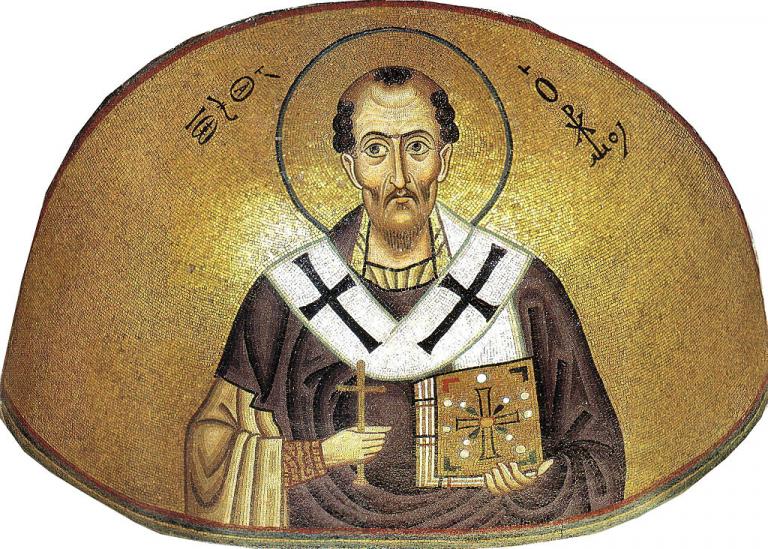
We Protestants don’t go by patron saints, but if there were to be a patron saint of literature, it should be St. John Chrysostom, that last name being an epithet for “golden-mouthed.” Now I know why.
In the reading group I attend with area pastors and teachers, we just finished Chrysostom’s On the Priesthood.
This is a classic of pastoral theology–useful for Protestant ministers as well as Catholic or Orthodox priests–that explores not only the theory but the practice of what the spiritual leaders of a congregation go through, showing that congregational dynamics (unrealistic and contradictory expectations, hurt feelings, and in-fighting) have not changed all that much in 1600 years.
But what struck me the most is the way it was written. It sets forth the value of the pastoral office by means of a dramatic dialogue arguing against becoming a pastor! Thus the arguments are all backwards and turned around, with abounding ironies and self-reflective contradictions.
The work was evidently written before John (349-407 A.D.) became “Chrysostom” or a saint or a leading theologian of Eastern Orthodoxy or the Bishop of Constantinople or even a priest. What this young Christian really wanted to do was be a monk–indeed, not being “sociable,” as he says, he wanted to be a hermit. But he promised his widowed mother, who could not bear to be parted from him, that he would not take that step until her death, so he took minor orders in the church at Antioch and became a “lector” who read the Scriptures during worship and who became something of an assistant to the Bishop.
He had a really close friend named Basil who likewise wanted to become a monk. They both heard from the grapevine that they had each been “elected” to be ordained as priests. At that time, in the early church, there were no seminaries or voluntary paths to the ministry. Churches just identified someone whom they wanted to serve as priest and elected him, whereupon he would be ordained.
But neither John nor Basil wanted to be priests. Nevertheless, the two agreed that they would both make the same decision on whether to be ordained or to refuse the honor. But while John felt unqualified and not up to the tasks, he believed that his friend would, in fact, make a good priest. So John got Basil to agree to through with it, but when the electors showed up, John went into hiding! Leaving Basil high and dry in the priesthood that he didn’t want!
The treatise On the Priesthood is a dialogue between John and Basil, who is furious with his friend for pulling this stunt. In defending himself, John explains why he turned down the priesthood but also why he wanted Basil to be one.
John has a high view of the pastoral office. It is better than being a king, he says. Kings preside over merely worldly matters, but pastors preside over spiritual matters. It is better than being an Old Testament prophet. Elijah called down fire from Heaven to consume the sacrifice and slay the idolaters, but preachers call down the Fire of the Holy Spirit on their hearers, bringing them into everlasting life. It’s just that John doesn’t feel worthy of holding an office so exalted.
John goes on to expound the heavy responsibilities of priests and all of the difficulties they have to deal with, from the logistical and personal difficulties of caring for the widows (we get a glimpse of the early church’s welfare system) to the misunderstandings and resentments that parishioners often fall into. (Our pastor shows favoritism! He is too harsh! He is too lenient! His sermons need to be more entertaining!)
He is haunted by this Scripture: “Obey your leaders and submit to them, for they are keeping watch over your souls, as those who will have to give an account. Let them do this with joy and not with groaning, for that would be of no advantage to you” (Hebrews 13:17). As a monk, he would only be responsible for his own spiritual state, which he thinks he could handle, but as a priest he would be responsible also for the spiritual state of others, and the prospect of that terrifies him. Because he would have “to give an account” before God. How could he endure that?
Basil keeps interrupting him with a plaintive “What about me?” If being a priest is so hard and potentially a danger to my soul, why did you stick me with it?
This is theology that you need to read like a novel, a literary form that would not be invented for 13 centuries, though Chrysostom might have invented it had he not succumbed to ordination a few years later. At one point in the dialogue, John says that anyone who desires to be a priest should not become one, since that would reveal bad motives. He then says that this is another reason he turned down becoming a priest, because he really would like to be one! So he doesn’t want to be a priest because he wants to be a priest. Which calls to mind an even bigger contradiction: If not wanting to be a priest is a qualification for becoming one, what do we make of his entire explanation why he doesn’t want to enter the priesthood? Doesn’t such unwillingness, in terms of his own argument, mean that he should become a priest? The multiple levels of ironic meanings outdo those of a postmodern novel.
Not that this is all just a rhetorical game. Chrysostom warns preachers against overdoing the rhetorical devices in sermons, insisting that Scriptural content is everything. There is nothing merely decorative or ornamental in Chrysostom’s writings. His literary genius shows up in the aptness of his expression, the vivid detail and effectiveness of his examples, and his mastery of language.
Protestants can’t go all the way with Chrysostom’s views–Holy Communion as sacrifice; no sense of the priesthood of all believers; his pervasive fear of falling short and being condemned to Hell–but there is much insight here. For example, I was struck by his point that priests and thus pastors must be “many-sided.” That is, they must be complicated. They will be dealing with many different kinds of people in many different professions and walks of life with many different kinds of problems. Their pastor needs to understand the people he is ministering to, which requires a wide range of interests and a multi-faceted sensibility. Notice how much good advice is packed into this one sentence:
For since he must mix with men who have wives, and who bring up children, who possess servants, and are surrounded with wealth, and fill public positions, and are persons of influence, he too should be a many-sided man — I say many-sided, not unreal, nor yet fawning and hypocritical, but full of much freedom and assurance, and knowing how to adapt himself profitably, where the circumstances of the case require it, and to be both kind and severe, for it is not possible to treat all those under one’s charge on one plan, since neither is it well for physicians to apply one course of treatment to all their sick, nor for a pilot to know but one way of contending with the winds.
He should be “full of much freedom.” He should be flexible, not applying the same medicine to every sickness. And, at the end, he finally answers Basil’s panic in terms of the actual solution: faith in Christ, the assurance of the Gospel, and vocation.
For I believe, said I, that through Christ who has called you, and set you over his own sheep, you will obtain such assurance from this ministry as to receive me also, if I am in danger at the last day, into your everlasting tabernacle.
He is asking Basil to be his pastor.
Two more things in conclusion. . . .On the Priesthood is available for free online, but I wanted to read it on my Kindle. Amazon makes available lots of classics that people aren’t reading much of anymore for ridiculously low prices, some of which cost nothing. One can download a Kindle edition of On the Priesthood for 99 cents. But then I saw that I could download The Complete Works of St. John Chrysostom for only $1.99. More works of Chrysostom, including hundreds of sermons, have survived than any other Church Father next to Augustine. So for two dollars I received 36 volumes consisting of 7,197 pages. That has to be one of the best bargains ever.
Finally, I give you one of his sermons. Chrysostom became famous for his preaching, which set aside much of the allegoricalizing approach to Scripture that was popular in his day in favor of a more literal exposition of God’s Word that was filled with perceptive insights and expressed with his “golden mouth.” (The Catholic Church did make him the patron saint of preachers.) This is an Easter sermon fitting for our season, since it will still be Easter until Pentecost. This sermon is read every year in Orthodox Churches. (Chrystostom is the author of the Orthodox liturgy for the Divine Service.)
From the Facebook page of the Lutheran Church Missouri Synod:
PASCHAL HOMILY OF ST. JOHN CHRYSOSTOM
Are there any who are devout lovers of God?
Let them enjoy this beautiful bright festival!
Are there any who are grateful servants?
Let them rejoice and enter into the joy of their Lord!
Are there any weary with fasting?
Let them now receive their wages!
If any have toiled from the first hour,
let them receive their due reward;
If any have come after the third hour,
let him with gratitude join in the Feast!
And he that arrived after the sixth hour,
let him not doubt; for he too shall sustain no loss.
And if any delayed until the ninth hour,
let him not hesitate; but let him come too.
And he who arrived only at the eleventh hour,
let him not be afraid by reason of his delay.
For the Lord is gracious and receives the last even as the first.
He gives rest to him that comes at the eleventh hour,
as well as to him that toiled from the first.
To this one He gives, and upon another He bestows.
He accepts the works as He greets the endeavor.
The deed He honors and the intention He commends.
Let us all enter into the joy of the Lord!
First and last alike receive your reward;
rich and poor, rejoice together!
Sober and slothful, celebrate the day!
You that have kept the fast, and you that have not,
rejoice today for the Table is richly laden!
Feast royally on it, the calf is a fatted one.
Let no one go away hungry. Partake, all, of the cup of faith.
Enjoy all the riches of His goodness!
Let no one grieve at his poverty,
for the universal kingdom has been revealed.
Let no one mourn that he has fallen again and again;
for forgiveness has risen from the grave.
Let no one fear death, for the Death of our Savior has set us free.
He has destroyed it by enduring it.
He destroyed Hell when He descended into it.
He put it into an uproar even as it tasted of His flesh.
Isaiah foretold this when he said,
“You, O Hell, have been troubled by encountering Him below.”
Hell was in an uproar because it was done away with.
It was in an uproar because it was mocked.
It was in an uproar, for it was destroyed.
It is in an uproar, for it is annihilated.
It is in an uproar, for it is now made captive.
Hell took a body, and discovered God.
It took earth, and encountered Heaven.
It took what it saw, and was overcome by what it did not see.
O death, where is thy sting?
O Hell, where is thy victory?
Christ is Risen, and you, O death, are annihilated!
Christ is Risen, and the evil ones are cast down!
Christ is Risen, and the angels rejoice!
Christ is Risen, and life is liberated!
Christ is Risen, and the tomb is emptied of its dead;
for Christ having risen from the dead,
is become the first-fruits of those who have fallen asleep.
To Him be Glory and Power forever and ever. Amen!
Illustration: Mosaic of St. John Chrystostom (11th century), Hosios Loukas [St. Luke’s] Monastery, Boeotia, Greece [Public domain] via Wikimedia Commons
Previous Post

May 2, 2019
Dehumanizing Christians
Next Post
May 6, 2019 T. S. Eliot Predicts Today
Recent Comments
"While she worked for Trump she was a tool's tool!"
"I know wired earbuds are making a comeback (I never stopped using them as I ..."
"VCRs, tape decks, and cassette players are all having a revival among a segment of ..."
"As a (retired) lawyer I see potential liability from sharing things like power or sharp ..."
Browse Our Archives
Select a Category America Apologetics Art baseball Bible Blog Christ Church crime Culture Economics Education Ethics Family Food Football Government History Holidays Holy Week Humor International Islam Language Law Life Issues Literature Media Medicine Movies Music Nature News Personal Philosophy Politics psychology Reformation Religions Sacraments Science sex Social Science Sports technology television terrorism Theology Uncategorized Vocation war
Select a Month October 2026 September 2026 August 2026 July 2026 June 2026 May 2026 April 2026 March 2026 February 2026 January 2026 December 2025 November 2025 October 2025 September 2025 August 2025 July 2025 June 2025 May 2025 April 2025 March 2025 February 2025 January 2025 December 2024 November 2024 October 2024 September 2024 August 2024 July 2024 June 2024 May 2024 April 2024 March 2024 February 2024 January 2024 December 2023 November 2023 October 2023 September 2023 August 2023 July 2023 June 2023 May 2023 April 2023 March 2023 February 2023 January 2023 December 2022 November 2022 October 2022 September 2022 August 2022 July 2022 June 2022 May 2022 April 2022 March 2022 February 2022 January 2022 December 2021 November 2021 October 2021 September 2021 August 2021 July 2021 June 2021 May 2021 April 2021 March 2021 February 2021 January 2021 December 2020 November 2020 October 2020 September 2020 August 2020 July 2020 June 2020 May 2020 April 2020 March 2020 February 2020 January 2020 December 2019 November 2019 October 2019 September 2019 August 2019 July 2019 June 2019 May 2019 April 2019 March 2019 February 2019 January 2019 December 2018 November 2018 October 2018 September 2018 August 2018 July 2018 June 2018 May 2018 April 2018 March 2018 February 2018 January 2018 December 2017 November 2017 October 2017 September 2017 August 2017 July 2017 June 2017 May 2017 April 2017 March 2017 February 2017 January 2017 December 2016 November 2016 October 2016 September 2016 August 2016 July 2016 June 2016 May 2016 April 2016 March 2016 February 2016 January 2016 December 2015 November 2015 October 2015 September 2015 August 2015 July 2015 June 2015 May 2015 April 2015 March 2015 February 2015 January 2015 December 2014 November 2014 October 2014 September 2014 August 2014 July 2014 June 2014 May 2014 April 2014 March 2014 February 2014 January 2014 December 2013 November 2013 October 2013 September 2013 August 2013 July 2013 June 2013 May 2013 April 2013 March 2013 February 2013 January 2013 December 2012 November 2012 October 2012 September 2012 August 2012 July 2012 June 2012 May 2012 April 2012 March 2012 February 2012 January 2012 December 2011 November 2011 October 2011 September 2011 August 2011 July 2011 June 2011 May 2011 April 2011 March 2011 February 2011 January 2011 December 2010 November 2010 October 2010 September 2010 August 2010 July 2010 June 2010 May 2010 April 2010 March 2010 February 2010 January 2010 December 2009 November 2009 October 2009 September 2009 August 2009 July 2009 June 2009 May 2009 April 2009 March 2009 February 2009 January 2009 December 2008 November 2008 October 2008 September 2008 August 2008 July 2008 June 2008 May 2008 April 2008 March 2008 February 2008 January 2008 December 2007 November 2007 October 2007
Follow Us!
TAKE THE
Religious Wisdom Quiz
True or False: In Luke's Gospel, the angels appeared to wealthy merchants to announce Jesus' birth.
Select your answer to see how you score.
FALSE TRUE
Books by This Author Books by Gene Veith
Related posts from Cranach


Our New Book on Technology & Vocation

Gen Z Wants Evildoers to Be Punished, Not...

TRENDING AT PATHEOS Evangelical

Emotion in Early Christianity by Andrew Crislip
Andrew Crislip’s Emotion in Early Christianity examines an often overlooked dimension of...

16 Spiritual Touchstones for a More Grounded Life
After decades of spiritual study, here are 16 principles I try...

Catholic Evangelization: Sharing Your Faith Every Day
Welcome back to the Graceful Awakening mini-series called, “From Faith to Mission.” ...

The Pillar of the Boatmen: the Ancient Monument...
The Pillar of the Boatmen is a Romano-Gaulish sculpture that dates from...

In one sense walking into Westminster Abbey is like walking down the...

'Super Scam Me' Exposes AI Jon Bon Jovi...
Leslie Pickett believed she was in a relationship with Jon Bon Jovi....
view all Evangelical blogs
What Are Your Thoughts?leave a comment
Ad-Free & Subscriber Log-In Subscription Support
- About Us
- 2026 Calendar
- Videos
- Podcasts
- Library of World Religions
- Faith In Media Tracker
- Advertise With Us
- Write for Us
- Privacy Policy
- Terms of Service
- Do Not Sell My Data
- Contact Us
- Radiant Digital
- Manage Newsletter Subscriptions
- Unsubscribe From Notifications
- Sitemap
Copyright 2008-2026, Patheos. All rights reserved.
Subscription Support Ad-Free & Subscriber Log-In
Follow Patheos