
BuddhistCatholicContemplativeEvangelicalGeneral ChristianHinduJewishLatter-day SaintMuslimNew VisionsProgressive Christian
Beliefs
- Buddhist
- Catholic
- Contemplative
- Evangelical
- General Christian
- Hindu
- Jewish
- Latter-day Saint
- More Voices
- Muslim
- New Visions
- Pagan
- Progressive Christian
Topics
- Religion News
- Food and Religion
- Sports and Religion
- Religious Art
- Religious Music and Entertainment
- Religious Events
- History and Religion
- Style and Religion
- Politics and Religion
- Women in Religion
- Recreation Outdoors and Religion
- Business Finance and Religion
- Careers Workplace and Religion
- Education and Religion
- Family Parenting and Religion
- Health Fitness and Religion
- Home and Religion
- Relationships and Religion
- Technology and Religion
- Travel and Religion
Columnists
- Buddhist Columnists
- Business Finance and Religion Columnists
- Careers Workplace and Religion Columnists
- Catholic Columnists
- Contemplative Columnists
- Education and Religion Columnists
- Evangelists Columnists
- Family Parenting and Religion Columnists
- General Christian Columnists
- Health Fitness and Religion Columnists
- Hindu Columnists
- History and Religion Columnists
- Home and Religion Columnists
- Jewish Columnists
- More Voices Columnists
- Latter Day Columnists
- Muslim Columnists
- New Visions Columnists
- Nonreligious Columnists
- Pagan Columnists
- Politics and Religion Columnists
- Progressive Columnists
- Recreation Outdoors and Religion Columnists
- Relationships and Religion Columnists
- Religion News Columnists
- Religious Art Columnists
- Religious Events Columnists
- Religious Music and Entertainment Columnists
- Sports and Religion Columnists
- Style and Religion Columnists
- Technology and Religion Columnists
- Travel and Religion Columnists
- Women in Religion Columnists
Resource Library
- 2026 Calendar
- Library of World Religions
- The 100 Most Holy Places on Earth
- Patheos Answers
- Podcasts
- Videos
- Faith Leaders Database
- Anglican Episcopalian
- Bahai
- Baptist
- Buddhism
- Christianity
- Confucianism
- Eastern Orthodoxy
- Hinduism
- Holiness and Pentecostal
- ISKCON
- Islam
- Judaism
- Lutheran
- Methodist
- The Church of Jesus Christ of Latter-day Saints
- New Age
- Paganism
- Presbytarian and Reformed
- Protestantism
- Religion Behind the Scenes
- Roman Catholic
- Scientology
- Shia Islam
- Sikhism
- Sufism
- Sunni Islam
- Taoism
- Zen
- See all religions
Research Tools
 Ad-Free & Subscriber Log-In Subscription Support
Ad-Free & Subscriber Log-In Subscription Support
Follow Patheos 

- Trending:
- Forgiveness
- |
- Marriage
- |
- Consciousness
- |
- Death Penalty
- |
- Election
- |
- Halloween

- Home
- Evangelical
- Politics and Religion
- Luther and Trump?
Luther and Trump?
Last updated on: April 30, 2018 at 6:00 am by Gene Veith
Luther and Trump? 2018-04-27T17:20:17-04:00 Gene Veith
Patheos Explore the world's faith through different perspectives on religion and spirituality! Patheos has the views of the prevalent religions and spiritualities of the world.
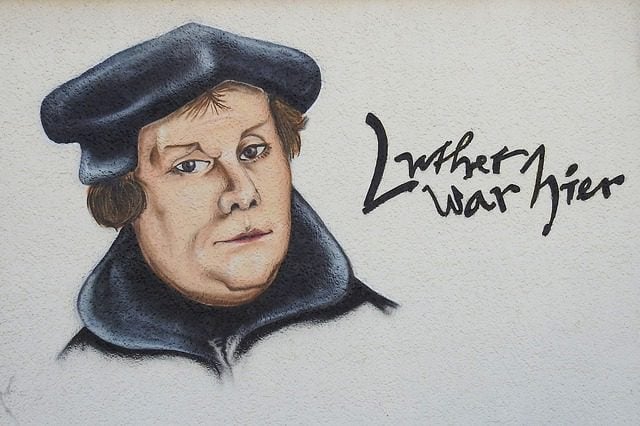
Did Martin Luther give us Donald Trump? Are Lutherans responsible for getting Trump elected? This is what some writers are saying.
Whether you think Luther’s alleged complicity with Trump would be a good thing or a bad thing, most of these writers see it as bad. In doing so, they tend to get Luther wildly wrong. But in the midst of all of these claims, one writer gives us a very good explanation of Luther’s teachings about politics.
Alec Ryrie in Foreign Policy maintains that Martin Luther Was the Donald Trump of 1517. Rev. Alexander M. Santora, a Catholic priest, wrote an op-ed piece in a New Jersey newspaper entitled Did Martin Luther Spawn Donald Trump?, answering in the affirmative. Michael Massing, writing in The Nation, explains How Martin Luther Paved the Way for Donald Trump.
Their point is generally that Luther was a populist, though they then also blame him for urging the princes to crush the peasants’ populist uprising. They say he was an anti-establishment figure, which is true. And that he employed Trump-like inflammatory rhetoric, which is a half-truth. And that he favored brutal government policies, which is not true.
Massing has the most substantive argument. He says, “Luther also believed in the concept of the ‘two kingdoms,’ the secular and the spiritual, which had to be kept rigorously apart. Christ’s Gospel was to apply only in the spiritual realm; in the secular, the government’s role was to maintain order and punish evildoers, not to show compassion and mercy.”
Massing is right to focus on the doctrine of the Two Kingdoms, but his description distorts its implications. God is the King of both realms, the secular no less than the secular. God’s moral law does apply to the secular realm. In the spiritual realm, those freed by the Gospel of God’s “compassion and mercy” through Christ are free of the Law, though they remain citizens also of the secular realm and are obliged to follow God’s commandments as their faith bears fruit in love for their neighbors.
But even taking Massing’s formulation of the Two Kingdoms as he states it, one would think that he would applaud keeping “the secular and the spiritual. . .rigorously apart.” Readers of the left-leaning The Nation have been scaring themselves at the prospect of the Christian right establishing a theocracy. Luther does not keep the secular and the spiritual rigorously apart–the Two Kingdoms actually brings them together under one King–but in distinguishing between these two spheres and making a place for secular rule, he makes theocracy impossible.
Massing’s biggest mistake in his article is his claim that today’s evangelicals, including the Southern Baptists he focuses upon and the Pentecostalists who are enthusiastic about Trump, follow Luther. They don’t!
As so often happens with British and American commentators, they conflate Luther with Calvin. Massing even associates Luther with the belief in predestination! Calvin’s Reformed tradition, which has been extremely influential in England and the United States, for the most part, does not believe in Luther’s Two Kingdoms distinction. They tend to believe that there is one kingdom and to emphasize Christian influence in the world. Most of American evangelicalism derives from this tradition, rather than Lutheranism, as did most of today’s Christian political activism.
More intriguing is economist Lyman Stone’s analysis of election data, which credits midwestern Lutherans, in part, for tipping the election to Trump. He points to the states of “Pennsylvania, which Trump flipped, and Wisconsin, which Trump flipped, and Iowa, which Trump flipped, and rural Minnesota, which Trump came astonishingly close to flipping.” These states more often vote Democratic, but in the 2016 election, these heavily-Lutheran states switched to Trump, giving him the election.
Specifically and counter-intuitively, Stone credits liberal Lutherans. “In areas with 35 percent Evangelical Lutheran Church of America adherence, the pro-Trump effect direction is consistent, but the coefficient is even larger. Ten percent ELCA counties had a 4.7 percent swing for Trump; 25 percent ELCA counties had an 8 percent swing for Trump; 35 percent ELCA counties had an 11 percent swing for Trump.”
How could that be? Stone compares the evangelical turnout for Trump with their turnout for Romney in the 2012 election. Evangelical support for Romney was far greater, even though many had qualms about him because he is a Mormon. While it is true that the overwhelming majority of evangelicals who voted picked Trump, a significant number, faced with the alternative of Hillary Clinton, opted for “none of the above” and did not vote for president.
The real difference, according to Stone, was the behavior of mainline Protestant voters. Those denominations, such as the ELCA, are politically very liberal. They are also in notable decline. Stone says that part of the weakness of the mainline denominations is that their political influence with their members is diminishing. Thus the large numbers of voters in ELCA enclaves who turned to Trump.
Now, Lyman Stone, who identifies himself as “a theologically confessional Lutheran and politically conservative Republican,” has also written a perceptive article on Luther’s actual political theology. We’ll blog about that tomorrow. (Tip of the Hat to him for putting me onto these Luther as Trump articles.)
The bottom line, for now, is that comparisons between figures of very different ages can never be very accurate. Our divisions of “liberal” and “conservative” don’t even work for the 19th century. Was Lincoln “liberal” or “conservative”? How about Queen Elizabeth I? Or Cicero? The questions are meaningless.
At the same time, you can construct analogies between just about any two individuals. Lincoln is like Trump in wanting to put America first. Queen Elizabeth I is like Trump in always retaliating against her enemies. Cicero is like Trump in using language to control a crowd.
At the same time, Lincoln, Queen Elizabeth I, and Cicero–and Luther–are nothing like Trump since they all exist in such radically different times, cultures, and contexts.
Illustration by hansbenn via Pixabay, CC0, Creative Commons
Evangelical Lutheran Church in America
Previous Post

April 30, 2018
Give the Word "Evangelical" Back to the Lutherans!
Next Post
May 1, 2018 NIetzscheans of Both the Left and the Right
Recent Comments
"I know wired earbuds are making a comeback (I never stopped using them as I ..."
"VCRs, tape decks, and cassette players are all having a revival among a segment of ..."
"As a (retired) lawyer I see potential liability from sharing things like power or sharp ..."
"I am not sure the items you mentioned, though disused, discontinued, discarded, could be considered ..."
Browse Our Archives
Select a Category America Apologetics Art baseball Bible Blog Christ Church crime Culture Economics Education Ethics Family Food Football Government History Holidays Holy Week Humor International Islam Language Law Life Issues Literature Media Medicine Movies Music Nature News Personal Philosophy Politics psychology Reformation Religions Sacraments Science sex Social Science Sports technology television terrorism Theology Uncategorized Vocation war
Select a Month October 2026 September 2026 August 2026 July 2026 June 2026 May 2026 April 2026 March 2026 February 2026 January 2026 December 2025 November 2025 October 2025 September 2025 August 2025 July 2025 June 2025 May 2025 April 2025 March 2025 February 2025 January 2025 December 2024 November 2024 October 2024 September 2024 August 2024 July 2024 June 2024 May 2024 April 2024 March 2024 February 2024 January 2024 December 2023 November 2023 October 2023 September 2023 August 2023 July 2023 June 2023 May 2023 April 2023 March 2023 February 2023 January 2023 December 2022 November 2022 October 2022 September 2022 August 2022 July 2022 June 2022 May 2022 April 2022 March 2022 February 2022 January 2022 December 2021 November 2021 October 2021 September 2021 August 2021 July 2021 June 2021 May 2021 April 2021 March 2021 February 2021 January 2021 December 2020 November 2020 October 2020 September 2020 August 2020 July 2020 June 2020 May 2020 April 2020 March 2020 February 2020 January 2020 December 2019 November 2019 October 2019 September 2019 August 2019 July 2019 June 2019 May 2019 April 2019 March 2019 February 2019 January 2019 December 2018 November 2018 October 2018 September 2018 August 2018 July 2018 June 2018 May 2018 April 2018 March 2018 February 2018 January 2018 December 2017 November 2017 October 2017 September 2017 August 2017 July 2017 June 2017 May 2017 April 2017 March 2017 February 2017 January 2017 December 2016 November 2016 October 2016 September 2016 August 2016 July 2016 June 2016 May 2016 April 2016 March 2016 February 2016 January 2016 December 2015 November 2015 October 2015 September 2015 August 2015 July 2015 June 2015 May 2015 April 2015 March 2015 February 2015 January 2015 December 2014 November 2014 October 2014 September 2014 August 2014 July 2014 June 2014 May 2014 April 2014 March 2014 February 2014 January 2014 December 2013 November 2013 October 2013 September 2013 August 2013 July 2013 June 2013 May 2013 April 2013 March 2013 February 2013 January 2013 December 2012 November 2012 October 2012 September 2012 August 2012 July 2012 June 2012 May 2012 April 2012 March 2012 February 2012 January 2012 December 2011 November 2011 October 2011 September 2011 August 2011 July 2011 June 2011 May 2011 April 2011 March 2011 February 2011 January 2011 December 2010 November 2010 October 2010 September 2010 August 2010 July 2010 June 2010 May 2010 April 2010 March 2010 February 2010 January 2010 December 2009 November 2009 October 2009 September 2009 August 2009 July 2009 June 2009 May 2009 April 2009 March 2009 February 2009 January 2009 December 2008 November 2008 October 2008 September 2008 August 2008 July 2008 June 2008 May 2008 April 2008 March 2008 February 2008 January 2008 December 2007 November 2007 October 2007
Follow Us!
TAKE THE
Religious Wisdom Quiz
Who said: "Therefore, since we have a great high priest who has ascended into heaven, Jesus the Son of God, let us hold firmly to the faith"?
Select your answer to see how you score.
James Peter John Paul
Books by This Author Books by Gene Veith
Related posts from Cranach



Gen Z Wants Evildoers to Be Punished, Not...

On Trump's Political Ads That You Paid For
TRENDING AT PATHEOS Evangelical

57th Dove Awards Honor Dolly Parton, Crown New...
On gospel music’s biggest night, the 57th annual GMA Dove Awards honored...

The First Eucharistic Controversy: Christ’s Real Presence
For Catholics, the Eucharist is the source and summit of the Christian...

What a Stop Sign Can Teach Us About...
How to Make a Decision When You Can't Hear God Main point:...

Archdiocese Hosts Military Marriage Retreat in Germany
RASTATT, Germany — The transient military lifestyle, with its frequent deployments and...

Nearly every morning, I make the drive to Detroit with my high-school-age...

The Real AI Story Is Adoption Without Trust
Artificial intelligence has crossed a political threshold. It is no longer a...
view all Evangelical blogs
What Are Your Thoughts?leave a comment
Ad-Free & Subscriber Log-In Subscription Support
- About Us
- 2026 Calendar
- Videos
- Podcasts
- Library of World Religions
- Faith In Media Tracker
- Advertise With Us
- Write for Us
- Privacy Policy
- Terms of Service
- Do Not Sell My Data
- Contact Us
- Radiant Digital
- Manage Newsletter Subscriptions
- Unsubscribe From Notifications
- Sitemap
Copyright 2008-2026, Patheos. All rights reserved.
Subscription Support Ad-Free & Subscriber Log-In
Follow Patheos