
BuddhistCatholicContemplativeEvangelicalGeneral ChristianHinduJewishLatter-day SaintMuslimNew VisionsProgressive Christian
Beliefs
- Buddhist
- Catholic
- Contemplative
- Evangelical
- General Christian
- Hindu
- Jewish
- Latter-day Saint
- More Voices
- Muslim
- New Visions
- Pagan
- Progressive Christian
Topics
- Religion News
- Food and Religion
- Sports and Religion
- Religious Art
- Religious Music and Entertainment
- Religious Events
- History and Religion
- Style and Religion
- Politics and Religion
- Women in Religion
- Recreation Outdoors and Religion
- Business Finance and Religion
- Careers Workplace and Religion
- Education and Religion
- Family Parenting and Religion
- Health Fitness and Religion
- Home and Religion
- Relationships and Religion
- Technology and Religion
- Travel and Religion
Columnists
- Buddhist Columnists
- Business Finance and Religion Columnists
- Careers Workplace and Religion Columnists
- Catholic Columnists
- Contemplative Columnists
- Education and Religion Columnists
- Evangelists Columnists
- Family Parenting and Religion Columnists
- General Christian Columnists
- Health Fitness and Religion Columnists
- Hindu Columnists
- History and Religion Columnists
- Home and Religion Columnists
- Jewish Columnists
- More Voices Columnists
- Latter Day Columnists
- Muslim Columnists
- New Visions Columnists
- Nonreligious Columnists
- Pagan Columnists
- Politics and Religion Columnists
- Progressive Columnists
- Recreation Outdoors and Religion Columnists
- Relationships and Religion Columnists
- Religion News Columnists
- Religious Art Columnists
- Religious Events Columnists
- Religious Music and Entertainment Columnists
- Sports and Religion Columnists
- Style and Religion Columnists
- Technology and Religion Columnists
- Travel and Religion Columnists
- Women in Religion Columnists
Resource Library
- 2026 Calendar
- Library of World Religions
- The 100 Most Holy Places on Earth
- Patheos Answers
- Podcasts
- Videos
- Faith Leaders Database
- Anglican Episcopalian
- Bahai
- Baptist
- Buddhism
- Christianity
- Confucianism
- Eastern Orthodoxy
- Hinduism
- Holiness and Pentecostal
- ISKCON
- Islam
- Judaism
- Lutheran
- Methodist
- The Church of Jesus Christ of Latter-day Saints
- New Age
- Paganism
- Presbytarian and Reformed
- Protestantism
- Religion Behind the Scenes
- Roman Catholic
- Scientology
- Shia Islam
- Sikhism
- Sufism
- Sunni Islam
- Taoism
- Zen
- See all religions
Research Tools
 Ad-Free & Subscriber Log-In Subscription Support
Ad-Free & Subscriber Log-In Subscription Support
Follow Patheos 

- Trending:
- Forgiveness
- |
- Marriage
- |
- Consciousness
- |
- Death Penalty
- |
- Election
- |
- Halloween

- Home
- Evangelical
- Politics and Religion
- Extremely Early Testimonies to the Deity of Christ
Extremely Early Testimonies to the Deity of Christ
Last updated on: March 6, 2018 at 6:27 pm by Gene Veith
Extremely Early Testimonies to the Deity of Christ 2018-03-06T18:27:07-05:00 Gene Veith
Patheos Explore the world's faith through different perspectives on religion and spirituality! Patheos has the views of the prevalent religions and spiritualities of the world.
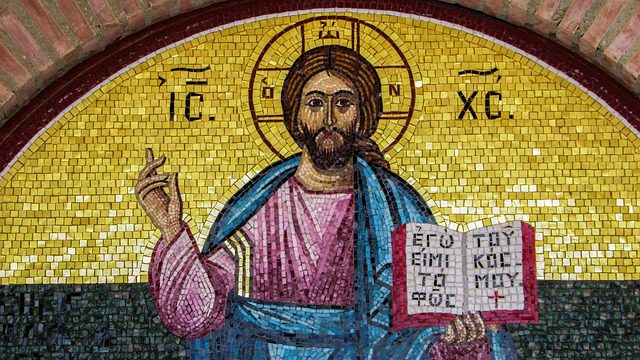
The conventional wisdom among liberal theologians and higher critics of the Bible is that the deity of Christ was a concept that grew up out of a long oral tradition that gradually elevated the historical Jesus, culminating in the Council of Nicaea, which defined the doctrine in 325 A.D. But there are references to the deity of Christ long before Nicaea.
A mosaic table, apparently used for Holy Communion in a house church at Tel Megiddo (a.k.a. Armageddon), is going on display in Israel. First discovered in 2005 in the excavation of the earliest place of Christian worship that has been discovered, the table is dated 230 A.D. An inscription on the table reads, “The god-loving Akeptous has offered the table to God Jesus Christ as a memorial.” See the inscription and details about it in the article Ancient mosaic describing Jesus Christ as ‘God’ to be unveiled in Israel, which calls it “one of the earliest-known testaments to early Christian belief in the divinity of Christ.”
But that is only 100 years before the Council of Nicaea. We have writings that go back far earlier than that.
Tim Barnett at Stand to Reason has compiled these statements from early church fathers, some of whom were second-generation Christians, coming to faith through the ministry of Christ’s apostles:
Polycarp (AD 69-155) was the bishop at the church in Smyrna and a disciple of John the Apostle. In his Letter to the Philippians, he writes,
Now may the God and Father of our Lord Jesus Christ, and the eternal high priest himself, the Son of God Jesus Christ, build you up in faith and truth…and to us with you, and to all those under heaven who will yet believe in our Lord and God Jesus Christ and in his Father who raised him from the dead.[4]
Ignatius (AD 50-117) was the bishop at the church in Antioch and another disciple of John. He wrote a series of letters to various churches on his way to Rome, where he was to be martyred. He writes,
There is only one physician, who is both flesh and spirit, born and unborn, God in man, true life in death, both from Mary and from God, first subject to suffering and then beyond it, Jesus Christ our Lord.[5]
For our God, Jesus the Christ, was conceived by Mary according to God’s plan, both from the seed of David and of the Holy Spirit.[6]
Justin Martyr (AD 100–165) was a Christian apologist of the second century. He boldly states,
And that Christ being Lord, and God the Son of God, and appearing formerly in power as Man, and Angel, and in the glory of fire as at the bush, so also was manifested at the judgment executed on Sodom, has been demonstrated fully by what has been said.[7]
Permit me first to recount the prophecies, which I wish to do in order to prove that Christ is called both God and Lord of hosts.[8]
Irenaeus of Lyons (AD 130–202) was bishop of what is now known as Lyons, France. Irenaeus studied under bishop Polycarp, who in turn had been a disciple of John the Apostle. He writes,
He received testimony from all that He was very man, and that He was very God, from the Father, from the Spirit, from angels, from the creation itself, from men, from apostate spirits and demons.[9]
…Christ Jesus our Lord, and God, and Savior, and King, according to the will of the invisible Father.[10]
Clement of Alexandria (AD 150–215) was another early church father. He wrote around AD 200. He writes,
This Word, then, the Christ, the cause of both our being at first (for He was in God) and of our well-being, this very Word has now appeared as man, He alone being both, both God and man….[11]
Tertullian (AD 150-225) was an early Christian apologist writing around a century after John. He said,
For God alone is without sin; and the only man without sin is Christ, since Christ is also God.[12]
Hippolytus of Rome (AD 170-235) was a third century theologian. He was a disciple of Irenaeus, who was a disciple of Polycarp, who was a disciple of John. He writes,
The Logos alone of this God is from God himself; wherefore also the Logos is God, being the substance of God.[13]
For all, the righteous and the unrighteous alike, shall be brought before God the Word.[14]
Then there are the first generation accounts in the Bible from the Apostles (e.g., John 1:1, Colossians 1:15-20), and the words of Jesus Himself (e.g., John 10:30, 14:9), and the prophecies before Jesus was born (e.g., Isaiah 9:6).
Of course, higher critics of the Bible date the New Testament documents that affirm Christ’s divinity very late, assuming that they must have been written in post-apostolic times after the doctrine had been developed. Such circular reasoning is a hallmark of liberal Biblical criticism.
But as more and more ancient manuscripts have been discovered, the dates of the composition of the books in the New Testament are being pushed farther and farther back.
The point is, there is not enough time for a long oral tradition or for the evolution of doctrine. Jesus is Lord, in the words of one of the earliest confessions of faith (Romans 10:9), and all Christians throughout time have always believed that.
Illustration by dimitrisvetsikas1969, via Pixabay, CC0, Creative Commons
Previous Post

March 6, 2018
Return to a Demand-Side Economy
Next Post

March 7, 2018 Surrogacy for Money
Recent Comments
"While she worked for Trump she was a tool's tool!"
"I know wired earbuds are making a comeback (I never stopped using them as I ..."
"VCRs, tape decks, and cassette players are all having a revival among a segment of ..."
"As a (retired) lawyer I see potential liability from sharing things like power or sharp ..."
Browse Our Archives
Select a Category America Apologetics Art baseball Bible Blog Christ Church crime Culture Economics Education Ethics Family Food Football Government History Holidays Holy Week Humor International Islam Language Law Life Issues Literature Media Medicine Movies Music Nature News Personal Philosophy Politics psychology Reformation Religions Sacraments Science sex Social Science Sports technology television terrorism Theology Uncategorized Vocation war
Select a Month October 2026 September 2026 August 2026 July 2026 June 2026 May 2026 April 2026 March 2026 February 2026 January 2026 December 2025 November 2025 October 2025 September 2025 August 2025 July 2025 June 2025 May 2025 April 2025 March 2025 February 2025 January 2025 December 2024 November 2024 October 2024 September 2024 August 2024 July 2024 June 2024 May 2024 April 2024 March 2024 February 2024 January 2024 December 2023 November 2023 October 2023 September 2023 August 2023 July 2023 June 2023 May 2023 April 2023 March 2023 February 2023 January 2023 December 2022 November 2022 October 2022 September 2022 August 2022 July 2022 June 2022 May 2022 April 2022 March 2022 February 2022 January 2022 December 2021 November 2021 October 2021 September 2021 August 2021 July 2021 June 2021 May 2021 April 2021 March 2021 February 2021 January 2021 December 2020 November 2020 October 2020 September 2020 August 2020 July 2020 June 2020 May 2020 April 2020 March 2020 February 2020 January 2020 December 2019 November 2019 October 2019 September 2019 August 2019 July 2019 June 2019 May 2019 April 2019 March 2019 February 2019 January 2019 December 2018 November 2018 October 2018 September 2018 August 2018 July 2018 June 2018 May 2018 April 2018 March 2018 February 2018 January 2018 December 2017 November 2017 October 2017 September 2017 August 2017 July 2017 June 2017 May 2017 April 2017 March 2017 February 2017 January 2017 December 2016 November 2016 October 2016 September 2016 August 2016 July 2016 June 2016 May 2016 April 2016 March 2016 February 2016 January 2016 December 2015 November 2015 October 2015 September 2015 August 2015 July 2015 June 2015 May 2015 April 2015 March 2015 February 2015 January 2015 December 2014 November 2014 October 2014 September 2014 August 2014 July 2014 June 2014 May 2014 April 2014 March 2014 February 2014 January 2014 December 2013 November 2013 October 2013 September 2013 August 2013 July 2013 June 2013 May 2013 April 2013 March 2013 February 2013 January 2013 December 2012 November 2012 October 2012 September 2012 August 2012 July 2012 June 2012 May 2012 April 2012 March 2012 February 2012 January 2012 December 2011 November 2011 October 2011 September 2011 August 2011 July 2011 June 2011 May 2011 April 2011 March 2011 February 2011 January 2011 December 2010 November 2010 October 2010 September 2010 August 2010 July 2010 June 2010 May 2010 April 2010 March 2010 February 2010 January 2010 December 2009 November 2009 October 2009 September 2009 August 2009 July 2009 June 2009 May 2009 April 2009 March 2009 February 2009 January 2009 December 2008 November 2008 October 2008 September 2008 August 2008 July 2008 June 2008 May 2008 April 2008 March 2008 February 2008 January 2008 December 2007 November 2007 October 2007
Follow Us!
TAKE THE
Religious Wisdom Quiz
True or False: Elijah defeated 400 prophets of Baal on Mount Carmel.
Select your answer to see how you score.
FALSE TRUE
Books by This Author Books by Gene Veith
Related posts from Cranach


Gen Z Wants Evildoers to Be Punished, Not...

TRENDING AT PATHEOS Evangelical

Emotion in Early Christianity by Andrew Crislip
Andrew Crislip’s Emotion in Early Christianity examines an often overlooked dimension of...

16 Spiritual Touchstones for a More Grounded Life
After decades of spiritual study, here are 16 principles I try...

Catholic Evangelization: Sharing Your Faith Every Day
Welcome back to the Graceful Awakening mini-series called, “From Faith to Mission.” ...

The Pillar of the Boatmen: the Ancient Monument...
The Pillar of the Boatmen is a Romano-Gaulish sculpture that dates from...

In one sense walking into Westminster Abbey is like walking down the...

'Super Scam Me' Exposes AI Jon Bon Jovi...
Leslie Pickett believed she was in a relationship with Jon Bon Jovi....
view all Evangelical blogs
What Are Your Thoughts?leave a comment
Ad-Free & Subscriber Log-In Subscription Support
- About Us
- 2026 Calendar
- Videos
- Podcasts
- Library of World Religions
- Faith In Media Tracker
- Advertise With Us
- Write for Us
- Privacy Policy
- Terms of Service
- Do Not Sell My Data
- Contact Us
- Radiant Digital
- Manage Newsletter Subscriptions
- Unsubscribe From Notifications
- Sitemap
Copyright 2008-2026, Patheos. All rights reserved.
Subscription Support Ad-Free & Subscriber Log-In
Follow Patheos