
BuddhistCatholicContemplativeEvangelicalGeneral ChristianHinduJewishLatter-day SaintMuslimNew VisionsProgressive Christian
Beliefs
- Buddhist
- Catholic
- Contemplative
- Evangelical
- General Christian
- Hindu
- Jewish
- Latter-day Saint
- More Voices
- Muslim
- New Visions
- Pagan
- Progressive Christian
Topics
- Religion News
- Food and Religion
- Sports and Religion
- Religious Art
- Religious Music and Entertainment
- Religious Events
- History and Religion
- Style and Religion
- Politics and Religion
- Women in Religion
- Recreation Outdoors and Religion
- Business Finance and Religion
- Careers Workplace and Religion
- Education and Religion
- Family Parenting and Religion
- Health Fitness and Religion
- Home and Religion
- Relationships and Religion
- Technology and Religion
- Travel and Religion
Columnists
- Buddhist Columnists
- Business Finance and Religion Columnists
- Careers Workplace and Religion Columnists
- Catholic Columnists
- Contemplative Columnists
- Education and Religion Columnists
- Evangelists Columnists
- Family Parenting and Religion Columnists
- General Christian Columnists
- Health Fitness and Religion Columnists
- Hindu Columnists
- History and Religion Columnists
- Home and Religion Columnists
- Jewish Columnists
- More Voices Columnists
- Latter Day Columnists
- Muslim Columnists
- New Visions Columnists
- Nonreligious Columnists
- Pagan Columnists
- Politics and Religion Columnists
- Progressive Columnists
- Recreation Outdoors and Religion Columnists
- Relationships and Religion Columnists
- Religion News Columnists
- Religious Art Columnists
- Religious Events Columnists
- Religious Music and Entertainment Columnists
- Sports and Religion Columnists
- Style and Religion Columnists
- Technology and Religion Columnists
- Travel and Religion Columnists
- Women in Religion Columnists
Resource Library
- 2026 Calendar
- Library of World Religions
- The 100 Most Holy Places on Earth
- Patheos Answers
- Podcasts
- Videos
- Faith Leaders Database
- Anglican Episcopalian
- Bahai
- Baptist
- Buddhism
- Christianity
- Confucianism
- Eastern Orthodoxy
- Hinduism
- Holiness and Pentecostal
- ISKCON
- Islam
- Judaism
- Lutheran
- Methodist
- The Church of Jesus Christ of Latter-day Saints
- New Age
- Paganism
- Presbytarian and Reformed
- Protestantism
- Religion Behind the Scenes
- Roman Catholic
- Scientology
- Shia Islam
- Sikhism
- Sufism
- Sunni Islam
- Taoism
- Zen
- See all religions
Research Tools
 Ad-Free & Subscriber Log-In Subscription Support
Ad-Free & Subscriber Log-In Subscription Support
Follow Patheos 

- Trending:
- Forgiveness
- |
- Marriage
- |
- Consciousness
- |
- Death Penalty
- |
- Election
- |
- Halloween

- Home
- Evangelical
- Politics and Religion
- Mary, the Mother of God
Mary, the Mother of God
Last updated on: December 14, 2017 at 6:00 am by Gene Veith
Mary, the Mother of God 2017-12-13T16:09:43-05:00 Gene Veith
Patheos Explore the world's faith through different perspectives on religion and spirituality! Patheos has the views of the prevalent religions and spiritualities of the world.
Roman Catholics venerate Mary, the mother of Jesus, with many titles: Queen of Heaven (the notion that she reigns with her Son), Immaculate Conception (indicating the belief that she was born without original sin), Co-Redemptrix (the view that she is the co-redeemer with her Son). These reflect what Protestants consider the outsized role that Mary plays in Catholic theology and piety. But even non-Catholics can accept some of her titles: “Blessed” (as in “all generations will call me blessed” [Luke 1:48]); “Virgin” (Matthew 1:23); and “Mother of God” (or, in Greek, Theotokos).
My fellow Patheos blogger, G. Shane Morris at Troubler of Israel has written an illuminating post entitled Yes, Fellow Protestants, Mary is the Mother of God (It’s Good Christology). To call Mary “the Mother of God” is not venerating her, as such. Rather, it confesses orthodox Christology, particularly aspects that are important for Lutheran theology.
Let’s let Shane explain it:
The mid fifth century saw a showdown between two presbyters (who also held the patriarchates of their respective cities), Cyril of Alexandria and Nestorius of Constantinople. These clergymen represented two sides in a debate over the relationship between Christ’s human nature and divine nature.
Both sides claimed to adhere to the Nicene Creed, the product of the first ecumenical council, which condemned the Arian heresy and codified the doctrine of the Trinity as all Christians today confess it. Nestorius agreed in theory that Jesus was truly God the Son, Second Person of the Trinity, and truly man, but he emphasized the distinctiveness of the two natures so much that he created, in effect, two persons: Jesus the man, and Jesus, the Son of God. The word he used for this apparent (but not actual) union of divinity and humanity was “prosopon,” a term for actors’ masks in Greek theater. In other words, Jesus of Nazareth, the person the first Christians saw, heard, followed, and touched on earth, wasn’t necessarily the same person as God the Son. The things that were said about Christ couldn’t necessarily be said about the Son.
Cyril of Alexandria became the chief opponent of Nestorius and exponent of the orthodox view. What’s surprising is that he did so using a single title not for Jesus, but for His mother, the virgin Mary. That title was “thetokos“–mother of God. Though Cyril didn’t come up with the title (it was already centuries old by that time), he used it brilliantly to smoke out Nestorius’ heretical views about Jesus.
Nestorius, you see, couldn’t use the term “mother of God,” because he didn’t think the “God” in Jesus was sufficiently united to the “man” to use them as a subject with the same predicates. Christ may have hungered, but in Nestorius’ view, God the Son did not. Christ may have slept, but God the Son did not. Christ may have died, but God the Son did not. Christ may have had a mother, but God the Son did not. So Nestorius invented an alternative title for Mary that allowed for his view: *“Christotokos”–*mother of Christ.
Cyril and the Alexandrians were having none of it. And once Byzantine emperor Theodosius II called the Council of Ephesus to settle the matter, Nestorius was quickly stripped of his office and his views condemned as heresy. Cyril’s view–that the natures of Christ were united perfectly but remained distinct in one Person, Who could rightly be said to hunger, sleep, suffer, die, and have a mother, all while remaining fully God–went on to inform the Council of Chalcedon in 451.
Flash forward a thousand plus years to the sacramental controversies between Luther and Zwingli. How could the body of Christ be on the altars of churches all around the world? Zwingli said that only the human nature of Christ has a body and that body was taken up into Heaven, so that it is not here anymore.
Luther said that the divine nature and the human nature come together in the person of Jesus Christ, forming a “personal union.” Thus, there is a “communication of attributes.” That is, the attributes of the divine nature and those of the human nature are shared with each other in Christ.
God is omnipresent; human bodies are spatially located. But the ascended Christ, who now fills all things (Ephesians 1:23) is omnipresent in both of His natures. Thus, His body can be many places at once.
The Incarnation means that what is said of one nature can be said of the other. God, as such, cannot die. But Jesus died. So, because of the personal union, we can say that God died. God, as such, has no mother. But Jesus had a mother. And because Jesus is God in the flesh, we can say that Mary is the Mother of God.
The Lutheran confessions address these issues and this kind of language explicitly. As we have discussed, Lutherans insisted that the Incarnation is such that it is appropriate to say that “God suffered” and “God died.” This was in opposition to some Reformed theologians who taught that only the human nature of Christ suffered and died. Some went on to maintain the extra Calvinisticum, the notion that God the Son was not completely incarnate in Jesus, that the divine nature of the Second Person of the Trinity continued to reside in Heaven even while He was partially joined with the human nature of Jesus. To Lutherans, such a distancing of the two natures is Nestorianism.
All of this is discussed in the Formula of Concord, Article VIII, “The Person of Christ,” both in the Epitome and in the Solid Declaration. This is what the Lutheran confessors say about Mary:
We believe, teach, and confess that Mary conceived and bore not a mere man and no more, but the true Son of God; therefore she also is rightly called and truly is the mother of God. (Epitome, VIII.12)
Mary, the most blessed virgin, did not conceive a mere, ordinary human being, but a human being who is truly the Son of the most high God, as the angel testifies … Therefore she is truly the mother of God … (Solid Declaration, Article VIII)
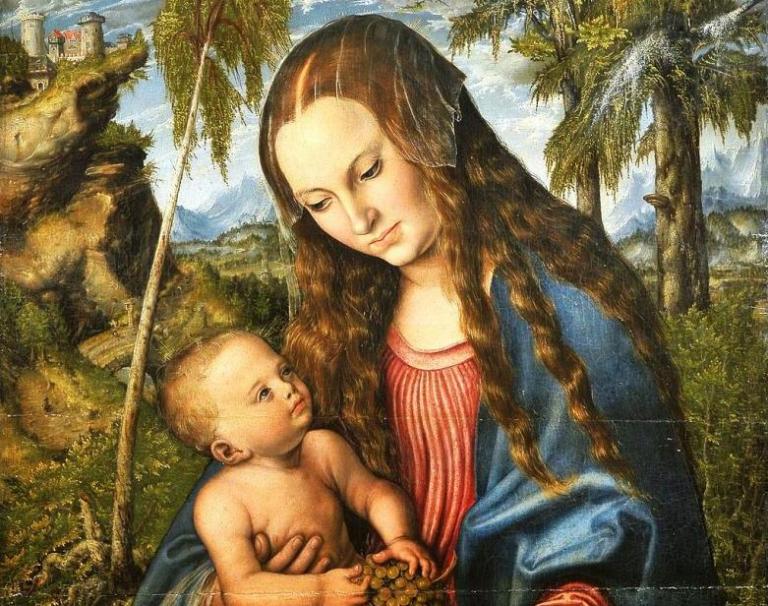
Painting, detail from “Madonna under the Fir Tree,” by Lucas Cranach the Elder [Public domain], via Wikimedia Commons
communication of the attributes
Previous Post

December 14, 2017
The "Yellow Dog" Political Fallacy
Next Post

December 15, 2017 The Court's Gay Marriage Ruling Already Allows for Dissenters
Recent Comments
"While she worked for Trump she was a tool's tool!"
"I know wired earbuds are making a comeback (I never stopped using them as I ..."
"VCRs, tape decks, and cassette players are all having a revival among a segment of ..."
"As a (retired) lawyer I see potential liability from sharing things like power or sharp ..."
Browse Our Archives
Select a Category America Apologetics Art baseball Bible Blog Christ Church crime Culture Economics Education Ethics Family Food Football Government History Holidays Holy Week Humor International Islam Language Law Life Issues Literature Media Medicine Movies Music Nature News Personal Philosophy Politics psychology Reformation Religions Sacraments Science sex Social Science Sports technology television terrorism Theology Uncategorized Vocation war
Select a Month October 2026 September 2026 August 2026 July 2026 June 2026 May 2026 April 2026 March 2026 February 2026 January 2026 December 2025 November 2025 October 2025 September 2025 August 2025 July 2025 June 2025 May 2025 April 2025 March 2025 February 2025 January 2025 December 2024 November 2024 October 2024 September 2024 August 2024 July 2024 June 2024 May 2024 April 2024 March 2024 February 2024 January 2024 December 2023 November 2023 October 2023 September 2023 August 2023 July 2023 June 2023 May 2023 April 2023 March 2023 February 2023 January 2023 December 2022 November 2022 October 2022 September 2022 August 2022 July 2022 June 2022 May 2022 April 2022 March 2022 February 2022 January 2022 December 2021 November 2021 October 2021 September 2021 August 2021 July 2021 June 2021 May 2021 April 2021 March 2021 February 2021 January 2021 December 2020 November 2020 October 2020 September 2020 August 2020 July 2020 June 2020 May 2020 April 2020 March 2020 February 2020 January 2020 December 2019 November 2019 October 2019 September 2019 August 2019 July 2019 June 2019 May 2019 April 2019 March 2019 February 2019 January 2019 December 2018 November 2018 October 2018 September 2018 August 2018 July 2018 June 2018 May 2018 April 2018 March 2018 February 2018 January 2018 December 2017 November 2017 October 2017 September 2017 August 2017 July 2017 June 2017 May 2017 April 2017 March 2017 February 2017 January 2017 December 2016 November 2016 October 2016 September 2016 August 2016 July 2016 June 2016 May 2016 April 2016 March 2016 February 2016 January 2016 December 2015 November 2015 October 2015 September 2015 August 2015 July 2015 June 2015 May 2015 April 2015 March 2015 February 2015 January 2015 December 2014 November 2014 October 2014 September 2014 August 2014 July 2014 June 2014 May 2014 April 2014 March 2014 February 2014 January 2014 December 2013 November 2013 October 2013 September 2013 August 2013 July 2013 June 2013 May 2013 April 2013 March 2013 February 2013 January 2013 December 2012 November 2012 October 2012 September 2012 August 2012 July 2012 June 2012 May 2012 April 2012 March 2012 February 2012 January 2012 December 2011 November 2011 October 2011 September 2011 August 2011 July 2011 June 2011 May 2011 April 2011 March 2011 February 2011 January 2011 December 2010 November 2010 October 2010 September 2010 August 2010 July 2010 June 2010 May 2010 April 2010 March 2010 February 2010 January 2010 December 2009 November 2009 October 2009 September 2009 August 2009 July 2009 June 2009 May 2009 April 2009 March 2009 February 2009 January 2009 December 2008 November 2008 October 2008 September 2008 August 2008 July 2008 June 2008 May 2008 April 2008 March 2008 February 2008 January 2008 December 2007 November 2007 October 2007
Follow Us!
TAKE THE
Religious Wisdom Quiz
What does the name "Elijah" mean?
Select your answer to see how you score.
My God is Yahweh God saves God heals God is judge
Books by This Author Books by Gene Veith
Related posts from Cranach


Gen Z Wants Evildoers to Be Punished, Not...

TRENDING AT PATHEOS Evangelical

'Super Scam Me' Exposes AI Jon Bon Jovi...
Leslie Pickett believed she was in a relationship with Jon Bon Jovi....

The Brazilian Remake of Kendricks' 'Flywheel' Opens in...
“Flywheel,” the story that launched the Kendrick Brothers’ filmmaking career is getting...

The Dangers of Gradual Accommodation (Winking at Sin)
Recently, the “law of gradualness” resurfaced during the opening of a weeklong,...

The Iron Gates and the Lion of the...
Yesterday, I didn't finish my report about, well, yesterday. So I'll...

The Image: On the Horror of Capitalism and...
The Image Then went the Pharisees, and took counsel how they might...

We are approaching the date of our new American national holiday: October...
view all Evangelical blogs
What Are Your Thoughts?leave a comment
Ad-Free & Subscriber Log-In Subscription Support
- About Us
- 2026 Calendar
- Videos
- Podcasts
- Library of World Religions
- Faith In Media Tracker
- Advertise With Us
- Write for Us
- Privacy Policy
- Terms of Service
- Do Not Sell My Data
- Contact Us
- Radiant Digital
- Manage Newsletter Subscriptions
- Unsubscribe From Notifications
- Sitemap
Copyright 2008-2026, Patheos. All rights reserved.
Subscription Support Ad-Free & Subscriber Log-In
Follow Patheos