
BuddhistCatholicContemplativeEvangelicalGeneral ChristianHinduJewishLatter-day SaintMuslimNew VisionsProgressive Christian
Beliefs
- Buddhist
- Catholic
- Contemplative
- Evangelical
- General Christian
- Hindu
- Jewish
- Latter-day Saint
- More Voices
- Muslim
- New Visions
- Pagan
- Progressive Christian
Topics
- Religion News
- Food and Religion
- Sports and Religion
- Religious Art
- Religious Music and Entertainment
- Religious Events
- History and Religion
- Style and Religion
- Politics and Religion
- Women in Religion
- Recreation Outdoors and Religion
- Business Finance and Religion
- Careers Workplace and Religion
- Education and Religion
- Family Parenting and Religion
- Health Fitness and Religion
- Home and Religion
- Relationships and Religion
- Technology and Religion
- Travel and Religion
Columnists
- Buddhist Columnists
- Business Finance and Religion Columnists
- Careers Workplace and Religion Columnists
- Catholic Columnists
- Contemplative Columnists
- Education and Religion Columnists
- Evangelists Columnists
- Family Parenting and Religion Columnists
- General Christian Columnists
- Health Fitness and Religion Columnists
- Hindu Columnists
- History and Religion Columnists
- Home and Religion Columnists
- Jewish Columnists
- More Voices Columnists
- Latter Day Columnists
- Muslim Columnists
- New Visions Columnists
- Nonreligious Columnists
- Pagan Columnists
- Politics and Religion Columnists
- Progressive Columnists
- Recreation Outdoors and Religion Columnists
- Relationships and Religion Columnists
- Religion News Columnists
- Religious Art Columnists
- Religious Events Columnists
- Religious Music and Entertainment Columnists
- Sports and Religion Columnists
- Style and Religion Columnists
- Technology and Religion Columnists
- Travel and Religion Columnists
- Women in Religion Columnists
Resource Library
- 2026 Calendar
- Library of World Religions
- The 100 Most Holy Places on Earth
- Patheos Answers
- Podcasts
- Videos
- Faith Leaders Database
- Anglican Episcopalian
- Bahai
- Baptist
- Buddhism
- Christianity
- Confucianism
- Eastern Orthodoxy
- Hinduism
- Holiness and Pentecostal
- ISKCON
- Islam
- Judaism
- Lutheran
- Methodist
- The Church of Jesus Christ of Latter-day Saints
- New Age
- Paganism
- Presbytarian and Reformed
- Protestantism
- Religion Behind the Scenes
- Roman Catholic
- Scientology
- Shia Islam
- Sikhism
- Sufism
- Sunni Islam
- Taoism
- Zen
- See all religions
Research Tools
 Ad-Free & Subscriber Log-In Subscription Support
Ad-Free & Subscriber Log-In Subscription Support
Follow Patheos 

- Trending:
- Forgiveness
- |
- Marriage
- |
- Consciousness
- |
- Death Penalty
- |
- Election
- |
- Halloween

- Home
- Evangelical
- Politics and Religion
- How Science & Art Come Together in Da Vinci’s “Savior of the World”
How Science & Art Come Together in Da Vinci’s “Savior of the World”
Last updated on: November 20, 2017 at 5:30 am by Gene Veith
How Science & Art Come Together in Da Vinci’s “Savior of the World” 2017-11-19T20:25:22-05:00 Gene Veith
Patheos Explore the world's faith through different perspectives on religion and spirituality! Patheos has the views of the prevalent religions and spiritualities of the world.
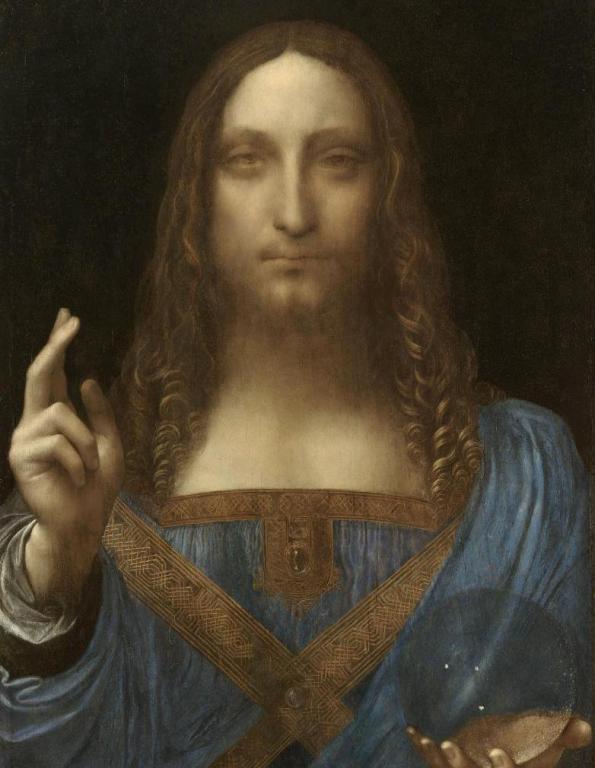
Leonardo da Vinci was not only a great artist. He was also a great scientist–and engineer, mathematician, inventor, and much more. For Leonardo, these were interconnected, not separate specialities, reflecting the integration of knowledge that is the goal of classical learning. The new painting of his that was recently discovered, “Savior of the World,” which we discussed recently, demonstrates how Leonardo integrated his scientific research with his art.
Da Vinci biographer Walter Isaacson focuses on some striking details of the painting in his article Why ‘Salvator Mundi,’ which sold for $450 million, is further proof of Leonardo da Vinci’s genius in The Washington Post. Notice how the “science” is not just added onto the art, but that Leonardo’s study of nature is responsible for the painting’s most evocative aesthetic effects. Isaacson writes,
Leonardo’s feel for the patterns and connections of nature helped him to create, in “Salvator Mundi,” a face that manages to be at once both reassuring and unsettling. Jesus’ stare follows us as we move, and it seems to interact with us. Is he staring at us or into the distance? Move from side to side and ask again. Is there a hint of a smile? Look again. Is his blessing hand moving out at us?
Leonardo worked out the mathematics of perspective, how objects appear smaller the farther away they are, a phenomenon that he and other Renaissance artists exploited to create the illusion of three-dimensional depth on a flat surface. But Leonardo’s study of optics, Isaacson explains, included “acuity,” how the eye focuses. Objects farther away appear blurrier, whereas closer objects are in sharper focus.
“You must diminish the sharpness of those objects in proportion to their increasing distance from the eye of the spectator,” wrote Leonardo. “The parts that are near in the foreground should be finished in a bold determined manner; but those in the distance must be unfinished, and confused in their outlines.”
Thus, in this painting Christ’s hand of blessing is sharply drawn, compared to the rest of the painting, making it appear as if Christ’s hand is reaching towards us.
Leonardo also worked with the way light plays on the surface of the retina and on what it means for our perception that we have two eyes. Isaacson says,
From his optics studies he knew that light does not register in a single point in the eye but instead is perceived along the entire retina. Combined with the fact that we have two eyes, this means that we perceive the edges of objects as slightly blurred rather than sharply delineated. This led to his mastery of sfumato, the gentle blurring of lines in his paintings. We see that technique in blurred outlines of Jesus’ face.
I would add that this is why Jesus’s eyes appear to follow us no matter what angle we look at them. In the comments in our earlier discussion, it was noted that the eyes are not quite in line, which is part of this illusion
Leonardo not only pioneered the study of optics, he studied anatomy, dissecting cadavers in the morgue to understand the muscles and structures of the human body. Isaacson discusses how Leonardo explored the physiology of the smile. Some muscles of the lips turn up, while others turn down.
Leonardo’s portraits are notable for their subtle, evocative smiles. We see this, most famously, in Mona Lisa, but also St. John the Baptist, and now Savior of the World (Salvator Mundi). Isaacson analyzes how they are working, combining Leonardo’s knowledge of physiology–not only of his subjects but of the viewers who look at the painting–with his knowledge of optics:


All three of these similar smiles are made elusive and eerie by Leonardo’s study of light rays and the retina. The central area of the retina, known as the fovea, is best at seeing color and small details; the area surrounding the fovea is best at picking up shadows and shadings of black and white.
When we look carefully at the smiles of Leonardo’s three portrait subjects, especially the left sides (from our vantage) of each set of lips, there are tiny black-and-white details that turn downward. Yet the shadows and colors turn upward. If you stare directly at the mouths, your retina catches the tiny details, making the smiles elusive. But if you move your gaze slightly away from the mouths, the shadows make the lips seem to turn upward into a subtle smile. The result are smiles that are interactive, augmented realities that flicker brighter the less you search for them.
Isaacson also takes up the question of why the orb held by Christ in “Savior of the World” shows no distortion, as a globe of glass would inevitably do. I like his explanation: “What he is doing in his portrayal of Christ as savior of the world is trying to convey the miraculous quality of his stewardship, that nothing he touches is distorted.”
More likely, I think, is that what Christ is holding is not an orb, of the kind kings and emperors held to symbolize their worldly control. He is holding not a symbol but the real thing: Namely, the crystalline sphere that is the primum mobile, which contains the universe, which, with the inner planetary sphere, convey the light of God perfectly. What Isaacson identifies as bubbles in the glass I believe are stars.
Painting by Leonardo da Vinci – Getty Images, Public Domain, https://commons.wikimedia.org/w/index.php?curid=64103353
Previous Post

November 17, 2017
The Connection Between Domestic Abuse and Church Shootings
Next Post

November 20, 2017 The Church of Artificial Intelligence Develops Its Theology
Recent Comments
"Turns out, she wasn’t the right tool for the job."
"You may have just given me my next sermon opening line."
"So Katie Zacharia lasted only a demiScaramucci as press secretary......"
"Apropos to the post on Gen Z a couple days ago: "If you want the ..."
Browse Our Archives
Select a Category America Apologetics Art baseball Bible Blog Christ Church crime Culture Economics Education Ethics Family Food Football Government History Holidays Holy Week Humor International Islam Language Law Life Issues Literature Media Medicine Movies Music Nature News Personal Philosophy Politics psychology Reformation Religions Sacraments Science sex Social Science Sports technology television terrorism Theology Uncategorized Vocation war
Select a Month October 2026 September 2026 August 2026 July 2026 June 2026 May 2026 April 2026 March 2026 February 2026 January 2026 December 2025 November 2025 October 2025 September 2025 August 2025 July 2025 June 2025 May 2025 April 2025 March 2025 February 2025 January 2025 December 2024 November 2024 October 2024 September 2024 August 2024 July 2024 June 2024 May 2024 April 2024 March 2024 February 2024 January 2024 December 2023 November 2023 October 2023 September 2023 August 2023 July 2023 June 2023 May 2023 April 2023 March 2023 February 2023 January 2023 December 2022 November 2022 October 2022 September 2022 August 2022 July 2022 June 2022 May 2022 April 2022 March 2022 February 2022 January 2022 December 2021 November 2021 October 2021 September 2021 August 2021 July 2021 June 2021 May 2021 April 2021 March 2021 February 2021 January 2021 December 2020 November 2020 October 2020 September 2020 August 2020 July 2020 June 2020 May 2020 April 2020 March 2020 February 2020 January 2020 December 2019 November 2019 October 2019 September 2019 August 2019 July 2019 June 2019 May 2019 April 2019 March 2019 February 2019 January 2019 December 2018 November 2018 October 2018 September 2018 August 2018 July 2018 June 2018 May 2018 April 2018 March 2018 February 2018 January 2018 December 2017 November 2017 October 2017 September 2017 August 2017 July 2017 June 2017 May 2017 April 2017 March 2017 February 2017 January 2017 December 2016 November 2016 October 2016 September 2016 August 2016 July 2016 June 2016 May 2016 April 2016 March 2016 February 2016 January 2016 December 2015 November 2015 October 2015 September 2015 August 2015 July 2015 June 2015 May 2015 April 2015 March 2015 February 2015 January 2015 December 2014 November 2014 October 2014 September 2014 August 2014 July 2014 June 2014 May 2014 April 2014 March 2014 February 2014 January 2014 December 2013 November 2013 October 2013 September 2013 August 2013 July 2013 June 2013 May 2013 April 2013 March 2013 February 2013 January 2013 December 2012 November 2012 October 2012 September 2012 August 2012 July 2012 June 2012 May 2012 April 2012 March 2012 February 2012 January 2012 December 2011 November 2011 October 2011 September 2011 August 2011 July 2011 June 2011 May 2011 April 2011 March 2011 February 2011 January 2011 December 2010 November 2010 October 2010 September 2010 August 2010 July 2010 June 2010 May 2010 April 2010 March 2010 February 2010 January 2010 December 2009 November 2009 October 2009 September 2009 August 2009 July 2009 June 2009 May 2009 April 2009 March 2009 February 2009 January 2009 December 2008 November 2008 October 2008 September 2008 August 2008 July 2008 June 2008 May 2008 April 2008 March 2008 February 2008 January 2008 December 2007 November 2007 October 2007
Follow Us!
TAKE THE
Religious Wisdom Quiz
What was the primary method of food preservation in Biblical times?
Select your answer to see how you score.
Pickling Salting Smoking Drying
Books by This Author Books by Gene Veith
Related posts from Cranach

The (Lutheran) Mathematician of Infinity

William Lane Craig's Proof of God's Existence

TRENDING AT PATHEOS Evangelical

A new article, written by Jeff Lindsay and Gale L. Pooley,...

Swimfan: Forgotten Aughts Pleasures
This is a recovery effort. In 2002, My Big Fat Greek Wedding...

Top Three Anti-Catholic Lies About Catholicism
This is my initial transcript for the video, "THE 3 WORST...

Pope Leo Celebrates Mass for Nurses & Docs...
I don't have any idea how he did it, but Pope Leo...

The Sermon on the Mount, Part I: Matthew...
The Sermon on the Mount, Part I (Matthew 4:12-5:12) St. Matthew moves...

What's up from Crossway: Reviewing some of their latest A few weeks...
view all Evangelical blogs
What Are Your Thoughts?leave a comment
Ad-Free & Subscriber Log-In Subscription Support
- About Us
- 2026 Calendar
- Videos
- Podcasts
- Library of World Religions
- Faith In Media Tracker
- Advertise With Us
- Write for Us
- Privacy Policy
- Terms of Service
- Do Not Sell My Data
- Contact Us
- Radiant Digital
- Manage Newsletter Subscriptions
- Unsubscribe From Notifications
- Sitemap
Copyright 2008-2026, Patheos. All rights reserved.
Subscription Support Ad-Free & Subscriber Log-In
Follow Patheos