
BuddhistCatholicContemplativeEvangelicalGeneral ChristianHinduJewishLatter-day SaintMuslimNew VisionsProgressive Christian
Beliefs
- Buddhist
- Catholic
- Contemplative
- Evangelical
- General Christian
- Hindu
- Jewish
- Latter-day Saint
- More Voices
- Muslim
- New Visions
- Pagan
- Progressive Christian
Topics
- Religion News
- Food and Religion
- Sports and Religion
- Religious Art
- Religious Music and Entertainment
- Religious Events
- History and Religion
- Style and Religion
- Politics and Religion
- Women in Religion
- Recreation Outdoors and Religion
- Business Finance and Religion
- Careers Workplace and Religion
- Education and Religion
- Family Parenting and Religion
- Health Fitness and Religion
- Home and Religion
- Relationships and Religion
- Technology and Religion
- Travel and Religion
Columnists
- Buddhist Columnists
- Business Finance and Religion Columnists
- Careers Workplace and Religion Columnists
- Catholic Columnists
- Contemplative Columnists
- Education and Religion Columnists
- Evangelists Columnists
- Family Parenting and Religion Columnists
- General Christian Columnists
- Health Fitness and Religion Columnists
- Hindu Columnists
- History and Religion Columnists
- Home and Religion Columnists
- Jewish Columnists
- More Voices Columnists
- Latter Day Columnists
- Muslim Columnists
- New Visions Columnists
- Nonreligious Columnists
- Pagan Columnists
- Politics and Religion Columnists
- Progressive Columnists
- Recreation Outdoors and Religion Columnists
- Relationships and Religion Columnists
- Religion News Columnists
- Religious Art Columnists
- Religious Events Columnists
- Religious Music and Entertainment Columnists
- Sports and Religion Columnists
- Style and Religion Columnists
- Technology and Religion Columnists
- Travel and Religion Columnists
- Women in Religion Columnists
Resource Library
- 2026 Calendar
- Library of World Religions
- The 100 Most Holy Places on Earth
- Patheos Answers
- Podcasts
- Videos
- Faith Leaders Database
- Anglican Episcopalian
- Bahai
- Baptist
- Buddhism
- Christianity
- Confucianism
- Eastern Orthodoxy
- Hinduism
- Holiness and Pentecostal
- ISKCON
- Islam
- Judaism
- Lutheran
- Methodist
- The Church of Jesus Christ of Latter-day Saints
- New Age
- Paganism
- Presbytarian and Reformed
- Protestantism
- Religion Behind the Scenes
- Roman Catholic
- Scientology
- Shia Islam
- Sikhism
- Sufism
- Sunni Islam
- Taoism
- Zen
- See all religions
Research Tools
 Ad-Free & Subscriber Log-In Subscription Support
Ad-Free & Subscriber Log-In Subscription Support
Follow Patheos 

- Trending:
- Forgiveness
- |
- Marriage
- |
- Consciousness
- |
- Death Penalty
- |
- Election
- |
- Halloween

- Home
- Evangelical
- Politics and Religion
- Misunderstanding the cultural influence of the Reformation
Misunderstanding the cultural influence of the Reformation
Last updated on: July 14, 2017 at 9:32 am by Gene Veith
Misunderstanding the cultural influence of the Reformation 2017-07-14T09:32:10-04:00 Gene Veith
Patheos Explore the world's faith through different perspectives on religion and spirituality! Patheos has the views of the prevalent religions and spiritualities of the world.
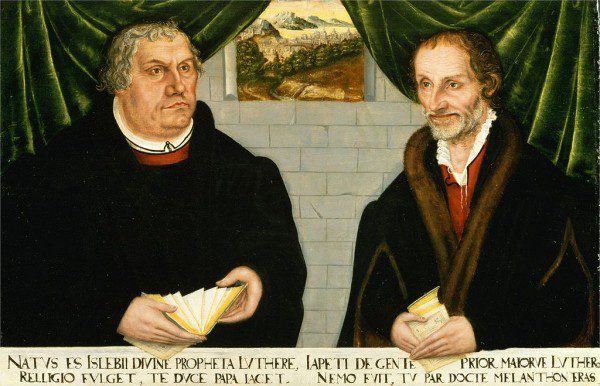
The cultural influence of the Reformation is getting lots of attention on this 500th anniversary of Luther’s 95 Theses. But the topic is often treated with a theological ignorance that is surprising to find in works of scholarship.
The Nation has a long article on the subject, quoted and linked after the jump, which is essentially a review essay of several new books on Luther and Protestantism. As the article observes, the Reformation is often credited or blamed for opposite influences: for a new personal piety and for the rise of secularism; for recovering the Bible and for launching modernity; for the rise of individualism and for the rise of the nation state; for inventing freedom and for capitalist oppression, etc., etc.
The article by Elizabeth Bruenig, drawing on the books she is reviewing, says that what Luther did was to make religion a private, inward matter. Whereas the external world–including the state, the society, the economic order–was irrelevant spiritually. Therefore, it was allowed to run along on its own without a religious context (as in Catholicism). Thus the rise of secularism, modernity, science, and a world that does not need to consider God.
Meanwhile, the inner spiritual life that Luther encouraged had the additional effect of questioning all external authority, making a space for freedom and undermining institutions, which also had a secularizing and eventually revolutionary effect.
But this analysis, while citing Luther’s doctrine of the Two Kingdoms, completely misunderstands what it means–to the point of interpreting it to mean its opposite. And it utterly ignores one of Luther’s greatest and most culturally influential theological contributions, the place where he directly addressed the value of the “secular” realm and to the role it plays in the Christian’s faith; namely, his doctrine of vocation.
What other examples of theological illiteracy do you see in this article? (Hint: Did Luther really teach a theology based on inwardness, with individuals going inside themselves for a purely interior relationship with God?)
The Two Kingdoms does NOT teach “the kingdom of God” vs. “the kingdom of secular politics,” as the article states. Rather, God is the King of both kingdoms! Both the Heavenly Kingdom and the Earthly Kingdom are ruled by God. But they are to be distinguished from each other.
God rules them both in different ways and Christians, who are citizens of both kingdoms, live in them in different ways. God is hidden in the Earthly Kingdom, where He providentially cares for His whole creation, including those who do not know Him. He rules it by His moral Law, which is applicable in the world and remains a standard by which earthly rulers and institutions can be judged. And Christians are to do good works in the world–to work for justice, care for the poor, and battle the evils that are part of the fallen human condition.
In the Heavenly Kingdom, in contrast, God is revealed, and Christians are under the Gospel of God’s grace and the forgiveness of sins through faith in Christ.
But then God sends Christians out into the world to live out their faith in their worldly vocations. Not just their economic work, but their callings in the family, the church, and the state. (Luther’s theology of the three estates should also be a part of any discussion of the Reformation teaching about culture.)
In all of their vocations, Christians are to love and serve their neighbors. Vocation is the place of good works. Also spiritual growth, as Christians endure the trials and tribulations that their vocations bring. Here they co-operate with God as He governs His world.
Far from being dualistic, as these studies assume, Luther’s theology brings these realms together, which had been separated by monasticism and the Catholic position that spiritual perfection requires vows of celibacy (rejecting the estate of the family), poverty (rejecting full participation in the economy), and obedience (in which the “religious” person had to obey the laws of the church but was exempt from the authority of the state).
Luther’s theology did open up the “secular” realm, but he did it by, in effect, making it “spiritual”–insisting on God’s presence and providential care in the world and making it the arena for Christian life.
The Nation article says nothing about the cultural influence of the doctrine of vocation, also known as the “priesthood of all believers.” One result was universal education. The breakdown of medieval religious and eventually social hierarchies in the name of Christian equality before God. Social mobility, as education and the spiritually-motivated work ethic contributed, if not to the theory of capitalism, to the accumulation of wealth on the part of former peasants.
The Reformation did lead to a new concept of freedom based on the freedom that came from the Gospel. It did lead to a new valuation of the world and social pursuits, but it did so because it gave that valuation and those pursuits a religious motivation.
Yes, Protestantism soon took many different forms, each with influences of its own.
But one shouldn’t write about Luther’s cultural influence without attention to the influence of Luther’s theology of culture.
From Elizabeth Bruenig, Martin Luther’s Revolution, The Nation:
Theology is morality is politics is law—and whether or not it’s immediately obvious, the world is steeped in theology. In contemporary America, and especially in the more secular precincts of Western Europe, it seems unlikely that one could look at a property deed or a government budget and find, just beneath its explicit reasoning, traces of old theological disputes and their resolutions. But they’re there, and examining them offers a view of what might have been, had history—in particular, the Protestant Reformation, ignited 500 years ago this October by a German monk named Martin Luther—unfolded differently. . . .
This paradox—that the Reformation could birth a peasant revolt while its instigator rallied behind the princes—is a picture of Protestantism’s confusing political legacy in miniature. Protestantism arguably brought about many of the preconditions for the Enlightenment and liberalism, and at the very least introduced Europe to a headier skepticism of authority than had prevailed before. (Indeed, Roper credits the Reformation with sparking the secularization of the West.) On the other hand, the release of significant portions of life—namely politics and economics—-from the purview of religious authority may have expanded certain freedoms, but it didn’t result in a betterment of conditions for the most disadvantaged, even as it helped transform the Christian message into something far more internal and private than that of the earlier Church.
Painting of Luther and Melanchthon, attributed to Lucas Cranach the Younger [Public domain], via Wikimedia Commons
Luther's doctrine of the estates
Reformation's cultural influence
Previous Post

July 14, 2017
OK, try this health care bill
Next Post

July 14, 2017 The earth will soon be uninhabitable
Recent Comments
"While she worked for Trump she was a tool's tool!"
"I know wired earbuds are making a comeback (I never stopped using them as I ..."
"VCRs, tape decks, and cassette players are all having a revival among a segment of ..."
"As a (retired) lawyer I see potential liability from sharing things like power or sharp ..."
Browse Our Archives
Select a Category America Apologetics Art baseball Bible Blog Christ Church crime Culture Economics Education Ethics Family Food Football Government History Holidays Holy Week Humor International Islam Language Law Life Issues Literature Media Medicine Movies Music Nature News Personal Philosophy Politics psychology Reformation Religions Sacraments Science sex Social Science Sports technology television terrorism Theology Uncategorized Vocation war
Select a Month October 2026 September 2026 August 2026 July 2026 June 2026 May 2026 April 2026 March 2026 February 2026 January 2026 December 2025 November 2025 October 2025 September 2025 August 2025 July 2025 June 2025 May 2025 April 2025 March 2025 February 2025 January 2025 December 2024 November 2024 October 2024 September 2024 August 2024 July 2024 June 2024 May 2024 April 2024 March 2024 February 2024 January 2024 December 2023 November 2023 October 2023 September 2023 August 2023 July 2023 June 2023 May 2023 April 2023 March 2023 February 2023 January 2023 December 2022 November 2022 October 2022 September 2022 August 2022 July 2022 June 2022 May 2022 April 2022 March 2022 February 2022 January 2022 December 2021 November 2021 October 2021 September 2021 August 2021 July 2021 June 2021 May 2021 April 2021 March 2021 February 2021 January 2021 December 2020 November 2020 October 2020 September 2020 August 2020 July 2020 June 2020 May 2020 April 2020 March 2020 February 2020 January 2020 December 2019 November 2019 October 2019 September 2019 August 2019 July 2019 June 2019 May 2019 April 2019 March 2019 February 2019 January 2019 December 2018 November 2018 October 2018 September 2018 August 2018 July 2018 June 2018 May 2018 April 2018 March 2018 February 2018 January 2018 December 2017 November 2017 October 2017 September 2017 August 2017 July 2017 June 2017 May 2017 April 2017 March 2017 February 2017 January 2017 December 2016 November 2016 October 2016 September 2016 August 2016 July 2016 June 2016 May 2016 April 2016 March 2016 February 2016 January 2016 December 2015 November 2015 October 2015 September 2015 August 2015 July 2015 June 2015 May 2015 April 2015 March 2015 February 2015 January 2015 December 2014 November 2014 October 2014 September 2014 August 2014 July 2014 June 2014 May 2014 April 2014 March 2014 February 2014 January 2014 December 2013 November 2013 October 2013 September 2013 August 2013 July 2013 June 2013 May 2013 April 2013 March 2013 February 2013 January 2013 December 2012 November 2012 October 2012 September 2012 August 2012 July 2012 June 2012 May 2012 April 2012 March 2012 February 2012 January 2012 December 2011 November 2011 October 2011 September 2011 August 2011 July 2011 June 2011 May 2011 April 2011 March 2011 February 2011 January 2011 December 2010 November 2010 October 2010 September 2010 August 2010 July 2010 June 2010 May 2010 April 2010 March 2010 February 2010 January 2010 December 2009 November 2009 October 2009 September 2009 August 2009 July 2009 June 2009 May 2009 April 2009 March 2009 February 2009 January 2009 December 2008 November 2008 October 2008 September 2008 August 2008 July 2008 June 2008 May 2008 April 2008 March 2008 February 2008 January 2008 December 2007 November 2007 October 2007
Follow Us!
TAKE THE
Religious Wisdom Quiz
What does "Jordan" (as in Jordan River) mean?
Select your answer to see how you score.
To descend To open To heal To anoint
Books by This Author Books by Gene Veith
Related posts from Cranach


Our New Book on Technology & Vocation

Gen Z Wants Evildoers to Be Punished, Not...

TRENDING AT PATHEOS Evangelical

Emotion in Early Christianity by Andrew Crislip
Andrew Crislip’s Emotion in Early Christianity examines an often overlooked dimension of...

16 Spiritual Touchstones for a More Grounded Life
After decades of spiritual study, here are 16 principles I try...

Catholic Evangelization: Sharing Your Faith Every Day
Welcome back to the Graceful Awakening mini-series called, “From Faith to Mission.” ...

The Pillar of the Boatmen: the Ancient Monument...
The Pillar of the Boatmen is a Romano-Gaulish sculpture that dates from...

In one sense walking into Westminster Abbey is like walking down the...

'Super Scam Me' Exposes AI Jon Bon Jovi...
Leslie Pickett believed she was in a relationship with Jon Bon Jovi....
view all Evangelical blogs
What Are Your Thoughts?leave a comment
Ad-Free & Subscriber Log-In Subscription Support
- About Us
- 2026 Calendar
- Videos
- Podcasts
- Library of World Religions
- Faith In Media Tracker
- Advertise With Us
- Write for Us
- Privacy Policy
- Terms of Service
- Do Not Sell My Data
- Contact Us
- Radiant Digital
- Manage Newsletter Subscriptions
- Unsubscribe From Notifications
- Sitemap
Copyright 2008-2026, Patheos. All rights reserved.
Subscription Support Ad-Free & Subscriber Log-In
Follow Patheos