
BuddhistCatholicContemplativeEvangelicalGeneral ChristianHinduJewishLatter-day SaintMuslimNew VisionsProgressive Christian
Beliefs
- Buddhist
- Catholic
- Contemplative
- Evangelical
- General Christian
- Hindu
- Jewish
- Latter-day Saint
- More Voices
- Muslim
- New Visions
- Pagan
- Progressive Christian
Topics
- Religion News
- Food and Religion
- Sports and Religion
- Religious Art
- Religious Music and Entertainment
- Religious Events
- History and Religion
- Style and Religion
- Politics and Religion
- Women in Religion
- Recreation Outdoors and Religion
- Business Finance and Religion
- Careers Workplace and Religion
- Education and Religion
- Family Parenting and Religion
- Health Fitness and Religion
- Home and Religion
- Relationships and Religion
- Technology and Religion
- Travel and Religion
Columnists
- Buddhist Columnists
- Business Finance and Religion Columnists
- Careers Workplace and Religion Columnists
- Catholic Columnists
- Contemplative Columnists
- Education and Religion Columnists
- Evangelists Columnists
- Family Parenting and Religion Columnists
- General Christian Columnists
- Health Fitness and Religion Columnists
- Hindu Columnists
- History and Religion Columnists
- Home and Religion Columnists
- Jewish Columnists
- More Voices Columnists
- Latter Day Columnists
- Muslim Columnists
- New Visions Columnists
- Nonreligious Columnists
- Pagan Columnists
- Politics and Religion Columnists
- Progressive Columnists
- Recreation Outdoors and Religion Columnists
- Relationships and Religion Columnists
- Religion News Columnists
- Religious Art Columnists
- Religious Events Columnists
- Religious Music and Entertainment Columnists
- Sports and Religion Columnists
- Style and Religion Columnists
- Technology and Religion Columnists
- Travel and Religion Columnists
- Women in Religion Columnists
Resource Library
- 2026 Calendar
- Library of World Religions
- The 100 Most Holy Places on Earth
- Patheos Answers
- Podcasts
- Videos
- Faith Leaders Database
- Anglican Episcopalian
- Bahai
- Baptist
- Buddhism
- Christianity
- Confucianism
- Eastern Orthodoxy
- Hinduism
- Holiness and Pentecostal
- ISKCON
- Islam
- Judaism
- Lutheran
- Methodist
- The Church of Jesus Christ of Latter-day Saints
- New Age
- Paganism
- Presbytarian and Reformed
- Protestantism
- Religion Behind the Scenes
- Roman Catholic
- Scientology
- Shia Islam
- Sikhism
- Sufism
- Sunni Islam
- Taoism
- Zen
- See all religions
Research Tools
 Ad-Free & Subscriber Log-In Subscription Support
Ad-Free & Subscriber Log-In Subscription Support
Follow Patheos 

- Trending:
- Forgiveness
- |
- Marriage
- |
- Consciousness
- |
- Death Penalty
- |
- Election
- |
- Halloween

- Home
- Evangelical
- Politics and Religion
- Martin Luther as inventor of freedom
Martin Luther as inventor of freedom
Last updated on: April 7, 2017 at 6:00 am by Gene Veith
Martin Luther as inventor of freedom 2017-04-06T21:06:32-04:00 Gene Veith
Patheos Explore the world's faith through different perspectives on religion and spirituality! Patheos has the views of the prevalent religions and spiritualities of the world.
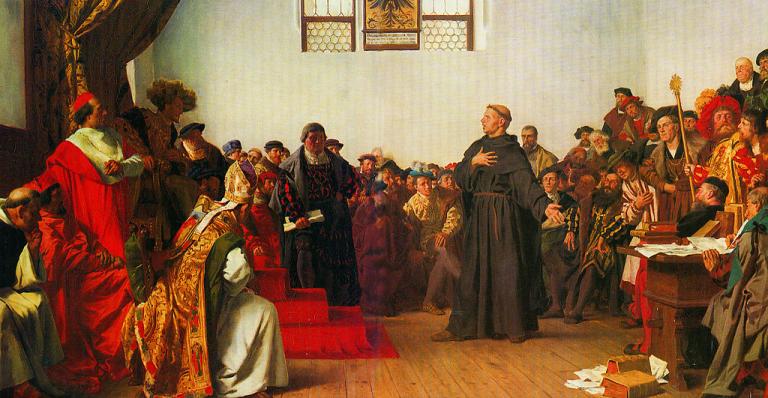 Lutherans aren’t the only ones celebrating the 500th anniversary of Luther’s posting of the 95 theses. Nor are Protestants or other Christians. Luther had a monumental impact on Western Civilization, so even the secularists are taking the opportunity to study Luther’s cultural contributions, from his impact on universal education to his pioneering use of information technology (the printing press).
Time Magazine has published an article reprinted from History Today by scholar Frank Furedi entitled How Martin Luther Helped Invent Individual Freedom.
Furedi argues that when Luther stood up against Pope and Emperor at the Diet of Wurms, making his stand on his individual conscience, he, in effect, invented personal freedom. His rejection of temporal and ecclesiastical authority would lead, Furedi says, to the undermining of all authority. Including, eventually, to the authority of God.
Read Furedi’s argument, quoted and linked after the jump. After which, I will explain what is wrong with what he says, while acknowledging that Luther did play an important role in the rise of freedom.
From Frank Furedi, Martin Luther Anniversary and the Idea of Individual Freedom | Time.com:
Did Luther really hurl the legendary words — “Here I stand, so help me God, I can do no other” — at his accusers? In a sense it does not matter. Luther did not merely assert the authority of individual conscience to justify his own actions; he advanced a compelling case for the value of people being able to act in accordance with the dictates of their conscience. In so doing, his argument implicitly called into question the right of external authority to exercise power over the inner life of people.
The distinction that Luther drew about the nature of authority represented an important step in the conceptualization of a new limit on its exercise. His Treatise on Good Works (1520) asserted that “the power of the temporal authority, whether it does right or wrong, cannot harm the soul.” This idealization of the soul and its protected status from external authority encouraged European culture to devote greater interest in individual conscience and eventually to endow the self with moral authority.
In helping to free the inner person from the power of external authority, Luther’s theology contributed to the weakening of the very concept of external authority, including that of divine authority. The freeing of the inner person from the power of external authority restricted the exercise of absolute authority in all its forms.
Luther’s protection of the soul from secular imposition led to the paradox of inner freedom with external domination. Nevertheless, the coexistence of apparently contradictory relations to authority could not indefinitely survive without one giving way to another. The recognition of a sphere where political rule could not legitimately coerce the individual ultimately undermined the status of absolutist authority in all spheres of life. It soon became clear that once individuals are granted inner freedom they find it difficult to unquestioningly obey any form of authority.
When Luther suggested that he could not but obey his individual conscience, he provided the basis for an argument that was soon perceived as subversive. The very suggestion that individual conscience could oppose external authority would, in the years to come, crystallize into the affirmation of the ideal of individual freedom.
First of all, Luther did not take his “stand” on personal conscience. In his Diet of Wurms speech, he said, “My conscience is captive to the Word of God.” He was not rejecting authority, but rather obeying a higher authority that the Pope was neglecting: the authority of the Bible. That is, the authority of God, whose will and whose actions are revealed in His Word.
Luther not only insisted that the Word of God should be the highest authority for the Church. By translating it into the vernacular and then opening schools to teach all Christians–women as well as men, peasants as well as Lords–to read it, he did strike a blow for freedom. Now ordinary citizens had access to a higher authority than their rulers. Thus, they had a basis for criticizing their superiors, their governments, and their cultures when they were in violation of God’s moral law.
Luther did not believe that human beings had freedom in the humanist sense. His debate with Erasmus over the issue resulted in some of Luther’s most profound theological writings: The Bondage of the Will. Luther didn’t deny that we have a will. Rather, he argued that the will is in bondage to sin. We will not freely choose God on our own. Rather, we will choose to sin. But sin enslaves us.
Today we tend to think of freedom in terms of our ability to do whatever we want, including the freedom to sin. But sin is not liberating. Sin brings bondage. Addicts to drugs, alcohol, pornography, gambling, violence, and other compulsions are not free. Neither are thieves, liars, adulterers, abusers, or other overt sinners. Our very personalities are bound up in our vices, and we cannot change them by ourselves any more than we can change who we are.
But Christ sets us free. In Luther’s other great theological work, The Freedom of the Christian, he explains the freedom that comes from the Gospel, from being justified not by our works or our choices but by faith in the saving work of Christ on the Cross. When we are justified by Christ, we are liberated from sin, from the Law, from Satan, from death, from fear.
But even here is a paradox. “A Christian is the most free lord of all, and subject to none; a Christian is the most dutiful servant of all, and subject to every one.” Freed by the Gospel, Christians freely take on a new bondage to the love and service, in vocation, of their neighbors.
That a Christian is “the most free lord of all, and subject to none” is indeed revolutionary. Think of the impact that statement would have, say, on a peasant, reading it in a time of rigorous social hierarchy. Indeed, some peasants did seize on such concepts, to the point of killing their masters and burning their estates. Luther condemned their uprising and urged the princes to squelch it, which they did. Furedi says that Luther upheld inner freedom, while still upholding outward obedience to external authorities, somewhat criticizing Luther for that. But he surely had a point. And the peasants would have done well to read the second part of the paradox.
But Luther was an insightful commenter on the nature of freedom. Not freedom in our sense of being unconstrained from authority. Far from it. Yet Luther’s notion of freedom–issuing from the Gospel–was certainly influential and formative. And it is a view of freedom that we need to recover today.
Painting of Luther at the Diet of Wurms by Anton von Werner [Public domain], via Wikimedia Commons
Previous Post

April 7, 2017
Trump attacks Syria
Next Post
April 10, 2017 Russell Westbrook for MVP
Recent Comments
"While she worked for Trump she was a tool's tool!"
"I know wired earbuds are making a comeback (I never stopped using them as I ..."
"VCRs, tape decks, and cassette players are all having a revival among a segment of ..."
"As a (retired) lawyer I see potential liability from sharing things like power or sharp ..."
Browse Our Archives
Select a Category America Apologetics Art baseball Bible Blog Christ Church crime Culture Economics Education Ethics Family Food Football Government History Holidays Holy Week Humor International Islam Language Law Life Issues Literature Media Medicine Movies Music Nature News Personal Philosophy Politics psychology Reformation Religions Sacraments Science sex Social Science Sports technology television terrorism Theology Uncategorized Vocation war
Select a Month October 2026 September 2026 August 2026 July 2026 June 2026 May 2026 April 2026 March 2026 February 2026 January 2026 December 2025 November 2025 October 2025 September 2025 August 2025 July 2025 June 2025 May 2025 April 2025 March 2025 February 2025 January 2025 December 2024 November 2024 October 2024 September 2024 August 2024 July 2024 June 2024 May 2024 April 2024 March 2024 February 2024 January 2024 December 2023 November 2023 October 2023 September 2023 August 2023 July 2023 June 2023 May 2023 April 2023 March 2023 February 2023 January 2023 December 2022 November 2022 October 2022 September 2022 August 2022 July 2022 June 2022 May 2022 April 2022 March 2022 February 2022 January 2022 December 2021 November 2021 October 2021 September 2021 August 2021 July 2021 June 2021 May 2021 April 2021 March 2021 February 2021 January 2021 December 2020 November 2020 October 2020 September 2020 August 2020 July 2020 June 2020 May 2020 April 2020 March 2020 February 2020 January 2020 December 2019 November 2019 October 2019 September 2019 August 2019 July 2019 June 2019 May 2019 April 2019 March 2019 February 2019 January 2019 December 2018 November 2018 October 2018 September 2018 August 2018 July 2018 June 2018 May 2018 April 2018 March 2018 February 2018 January 2018 December 2017 November 2017 October 2017 September 2017 August 2017 July 2017 June 2017 May 2017 April 2017 March 2017 February 2017 January 2017 December 2016 November 2016 October 2016 September 2016 August 2016 July 2016 June 2016 May 2016 April 2016 March 2016 February 2016 January 2016 December 2015 November 2015 October 2015 September 2015 August 2015 July 2015 June 2015 May 2015 April 2015 March 2015 February 2015 January 2015 December 2014 November 2014 October 2014 September 2014 August 2014 July 2014 June 2014 May 2014 April 2014 March 2014 February 2014 January 2014 December 2013 November 2013 October 2013 September 2013 August 2013 July 2013 June 2013 May 2013 April 2013 March 2013 February 2013 January 2013 December 2012 November 2012 October 2012 September 2012 August 2012 July 2012 June 2012 May 2012 April 2012 March 2012 February 2012 January 2012 December 2011 November 2011 October 2011 September 2011 August 2011 July 2011 June 2011 May 2011 April 2011 March 2011 February 2011 January 2011 December 2010 November 2010 October 2010 September 2010 August 2010 July 2010 June 2010 May 2010 April 2010 March 2010 February 2010 January 2010 December 2009 November 2009 October 2009 September 2009 August 2009 July 2009 June 2009 May 2009 April 2009 March 2009 February 2009 January 2009 December 2008 November 2008 October 2008 September 2008 August 2008 July 2008 June 2008 May 2008 April 2008 March 2008 February 2008 January 2008 December 2007 November 2007 October 2007
Follow Us!
TAKE THE
Religious Wisdom Quiz
What does "Shema," the central Jewish prayer, mean?
Select your answer to see how you score.
Peace Pray Light Hear
Books by This Author Books by Gene Veith
Related posts from Cranach


Gen Z Wants Evildoers to Be Punished, Not...

TRENDING AT PATHEOS Evangelical

Jad Gillies on New Hillsong Worship Songs and...
For worship leader Jad Gillies, Hillsong Worship’s next chapter is not about...

Looking at the Largest Orthodox Cathedral on Earth
There is often a considerable amount of anger and, shall we...

The Problem with False Prophets
Miller’s Station UMC| 10/18/26| Anchor Verse: Jeremiah 23: 1, 9-23 I...

Emotion in Early Christianity by Andrew Crislip
Andrew Crislip’s Emotion in Early Christianity examines an often overlooked dimension of...

16 Spiritual Touchstones for a More Grounded Life
After decades of spiritual study, here are 16 principles I try...

Catholic Evangelization: Sharing Your Faith Every Day
Welcome back to the Graceful Awakening mini-series called, “From Faith to Mission.” ...
view all Evangelical blogs
What Are Your Thoughts?leave a comment
Ad-Free & Subscriber Log-In Subscription Support
- About Us
- 2026 Calendar
- Videos
- Podcasts
- Library of World Religions
- Faith In Media Tracker
- Advertise With Us
- Write for Us
- Privacy Policy
- Terms of Service
- Do Not Sell My Data
- Contact Us
- Radiant Digital
- Manage Newsletter Subscriptions
- Unsubscribe From Notifications
- Sitemap
Copyright 2008-2026, Patheos. All rights reserved.
Subscription Support Ad-Free & Subscriber Log-In
Follow Patheos