
BuddhistCatholicContemplativeEvangelicalGeneral ChristianHinduJewishLatter-day SaintMuslimNew VisionsProgressive Christian
Beliefs
- Buddhist
- Catholic
- Contemplative
- Evangelical
- General Christian
- Hindu
- Jewish
- Latter-day Saint
- More Voices
- Muslim
- New Visions
- Pagan
- Progressive Christian
Topics
- Religion News
- Food and Religion
- Sports and Religion
- Religious Art
- Religious Music and Entertainment
- Religious Events
- History and Religion
- Style and Religion
- Politics and Religion
- Women in Religion
- Recreation Outdoors and Religion
- Business Finance and Religion
- Careers Workplace and Religion
- Education and Religion
- Family Parenting and Religion
- Health Fitness and Religion
- Home and Religion
- Relationships and Religion
- Technology and Religion
- Travel and Religion
Columnists
- Buddhist Columnists
- Business Finance and Religion Columnists
- Careers Workplace and Religion Columnists
- Catholic Columnists
- Contemplative Columnists
- Education and Religion Columnists
- Evangelists Columnists
- Family Parenting and Religion Columnists
- General Christian Columnists
- Health Fitness and Religion Columnists
- Hindu Columnists
- History and Religion Columnists
- Home and Religion Columnists
- Jewish Columnists
- More Voices Columnists
- Latter Day Columnists
- Muslim Columnists
- New Visions Columnists
- Nonreligious Columnists
- Pagan Columnists
- Politics and Religion Columnists
- Progressive Columnists
- Recreation Outdoors and Religion Columnists
- Relationships and Religion Columnists
- Religion News Columnists
- Religious Art Columnists
- Religious Events Columnists
- Religious Music and Entertainment Columnists
- Sports and Religion Columnists
- Style and Religion Columnists
- Technology and Religion Columnists
- Travel and Religion Columnists
- Women in Religion Columnists
Resource Library
- 2026 Calendar
- Library of World Religions
- The 100 Most Holy Places on Earth
- Patheos Answers
- Podcasts
- Videos
- Faith Leaders Database
- Anglican Episcopalian
- Bahai
- Baptist
- Buddhism
- Christianity
- Confucianism
- Eastern Orthodoxy
- Hinduism
- Holiness and Pentecostal
- ISKCON
- Islam
- Judaism
- Lutheran
- Methodist
- The Church of Jesus Christ of Latter-day Saints
- New Age
- Paganism
- Presbytarian and Reformed
- Protestantism
- Religion Behind the Scenes
- Roman Catholic
- Scientology
- Shia Islam
- Sikhism
- Sufism
- Sunni Islam
- Taoism
- Zen
- See all religions
Research Tools
 Ad-Free & Subscriber Log-In Subscription Support
Ad-Free & Subscriber Log-In Subscription Support
Follow Patheos 

- Trending:
- Forgiveness
- |
- Marriage
- |
- Consciousness
- |
- Death Penalty
- |
- Election
- |
- Halloween

- Home
- Evangelical
- Politics and Religion
- What the Reformation did for preaching
What the Reformation did for preaching
Last updated on: February 21, 2017 at 6:00 am by Gene Veith
What the Reformation did for preaching 2017-02-20T20:06:56-05:00 Gene Veith
Patheos Explore the world's faith through different perspectives on religion and spirituality! Patheos has the views of the prevalent religions and spiritualities of the world.
Evangelical theologian Timothy George has written a fascinating and illuminating post entitled “How the Reformation Recovered Preaching.”
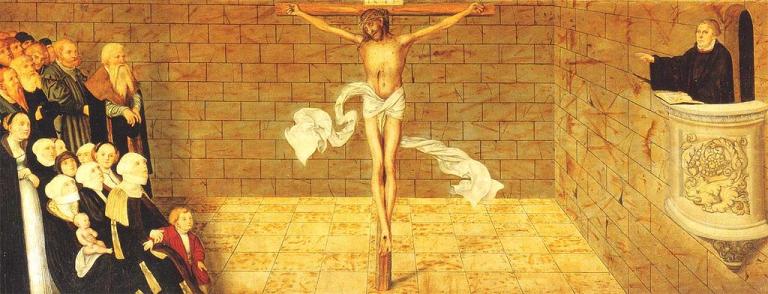
Prof. George shows not only historical facts about how the Reformation put the sermon back into the worship service. (Before, sermons were only given on special occasions, and often outdoors instead of in the sanctuary.) Drawing deeply on Luther, He also explores the theology of the sermon, which is a “sacramental event.”
Read highlights after the jump.
(Painting by Lucas Cranach, Altarpiece at St. Mary’s Church, Wittenberg. Reproduction by Torsten Schleese (Own work) [Public domain], via Wikimedia Commons.)
From TImothy George, How the Reformation Recovered Preaching, The Gospel Coalition:
The preaching of the gospel as a sacramental event is at the heart of Reformation theology. Preaching is also at the heart of Reformation faith—preaching as an indispensable means of grace and a sure sign of the true church. Where is the church? According to Article VII of the Augsburg Confession (1530), the church is that place where the Word is purely preached and the sacraments are duly administered. The Second Helvetic Confession (1566) went even further when it declared that “the preaching of the Word of God is the Word of God.”
Of course, preaching—unlike the printing press—was not a new invention of the Reformation era. Far from it. Think of Augustine and Chrysostom in the early church, Bernard of Clairvaux, John Hus, and the many mendicant friars who fanned out across Europe in the Middle Ages.
St. Francis preached the gospel to a Muslim sultan, and Savonarola declared God’s judgment on the sinful leaders of Florence. Bernardino of Siena, the great Franciscan herald, preached to throngs in the 15th century, calling on his listeners to repent, confess their sins, and go to Mass. The Protestant reformers knew this tradition and built on it, but they also transformed it in two important respects.
Central Act of Worship
First, they made the sermon the centerpiece of the church’s regular worship. Prior to the Reformation, the sermon was mostly an ad hoc event reserved for special occasions or seasons of the liturgical cycle, especially Christmas and Eastertide. Most sermons were preached in town squares or open fields. The reformers brought the sermon back inside the church and gave it an honored place in the public worship of the gathered community. The central role of preaching in Protestant worship can be seen in the way pulpits were raised to a higher elevation as families gathered with their children to hear the Word proclaimed.
Second, the reformers introduced a new theology of preaching. They were concerned that the Bible take deep root in the lives of the people. The Word of God was meant not only to be read, studied, translated, memorized, and meditated on; it was also to be embodied in the life and worship of the church. What might be called the practicing of the Bible—its embodiment—was most clearly expressed in the ministry of preaching. Martin Luther believed that a call to the preaching office was a sacred trust and shouldn’t be used for selfish purposes. “Christ did not establish the ministry of proclamation to provide us with money, property, popularity, honor, or friendship,” he said. . . .
Three Marks of Reformation Preaching
In an important essay published in Theology Today in 1961, Heiko A. Oberman set forth the distinctive marks of Reformation preaching in terms of three interrelated aspects.
1. The sermon is an apocalyptic event.
Not quite in the sense of Savonarola’s preaching of impending doom to the people of Florence, but in the sense that the sermon unveils and makes present the last judgment here and now. Without demythologizing Christ’s future coming, gospel preaching existentializes the final will of God for every hearer by calling for a decisive response here and now. “In the sermon,” Oberman observed, “Christ and the Devil are revealed, Creator and creature, love and wrath, essence and existence, ‘Yes’ and ‘No.’”
2. The sermon is not an isolated speaking part in an otherwise sterile liturgy.
The sermon is a vital and integral part of corporate worship. Praying, singing, confessing sins, declaring forgiveness, baptizing, gathering around the Lord’s Table to receive in faith Christ’s body and blood “in, with, and under” (Luther) and “exhibited by” (Calvin) the earthly elements of bread and wine—all of these activities presuppose, and are supported by, the lively preaching of God’s Word. Woven into the texture of the whole worship event by the dynamic operation of the Spirit, the Reformation sermon, Oberman noted, is “not legalistic but redemptive; not only directed to individual souls but especially to the corporate existence of the congregation; not elevating but mobilizing; not a refuge but a starting point; and, finally, not holy and vertical, but secular and horizontal: time, space, and dust.”
3. The sermon is similar in one respect to the role of the eucharist in medieval Catholic theology.
The preaching event has an utterly objective character that transcends the weak and sinful status of the preacher himself. Whenever God’s Word is proclaimed, the Lord truly speaks and is truly present in judgment and in grace. There is, to say it boldly, an ex opere operato presence of God’s Word in the preached Word. For this reason, God has chosen what Paul called “the folly of preaching” to bring sinful men and women to new life in Christ, to nourish the flock of God, and to sustain the pilgrim church on its way to the heavenly city.
In the final analysis, the Reformation was a recovery of biblical preaching.
Previous Post

February 21, 2017
Intersectionality
Next Post
February 22, 2017 Parents who regret having children
Recent Comments
"I know wired earbuds are making a comeback (I never stopped using them as I ..."
"VCRs, tape decks, and cassette players are all having a revival among a segment of ..."
"As a (retired) lawyer I see potential liability from sharing things like power or sharp ..."
"I am not sure the items you mentioned, though disused, discontinued, discarded, could be considered ..."
Browse Our Archives
Select a Category America Apologetics Art baseball Bible Blog Christ Church crime Culture Economics Education Ethics Family Food Football Government History Holidays Holy Week Humor International Islam Language Law Life Issues Literature Media Medicine Movies Music Nature News Personal Philosophy Politics psychology Reformation Religions Sacraments Science sex Social Science Sports technology television terrorism Theology Uncategorized Vocation war
Select a Month October 2026 September 2026 August 2026 July 2026 June 2026 May 2026 April 2026 March 2026 February 2026 January 2026 December 2025 November 2025 October 2025 September 2025 August 2025 July 2025 June 2025 May 2025 April 2025 March 2025 February 2025 January 2025 December 2024 November 2024 October 2024 September 2024 August 2024 July 2024 June 2024 May 2024 April 2024 March 2024 February 2024 January 2024 December 2023 November 2023 October 2023 September 2023 August 2023 July 2023 June 2023 May 2023 April 2023 March 2023 February 2023 January 2023 December 2022 November 2022 October 2022 September 2022 August 2022 July 2022 June 2022 May 2022 April 2022 March 2022 February 2022 January 2022 December 2021 November 2021 October 2021 September 2021 August 2021 July 2021 June 2021 May 2021 April 2021 March 2021 February 2021 January 2021 December 2020 November 2020 October 2020 September 2020 August 2020 July 2020 June 2020 May 2020 April 2020 March 2020 February 2020 January 2020 December 2019 November 2019 October 2019 September 2019 August 2019 July 2019 June 2019 May 2019 April 2019 March 2019 February 2019 January 2019 December 2018 November 2018 October 2018 September 2018 August 2018 July 2018 June 2018 May 2018 April 2018 March 2018 February 2018 January 2018 December 2017 November 2017 October 2017 September 2017 August 2017 July 2017 June 2017 May 2017 April 2017 March 2017 February 2017 January 2017 December 2016 November 2016 October 2016 September 2016 August 2016 July 2016 June 2016 May 2016 April 2016 March 2016 February 2016 January 2016 December 2015 November 2015 October 2015 September 2015 August 2015 July 2015 June 2015 May 2015 April 2015 March 2015 February 2015 January 2015 December 2014 November 2014 October 2014 September 2014 August 2014 July 2014 June 2014 May 2014 April 2014 March 2014 February 2014 January 2014 December 2013 November 2013 October 2013 September 2013 August 2013 July 2013 June 2013 May 2013 April 2013 March 2013 February 2013 January 2013 December 2012 November 2012 October 2012 September 2012 August 2012 July 2012 June 2012 May 2012 April 2012 March 2012 February 2012 January 2012 December 2011 November 2011 October 2011 September 2011 August 2011 July 2011 June 2011 May 2011 April 2011 March 2011 February 2011 January 2011 December 2010 November 2010 October 2010 September 2010 August 2010 July 2010 June 2010 May 2010 April 2010 March 2010 February 2010 January 2010 December 2009 November 2009 October 2009 September 2009 August 2009 July 2009 June 2009 May 2009 April 2009 March 2009 February 2009 January 2009 December 2008 November 2008 October 2008 September 2008 August 2008 July 2008 June 2008 May 2008 April 2008 March 2008 February 2008 January 2008 December 2007 November 2007 October 2007
Follow Us!
TAKE THE
Religious Wisdom Quiz
What city was Paul imprisoned in before writing to the Philippians?
Select your answer to see how you score.
Corinth Antioch Jerusalem Rome
Books by This Author Books by Gene Veith
Related posts from Cranach


Gen Z Wants Evildoers to Be Punished, Not...

TRENDING AT PATHEOS Evangelical

When Halloween Unmasks Married Hearts
Written by Dr. David K. Ewen from Eternal Truth Bible College Behind...

Aristotle. He’s been called the father of logic, the father of the...

Methodist Central Hall and Westminster Abbey
Situated on the same square is Methodist Central Hall and Westminster Abbey. ...

57th Dove Awards Honor Dolly Parton, Crown New...
On gospel music’s biggest night, the 57th annual GMA Dove Awards honored...

The First Eucharistic Controversy: Christ’s Real Presence
For Catholics, the Eucharist is the source and summit of the Christian...

What a Stop Sign Can Teach Us About...
How to Make a Decision When You Can't Hear God Main point:...
view all Evangelical blogs
What Are Your Thoughts?leave a comment
Ad-Free & Subscriber Log-In Subscription Support
- About Us
- 2026 Calendar
- Videos
- Podcasts
- Library of World Religions
- Faith In Media Tracker
- Advertise With Us
- Write for Us
- Privacy Policy
- Terms of Service
- Do Not Sell My Data
- Contact Us
- Radiant Digital
- Manage Newsletter Subscriptions
- Unsubscribe From Notifications
- Sitemap
Copyright 2008-2026, Patheos. All rights reserved.
Subscription Support Ad-Free & Subscriber Log-In
Follow Patheos