
BuddhistCatholicContemplativeEvangelicalGeneral ChristianHinduJewishLatter-day SaintMuslimNew VisionsProgressive Christian
Beliefs
- Buddhist
- Catholic
- Contemplative
- Evangelical
- General Christian
- Hindu
- Jewish
- Latter-day Saint
- More Voices
- Muslim
- New Visions
- Pagan
- Progressive Christian
Topics
- Religion News
- Food and Religion
- Sports and Religion
- Religious Art
- Religious Music and Entertainment
- Religious Events
- History and Religion
- Style and Religion
- Politics and Religion
- Women in Religion
- Recreation Outdoors and Religion
- Business Finance and Religion
- Careers Workplace and Religion
- Education and Religion
- Family Parenting and Religion
- Health Fitness and Religion
- Home and Religion
- Relationships and Religion
- Technology and Religion
- Travel and Religion
Columnists
- Buddhist Columnists
- Business Finance and Religion Columnists
- Careers Workplace and Religion Columnists
- Catholic Columnists
- Contemplative Columnists
- Education and Religion Columnists
- Evangelists Columnists
- Family Parenting and Religion Columnists
- General Christian Columnists
- Health Fitness and Religion Columnists
- Hindu Columnists
- History and Religion Columnists
- Home and Religion Columnists
- Jewish Columnists
- More Voices Columnists
- Latter Day Columnists
- Muslim Columnists
- New Visions Columnists
- Nonreligious Columnists
- Pagan Columnists
- Politics and Religion Columnists
- Progressive Columnists
- Recreation Outdoors and Religion Columnists
- Relationships and Religion Columnists
- Religion News Columnists
- Religious Art Columnists
- Religious Events Columnists
- Religious Music and Entertainment Columnists
- Sports and Religion Columnists
- Style and Religion Columnists
- Technology and Religion Columnists
- Travel and Religion Columnists
- Women in Religion Columnists
Resource Library
- 2026 Calendar
- Library of World Religions
- The 100 Most Holy Places on Earth
- Patheos Answers
- Podcasts
- Videos
- Faith Leaders Database
- Anglican Episcopalian
- Bahai
- Baptist
- Buddhism
- Christianity
- Confucianism
- Eastern Orthodoxy
- Hinduism
- Holiness and Pentecostal
- ISKCON
- Islam
- Judaism
- Lutheran
- Methodist
- The Church of Jesus Christ of Latter-day Saints
- New Age
- Paganism
- Presbytarian and Reformed
- Protestantism
- Religion Behind the Scenes
- Roman Catholic
- Scientology
- Shia Islam
- Sikhism
- Sufism
- Sunni Islam
- Taoism
- Zen
- See all religions
Research Tools
 Ad-Free & Subscriber Log-In Subscription Support
Ad-Free & Subscriber Log-In Subscription Support
Follow Patheos 

- Trending:
- Forgiveness
- |
- Marriage
- |
- Consciousness
- |
- Death Penalty
- |
- Election
- |
- Halloween

- Home
- Evangelical
- Politics and Religion
- J. W. Montgomery on Cranach’s Seal
J. W. Montgomery on Cranach’s Seal
Last updated on: May 23, 2011 at 5:00 am by Gene Veith
J. W. Montgomery on Cranach’s Seal 2011-05-23T05:00:53-04:00 Gene Veith
Patheos Explore the world's faith through different perspectives on religion and spirituality! Patheos has the views of the prevalent religions and spiritualities of the world.
I heard back from the distinguished scholar John Warwick Montgomery on the symbolism of Lucas Cranach’s seal, the winged serpent device from his coat of arms that he used to sign his paintings and that we have adopted as the logo of the Cranach Institute and this blog. (See the title heading above.)
I’ve now had an opportunity to research this. I was particularly helped by the wonderful Cranach exhibit last month at the Musée du Luxembourg in Paris. The exhibit included examples of Cranach’s coat-of-arms and the exhibit description makes the following point: “En remerciement de ses loyaux services, Luca Cranach se voit remettre dès 1508 des armoiries, un serpent ailé tenant une bague dans sa gueule qui lui servira désormais de signature.” [In appreciation of his loyal services, Lucas Cranach received in 1508 (from Frederick the Wise) his coat-of-arms–a winged serpent holding a ring in its mouth–which served from then on as his signature] We are also informed that in 1537, following the death of his son Hans, Lucas Cranach modified the design of his coat-of-arms, “lowering the serpent’s wings” (Cranach et son temps [Paris: Beaux Arts/TTM, 2011], p. 65).
Viewing the serpent as a dragon, one has a strong tendency to see it as alchemical symbolism. However, contemporary dictionaries of the subject (e.g., the standard Dictionaire hermetique [Paris, 1695]) and modern authorities (Carl Gustav Jung) present the alchemical dragon or serpent very differently: as the ouroboros which eats its own tail, or as an uncrowned dragon symbolising the element mercury).
It is therefore far more productive to view the coat-of-arms from a straightforward heraldic standpoint. Rietstap’s Armorial Général (2d ed., 1884) includes a listing for the Cranachs, describing the coat-of-arms as consisting of a crowned serpent with bat’s wings, holding in its mouth a golden ring with a ruby. A variant (apparently used by later generation Cranachs) consisted of a serpent surmounting a crown of thorns.
But why the particular symbolism chosen or employed by Cranach himself? Here, we are strongly warned as a general principle in interpreting heraldic figures to avoid simplistic equivalents or easy allegory. Symbols are often chosen for aesthetic reasons, not with any attempts at profundity or classical/theological reference. Emile Gevaert’s marvelous L’Héraldique: son esprit, son langage et ses applications (Paris: Editions du Bulletin des Métiers d’Art [ca. 1920]) offers some assistance. A serpent can symbolise “prudence” and at the same time “desire” (p. 362). (Here, I am immediately reminded of the arms of the Aldine printing house in Renaissance Florence, consisting of an anchor and a dolphin, to carry the idea of simultaneous solidity and progress. Note also that Cranach’s serpent is given wings, making it not just an earthly beast but at the same time a dynamic, heavenly creature.) One thinks inevitably, as well, of the biblical reference to serpents as “wise” (Matt. 10:16).
As for the addition of a crown or diadem (uncommon on a heraldic serpent), its presence generally signifies that the arms belong to a “household of eminence”–and “a crown surmounting a figure seemingly indicates a power which the bearer does not derive from himself” (Gevaert, p. 210). In the case of the Cranach arms, the latter point could remind the observer that Cranach received the grant from his prince–or (since any legitimate coat-of-arms results from a grant and is not the personal creation of the bearer) it might represent Cranach’s Refomation belief that he is saved and receives his talents by God’s grace, not through any personal capacity or efforts on his own part. The golden ring in the serpent’s mouth could perhaps reinforce this interpretation, since a ring, like a circle, represents eternity theologically, and gold is the colour not just of nobility and richness but also of faith and divinity (= God). The ruby on the ring could represent “the pearl of great price,” i.e., the gospel.
Beyond this I cannot go. It would be important to check any surviving Cranach correspondence, particularly in the years surrounding 1508 and 1537, to see if by chance Cranach himself interprets his coat-of-arms–as Luther does in his oft-quoted letter to Lazarus Spengler (see my Heraldic Aspects of the German Reformation (Bonn: Verlag fuer Kultur und Wissenschaft, 2003).
JWM
Previous Post

May 23, 2011
Joplin is all but destroyed
Next Post
May 23, 2011 The president is in violation of the War Powers Act
Recent Comments
"I know wired earbuds are making a comeback (I never stopped using them as I ..."
"VCRs, tape decks, and cassette players are all having a revival among a segment of ..."
"As a (retired) lawyer I see potential liability from sharing things like power or sharp ..."
"I am not sure the items you mentioned, though disused, discontinued, discarded, could be considered ..."
Browse Our Archives
Select a Category America Apologetics Art baseball Bible Blog Christ Church crime Culture Economics Education Ethics Family Food Football Government History Holidays Holy Week Humor International Islam Language Law Life Issues Literature Media Medicine Movies Music Nature News Personal Philosophy Politics psychology Reformation Religions Sacraments Science sex Social Science Sports technology television terrorism Theology Uncategorized Vocation war
Select a Month October 2026 September 2026 August 2026 July 2026 June 2026 May 2026 April 2026 March 2026 February 2026 January 2026 December 2025 November 2025 October 2025 September 2025 August 2025 July 2025 June 2025 May 2025 April 2025 March 2025 February 2025 January 2025 December 2024 November 2024 October 2024 September 2024 August 2024 July 2024 June 2024 May 2024 April 2024 March 2024 February 2024 January 2024 December 2023 November 2023 October 2023 September 2023 August 2023 July 2023 June 2023 May 2023 April 2023 March 2023 February 2023 January 2023 December 2022 November 2022 October 2022 September 2022 August 2022 July 2022 June 2022 May 2022 April 2022 March 2022 February 2022 January 2022 December 2021 November 2021 October 2021 September 2021 August 2021 July 2021 June 2021 May 2021 April 2021 March 2021 February 2021 January 2021 December 2020 November 2020 October 2020 September 2020 August 2020 July 2020 June 2020 May 2020 April 2020 March 2020 February 2020 January 2020 December 2019 November 2019 October 2019 September 2019 August 2019 July 2019 June 2019 May 2019 April 2019 March 2019 February 2019 January 2019 December 2018 November 2018 October 2018 September 2018 August 2018 July 2018 June 2018 May 2018 April 2018 March 2018 February 2018 January 2018 December 2017 November 2017 October 2017 September 2017 August 2017 July 2017 June 2017 May 2017 April 2017 March 2017 February 2017 January 2017 December 2016 November 2016 October 2016 September 2016 August 2016 July 2016 June 2016 May 2016 April 2016 March 2016 February 2016 January 2016 December 2015 November 2015 October 2015 September 2015 August 2015 July 2015 June 2015 May 2015 April 2015 March 2015 February 2015 January 2015 December 2014 November 2014 October 2014 September 2014 August 2014 July 2014 June 2014 May 2014 April 2014 March 2014 February 2014 January 2014 December 2013 November 2013 October 2013 September 2013 August 2013 July 2013 June 2013 May 2013 April 2013 March 2013 February 2013 January 2013 December 2012 November 2012 October 2012 September 2012 August 2012 July 2012 June 2012 May 2012 April 2012 March 2012 February 2012 January 2012 December 2011 November 2011 October 2011 September 2011 August 2011 July 2011 June 2011 May 2011 April 2011 March 2011 February 2011 January 2011 December 2010 November 2010 October 2010 September 2010 August 2010 July 2010 June 2010 May 2010 April 2010 March 2010 February 2010 January 2010 December 2009 November 2009 October 2009 September 2009 August 2009 July 2009 June 2009 May 2009 April 2009 March 2009 February 2009 January 2009 December 2008 November 2008 October 2008 September 2008 August 2008 July 2008 June 2008 May 2008 April 2008 March 2008 February 2008 January 2008 December 2007 November 2007 October 2007
Follow Us!
TAKE THE
Religious Wisdom Quiz
True or False: Mordecai refused to bow down to Haman.
Select your answer to see how you score.
FALSE TRUE
Books by This Author Books by Gene Veith
Related posts from Cranach


Denying Laity the Chalice--Again

Luther vs. Kuyper on Christianity & Culture
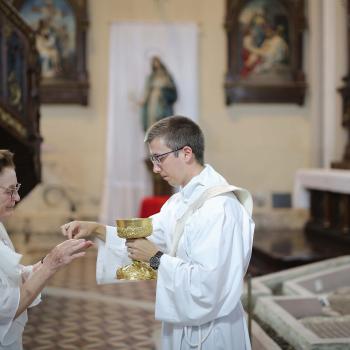
Learning from the Catholics' Worship Wars
TRENDING AT PATHEOS Evangelical

When Halloween Unmasks Married Hearts
Written by Dr. David K. Ewen from Eternal Truth Bible College Behind...

Aristotle. He’s been called the father of logic, the father of the...

Methodist Central Hall and Westminster Abbey
Situated on the same square is Methodist Central Hall and Westminster Abbey. ...

57th Dove Awards Honor Dolly Parton, Crown New...
On gospel music’s biggest night, the 57th annual GMA Dove Awards honored...

The First Eucharistic Controversy: Christ’s Real Presence
For Catholics, the Eucharist is the source and summit of the Christian...

What a Stop Sign Can Teach Us About...
How to Make a Decision When You Can't Hear God Main point:...
view all Evangelical blogs
What Are Your Thoughts?leave a comment
Ad-Free & Subscriber Log-In Subscription Support
- About Us
- 2026 Calendar
- Videos
- Podcasts
- Library of World Religions
- Faith In Media Tracker
- Advertise With Us
- Write for Us
- Privacy Policy
- Terms of Service
- Do Not Sell My Data
- Contact Us
- Radiant Digital
- Manage Newsletter Subscriptions
- Unsubscribe From Notifications
- Sitemap
Copyright 2008-2026, Patheos. All rights reserved.
Subscription Support Ad-Free & Subscriber Log-In
Follow Patheos