
BuddhistCatholicContemplativeEvangelicalGeneral ChristianHinduJewishLatter-day SaintMuslimNew VisionsProgressive Christian
Beliefs
- Buddhist
- Catholic
- Contemplative
- Evangelical
- General Christian
- Hindu
- Jewish
- Latter-day Saint
- More Voices
- Muslim
- New Visions
- Pagan
- Progressive Christian
Topics
- Religion News
- Food and Religion
- Sports and Religion
- Religious Art
- Religious Music and Entertainment
- Religious Events
- History and Religion
- Style and Religion
- Politics and Religion
- Women in Religion
- Recreation Outdoors and Religion
- Business Finance and Religion
- Careers Workplace and Religion
- Education and Religion
- Family Parenting and Religion
- Health Fitness and Religion
- Home and Religion
- Relationships and Religion
- Technology and Religion
- Travel and Religion
Columnists
- Buddhist Columnists
- Business Finance and Religion Columnists
- Careers Workplace and Religion Columnists
- Catholic Columnists
- Contemplative Columnists
- Education and Religion Columnists
- Evangelists Columnists
- Family Parenting and Religion Columnists
- General Christian Columnists
- Health Fitness and Religion Columnists
- Hindu Columnists
- History and Religion Columnists
- Home and Religion Columnists
- Jewish Columnists
- More Voices Columnists
- Latter Day Columnists
- Muslim Columnists
- New Visions Columnists
- Nonreligious Columnists
- Pagan Columnists
- Politics and Religion Columnists
- Progressive Columnists
- Recreation Outdoors and Religion Columnists
- Relationships and Religion Columnists
- Religion News Columnists
- Religious Art Columnists
- Religious Events Columnists
- Religious Music and Entertainment Columnists
- Sports and Religion Columnists
- Style and Religion Columnists
- Technology and Religion Columnists
- Travel and Religion Columnists
- Women in Religion Columnists
Resource Library
- 2026 Calendar
- Library of World Religions
- The 100 Most Holy Places on Earth
- Patheos Answers
- Podcasts
- Videos
- Faith Leaders Database
- Anglican Episcopalian
- Bahai
- Baptist
- Buddhism
- Christianity
- Confucianism
- Eastern Orthodoxy
- Hinduism
- Holiness and Pentecostal
- ISKCON
- Islam
- Judaism
- Lutheran
- Methodist
- The Church of Jesus Christ of Latter-day Saints
- New Age
- Paganism
- Presbytarian and Reformed
- Protestantism
- Religion Behind the Scenes
- Roman Catholic
- Scientology
- Shia Islam
- Sikhism
- Sufism
- Sunni Islam
- Taoism
- Zen
- See all religions
Research Tools
 Ad-Free & Subscriber Log-In Subscription Support
Ad-Free & Subscriber Log-In Subscription Support
Follow Patheos 

- Trending:
- Forgiveness
- |
- Marriage
- |
- Consciousness
- |
- Death Penalty
- |
- Election
- |
- Halloween
 Gathering Nectar
- Home
- Hindu
- Why prohibit onions and garlic?
Why prohibit onions and garlic?
Last updated on: February 4, 2015 at 7:46 am by Deepika Birks
Why prohibit onions and garlic? 2015-02-04T07:46:40-04:00 Deepika Birks
Patheos Explore the world's faith through different perspectives on religion and spirituality! Patheos has the views of the prevalent religions and spiritualities of the world.
Devotees of Vishnu don’t eat onions and garlic. Food they are allowed to eat is often called “vaishnav” food. Since they’re also not allowed to eat meat, a lot of people use “vaishnav” to mean “vegetarian.” This can lead to confusion. If a Hindu says they abstain from onions and garlic because they’re vegetarian, people will start arguing with them that those are plants and therefore totally vegetarian. This concept, vaishnav food, is more similar to kosher or halal. It means the food rules for the devout. A bacon cheeseburger, for example, is not kosher or halal or vaishnav.
The question I’ve always wondered is why.
I’ll be upfront here: I cook with onions and garlic all the time. Almost every time I go into the kitchen, I start the meal prep by chopping an onion and a few cloves a garlic. I have no intention of giving them up.
I’ve known people who’ve died from dengue fever, which is transmitted by mosquito bites. Though most of us don’t live in fear of malaria — we no longer have it in the US, and India has powerful medicine to combat it — according to the World Health Organization, more than 3.2 billion people are still at risk (about half the world population). One child under the age of five dies of malaria each minute, most of them in Africa. Diseases carried by mosquitoes kill 725,000 people a year, which is more deaths than those caused by all the things the news tells you to worry about combined.
What do dengue fever and malaria have to do with onions and garlic? Both diseases are deadly. Both are transmitted by mosquitoes. Garlic makes you unattractive to mosquitoes. Yes, eating garlic prevents more than vampire attacks: it wards off other bloodsucking killers.
Here’s my opinion, and you should know that it differs from that of most Hindus: I think garlic is our friend. It’s a plant that, when eaten, helps protect us from our deadliest threat. Garlic, to me, is sacred. You will not convince me that God doesn’t want people to eat garlic.
You can imagine that, since I disagree with a rule, that I’ve been more motivated than most to find out its origin.
- I’ve wondered if Krishna himself, in human form, didn’t personally like onions and garlic and that’s why food offered to him doesn’t contain it and therefore devotees, who offer all their food to him and eat the prasad, don’t cook with it.
- I’ve also wondered if it had to do with the smell: maybe priests don’t want you coming into the temple farting or burping and stinking up the air.
- I know that Jains don’t use onions and garlic because they rip up the ground when they’re harvested (Jain food centers on doing the least harm. They’ll eat an apple because it doesn’t kill the tree but refrain from eating potatoes, which kill the entire plant).
- One person explained to me that onions and garlic are often used to flavor meat, so if someone was abstaining from meat they would give them up. This made some sense to me and I remembered it as the most likely explanation.
The most common explanation I’ve heard is that onions and garlic increase desire. This always sounded absurd to me because everyone knows you can’t eat onions or garlic on a first date or before a job interview. They decrease desire — literally make you less desirable. Don’t they?
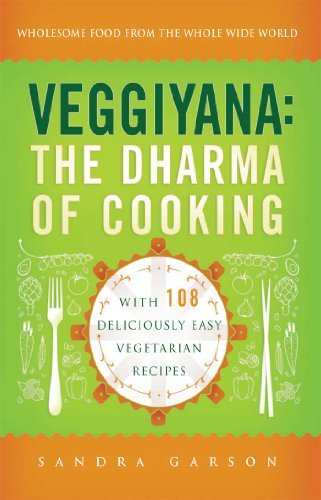 Last night I was reading a Buddhist cookbook called Veggiyana (as in veggie yana, the vegetarian path). It has 108 recipes, none of which I’ve tried, but it also has quotes and essays and is a great read.
There was an entire section about meat and why some Buddhists abstain while others (Tibetans, for example) eat a lot of it. Chinese Buddhists abstain from meat on certain days of the month but eat it on the others.
This part also talked about the prohibition on onions and garlic and it finally explained it in a way that made sense to me:
The fear of arousing a different hunger is another reason Chinese Buddhists decided a cook must abandon garlic, chives, onion, and leek. Because these have historically been the very ingredients Chinese cooks relied on in their quest for flavor, their tastiness was taken to be the cause of attraction to and craving for food.
That’s when I understood. I’d interpreted “desire” as lust. Garlic doesn’t increase lust. But “desire” meant gluttony. As in, “Aromatics make the food taste better and that’s why you eat too much.” This also ties in with the part about abstaining from meat: onions and garlic may increase the desire for meat since they’re often served with it. Just as tofu with barbecue sauce makes people say, “You know what this would be good with? Pulled pork!”
So now I know. The prohibition on onions and garlic is because they’re believed to cause, not sexual desire, but desire to overeat. Most people trying to eat a healthy diet already abstain from high-fructose corn syrup and MSG, but it should be noted that those are also known to contribute to food cravings. If you’re fasting or dieting or doing a cleanse, you may want to avoid those foods along with your own trigger foods. Unless you’re fasting while camping in a swampy area. Then I suggest as much garlic as possible (and maybe take a citronella candle and apply DEET to your skin).
Previous Post

January 7, 2015
The tyranny of unread books
Next Post
February 27, 2015 Is any diet truly sattvic?
Browse Our Archives
Select a Category Books Cultural Differences Food Holidays Issues in Hinduism Series Karma Movies Names of God News Ramayana Scripture Theology Yoga
Select a Month March 2015 February 2015 January 2015 December 2014 November 2014 October 2014 September 2014
Follow Us!
TAKE THE
Religious Wisdom Quiz
Jesus replied: "‘Love the Lord your God with all your heart and with all your soul and with all your mind.’ This is the first and greatest commandment. And the second is like it: ‘__________________’"
Select your answer to see how you score.
Do Not Kill Love Your Neighbor As Yourself Love Others Honor Your Father And Mother
Related posts from Gathering Nectar




Will the real Divine Mother please stand up?
TRENDING AT PATHEOS Hindu

Indian Hindu pilot’s valor in line of duty...
There is a hoary maritime tradition that the captain of the...

Movie on Neem Karoli Baba’s life is a...
Neem Karoli Baba’s life (1900-1973) is associated with miracles he made in...

20 Questions to Ask Before an Interfaith Marriage,...
Four questions every interfaith couple should discuss before marriage: Conversion. Will either...

Avadhānam: The Art of Concentration and Intellectual Mastery
What is Avadhānam? In the summer of 2015, during a three-day Sanskrit...

Jesus in the Dharma: Where Christ Fits in...
Where Does Jesus Fit in Hinduism? That’s a question I get often...

Hormuz: A Shared Hindu and Zoroastrian Heritage
Every evening, somewhere in the world, a newsreader utters the words: "The...
view all Hindu blogs
Ad-Free & Subscriber Log-In Subscription Support
- About Us
- 2026 Calendar
- Videos
- Podcasts
- Library of World Religions
- Faith In Media Tracker
- Advertise With Us
- Write for Us
- Privacy Policy
- Terms of Service
- Do Not Sell My Data
- Contact Us
- Radiant Digital
- Manage Newsletter Subscriptions
- Unsubscribe From Notifications
- Sitemap
Copyright 2008-2026, Patheos. All rights reserved.
Subscription Support Ad-Free & Subscriber Log-In
Follow Patheos