
BuddhistCatholicContemplativeEvangelicalGeneral ChristianHinduJewishLatter-day SaintMuslimNew VisionsProgressive Christian
Beliefs
- Buddhist
- Catholic
- Contemplative
- Evangelical
- General Christian
- Hindu
- Jewish
- Latter-day Saint
- More Voices
- Muslim
- New Visions
- Pagan
- Progressive Christian
Topics
- Religion News
- Food and Religion
- Sports and Religion
- Religious Art
- Religious Music and Entertainment
- Religious Events
- History and Religion
- Style and Religion
- Politics and Religion
- Women in Religion
- Recreation Outdoors and Religion
- Business Finance and Religion
- Careers Workplace and Religion
- Education and Religion
- Family Parenting and Religion
- Health Fitness and Religion
- Home and Religion
- Relationships and Religion
- Technology and Religion
- Travel and Religion
Columnists
- Buddhist Columnists
- Business Finance and Religion Columnists
- Careers Workplace and Religion Columnists
- Catholic Columnists
- Contemplative Columnists
- Education and Religion Columnists
- Evangelists Columnists
- Family Parenting and Religion Columnists
- General Christian Columnists
- Health Fitness and Religion Columnists
- Hindu Columnists
- History and Religion Columnists
- Home and Religion Columnists
- Jewish Columnists
- More Voices Columnists
- Latter Day Columnists
- Muslim Columnists
- New Visions Columnists
- Nonreligious Columnists
- Pagan Columnists
- Politics and Religion Columnists
- Progressive Columnists
- Recreation Outdoors and Religion Columnists
- Relationships and Religion Columnists
- Religion News Columnists
- Religious Art Columnists
- Religious Events Columnists
- Religious Music and Entertainment Columnists
- Sports and Religion Columnists
- Style and Religion Columnists
- Technology and Religion Columnists
- Travel and Religion Columnists
- Women in Religion Columnists
Resource Library
- 2026 Calendar
- Library of World Religions
- The 100 Most Holy Places on Earth
- Patheos Answers
- Podcasts
- Videos
- Faith Leaders Database
- Anglican Episcopalian
- Bahai
- Baptist
- Buddhism
- Christianity
- Confucianism
- Eastern Orthodoxy
- Hinduism
- Holiness and Pentecostal
- ISKCON
- Islam
- Judaism
- Lutheran
- Methodist
- The Church of Jesus Christ of Latter-day Saints
- New Age
- Paganism
- Presbytarian and Reformed
- Protestantism
- Religion Behind the Scenes
- Roman Catholic
- Scientology
- Shia Islam
- Sikhism
- Sufism
- Sunni Islam
- Taoism
- Zen
- See all religions
Research Tools
 Ad-Free & Subscriber Log-In Subscription Support
Ad-Free & Subscriber Log-In Subscription Support
Follow Patheos 

- Trending:
- Forgiveness
- |
- Marriage
- |
- Consciousness
- |
- Death Penalty
- |
- Election
- |
- Halloween
 Gathering Nectar
- Home
- Hindu
- Sikhs in the US Military
Sikhs in the US Military
Last updated on: November 14, 2014 at 9:41 am by Deepika Birks
Sikhs in the US Military 2014-11-14T09:41:50-04:00 Deepika Birks
Patheos Explore the world's faith through different perspectives on religion and spirituality! Patheos has the views of the prevalent religions and spiritualities of the world.
Yesterday morning I tweeted a news story from the Huffington Post about a Sikh who wants to join the ROTC but is being prevented from service because of his beard and long hair/turban. I commented that I was surprised at the attacks in the comments. A day later, it’s still on my mind. I know, one shouldn’t be surprised by attacks in the comments section of any internet site. But when all the comments were attacks, and when I was expecting this man to have some support, I was caught off-guard. I rarely agree with conservatives on anything, but they do have a point when they say that liberals are tolerant of anything unless it’s religion.
I’m not qualified to blog about Sikhism, but since Patheos doesn’t have any Sikh bloggers, I was afraid this story might not get covered.
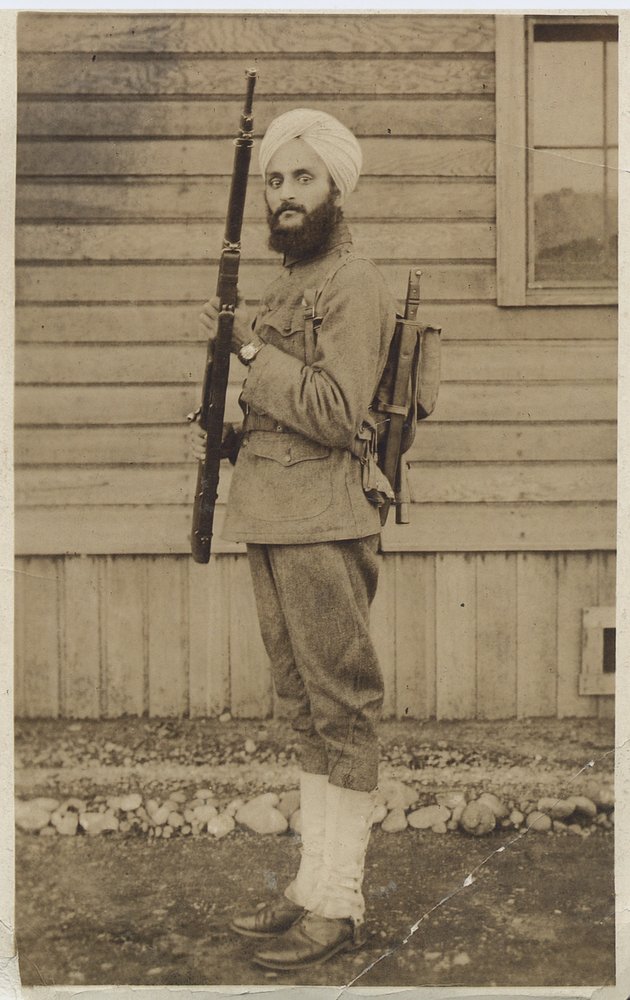
Bhagat Singh Thind, US Army
Sikhs have served in the US military for decades. In WWI, 138,000 Sikhs fought for the Allies. Prior to the 1980’s, there was no problem with Sikhs in the military keeping their beards. A 1986 beard ban has barred most Sikhs from serving in the last two decades. (The beard ban also means that Orthodox rabbis are barred from being chaplains).
What has happened in the decades since has been a series of lawsuits and the occasional Sikh being allowed exemptions. Here are a few articles about this ongoing conflict:
From the NY Times: Army Allows a Sikh Doctor to Serve Wearing a Turban
From the Army’s own website: Sikh Soldiers allowed to serve, retain their articles of faith
From the Times of India: Sikhs demand right to wear turban in US Army
From Time: Military Recruitment Rules Conflict With Sikh American’s Faith (This article is about Iknoor Singh, the author of the piece from the Huffington Post.)
From the ACLU’s website: ACLU, UNITED SIKHS File Suit after U.S. Army Bars Sikh Student from ROTC Due to Beard, Unshorn Hair, and Turban (This is also about Iknoor Singh)
From the Washington Times: Sikhs with long beards complain they can’t go in U.S. military
From NPR: Uniform Rule May Keep Religious Americans From Military Service
From the Washington Post: Pentagon clarifies rules on beards, turbans for Muslim and Sikh service members
According to the Pentagon, requests for such religious accommodation will still be decided on an individual basis but will generally be denied only if the item impairs the safe use of military equipment; poses a health or safety hazard; interferes with wearing a uniform, a helmet or other military gear; or “impairs the accomplishment of the military mission.”
The “expression of sincerely held beliefs” may not be used as the basis for “adverse personnel action” or discrimination, the new regulations state. They spell out “hair,” “grooming practices,” and “religious body art” such as tattoos or body piercings as eligible areas for religious accommodation.
As you can see, this is an ongoing legal battle. The Sikh Coalition has a page devoted to Sikhs in the US Military.
Again and again internet comments state that the reason Sikhs can’t have a beard and turban is because they won’t be able to wear a helmet and gas mask. In this opinion piece from On Faith, Let Sikh Americans Serve in the U.S. Military, author Simran Jeet Singh says:
One of the more common arguments is that Sikhs are unable to wear helmets and protective masks over their turbans and beards, and therefore, they bring unnecessary risk to themselves and their peers. This claim is outdated and patently untrue.
Sikhs have a long tradition of military service and have not had a problem placing helmets over their turbans and uncut hair. Moreover, it has been years since the military developed protective masks that safely protect people with facial hair. This argument may have been relevant in the early twentieth century when the policy was first implemented. At that time gas masks were unable to sufficiently protect soldiers with facial hair. However, this issue has been resolved and no longer justifies excluding Sikh Americans from military service.
Across the pond, we have another story.
From the Telegraph: Where would the British Army be without the Sikhs?
From the Times of India: British Parliament pays glowing tributes to Sikhs and Indian Army for WWI role (This article is from two days ago.)
From Winston Churchill:
“British people are highly indebted and obliged to Sikhs for a long time. I know that within this century we needed their help twice [in two world wars] and they did help us very well. As a result of their timely help, we are today able to live with honour, dignity, and independence. In the war, they fought and died for us, wearing the turbans.”
https://www.youtube.com/watch?v=EqrkCOOEnB4
One comment that stood out to me the most on the HuffPo article, the comment that made me decide to write about this topic, was this:
I have no sympathy for this guy, if you make a conscious decision to enter the Military, you also make a decision to abide by all its rules and head wear and facial hair are part of that. Period. Plus you religious conviction can’t be too strong if it centers on your hair cut
The sheer ignorance in that statement is one of the reasons I believe so strongly in the need for interfaith dialogue. This guy is assuming that since his own religious convictions don’t center on a haircut then no one’s should. Faith-must-look-like-mine-to-be-right syndrome. In fact, uncut hair is one of the articles of Sikh faith. From Wikipedia:
The five Ks (panj kakaar) are five articles of faith which all baptized Sikhs (Amritdhari Sikhs) are obliged to wear. The symbols represent the ideals of Sikhism: honesty, equality, fidelity, meditating on God and never bowing to tyranny.[42] The five symbols are:
- Kesh: Uncut hair, usually tied and wrapped in a Dastar
- Kanga: A wooden comb, usually worn under a Dastar
- Katchera: Cotton undergarments, historically appropriate in battle due to increased mobility when compared to a dhoti. Worn by both sexes, the katchera is a symbol of chastity.
- Kara: An iron bracelet, a weapon and a symbol of eternity
- Kirpan: An iron dagger in different sizes. In the UK Sikhs can wear a small dagger, but in the Punjab they might wear a traditional curved sword from one to three feet in length.
Anyone remember the story a few years back about a Sikh woman on the OSU campus here in Ohio? Someone snapped a photo of Balpreet Kaur, who has facial hair, and posted it on Reddit to ridicule her. This was her response:
Hey, guys. This is Balpreet Kaur, the girl from the picture. I actually didn’t know about this until one of my friends told on facebook. If the OP wanted a picture, they could have just asked and I could have smiled 🙂 However, I’m not embarrased or even humiliated by the attention [negative and positve] that this picture is getting because, it’s who I am. Yes, I’m a baptized Sikh woman with facial hair. Yes, I realize that my gender is often confused and I look different than most women. However, baptized Sikhs believe in the sacredness of this body – it is a gift that has been given to us by the Divine Being [which is genderless, actually] and, must keep it intact as a submission to the divine will. Just as a child doesn’t reject the gift of his/her parents, Sikhs do not reject the body that has been given to us. By crying ‘mine, mine’ and changing this body-tool, we are essentially living in ego and creating a seperateness between ourselves and the divinity within us. By transcending societal views of beauty, I believe that I can focus more on my actions. My attitude and thoughts and actions have more value in them than my body because I recognize that this body is just going to become ash in the end, so why fuss about it? When I die, no one is going to remember what I looked like, heck, my kids will forget my voice, and slowly, all physical memory will fade away. However, my impact and legacy will remain: and, by not focusing on the physical beauty, I have time to cultivate those inner virtues and hopefully, focus my life on creating change and progress for this world in any way I can. So, to me, my face isn’t important but the smile and the happiness that lie behind the face are. 🙂 So, if anyone sees me at OSU, please come up and say hello. I appreciate all of the comments here, both positive and less positive because I’ve gotten a better understanding of myself and others from this. Also, the yoga pants are quite comfortable and the Better Together tshirt is actually from Interfaith Youth Core, an organization that focuses on storytelling and engagement between different faiths. 🙂 I hope this explains everything a bit more, and I apologize for causing such confusion and uttering anything that hurt anyone.
The world needs more of Balpreet Kaur’s focus on cultivating virtue and leaving a legacy than “no sympathy for you” dude’s ignorance of other’s cultures and practices.
Previous Post

November 12, 2014
Minister of Yoga
Next Post
November 17, 2014 Wholehearted Living: Five-Minute Reflections for Modern Moms
Browse Our Archives
Select a Category Books Cultural Differences Food Holidays Issues in Hinduism Series Karma Movies Names of God News Ramayana Scripture Theology Yoga
Select a Month March 2015 February 2015 January 2015 December 2014 November 2014 October 2014 September 2014
Follow Us!
TAKE THE
Religious Wisdom Quiz
I gathered materials for the temple but was told my son would build it instead. Who am I?
Select your answer to see how you score.
Solomon Zadok Nathan David
Related posts from Gathering Nectar

What's the opposite of a white man?

What does it mean when Hindus touch someone's...
TRENDING AT PATHEOS Hindu

Indian Hindu pilot’s valor in line of duty...
There is a hoary maritime tradition that the captain of the...

Movie on Neem Karoli Baba’s life is a...
Neem Karoli Baba’s life (1900-1973) is associated with miracles he made in...

20 Questions to Ask Before an Interfaith Marriage,...
Four questions every interfaith couple should discuss before marriage: Conversion. Will either...

Avadhānam: The Art of Concentration and Intellectual Mastery
What is Avadhānam? In the summer of 2015, during a three-day Sanskrit...

Jesus in the Dharma: Where Christ Fits in...
Where Does Jesus Fit in Hinduism? That’s a question I get often...

Hormuz: A Shared Hindu and Zoroastrian Heritage
Every evening, somewhere in the world, a newsreader utters the words: "The...
view all Hindu blogs
Ad-Free & Subscriber Log-In Subscription Support
- About Us
- 2026 Calendar
- Videos
- Podcasts
- Library of World Religions
- Faith In Media Tracker
- Advertise With Us
- Write for Us
- Privacy Policy
- Terms of Service
- Do Not Sell My Data
- Contact Us
- Radiant Digital
- Manage Newsletter Subscriptions
- Unsubscribe From Notifications
- Sitemap
Copyright 2008-2026, Patheos. All rights reserved.
Subscription Support Ad-Free & Subscriber Log-In
Follow Patheos