
BuddhistCatholicContemplativeEvangelicalGeneral ChristianHinduJewishLatter-day SaintMuslimNew VisionsProgressive Christian
Beliefs
- Buddhist
- Catholic
- Contemplative
- Evangelical
- General Christian
- Hindu
- Jewish
- Latter-day Saint
- More Voices
- Muslim
- New Visions
- Pagan
- Progressive Christian
Topics
- Religion News
- Food and Religion
- Sports and Religion
- Religious Art
- Religious Music and Entertainment
- Religious Events
- History and Religion
- Style and Religion
- Politics and Religion
- Women in Religion
- Recreation Outdoors and Religion
- Business Finance and Religion
- Careers Workplace and Religion
- Education and Religion
- Family Parenting and Religion
- Health Fitness and Religion
- Home and Religion
- Relationships and Religion
- Technology and Religion
- Travel and Religion
Columnists
- Buddhist Columnists
- Business Finance and Religion Columnists
- Careers Workplace and Religion Columnists
- Catholic Columnists
- Contemplative Columnists
- Education and Religion Columnists
- Evangelists Columnists
- Family Parenting and Religion Columnists
- General Christian Columnists
- Health Fitness and Religion Columnists
- Hindu Columnists
- History and Religion Columnists
- Home and Religion Columnists
- Jewish Columnists
- More Voices Columnists
- Latter Day Columnists
- Muslim Columnists
- New Visions Columnists
- Nonreligious Columnists
- Pagan Columnists
- Politics and Religion Columnists
- Progressive Columnists
- Recreation Outdoors and Religion Columnists
- Relationships and Religion Columnists
- Religion News Columnists
- Religious Art Columnists
- Religious Events Columnists
- Religious Music and Entertainment Columnists
- Sports and Religion Columnists
- Style and Religion Columnists
- Technology and Religion Columnists
- Travel and Religion Columnists
- Women in Religion Columnists
Resource Library
- 2026 Calendar
- Library of World Religions
- The 100 Most Holy Places on Earth
- Patheos Answers
- Podcasts
- Videos
- Faith Leaders Database
- Anglican Episcopalian
- Bahai
- Baptist
- Buddhism
- Christianity
- Confucianism
- Eastern Orthodoxy
- Hinduism
- Holiness and Pentecostal
- ISKCON
- Islam
- Judaism
- Lutheran
- Methodist
- The Church of Jesus Christ of Latter-day Saints
- New Age
- Paganism
- Presbytarian and Reformed
- Protestantism
- Religion Behind the Scenes
- Roman Catholic
- Scientology
- Shia Islam
- Sikhism
- Sufism
- Sunni Islam
- Taoism
- Zen
- See all religions
Research Tools
 Ad-Free & Subscriber Log-In Subscription Support
Ad-Free & Subscriber Log-In Subscription Support
Follow Patheos 

- Trending:
- Forgiveness
- |
- Marriage
- |
- Consciousness
- |
- Death Penalty
- |
- Election
- |
- Halloween
 Gathering Nectar
- Home
- Hindu
- Meditation when we feel negative emotions
Meditation when we feel negative emotions
Last updated on: September 26, 2014 at 10:03 am by Deepika Birks
Meditation when we feel negative emotions 2014-09-26T10:03:19-04:00 Deepika Birks
Patheos Explore the world's faith through different perspectives on religion and spirituality! Patheos has the views of the prevalent religions and spiritualities of the world.
It’s easy to feel spiritual when things go our way. When we’re calm and content, we can imagine we’ve attained some grand mystical state. As soon as we lose our temper, the entire facade shatters.
I sit in meditation for a few minutes before bed, but I used to have nights when I felt I couldn’t. Maybe I’d just yelled at someone or I was feeling angry or upset. Whatever the reason, when I’d get these dark moods, I would feel unable to approach and sit before the altar, as though I wasn’t allowed to take my mood into that space.
A story from the Shiva Purana changed my practice profoundly. What follows is my own retelling from memory without looking at the text, so it’s filtered through the meaning it held for me:
Once upon a time there was a happily married couple who were unable to have children. The man was content with life the way it was, but his wife couldn’t stop wanting a child. She asked him to take a second wife and have a child. He was reluctant; their lives were good the way they were and perhaps a child was just not part of their destiny. His wife insisted that she’d only be happy if there was a child, so the husband took a second wife.
In time, the second wife had a son. He was raised to treat the first wife as his mother, and he did. He loved her and was a devoted son. But the first wife knew in her heart that he wasn’t really “her” son even though no one made her feel excluded. As the boy grew in strength and wisdom, her jealousy festered. Here was the perfect son, and he was not hers.
The son eventually took a wife, and the daughter-in-law moved into the household. She also treated the first wife like a mother and was devoted to her. This only fed the jealousy in the heart of the first wife: here was the perfect daughter-in-law, but she was not hers either.
Finally, one night when the daughter-in-law was menstruating (and therefore not sleeping in her husband’s bed), the first wife snuck into his room in the middle of the night and hacked the son to death with an ax. The entire room and the first wife were covered in blood when the sun rose.
What on earth is such a horrible story doing in a scripture? What can this tell us about how to live our lives?
The answer is that the first wife should have turned to Shiva when she was feeling these emotions. Our negative emotions, held inside, fester and become toxic. We can’t keep them in or they’ll destroy us. We can’t turn them outward or they’ll destroy those around us. What can we do but turn those emotions to Shiva?
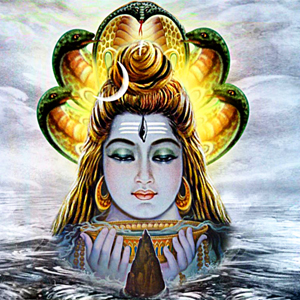 Shiva is called Nilakantha (“blue-throated”) because when the cosmic ocean was churned, a horrible poison arose that threatened to destroy the world. The only one who could save the world was Shiva, because only the Destroyer could swallow the poison and not be harmed. When poisonous emotions arise within us, we can turn to Shiva because our emotions can’t hurt him the way they can hurt us and the people in our lives.
Since the story in the Purana is a lesson, it ends with the first wife worshiping Shiva and the son being restored to life and everyone living happily ever after.
How has this story affected my own spiritual practice?
Now when I’m experiencing intense negative emotions, instead of thinking that I can’t approach the altar and sit in meditation because I’m so upset, I go immediately to the altar and sit. I may be too agitated to meditate, so I’ll just tell Shiva everything I feel. I won’t hold back and try to make myself sound like a better person. If I feel like I never want to forgive, then I’ll say so. No matter what I’m feeling, I simply pour it out to Shiva. Within minutes, a calm descends over me and the negative emotions are gone.
Here’s one thing I’ve learned: emotions are finite. When we’re feeling them, they feel infinite. We’re afraid they might go on forever so we pretend we aren’t feeling them at all. When we suppress them, we give them more power and they keep bubbling to the surface at unexpected times. But when we sit with our emotions and truly let ourselves feel (but not act on) them, they dissipate. They weren’t infinite after all, and once they’ve run their course, they’re gone forever. The more we do this, the less we’re tossed here and there by our emotions in the first place. Eventually we don’t need to avoid meditation when we’ve just yelled at someone because we’re starting to become the kind of person who rarely yells at people anymore.
In truth, you aren’t more spiritual when you’re happy and you haven’t suffered a setback when you’re angry. You start making progress when you keep up your spiritual practice whether you feel happy or angry or any other emotion. Emotions are fleeting and your true Self is beyond them. When the clouds of emotion pass and we feel profound peace, that’s when we start to catch a glimpse of who we really are.
Previous Post

September 25, 2014
Fat Karma
Next Post
September 29, 2014 We have a choice of two paths, Preya or Shreya
Browse Our Archives
Select a Category Books Cultural Differences Food Holidays Issues in Hinduism Series Karma Movies Names of God News Ramayana Scripture Theology Yoga
Select a Month March 2015 February 2015 January 2015 December 2014 November 2014 October 2014 September 2014
Follow Us!
TAKE THE
Religious Wisdom Quiz
Who led the animals onto the ark?
Select your answer to see how you score.
Jacob Isaac Moses Noah
Related posts from Gathering Nectar




Will the real Divine Mother please stand up?
TRENDING AT PATHEOS Hindu

Indian Hindu pilot’s valor in line of duty...
There is a hoary maritime tradition that the captain of the...

Movie on Neem Karoli Baba’s life is a...
Neem Karoli Baba’s life (1900-1973) is associated with miracles he made in...

20 Questions to Ask Before an Interfaith Marriage,...
Four questions every interfaith couple should discuss before marriage: Conversion. Will either...

Avadhānam: The Art of Concentration and Intellectual Mastery
What is Avadhānam? In the summer of 2015, during a three-day Sanskrit...

Jesus in the Dharma: Where Christ Fits in...
Where Does Jesus Fit in Hinduism? That’s a question I get often...

Hormuz: A Shared Hindu and Zoroastrian Heritage
Every evening, somewhere in the world, a newsreader utters the words: "The...
view all Hindu blogs
Ad-Free & Subscriber Log-In Subscription Support
- About Us
- 2026 Calendar
- Videos
- Podcasts
- Library of World Religions
- Faith In Media Tracker
- Advertise With Us
- Write for Us
- Privacy Policy
- Terms of Service
- Do Not Sell My Data
- Contact Us
- Radiant Digital
- Manage Newsletter Subscriptions
- Unsubscribe From Notifications
- Sitemap
Copyright 2008-2026, Patheos. All rights reserved.
Subscription Support Ad-Free & Subscriber Log-In
Follow Patheos