
BuddhistCatholicContemplativeEvangelicalGeneral ChristianHinduJewishLatter-day SaintMuslimNew VisionsProgressive Christian
Beliefs
- Buddhist
- Catholic
- Contemplative
- Evangelical
- General Christian
- Hindu
- Jewish
- Latter-day Saint
- More Voices
- Muslim
- New Visions
- Pagan
- Progressive Christian
Topics
- Religion News
- Food and Religion
- Sports and Religion
- Religious Art
- Religious Music and Entertainment
- Religious Events
- History and Religion
- Style and Religion
- Politics and Religion
- Women in Religion
- Recreation Outdoors and Religion
- Business Finance and Religion
- Careers Workplace and Religion
- Education and Religion
- Family Parenting and Religion
- Health Fitness and Religion
- Home and Religion
- Relationships and Religion
- Technology and Religion
- Travel and Religion
Columnists
- Buddhist Columnists
- Business Finance and Religion Columnists
- Careers Workplace and Religion Columnists
- Catholic Columnists
- Contemplative Columnists
- Education and Religion Columnists
- Evangelists Columnists
- Family Parenting and Religion Columnists
- General Christian Columnists
- Health Fitness and Religion Columnists
- Hindu Columnists
- History and Religion Columnists
- Home and Religion Columnists
- Jewish Columnists
- More Voices Columnists
- Latter Day Columnists
- Muslim Columnists
- New Visions Columnists
- Nonreligious Columnists
- Pagan Columnists
- Politics and Religion Columnists
- Progressive Columnists
- Recreation Outdoors and Religion Columnists
- Relationships and Religion Columnists
- Religion News Columnists
- Religious Art Columnists
- Religious Events Columnists
- Religious Music and Entertainment Columnists
- Sports and Religion Columnists
- Style and Religion Columnists
- Technology and Religion Columnists
- Travel and Religion Columnists
- Women in Religion Columnists
Resource Library
- 2026 Calendar
- Library of World Religions
- The 100 Most Holy Places on Earth
- Patheos Answers
- Podcasts
- Videos
- Faith Leaders Database
- Anglican Episcopalian
- Bahai
- Baptist
- Buddhism
- Christianity
- Confucianism
- Eastern Orthodoxy
- Hinduism
- Holiness and Pentecostal
- ISKCON
- Islam
- Judaism
- Lutheran
- Methodist
- The Church of Jesus Christ of Latter-day Saints
- New Age
- Paganism
- Presbytarian and Reformed
- Protestantism
- Religion Behind the Scenes
- Roman Catholic
- Scientology
- Shia Islam
- Sikhism
- Sufism
- Sunni Islam
- Taoism
- Zen
- See all religions
Research Tools
 Ad-Free & Subscriber Log-In Subscription Support
Ad-Free & Subscriber Log-In Subscription Support
Follow Patheos 

- Trending:
- Forgiveness
- |
- Marriage
- |
- Consciousness
- |
- Death Penalty
- |
- Election
- |
- Halloween
 Gathering Nectar
- Home
- Hindu
- Is pacifism passive?
Is pacifism passive?
Last updated on: September 20, 2014 at 8:38 am by Deepika Birks
Is pacifism passive? 2014-09-20T08:38:41-04:00 Deepika Birks
Patheos Explore the world's faith through different perspectives on religion and spirituality! Patheos has the views of the prevalent religions and spiritualities of the world.
I came across this sentence in a post about praying for our enemies on the Formerly Fundie blog here at Patheos:
This is precisely why the nonviolent teachings of Christ are anything but pacifism– they aren’t passive at all.
Is pacifism passive?
I think of Gandhi and his tireless satyagraha. Gandhi was anything but passive — he devoted his life to taking action day by day. Those actions didn’t involve him gunning anyone down, but he certainly didn’t stay at home thinking vaguely loving thoughts and hoping the British could feel his Care Bear stare and stop wanting to oppress India.
 When I was growing up, I considered myself a pacifist, which I thought meant believing that nations should never go to war and that people shouldn’t even own weapons. My sons, who have grown up in a nation at war, look at me in amazement when I tell them that when I was their ages, I honestly believed the world was moving toward peace and that we’d all learned so much from the wars of the 20th century that by the 21st century we’d be able to avoid conflict through negotiation and everyone would prosper and embrace each other.
I thought my naïve idealism was taught by Jesus and Krishna both, since Gandhi was famous for his admiration of the teachings of Jesus in the Sermon on the Mount and his daily devotion to the Bhagavad Gita, and since I had no real idea what Gandhi actually believed or practiced.
If you haven’t read the Gita, you might imagine, based on it being the guiding text of Gandhi’s life, that it teaches the principle of ahimsa (nonharming). It doesn’t.
In the opening chapter, Arjuna makes a clear case for sitting down on the battlefield and refusing to fight. I heard a speaker at the Krishna House say that if it ended there, we’d all be singing the Song of Arjuna, because he makes a pretty good argument. The first time I read the text, I finished that chapter thinking, “Yeah, you can’t argue with that.”
Then I turned to chapter two and Krishna tells him to get up and stop being weak.
Krishna didn’t praise Arjuna’s sudden tenderheartedness. Arjuna was a soldier who had spent more than a decade training for this very war. He hadn’t lived his life as a conscientious objector. For a well-trained soldier to decide on the battlefield that fighting is wrong is adharmic.
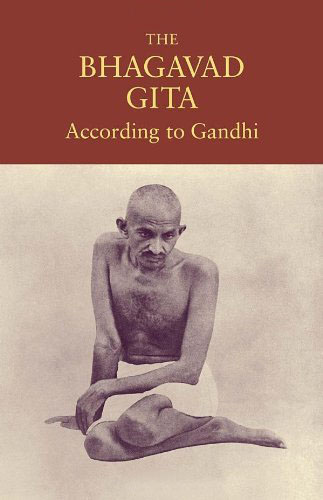
In The Bhagavad Gita According to Gandhi, Gandhi explains:
It is important to consider what Arjuna’s question was and what the circumstances were in which he raised it. Having got his chariot stationed between the two armies, he said he wanted to see who those men were against whom he would be fighting. His reason is, for the time being, clouded. He has lost his nerve. All that has come before shows that Arjuna is a great warrior and that, when starting out to fight, he does not hesitate and ask all manner of questions. In the past, he never hesitated even when he had to fight against relations. What is more, victory in the battle depends entirely on him. In their preparations for the battle during fourteen years’ exile, the other brothers always placed Arjuna at their head.
Let us suppose that Arjuna flees the battlefield. Though his enemies are wicked people, are sinners, they are his relations and he cannot bring himself to kill them. If he leaves the field, what would happen to those vast numbers on his side? If Arjuna went away, leaving them behind, would the Kauravas have mercy on them? No. If he left the battle, the Pandava army would be simply annihilated. What, then, would be the plight of their wives and children?
If Arjuna had left the battlefield, the very calamities which he feared would have befallen them. Their families would have been ruined, and the traditional dharma of these families and the race would have been destroyed. Arjuna, therefore, had no choice but to fight.
He goes on to say:
Even if we believe in nonviolence, it would not be proper for us to refuse, through cowardice, to protect the weak. If Arjuna…had been so filled with the spirit of nonviolence as to bring about a change of heart in Duryodhana, he would have been another Shri Krishna. Actually, however, he believed Duryodhana to be wicked. I might be ready to embrace a snake, but, if one comes to bite you, I should kill it and protect you.
Clearly the most famous pacifist of the last century didn’t believe in passive inaction. I don’t think the nonviolent teachings of Jesus should be contrasted with pacifism based on the misunderstanding that pacifism means slumping on the sofa and hoping the conflicts in the world go away.
Though the words sound similar when spoken, pacifism is not passivism. Pacifist comes from the same root as peace, and peacemaking is not passive. Speaking as the mother of sons, when I hear conflict start, I usually wish I could sit it out and let it blow over. Instead, it escalates. Actually pacifying the situation involves getting in there and making sure both sides communicate and both sides feel heard.
I bring up conflict between brothers because one of my sons thinks he’s a pacifist, but often loses his temper with his brother. He wants to know why nations can’t make peace with one another and I tell him that the same thing that makes him want to lash out at his brother makes nations want to lash out at each other.
Peace begins in the heart and until humans cultivate it there, there won’t be peace in the world.
I agree that the nonviolence taught by Jesus is not passive. The nonviolence taught by Gandhi wasn’t passive either. Pacifism is not the same thing as passiveness, and when we mistake the two, we’re actually making Arjuna’s error of thinking peace has something to do with weakness or cowardice. Krishna told him to stand up and face his problems head-on, which is the only way anything can ever be resolved.
Previous Post

September 18, 2014
Confused about English translations of the Bhagavad Gita?
Next Post
September 22, 2014 Dog Cat Monkey Theology
Browse Our Archives
Select a Category Books Cultural Differences Food Holidays Issues in Hinduism Series Karma Movies Names of God News Ramayana Scripture Theology Yoga
Select a Month March 2015 February 2015 January 2015 December 2014 November 2014 October 2014 September 2014
Follow Us!
TAKE THE
Religious Wisdom Quiz
Who was David's military commander and nephew?
Select your answer to see how you score.
Benaiah Abishai Ittai Joab
Related posts from Gathering Nectar




Will the real Divine Mother please stand up?
TRENDING AT PATHEOS Hindu

Indian Hindu pilot’s valor in line of duty...
There is a hoary maritime tradition that the captain of the...

Movie on Neem Karoli Baba’s life is a...
Neem Karoli Baba’s life (1900-1973) is associated with miracles he made in...

20 Questions to Ask Before an Interfaith Marriage,...
Four questions every interfaith couple should discuss before marriage: Conversion. Will either...

Avadhānam: The Art of Concentration and Intellectual Mastery
What is Avadhānam? In the summer of 2015, during a three-day Sanskrit...

Jesus in the Dharma: Where Christ Fits in...
Where Does Jesus Fit in Hinduism? That’s a question I get often...

Hormuz: A Shared Hindu and Zoroastrian Heritage
Every evening, somewhere in the world, a newsreader utters the words: "The...
view all Hindu blogs
Ad-Free & Subscriber Log-In Subscription Support
- About Us
- 2026 Calendar
- Videos
- Podcasts
- Library of World Religions
- Faith In Media Tracker
- Advertise With Us
- Write for Us
- Privacy Policy
- Terms of Service
- Do Not Sell My Data
- Contact Us
- Radiant Digital
- Manage Newsletter Subscriptions
- Unsubscribe From Notifications
- Sitemap
Copyright 2008-2026, Patheos. All rights reserved.
Subscription Support Ad-Free & Subscriber Log-In
Follow Patheos