
BuddhistCatholicContemplativeEvangelicalGeneral ChristianHinduJewishLatter-day SaintMuslimNew VisionsProgressive Christian
Beliefs
- Buddhist
- Catholic
- Contemplative
- Evangelical
- General Christian
- Hindu
- Jewish
- Latter-day Saint
- More Voices
- Muslim
- New Visions
- Pagan
- Progressive Christian
Topics
- Religion News
- Food and Religion
- Sports and Religion
- Religious Art
- Religious Music and Entertainment
- Religious Events
- History and Religion
- Style and Religion
- Politics and Religion
- Women in Religion
- Recreation Outdoors and Religion
- Business Finance and Religion
- Careers Workplace and Religion
- Education and Religion
- Family Parenting and Religion
- Health Fitness and Religion
- Home and Religion
- Relationships and Religion
- Technology and Religion
- Travel and Religion
Columnists
- Buddhist Columnists
- Business Finance and Religion Columnists
- Careers Workplace and Religion Columnists
- Catholic Columnists
- Contemplative Columnists
- Education and Religion Columnists
- Evangelists Columnists
- Family Parenting and Religion Columnists
- General Christian Columnists
- Health Fitness and Religion Columnists
- Hindu Columnists
- History and Religion Columnists
- Home and Religion Columnists
- Jewish Columnists
- More Voices Columnists
- Latter Day Columnists
- Muslim Columnists
- New Visions Columnists
- Nonreligious Columnists
- Pagan Columnists
- Politics and Religion Columnists
- Progressive Columnists
- Recreation Outdoors and Religion Columnists
- Relationships and Religion Columnists
- Religion News Columnists
- Religious Art Columnists
- Religious Events Columnists
- Religious Music and Entertainment Columnists
- Sports and Religion Columnists
- Style and Religion Columnists
- Technology and Religion Columnists
- Travel and Religion Columnists
- Women in Religion Columnists
Resource Library
- 2026 Calendar
- Library of World Religions
- The 100 Most Holy Places on Earth
- Patheos Answers
- Podcasts
- Videos
- Faith Leaders Database
- Anglican Episcopalian
- Bahai
- Baptist
- Buddhism
- Christianity
- Confucianism
- Eastern Orthodoxy
- Hinduism
- Holiness and Pentecostal
- ISKCON
- Islam
- Judaism
- Lutheran
- Methodist
- The Church of Jesus Christ of Latter-day Saints
- New Age
- Paganism
- Presbytarian and Reformed
- Protestantism
- Religion Behind the Scenes
- Roman Catholic
- Scientology
- Shia Islam
- Sikhism
- Sufism
- Sunni Islam
- Taoism
- Zen
- See all religions
Research Tools
 Ad-Free & Subscriber Log-In Subscription Support
Ad-Free & Subscriber Log-In Subscription Support
Follow Patheos 

- Trending:
- Forgiveness
- |
- Marriage
- |
- Consciousness
- |
- Death Penalty
- |
- Election
- |
- Halloween
 Gathering Nectar
- Home
- Hindu
- Hindus believe in eternal souls — but Christians don’t!
Hindus believe in eternal souls — but Christians don’t!
Last updated on: September 12, 2014 at 10:35 am by Deepika Birks
Hindus believe in eternal souls — but Christians don’t! 2014-09-12T10:35:02-04:00 Deepika Birks
Patheos Explore the world's faith through different perspectives on religion and spirituality! Patheos has the views of the prevalent religions and spiritualities of the world.
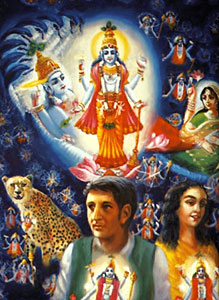
Concept art depicting the atma’s oneness with Paramatma.
One of the fundamental beliefs of Hinduism is that your eternal soul is One with God. It’s important to note that your eternal soul isn’t the same thing as your personality. An adult has the same soul s/he had as a child, even though the child hated spinach and the adult now loves spinach. Your soul is the part of you that doesn’t change when you start listening to a new style of music or learn a foreign language or give up drinking.
I think a common belief about Christianity is that, like Hinduism, it teaches that you have an eternal soul, but unlike Hinduism there is no reincarnation — only an eternity in heaven or hell. Not so.
Turns out, Christianity doesn’t actually teach that we have eternal souls! The first time I learned this was in a book I was reading six or seven years ago called Good Eating, which is about fasting, vegetarianism, and animal rights — basically, a theology of animals and our relationship to them as well as a spiritual discussion of food. The author, Stephen H. Webb, is a theologian and was a Professor of Religion and Philosophy at Wabash College until 2012. One reason people practice vegetarianism is that they believe animals have souls, but Webb points out that Christians don’t even believe humans have souls.
In chapter seven, “Will All Good Dogs Go to Heaven?”, he says (page 172):
One of the most striking and distinctive Christian beliefs is the resurrection of the body. The ancient Greeks believed in something very different from this, namely, the immortality of the soul. They defined the soul as that which is self-moving. The soul does not move due to any external cause. Since the soul has the essence of motion within itself, it is immortal, having no beginning and no end. The soul thus precedes and outlives the body, which is but a temporary home for that which never decays or changes.
This is a beautiful portrait of the soul, and many people are inspired by it to this day, but it is hardly Christian. The idea of an immortal soul puts a limit on God’s power and grace. It is as if the soul is a necessary precondition or prerequisite for the idea of heaven. We have an afterlife because that which is in us never really dies; we are immortal. Christians believe that humans are not comprised of eternal souls that are only temporarily visiting our bodies. Our bodies are not transitional soul homes that can be demolished once the occupant departs for heaven. Instead, heaven restores us completely, so that our very physical existence matters to God.
I was most struck by his statement that a soul puts a limit on God’s power and grace. I just can’t wrap my head around this concept.
He goes on to say:
God does not create souls and then plant them into bodies, using the flesh as a container that can be discarded when it has served its function. God creates material beings who can think, feel, suffer, and worship. In all creatures flows the breath of God’s invigorating spirit…God gives life, God can take life away, and God will restore all life in the end. Death is real and final, yet God conquers death as demonstrated by the resurrection of God’s son, Jesus Christ.
So in this sense, Christianity is as materialist as atheism.
Then on page 173, he says:
The idea that the soul is eternal is a pagan idea because it assumes that something in us will live forever regardless of God’s sustaining activity. The Christian idea is that the afterlife, just as with this life, is a gift of God’s grace.
He then directly contradicts what Krishna says in chapter two of the Bhagavad Gita — without referencing the Gita itself — (Bhagavad Gita 2.22 “As a man abandons worn-out clothes and acquires new ones, so when the body is worn out a new one is acquired by the Self, who lives within.”) by saying:
We cannot imagine ourselves as bodiless souls, wrapped in flesh which can be peeled off like a winter coat and left at the door of death. If there is an afterlife, it must involve who we are in terms of our most embodied experiences.
Another thing that strikes me is that, while souls would apparently limit God’s power in some way, the author confidently asserts, “If there is an afterlife, it must involve…” as though telling God what the afterlife must involve doesn’t limit God’s power.
I know that in Christian pop theology, Grandma’s “in heaven with Jesus,” but correct Christian theology is that Grandma’s decaying in the ground and Jesus will eventually restore her body. This must be why Christians preserve (to the best of their abilities) the body and bury it, rather than cremating. When Christians recite in the Apostle’s Creed that they believe in “the resurrection of the body” it really does mean that they believe the very body they inhabit now will come back to life. Contrast this with Hindu belief that this body will be discarded, as will the bodies that come after it, and that heavenly existence is Oneness with God that does not require a body.
Ironically, I had already drafted this post, but was nervous about it. I mean, obviously Christians believe in eternal souls. Don’t they? Then I happened upon a post at the Catholic Channel here at Patheos that answered my question: FACT: Christians DON’T Believe in the Immortality of the Soul. So there you have it. A key difference between Hindu and Christian thought is whether your soul is eternal and whether you’ll need this body back for the afterlife.
Previous Post

September 11, 2014
God the Soccer Mom
Next Post
September 13, 2014 Upcoming Holiday: Navratri
Browse Our Archives
Select a Category Books Cultural Differences Food Holidays Issues in Hinduism Series Karma Movies Names of God News Ramayana Scripture Theology Yoga
Select a Month March 2015 February 2015 January 2015 December 2014 November 2014 October 2014 September 2014
Follow Us!
TAKE THE
Religious Wisdom Quiz
What practice did Ezra enforce upon discovering intermarriage with pagans?
Select your answer to see how you score.
Worship at home Fast for months Ignore the issue Divorce foreign wives
Related posts from Gathering Nectar




Will the real Divine Mother please stand up?
TRENDING AT PATHEOS Hindu

Indian Hindu pilot’s valor in line of duty...
There is a hoary maritime tradition that the captain of the...

Movie on Neem Karoli Baba’s life is a...
Neem Karoli Baba’s life (1900-1973) is associated with miracles he made in...

20 Questions to Ask Before an Interfaith Marriage,...
Four questions every interfaith couple should discuss before marriage: Conversion. Will either...

Avadhānam: The Art of Concentration and Intellectual Mastery
What is Avadhānam? In the summer of 2015, during a three-day Sanskrit...

Jesus in the Dharma: Where Christ Fits in...
Where Does Jesus Fit in Hinduism? That’s a question I get often...

Hormuz: A Shared Hindu and Zoroastrian Heritage
Every evening, somewhere in the world, a newsreader utters the words: "The...
view all Hindu blogs
Ad-Free & Subscriber Log-In Subscription Support
- About Us
- 2026 Calendar
- Videos
- Podcasts
- Library of World Religions
- Faith In Media Tracker
- Advertise With Us
- Write for Us
- Privacy Policy
- Terms of Service
- Do Not Sell My Data
- Contact Us
- Radiant Digital
- Manage Newsletter Subscriptions
- Unsubscribe From Notifications
- Sitemap
Copyright 2008-2026, Patheos. All rights reserved.
Subscription Support Ad-Free & Subscriber Log-In
Follow Patheos