
BuddhistCatholicContemplativeEvangelicalGeneral ChristianHinduJewishLatter-day SaintMuslimNew VisionsProgressive Christian
Beliefs
- Buddhist
- Catholic
- Contemplative
- Evangelical
- General Christian
- Hindu
- Jewish
- Latter-day Saint
- More Voices
- Muslim
- New Visions
- Pagan
- Progressive Christian
Topics
- Religion News
- Food and Religion
- Sports and Religion
- Religious Art
- Religious Music and Entertainment
- Religious Events
- History and Religion
- Style and Religion
- Politics and Religion
- Women in Religion
- Recreation Outdoors and Religion
- Business Finance and Religion
- Careers Workplace and Religion
- Education and Religion
- Family Parenting and Religion
- Health Fitness and Religion
- Home and Religion
- Relationships and Religion
- Technology and Religion
- Travel and Religion
Columnists
- Buddhist Columnists
- Business Finance and Religion Columnists
- Careers Workplace and Religion Columnists
- Catholic Columnists
- Contemplative Columnists
- Education and Religion Columnists
- Evangelists Columnists
- Family Parenting and Religion Columnists
- General Christian Columnists
- Health Fitness and Religion Columnists
- Hindu Columnists
- History and Religion Columnists
- Home and Religion Columnists
- Jewish Columnists
- More Voices Columnists
- Latter Day Columnists
- Muslim Columnists
- New Visions Columnists
- Nonreligious Columnists
- Pagan Columnists
- Politics and Religion Columnists
- Progressive Columnists
- Recreation Outdoors and Religion Columnists
- Relationships and Religion Columnists
- Religion News Columnists
- Religious Art Columnists
- Religious Events Columnists
- Religious Music and Entertainment Columnists
- Sports and Religion Columnists
- Style and Religion Columnists
- Technology and Religion Columnists
- Travel and Religion Columnists
- Women in Religion Columnists
Resource Library
- 2026 Calendar
- Library of World Religions
- The 100 Most Holy Places on Earth
- Patheos Answers
- Podcasts
- Videos
- Faith Leaders Database
- Anglican Episcopalian
- Bahai
- Baptist
- Buddhism
- Christianity
- Confucianism
- Eastern Orthodoxy
- Hinduism
- Holiness and Pentecostal
- ISKCON
- Islam
- Judaism
- Lutheran
- Methodist
- The Church of Jesus Christ of Latter-day Saints
- New Age
- Paganism
- Presbytarian and Reformed
- Protestantism
- Religion Behind the Scenes
- Roman Catholic
- Scientology
- Shia Islam
- Sikhism
- Sufism
- Sunni Islam
- Taoism
- Zen
- See all religions
Research Tools
 Ad-Free & Subscriber Log-In Subscription Support
Ad-Free & Subscriber Log-In Subscription Support
Follow Patheos 

- Trending:
- Forgiveness
- |
- Marriage
- |
- Consciousness
- |
- Death Penalty
- |
- Election
- |
- Halloween
 The Fuller Blog
- Home
- Evangelical - Sponsored
- I’m Not Dead Yet!
I’m Not Dead Yet!
Last updated on: March 6, 2015 at 11:55 am by Guest Contributor
I’m Not Dead Yet! 2015-03-06T11:55:19-07:00 Guest Contributor
Patheos Explore the world's faith through different perspectives on religion and spirituality! Patheos has the views of the prevalent religions and spiritualities of the world.
By Rachel Paprocki
The 1975 pseudo-religious adventure comedy Monty Python and the Holy Grail, which I suspect and hope got most of us fumbling theology fans through the doldrums of middle school with its irreverent humor, sheds light on an uncomfortable thought I’ve been working on for some time: I don’t actually know everything, and neither do any of the people around me.
The scene is this: trouncing around medieval Europe, the cast of the Flying Circus finds itself in a world where the bodies of Plague victims are brought out to the curb for collection via wheelbarrow by Eric Idle, whether or not they properly belong there. One particularly resilient victim insists on not being dead yet: “I’m not dead yet. I’m gettin’ bettah!” he cries, flung over the shoulder of a family member clearly ready to be rid of him, whatever his state of convalescence. “I feel quite happy, I think I’ll go for a walk!” His arguments not convincing enough, his countrymen too used to people just up and dying, this poor chap is met with a blow to the head and a spot on the cart among his dead fellows.
The moral of the story (other than don’t get the Plague on the set of a Monty Python movie) is that when some conclusion is reached before its time (often all too easily—we’re in the habit of it), no one thinks to do anything else other than to go along with the status quo. We like to decide what things are and what they mean. If only there was some enlightened voice to help us mortal conclusion-reachers put on the brakes! I hope it is not too much of a reach to look to Monty Python for theological guidance along these lines: I identify now with the resilient plague victim; formerly, with his embittered kin. 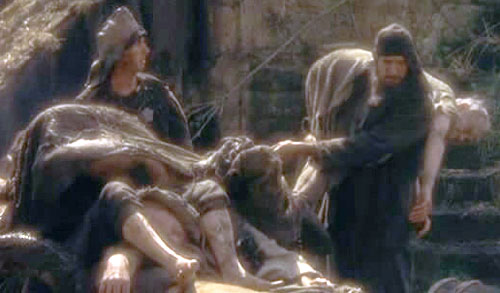
When I was in the shiny-happy stage of my Christian faith, between the ages of 18 and 21, I was more than happy to tell my classmates, mentees, roommates, and self that I had been cured of all the ills of depressive sadness and didn’t fear or ever anticipate their return, because I was confident I’d been redeemed and had always been taught that redemption is a forever-type thing. I’d determined the meaning (there could only be one of those or so) God had laid out for me to find, and I’d parade it around as testimony. To think otherwise was unreasonable, unfaithful. Then in the years immediately following that phase, when I was in the throes of major depression, I couldn’t even recall to my therapist what it was like to wake up in the morning in a neutral mood, let alone to consider hope in the future. Reality, I was certain, was unredeemed and forever-bad. Conceiving anything else was impossible, too painful.
These two opposite kinds of certainty are equally unhealthy. They’re also fairly impractical. I had not, in fact, solved all the mysteries of the world at age 20. Neither had I any idea about the nature of reality at 25. Too eager to draw conclusions about what my life and what my life with God meant, I had misestimated redemption. Now, actually, I think that if there is redemption, it has already happened, is happening now, and will also not be finished happening until some point in the future.
Not only am I not dead yet (instead with very much interest in feeling quite happy and wanting to go for a walk), but I’m also relatively certain that the rest of you are not yet dead, as well. None of us has finished living. More than a statement of the obvious, this is a theological truth that I recommend for your meditation queue.
Fortunately or unfortunately, having life (especially the having-it-to-the-full part) means that we have to (get to?) live. On the earth. In the real world. Today. Now (and also tomorrow, with enough worries of its own, still likely to catch us unawares). This means that, regardless of our beliefs on the existence of souls or the afterlife, as long as we assent Jesus’ statement that God was and is a part of human existence for our sakes, we also consent to participate in a state of constant flux. We might say that we know where we’re going, but the only thing we can say with certainty about that is we have no idea how it’s going to happen. Admitting that we’re not dead yet means acknowledging that we’ll die another way, by some other life circumstance, one that we don’t know. And perhaps that whatever redemption there is will precede, lead, and follow us.
Is this a problem? It might be, if we prefer to believe that we know what Divine promises are and how and when they will be fulfilled. And it certainly causes discomfort, though probably less so than being totally wrong in one way and then Gestalt-shifting to being totally wrong in another. Living with mystery (and God is one of those) means admitting (among many other things) that mental illness might come back, or that things might get much better. Both of those are pretty awful; both are better than winding up on the Plague cart, story curtailed. We are neither our illnesses nor their cures. We are creatures, acting and being acted upon, and I’d much rather enjoy that than pretend to understand it. Better to be interested in and to attempt forward motion than to throw hands up and pretend to be defeated.
How might we allow ourselves to be infinitely more open to being alive when we quit preemptively deciding that we know what’s up with the meaning of things? I have not yet gotten the corner on how to practice this open-hands style of living or of having faith, but I’ll report back when I have more than a suggestion. Now in the meantime, I am happy to admit that I’m not dead yet. I think I’ve done away with (at least temporarily) the part of myself that wants to pretend that my life means one thing or another, putting myself on the proverbial wheelbarrow. Someday, I’ll let you know what this was all about*.* But I must also offer the spoiler alert that that will happen when I am dead, and not a moment sooner.
Rachel Paprocki survived being raised in Murrieta, CA by knitting and reading voraciously. An alumna of Pepperdine University (BA, 2010) and Fuller Theological Seminary (MA, 2014), she has earned her keep with a year-long stint teaching English in northeastern China and then by making coffee in the greater Los Angeles area, which she traverses by bicycle. She is the managing editor of the the Fuller Writing Center.
You can follow Fuller Seminary on Twitter at @fullerseminary.
Previous Post

March 4, 2015
Should We Talk About How We 'Do Theology?'
Next Post
March 9, 2015 Conversion and Discipleship
Browse Our Archives
Select a Category Abuse and Recovery Art and Faith Biblical Interpretation Church History Community Life Cultural Engagement Fuller Forum Interfaith Dialogue Leadership Ministry Missiology Psychology Spirituality Theology Uncategorized
Select a Month June 2018 May 2018 April 2018 March 2018 February 2018 December 2017 November 2017 September 2017 August 2017 July 2017 June 2017 April 2017 March 2017 February 2017 January 2017 November 2016 October 2016 April 2016 March 2016 February 2016 January 2016 December 2015 November 2015 October 2015 September 2015 August 2015 July 2015 June 2015 May 2015 April 2015 March 2015 February 2015 January 2015 December 2014 September 2014
Follow Us!
TAKE THE
Religious Wisdom Quiz
True or False: All Scripture is God-breathed and is useful for teaching, rebuking, correcting and training in righteousness.
Select your answer to see how you score.
TRUE FALSE
Related posts from The Fuller Blog


Conversing: Willie Jennings on Race

A Conversation With Martin Scorsese on Faith and...

11 Sayings of Bono on the Psalms
TRENDING AT PATHEOS Evangelical - Sponsored

The REST of Your Life: A Creative Wrestles...
This week I had a conversation with a good friend from church....

How the author of the world's best hymn...
I've been working with John Newton for a while now. This makes...

Long before this Lectio Divina, Psalm 130 - the song - started...

What About the Trees? Another Living Parable
After I finished writing the last article about falling leaves as a...

Why Classical Education Is a Conversation, Not a...
Come and Read: Joy in Classical Education When I was a little...

Cornell University has received a great deal of negative publicity and intense...
view all Evangelical - Sponsored blogs
Ad-Free & Subscriber Log-In Subscription Support
- About Us
- 2026 Calendar
- Videos
- Podcasts
- Library of World Religions
- Faith In Media Tracker
- Advertise With Us
- Write for Us
- Privacy Policy
- Terms of Service
- Do Not Sell My Data
- Contact Us
- Radiant Digital
- Manage Newsletter Subscriptions
- Unsubscribe From Notifications
- Sitemap
Copyright 2008-2026, Patheos. All rights reserved.
Subscription Support Ad-Free & Subscriber Log-In
Follow Patheos