
BuddhistCatholicContemplativeEvangelicalGeneral ChristianHinduJewishLatter-day SaintMuslimNew VisionsProgressive Christian
Beliefs
- Buddhist
- Catholic
- Contemplative
- Evangelical
- General Christian
- Hindu
- Jewish
- Latter-day Saint
- More Voices
- Muslim
- New Visions
- Pagan
- Progressive Christian
Topics
- Religion News
- Food and Religion
- Sports and Religion
- Religious Art
- Religious Music and Entertainment
- Religious Events
- History and Religion
- Style and Religion
- Politics and Religion
- Women in Religion
- Recreation Outdoors and Religion
- Business Finance and Religion
- Careers Workplace and Religion
- Education and Religion
- Family Parenting and Religion
- Health Fitness and Religion
- Home and Religion
- Relationships and Religion
- Technology and Religion
- Travel and Religion
Columnists
- Buddhist Columnists
- Business Finance and Religion Columnists
- Careers Workplace and Religion Columnists
- Catholic Columnists
- Contemplative Columnists
- Education and Religion Columnists
- Evangelists Columnists
- Family Parenting and Religion Columnists
- General Christian Columnists
- Health Fitness and Religion Columnists
- Hindu Columnists
- History and Religion Columnists
- Home and Religion Columnists
- Jewish Columnists
- More Voices Columnists
- Latter Day Columnists
- Muslim Columnists
- New Visions Columnists
- Nonreligious Columnists
- Pagan Columnists
- Politics and Religion Columnists
- Progressive Columnists
- Recreation Outdoors and Religion Columnists
- Relationships and Religion Columnists
- Religion News Columnists
- Religious Art Columnists
- Religious Events Columnists
- Religious Music and Entertainment Columnists
- Sports and Religion Columnists
- Style and Religion Columnists
- Technology and Religion Columnists
- Travel and Religion Columnists
- Women in Religion Columnists
Resource Library
- 2026 Calendar
- Library of World Religions
- The 100 Most Holy Places on Earth
- Patheos Answers
- Podcasts
- Videos
- Faith Leaders Database
- Anglican Episcopalian
- Bahai
- Baptist
- Buddhism
- Christianity
- Confucianism
- Eastern Orthodoxy
- Hinduism
- Holiness and Pentecostal
- ISKCON
- Islam
- Judaism
- Lutheran
- Methodist
- The Church of Jesus Christ of Latter-day Saints
- New Age
- Paganism
- Presbytarian and Reformed
- Protestantism
- Religion Behind the Scenes
- Roman Catholic
- Scientology
- Shia Islam
- Sikhism
- Sufism
- Sunni Islam
- Taoism
- Zen
- See all religions
Research Tools
 Ad-Free & Subscriber Log-In Subscription Support
Ad-Free & Subscriber Log-In Subscription Support
Follow Patheos 

- Trending:
- Forgiveness
- |
- Marriage
- |
- Consciousness
- |
- Death Penalty
- |
- Election
- |
- Halloween
 The Fuller Blog
- Home
- Evangelical - Sponsored
- Conversion and Discipleship
Conversion and Discipleship
Last updated on: March 9, 2015 at 8:14 am by Guest Contributor
Conversion and Discipleship 2015-03-09T08:14:53-07:00 Guest Contributor
Patheos Explore the world's faith through different perspectives on religion and spirituality! Patheos has the views of the prevalent religions and spiritualities of the world.
By Dr. Kurt Fredrickson
Following Jesus is more of a journey than it is a point in time. Richard Peace in his excellent book Conversion in the New Testament: Paul and the Twelve reminds us that conversion happens in a variety of ways. Some come to faith in an instant–a Damascus Road experience as in the life of Paul (Acts 9). Others come to faith over time, a process, which finally leads to an awareness of “Yes! I am a follower of Jesus Christ.” Sometimes that awareness dawns by looking backwards. Whether suddenly or over time, something happens to a person when they confess Jesus Christ as Lord–they are changed from the inside out. And this process of change, becoming a new creation, is lived out over a lifetime.
We can talk about conversion and discipleship from a variety of perspectives. Here are two:
- The revivalist stream asks the question–When did you become a Christian?
- The pietistic stream asks: Are you still walking with Jesus?
The first stream looks back–when was the moment when you became a Christian; when did you say the prayer; when did you answer the altar-call? The second stream is more concerned with today, this moment–are you alive in Jesus now; are you seeking to be his follower now; are you abiding in him; who is Jesus Christ for you today (Bonhoeffer)? Early Pietists asked this question of each other on a regular basis: Are you living yet in Jesus? It is a call to ongoing discipleship.
Two questions: when were you saved; Are you alive in Jesus? The harder question to ask is the second. Conversion is not just a past event. It is an ongoing journey. We become new people, changed people in Christ. But we live that out over a lifetime. Conversion is not a contained event; it is instead inseparable from discipleship.
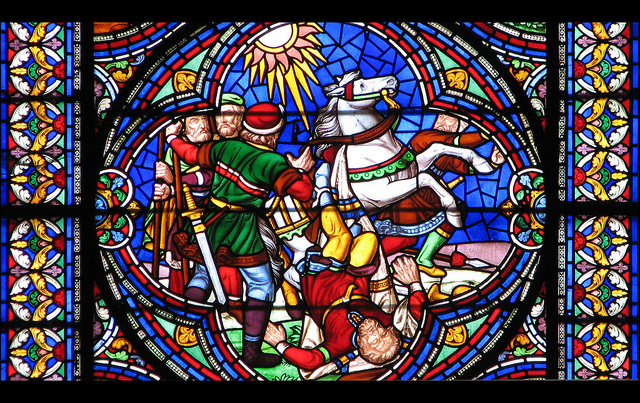
Conversion of St. Paul, in the Ely Cathedral. Photo by Lawrence OP. Flickr Commons.
There is a danger if we emphasize the past event too strongly and forget the ongoing process. In its extreme, we foster what John Wesley saw: “the church is full of almost Christians who have not gone all the way with Christ.” Or what George Whitefield described as “an almost Christian.”
Eugene Peterson says that the journey of discipleship is a long obedience in the same direction. It is the path all followers are called to; this is the path that starts at conversion. I understand discipleship best as a practice that focuses on being relational, intentional and in the ordinary. The model is described in Deuteronomy 6:4-9:
Hear, O Israel: The LORD our God, the LORD is one. Love the LORD your God with all your heart and with all your soul and with all your strength. These commandments that I give you today are to be on your hearts. Impress them on your children. Talk about them when you sit at home and when you walk along the road, when you lie down and when you get up. Tie them as symbols on your hands and bind them on your foreheads. Write them on the doorframes of your houses and on your gates.
From the text we get this sense: In the midst of ordinary life, as you relate to each other, impress the story of God’s working on your children, on others, don’t let them forget. Talk about it at home and on the road, create physical signs that remind you. This is formation that is relational, intentional and in the ordinary routines of life.
I became a Christian when I was in High School. I wanted to follow Jesus well; I knew that being a good disciple meant being a student of Scripture, so I began to filled my mind with good teaching via books, study guides, conferences, and cassette tapes.
All of this was good—as far as it went. I learned a lot, but it was an information dump without the benefit of mentors or fellow learners. Looking back what formed me as a follower of Jesus best was not the books, the tapes, the study guides. What formed me best were relationships. I don’t remember my high school Bible study, but I remember sitting together with guys who I respected, and studying Scripture together. This small group was more significant than all the study material. It wasn’t programmed; it certainly wasn’t a study in isolation. It was intentional, and relational, and in the ordinariness of life.
This is not a new idea. The Pietists in northern Europe, those who would become among other groups, the Evangelical Covenant Church understood this. They were simple people, who read the Bible and discovered, apart from the state church, new life in Christ. But they recognized that conversion wasn’t a singular point in time. As they met each other or gathered in small groups, they would ask—Are you alive in Jesus? How is your walk with the Lord?
Conversion and discipleship happen in relationships, in community. Kenda Dean says: “We need rich relational soil of families, congregations and mentor relationships where people see what faithful lives look like and encounter people who love them enacting the larger story of divine care and hope.”[1] This is a rigorous Christianity, focused on love. It is not people living in a stagnant point in the past, but instead walking with each other; carrying each other’s burdens (Gal 6:2); struggling to see Christ formed in each other (Gal 4:19)—relationally, intentionally, and in the ordinary.
[1] Kenda Creasy Dean, Almost Christian: What the Faith of our Teenagers is Telling the American Church (Oxford: Oxford University Press, 2010), 11.
Kurt Fredrickson is associate dean for Fuller’s Doctor of Ministry and Continuing Education programs and assistant professor of pastoral ministry. Prior to joining Fuller in 2003, he was on the pastoral staff at Simi Covenant Church in Simi Valley, CA for 24 years, serving as senior pastor for 18 of those years. He continues to serve as supervising chaplain with the Simi Valley Police Department, as a member of the city’s Homelessness Task Force, on the board of the Free Clinic of Simi Valley, and as a member of the Rotary Club of Simi Sunrise. Fredrickson’s blog, Church Then and Now, features timely updates and perspectives on changes in the church and culture, as well as helpful resources for pastors. He is ordained in the Evangelical Covenant Church.
Previous Post
March 6, 2015
I'm Not Dead Yet!
Next Post

March 11, 2015 Who Is Like Yahweh?
Browse Our Archives
Select a Category Abuse and Recovery Art and Faith Biblical Interpretation Church History Community Life Cultural Engagement Fuller Forum Interfaith Dialogue Leadership Ministry Missiology Psychology Spirituality Theology Uncategorized
Select a Month June 2018 May 2018 April 2018 March 2018 February 2018 December 2017 November 2017 September 2017 August 2017 July 2017 June 2017 April 2017 March 2017 February 2017 January 2017 November 2016 October 2016 April 2016 March 2016 February 2016 January 2016 December 2015 November 2015 October 2015 September 2015 August 2015 July 2015 June 2015 May 2015 April 2015 March 2015 February 2015 January 2015 December 2014 September 2014
Follow Us!
TAKE THE
Religious Wisdom Quiz
What happened to Lot’s wife when she looked back at Sodom?
Select your answer to see how you score.
She turned into a pillar of salt She disappeared She was blinded She lost her voice
Related posts from The Fuller Blog

THE FUTURE OF FULLER: The Way Forward
THE FUTURE OF FULLER: Value, Innovation, and Challenge
THE FUTURE OF FULLER: Discernment in the Whirlwind

TRENDING AT PATHEOS Evangelical - Sponsored

The REST of Your Life: A Creative Wrestles...
This week I had a conversation with a good friend from church....

How the author of the world's best hymn...
I've been working with John Newton for a while now. This makes...

Long before this Lectio Divina, Psalm 130 - the song - started...

What About the Trees? Another Living Parable
After I finished writing the last article about falling leaves as a...

Why Classical Education Is a Conversation, Not a...
Come and Read: Joy in Classical Education When I was a little...

Cornell University has received a great deal of negative publicity and intense...
view all Evangelical - Sponsored blogs
Ad-Free & Subscriber Log-In Subscription Support
- About Us
- 2026 Calendar
- Videos
- Podcasts
- Library of World Religions
- Faith In Media Tracker
- Advertise With Us
- Write for Us
- Privacy Policy
- Terms of Service
- Do Not Sell My Data
- Contact Us
- Radiant Digital
- Manage Newsletter Subscriptions
- Unsubscribe From Notifications
- Sitemap
Copyright 2008-2026, Patheos. All rights reserved.
Subscription Support Ad-Free & Subscriber Log-In
Follow Patheos