
BuddhistCatholicContemplativeEvangelicalGeneral ChristianHinduJewishLatter-day SaintMuslimNew VisionsProgressive Christian
Beliefs
- Buddhist
- Catholic
- Contemplative
- Evangelical
- General Christian
- Hindu
- Jewish
- Latter-day Saint
- More Voices
- Muslim
- New Visions
- Pagan
- Progressive Christian
Topics
- Religion News
- Food and Religion
- Sports and Religion
- Religious Art
- Religious Music and Entertainment
- Religious Events
- History and Religion
- Style and Religion
- Politics and Religion
- Women in Religion
- Recreation Outdoors and Religion
- Business Finance and Religion
- Careers Workplace and Religion
- Education and Religion
- Family Parenting and Religion
- Health Fitness and Religion
- Home and Religion
- Relationships and Religion
- Technology and Religion
- Travel and Religion
Columnists
- Buddhist Columnists
- Business Finance and Religion Columnists
- Careers Workplace and Religion Columnists
- Catholic Columnists
- Contemplative Columnists
- Education and Religion Columnists
- Evangelists Columnists
- Family Parenting and Religion Columnists
- General Christian Columnists
- Health Fitness and Religion Columnists
- Hindu Columnists
- History and Religion Columnists
- Home and Religion Columnists
- Jewish Columnists
- More Voices Columnists
- Latter Day Columnists
- Muslim Columnists
- New Visions Columnists
- Nonreligious Columnists
- Pagan Columnists
- Politics and Religion Columnists
- Progressive Columnists
- Recreation Outdoors and Religion Columnists
- Relationships and Religion Columnists
- Religion News Columnists
- Religious Art Columnists
- Religious Events Columnists
- Religious Music and Entertainment Columnists
- Sports and Religion Columnists
- Style and Religion Columnists
- Technology and Religion Columnists
- Travel and Religion Columnists
- Women in Religion Columnists
Resource Library
- 2026 Calendar
- Library of World Religions
- The 100 Most Holy Places on Earth
- Patheos Answers
- Podcasts
- Videos
- Faith Leaders Database
- Anglican Episcopalian
- Bahai
- Baptist
- Buddhism
- Christianity
- Confucianism
- Eastern Orthodoxy
- Hinduism
- Holiness and Pentecostal
- ISKCON
- Islam
- Judaism
- Lutheran
- Methodist
- The Church of Jesus Christ of Latter-day Saints
- New Age
- Paganism
- Presbytarian and Reformed
- Protestantism
- Religion Behind the Scenes
- Roman Catholic
- Scientology
- Shia Islam
- Sikhism
- Sufism
- Sunni Islam
- Taoism
- Zen
- See all religions
Research Tools
 Ad-Free & Subscriber Log-In Subscription Support
Ad-Free & Subscriber Log-In Subscription Support
Follow Patheos 

- Trending:
- Forgiveness
- |
- Marriage
- |
- Consciousness
- |
- Death Penalty
- |
- Election
- |
- Halloween

- Home
- Pagan
- Folk Magic & Rituals: Setting Up Sacred Space
Folk Magic & Rituals: Setting Up Sacred Space
Last updated on: February 18, 2019 at 1:03 pm by Chris Godwin
Folk Magic & Rituals: Setting Up Sacred Space 2019-02-18T13:03:55-04:00 Chris Godwin
Patheos Explore the world's faith through different perspectives on religion and spirituality! Patheos has the views of the prevalent religions and spiritualities of the world.
We generally call a Celtic sacred space a ‘nemeton’. Nemetona was a Gaulish goddess whose name means ‘She of the Sacred Grove’. Nemeton is a Gaulish word. We know that Celtic, Germanic, and Slavic speakers worshiped in groves, sacrificing water fowl because they are seen as masters of land, sky, and sea. In Irish, groves are called garrán for groves which are not oak, and doire for groves which are comprised of oaks. Names of places like Derry in Ireland or Derry, New Hampshire, are an anglicization of doire(prn. doy-ruh). Whether they worship in their home, at a sacred well, in a nemeton upon a hill, or in a grove of trees, a Gaelic pagan might poetically and vocally say appropriate charms and perform the right acts of rite acts.
Previously discussed topics are relevant: Samos and Giamos, and the Three Realms. These play heavily into our understanding of the establishment of a Nemeton. If you haven’t read these, you might want to consider reading them in parallel to this article.
The root word of nemeton, nemos, means sky. Sky has a peculiar relationship with the word axe in English and other Indo-European languages. The Proto-Indo-European word *h4éḱmōs is the word for stone. It produces both stone and sky in what J.P. Mallory calls a semantic convergence in the language from the speakers’ belief system. Either hills and mountains went up to the sky that was a blue stone vault, or that stone axes or ‘Thunder-Stones’ were thrown down by the Second Functional god, the Thunderer: Perun, Thor, Lugh or Dagda, Zeus, Jupiter, Indra, and Perkwunos. Stone tools were thought to have fallen from the sky, presumably flung by the warrior-bands that operate under the thunderer, such as the Maruts or maybe An Cailleach’s eight storm hags.
Oaks and Ashes are both used as sacred trees, tribal meeting trees, and as the world tree in folklore. The saying “Beware of an oak, it draws the stroke; avoid an ash, it courts the flash; creep under the thorn, it can save you from harm.” is a testament to how lightning strikes these trees. Almost as if anointing the trees in doirí(groves) by the gods directly. Lightning in view of our understanding of Samos and Giamos is a form of the Samos current. We can think about nemos, sky, and nemeton, and the lightning striking ashes and oaks, and we come to the conclusion that nemetons are where the sky is brought down to earth. In fact, that is precisely what ‘nemeton’ means.
Mide’s first fire at Uisneach can be seen as an act of combining the Samos energy of the fire with the Giamic flow of the land which rises up to kiss the sky. We can work this into our charms, incantations, and spells that we say over sacred fires when we kindle them with a friction fire drill. The words Prometheus and Pramathayas from Greece and India, reveal that fire stolen from the gods was that provided by ‘math/meth’ or friction. A Welsh parallel would be Math Mathonwy. Further confirming that the god of Magic, in celtic paganism, is the god who kindles or steals fire. Mide’s use of a fire drill is in the same Indo-European tradition. Sacred fires come from listening, or are taken carefully from that power into the hands of mankind.
Fire, Well, and Tree
In Celtic paganism, the sacred center is best represented by a pillar or tree, a wellspring or water source, or a sacred bonfire. In ADF we call these things the hallows. This is true for the wider spectrum of Indo-Europea religions, but that isn’t the focus of this article.
Establishing the Sacred Druid’s Fire
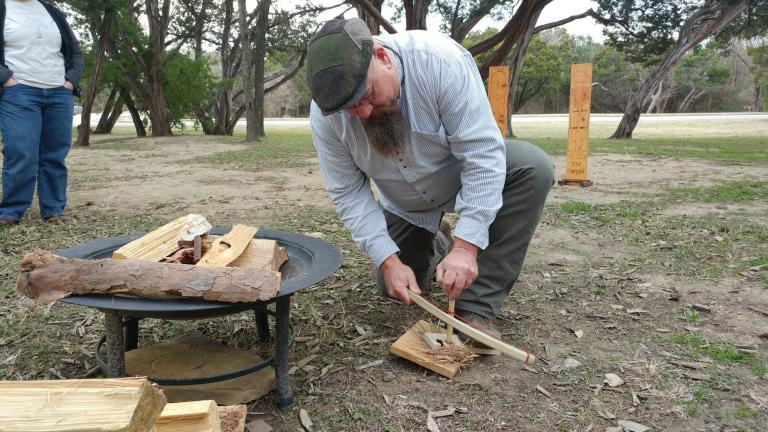
Kindling the druid’s fire with a fire drill and a bundle of local sacred woods.
The druid’s fire is the only one of these hallows we establish. The others are natural and thus we affirm this. If you happen upon a natural fire, instead of affirming it, put it out or call the authorities. In fact, it is a good idea to inform the authorities of any fire you plan to hold, fire departments are less likely to arrive if they know a conscientious person is burning.
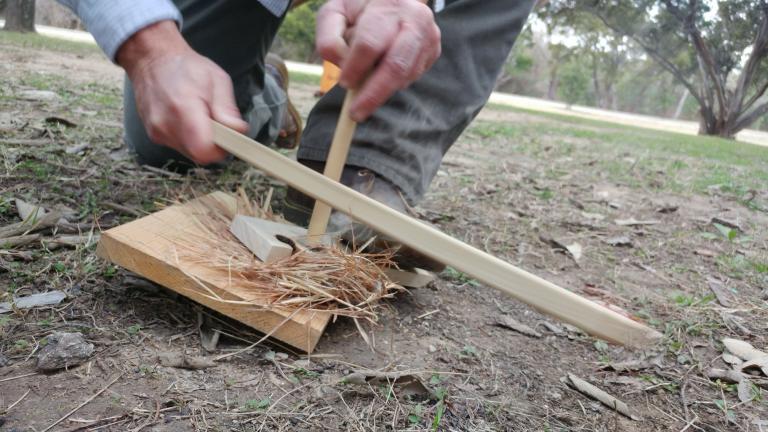
Stealing fire from the gods is not easy.
You can make your fire of only oak or the nine sacred woods which will change from area to area for the celts and for us. Locate your local sacred woods. Build a one-match fire, and use a tinder bundle and fire drill or strikers to catch the kindling.
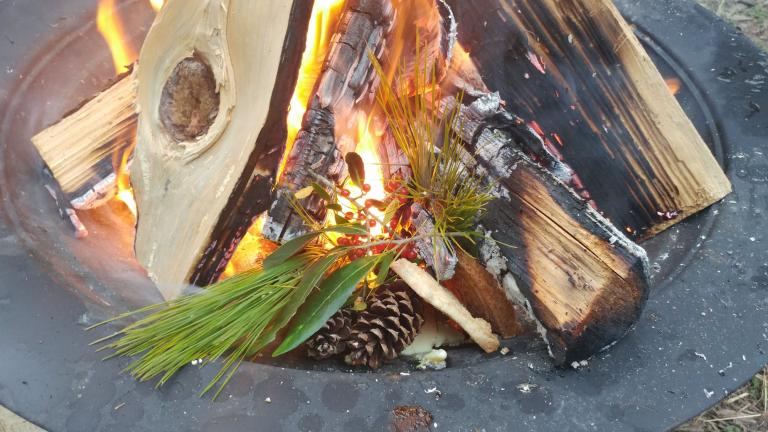
Say this charm in Irish:
Go dtabharfar air seo
An chéad tine in Éirinn,
Tine fhaire Tlachtga,
Tine ceannasach Uisneach.
An tine choice a thagann
Ar thinteán na ndaoine,
Ar thinteán na nDéithe.Go jor-FAR er SHUH,
On HAYd chiNUH in AIRin,
ChiNUH EYE-ruh Tlachtga,
ChiNUH KYANuhSOCK WISHknock,
On chiNUH HOYkuh uh HAGan,
Or hinCHIN nuh DEEnuh,
Or hinCHIN na NAYhuh.Let this be named,
The first fire in Erin,
Watchfire of Tlachtga,
Soverenty-fire of Uisneach.
The hill fire that reaches
The people’s hearth,
The Gods’ hearth.
Sacred Fire, Burn within us! – A Thine Naofa, dóigh istigh ionainn!
(A HIN-nuh KNEE-fuh DO-ee esh-TUH ANN-un)
or
Sacred Fire, Burn within me! – A Thine Naofa, dóigh istigh ionaim!
(A HIN-nuh KNEE-fuh DO-ee esh-TUH ANN-eyem)
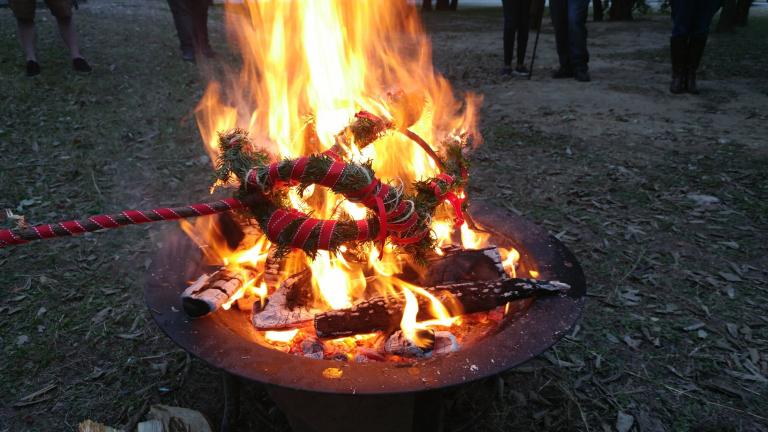
Affirming the Sacred Well
Wellsprings and wells around Ireland are world famous, especially the ones associated with Brighid. Catholic practice involves the continuation of circumambulation of these sites, a surviving practice we also see in Vedism and through Hinduism. Cauldrons often replace wells or are associated with their drawing of water. When a natural spring isn’t handy in my back pocket, I can bring out the cauldron, fill it with water, and put three drops of water from one of Brighid’s wells into it.
Sacred Well, Flow within us! – A Thobar Naofa, sruthaigh istigh ionainn!
(A Huber KNEE-fuh SRUH-hihg esh-TUH ANN-un)or
Sacred Well, Flow within me! – A Thobar Naofa, rith istigh ionaim!
(A Huber KNEE-fuh SRUH-hihg esh-TUH ANN-eyem)
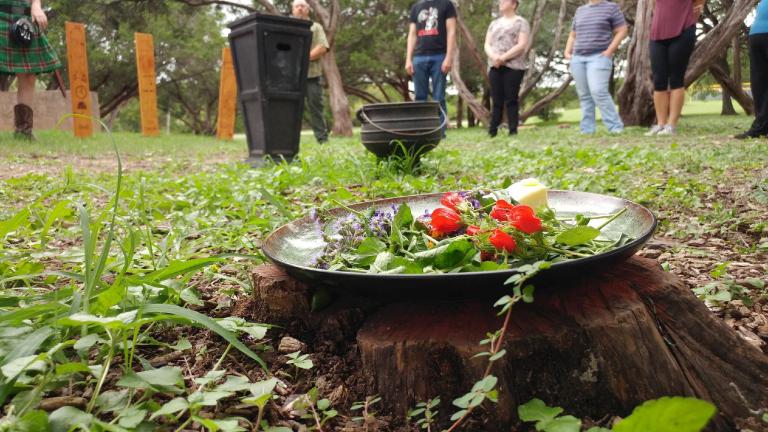
Affirming the Sacred Tree
They are common to other Indo-European faiths as well. In Vedism, the sacred center was a linga placed atop a pyramid where the axis mundi descended to earth. This is clearly the central nemeton for all the speakers of Sanskrit. While there are clan and tribal centers, this was the ‘national’ center. As in India, so in Ireland. The pillar stone on Uisnach was the Stone of Divisions. The Pillar stone on Tara was the Lia Fal and The five sacred trees in Ireland, one of which was legendary ash at Uisneach, were provincial sacred centers. The Lia fall has a counterpart in Munster, Tara Luachra. Munster was the last province of Ireland to join the others under the central High King, before that, this other Tara was Munster’s center and was a place that had Christian legends about gnosis giving angels surrounding it, clearly building on a pre-existing belief in it as a holy site, whose flagstone gave omens of right-kingship.
The pillar connects us to all the realms. The Stone of divisions has five edges, one for each of the kings of each of the ‘fifths’ of Ireland. The Lia fall connects the kingship to the Samos and Giamos currents. The stone tree at the bottom of Lough Gur in Limerick can be climbed to enter the Otherworld. So while we don’t have a central Yggdrasil for the entire world, we have several things that connect to all the worlds and realms, that exists in Ireland which was seen as a separate whole micro-cosmos set apart from any other whole micro-cosmos. In our rites, we can use a stone pillar, a tree we find in a place with inherent natural energy, a wooden 4″x4″ with ogham carved on it, or maybe even river stone you bring in from the home.
Sacred Tree, Grow within us! – A Chrann Naofa, fás istigh ionainn
(A Kron KNEE-fuh, FAWSH esh-TUH ANN-un)
or
Sacred Tree, Grow within me! – A Chrann Naofa, fás istigh ionaim
(A Kron KNEE-fuh, FAWSH esh-TUH ANN-eyem)
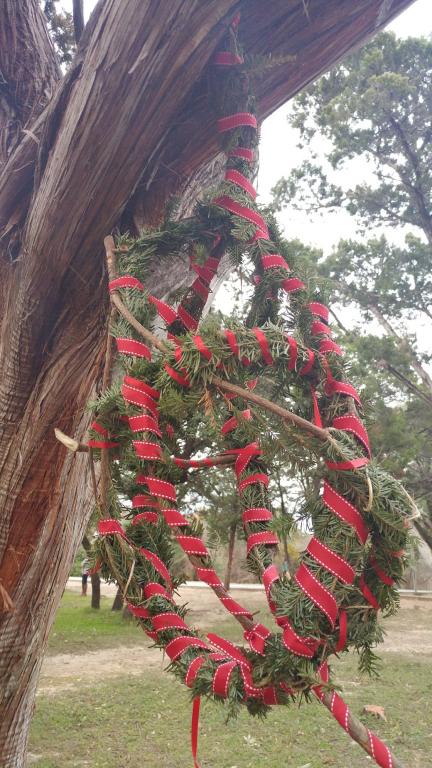
A Picture of this year’s Wren cage for St. Stephen’s Day hung on the sacred tree.
Circumambulation
It is important to go with the sun when increasing order and desired effects and when needing opportunity.
For Rituals
For rites, we generally always move sunwise. Especially when a rite is designed to mitigate chaos. There are other purposes to sacrifice, like commensality, protection, maintenance, and services through gifts.
For Magic
I generally see magic as probability modifiers on the real world. To increase likelihood, giamos, fluidity, opportunity, and magic, we’ll move against the sun. To increase solidity, rigidity, uneventfulness, fulfillment, and truth, we will move sunwise.
Treatment of the Sacred Fire
The sacred fire is seen as a being. It is summoned by the spell of charms and friction. In India, according to Reverend Archdruid Emeritus Fox Alderman, cotton is put into blowing tubes because no one wants to spit on the fire offending it. We know that wetness offends the fire, because the friction process does not summon the fire when we spit on it.
As a living being, we feed the fire many things. We do not feed it trash, cigarette butts, or things we would cast aside. Respectfully and without reservation we will give it as many things as we feel we ought. Whole meats, and cheeses, gallons of mead, whole bottles of whiskey. I’ve been offering shamed by presumed pagans because their idea of treatment of the sacred fire is different than mine. I don’t go into other camps and demand that they treat their fire with certain amounts of dignity, however, when people come into my camp, I demand a higher level of respect from guests toward the fire. The fire is an honored storyteller that can rarely speak for itself.
Sources:
Celtic Heritage, Rees Brothers
In Search of the Indo-Europeans, J.P. Mallory
https://www.youtube.com/watch?v=_KNlFw4HaVc, John ‘Fox’ Alderman
Fire Charm by Chris Godwin and Meron Nic Cruithne
Previous Post

January 8, 2019
Land, Sky, and Sea in Devotional Practice
Next Post
February 16, 2019 Building a Devotional Practice with the Sky
Browse Our Archives
Select a Category ADF at Festivals Autumn Equinox CMA Devotional Polytheism Druid Druid Magic Druid Mysticism Festival Folklore Groups and Organizing Ideology Imbolc Indo-European Interfaith Magic Midsummer Pagan Pagan Practice Pagan Worldview Parapsychology Prayer PriestCraft Ritual Samhain Uncategorized Wicca Winter Solstice Witchcraft Yule
Select a Month June 2026 February 2026 January 2026 October 2025 September 2025 August 2025 July 2025 May 2025 February 2025 January 2025 December 2024 November 2024 September 2024 August 2024 June 2024 May 2024 April 2024 February 2024 January 2024 December 2023 October 2023 August 2023 July 2023 January 2023 June 2022 May 2022 January 2022 August 2021 June 2021 January 2021 October 2020 July 2020 June 2020 April 2020 March 2020 February 2020 January 2020 November 2019 October 2019 September 2019 August 2019 July 2019 April 2019 March 2019 February 2019 January 2019 December 2018 November 2018 October 2018 September 2018 August 2018 July 2018 June 2018 May 2018 April 2018 March 2018 February 2018 January 2018 December 2017 November 2017 October 2017
Follow Us!
TAKE THE
Religious Wisdom Quiz
According to Romans, what can separate us from the love of Christ?
Select your answer to see how you score.
Nothing Sin Unbelief Disobedience
Related posts from From a Common Well
TRENDING AT PATHEOS Pagan

I was recently chatting with someone on Instagram. She asked me what...

While there are many people who share their results, the end of...

On July 23, I saw Christopher Nolan's The Odyssey which is Homer’s...

As I write this two big events have just finished up. One...

Restoring the Watershed of Divine Love
Perhaps cooperation is not something we manufacture through legislation, ideology, or moral...

Many UUs don’t pray because of bad experiences in a previous religion,...
view all Pagan blogs
Ad-Free & Subscriber Log-In Subscription Support
- About Us
- 2026 Calendar
- Videos
- Podcasts
- Library of World Religions
- Faith In Media Tracker
- Advertise With Us
- Write for Us
- Privacy Policy
- Terms of Service
- Do Not Sell My Data
- Contact Us
- Radiant Digital
- Manage Newsletter Subscriptions
- Unsubscribe From Notifications
- Sitemap
Copyright 2008-2026, Patheos. All rights reserved.
Subscription Support Ad-Free & Subscriber Log-In
Follow Patheos