
BuddhistCatholicContemplativeEvangelicalGeneral ChristianHinduJewishLatter-day SaintMuslimNew VisionsProgressive Christian
Beliefs
- Buddhist
- Catholic
- Contemplative
- Evangelical
- General Christian
- Hindu
- Jewish
- Latter-day Saint
- More Voices
- Muslim
- New Visions
- Pagan
- Progressive Christian
Topics
- Religion News
- Food and Religion
- Sports and Religion
- Religious Art
- Religious Music and Entertainment
- Religious Events
- History and Religion
- Style and Religion
- Politics and Religion
- Women in Religion
- Recreation Outdoors and Religion
- Business Finance and Religion
- Careers Workplace and Religion
- Education and Religion
- Family Parenting and Religion
- Health Fitness and Religion
- Home and Religion
- Relationships and Religion
- Technology and Religion
- Travel and Religion
Columnists
- Buddhist Columnists
- Business Finance and Religion Columnists
- Careers Workplace and Religion Columnists
- Catholic Columnists
- Contemplative Columnists
- Education and Religion Columnists
- Evangelists Columnists
- Family Parenting and Religion Columnists
- General Christian Columnists
- Health Fitness and Religion Columnists
- Hindu Columnists
- History and Religion Columnists
- Home and Religion Columnists
- Jewish Columnists
- More Voices Columnists
- Latter Day Columnists
- Muslim Columnists
- New Visions Columnists
- Nonreligious Columnists
- Pagan Columnists
- Politics and Religion Columnists
- Progressive Columnists
- Recreation Outdoors and Religion Columnists
- Relationships and Religion Columnists
- Religion News Columnists
- Religious Art Columnists
- Religious Events Columnists
- Religious Music and Entertainment Columnists
- Sports and Religion Columnists
- Style and Religion Columnists
- Technology and Religion Columnists
- Travel and Religion Columnists
- Women in Religion Columnists
Resource Library
- 2026 Calendar
- Library of World Religions
- The 100 Most Holy Places on Earth
- Patheos Answers
- Podcasts
- Videos
- Faith Leaders Database
- Anglican Episcopalian
- Bahai
- Baptist
- Buddhism
- Christianity
- Confucianism
- Eastern Orthodoxy
- Hinduism
- Holiness and Pentecostal
- ISKCON
- Islam
- Judaism
- Lutheran
- Methodist
- The Church of Jesus Christ of Latter-day Saints
- New Age
- Paganism
- Presbytarian and Reformed
- Protestantism
- Religion Behind the Scenes
- Roman Catholic
- Scientology
- Shia Islam
- Sikhism
- Sufism
- Sunni Islam
- Taoism
- Zen
- See all religions
Research Tools
 Ad-Free & Subscriber Log-In Subscription Support
Ad-Free & Subscriber Log-In Subscription Support
Follow Patheos 

- Trending:
- Forgiveness
- |
- Marriage
- |
- Consciousness
- |
- Death Penalty
- |
- Election
- |
- Halloween

- Home
- Pagan
- We Have No Idea How Druids Practiced? Balderdash!
We Have No Idea How Druids Practiced? Balderdash!
Last updated on: September 25, 2018 at 3:58 am by Chris Godwin
We Have No Idea How Druids Practiced? Balderdash! 2018-09-25T03:58:10-04:00 Chris Godwin
Patheos Explore the world's faith through different perspectives on religion and spirituality! Patheos has the views of the prevalent religions and spiritualities of the world.
” Extremely little. The total of evidence we have for the druids could probably fit on a few pages. All that comes down to us directly are a handful of references by Roman authors, non of which sets out to describe the druids, the mentions are all incidental.” – Redditor
“We don’t know what druids wore. We don’t know whether men and women worshipped together. We don’t know what druids believed or taught. We don’t know what druids said or did during their worship. We don’t know what their cosmology was. We don’t know how they performed divination. We don’t know what their astrological systems were like.” – Francine Nicholson, M.A.
That we have ‘no idea’ about these things is Balderdash.
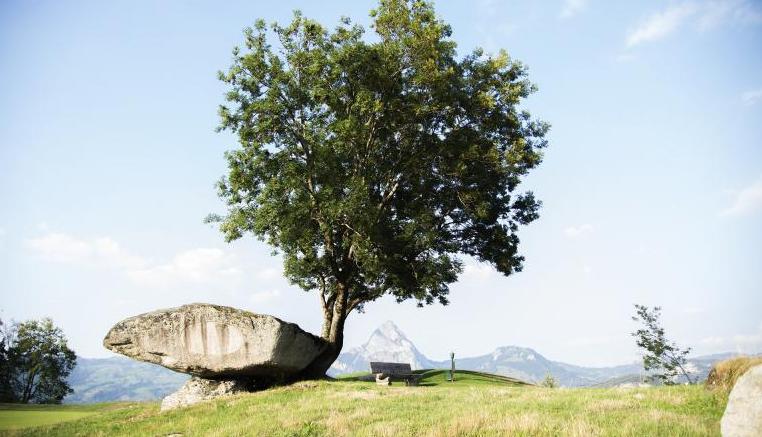
Courtesy of Pixabay
How Much About Druids Can Be Known?
We have no reason to believe that the development of Druids, proto-druids, and culture surrounding them was subject to a different set of rules than the priests of their sister cultures. Because we have no such evidence, we are left to conclude that the druids and things about them, developed the same way as other Indo-European priests, lawmakers, and sacrifices.
Quite the contrary is true in actuality. We know through the study of linguistics, archeology, and anthropology that the Proto-Indo-Europeans and their descendants migrated core ideas of pagan ideology and practice throughout Europe and India.
The CR faq addresses this on their page about what the druid believed:
“It is possible that the druids had restrictions on writing down anything that was considered sacred. However, some of the Celtic peoples did leave records of their beliefs and practices, and some of these traditions have survived, in a modified form, up to the present day.”
The various Indo-European cultures moved into new areas and blended with the Old European pre-Indo-European customs and faiths. Because pastoral herdsmen clashed with agrarian farmers, these beliefs took on mutations, new ideas, new flavors, and new characters.
What can we learn from Christianization?
Add to all of this; these cultures underwent a period of slow Christianization. However, their Christianization bespeaks of their similarities in proto-Indo-European paganism. Our ancestors accepted Catholicism so readily in these cultures with such high numbers, and that a single ritual format worked for all of them is less of an indictment on Catholic culture theft and more a celebrated understanding of a continuation of pagan practice in European religion.
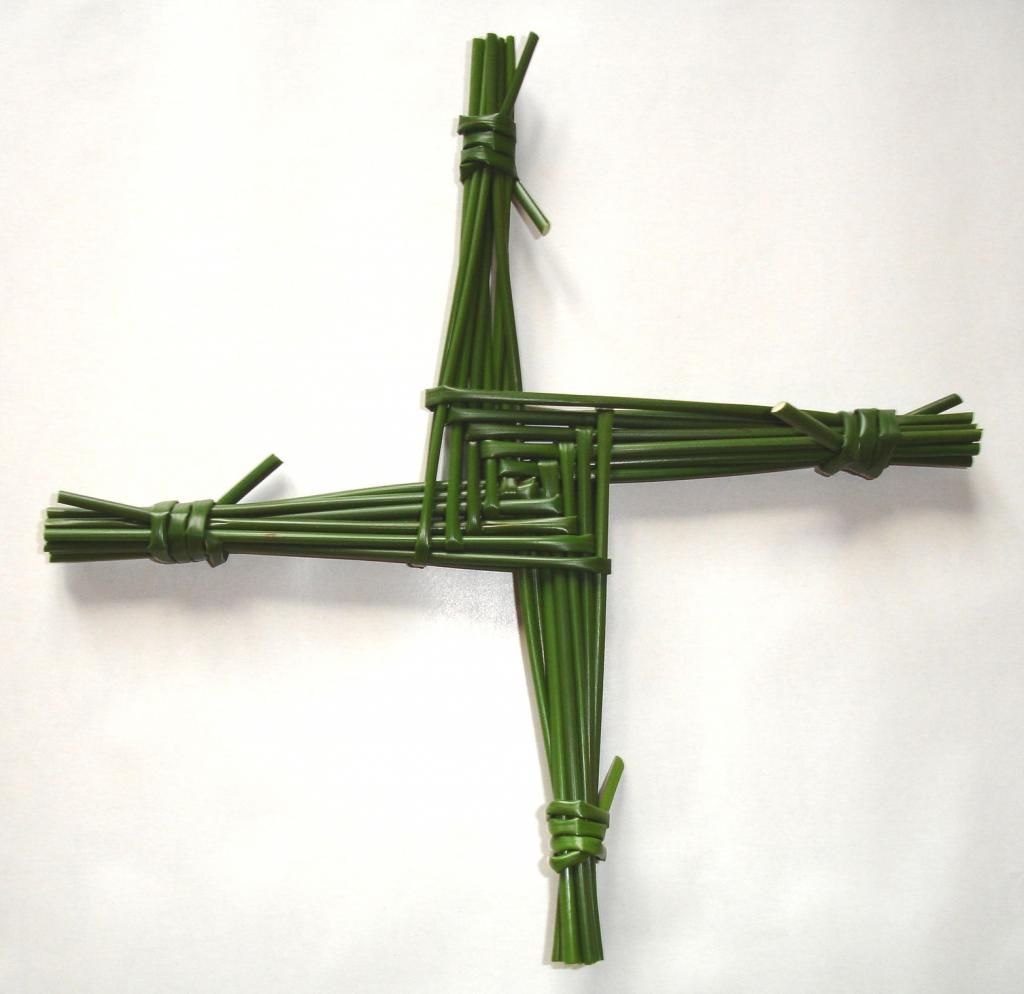
Courtesy of Wikimedia Commons
Taking Caution
Where we take caution and care is in dissecting worldview in information which has come down to us. So far, we can draw from the first-hand accounts of customs of our recent Celtic ancestors from things like the Carmina Gadelica, the Irish Rite and Celtic Rites from the order of liturgies from treating the sick, St. Galls Incantations, and Danaher’s “The Year in Ireland,” among other works. We take these things and the myths and filter it in reverse through a pagan worldview built out of an exhaustive comparative study of pre-Christian Indo-European pagan religions.
Triplicities of gods in prayers, for example, stay, but we then have to replace Father, Son, Holy Spirit in prayers. But that isn’t enough, we then have to rewrite the prayer to be in a Celtic pagan worldview, triangulating your good guesses from other facts. When we do this, we define a safe region with which to mix the elements of practice and belief around to make it work and see how the psyche performs.
Experimenting
If we do certain ascetic practices and experience the Inspiration Which Illuminates, and all the symptoms of that experience match even what Christians wrote, you realize that such things aren’t as altered as you thought, and maybe we don’t give the Christians enough credit here, and too much there.
This region that exists between all the facts and the best guesses turns out to be a place in your religion which everything fits, lines up, and is undoubtedly druidic and Celtic, and by all measures, undeniably recognizable by our ancestors. Anybody who celebrates the Goose Harvest in Ireland understands the Russian pagans who sacrifice water foul on the same day in sacred groves on the borders of Baltic and Slavic Europe.
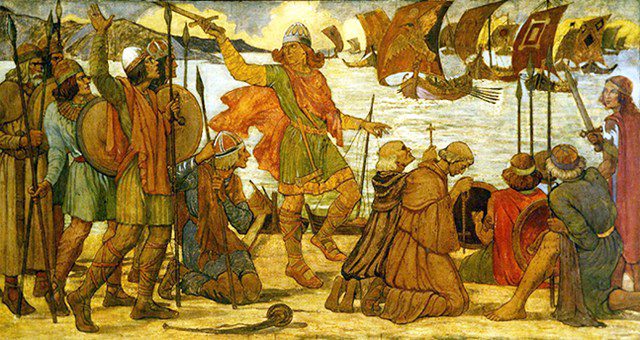
Courtesy of Wikimedia Commons
Where Does Information About the Druids Exist?
We can look at similarities in the clergy of other Indo-European cultures and rebuild Celtic belief, give it a workable skeleton which renders a practice out of the reconstructionist approach and methodology that is whole. It is not only possible to have a ballpark knowledge of clothing, worship, cosmology, and cosmogony, and we know they divined by sacrifice like everyone else. The Old Religion nearly rebuilds itself in the hands of great minds who do the work and the due diligence.
Roman and Vedic priests have nearly same taboos, which is just one fact among a myriad demonstrating there is an underlying ideology in Indo-European paganism and an underlying universal structure with the way the gods evolved through migrations from the Yamnaya culture → Corded Wares Culture → Urnfield Culture → Hallstatt Culture → Gaulish Culture → Irish Culture. It is with the Corded Ware Culture that we have split-offs into Germanic and Slavic paganism. These other cultures are what I call ‘Sister Cultures’ to the Celts. Through the writings contained in their sister cultures, we’ve never lost anything. Instead, our ancestors distributed the information, and we can garner enough data for a lifetime of study and practice, certainly more than the troupe if ignorance about the druids implies.
We look to works like “Druids: A Very Short Introduction” by Barry Cunliffe, and “A Brief History of the Druids” by Peter Beresford Ellis. We look to Classical Texts by the Romans and Greeks while trying to clean the information of their biases and the ongoings of the day(Like, for instance, that Rome ran out of gold before they decided to plunder the offering hoards of the Gauls). This information exists in manuscripts, wisdom tracts, myths and recorded practices from the 1800s, books like Danaher’s, and the book called “Irish Folkways” by E. Estyn Evans and the “Fairy Faith in Celtic Countries” by W.Y. Evans-Wentz. We have the writings of the Greeks, Romans, and Vedic pagans about their religions, and 20 & 21st century Indo-Europeanist assessments of how those things relate to Celtic paganism, for instance, the concept *swed-dhos, the universal Indo-European warrior ethic for the band of boon takers. And that scratches the surface.
In more ways than one, it is a blessing that the druids didn’t write first-hand accounts because the pursuit of a workable system is all the point of being a Celtic pagan.
Previous Post
August 29, 2018
12 Steps Toward Decolonizing Irish American Paganism

Browse Our Archives
Select a Category ADF at Festivals Autumn Equinox CMA Devotional Polytheism Druid Druid Magic Druid Mysticism Festival Folklore Groups and Organizing Ideology Imbolc Indo-European Interfaith Magic Midsummer Pagan Pagan Practice Pagan Worldview Parapsychology Prayer PriestCraft Ritual Samhain Uncategorized Wicca Winter Solstice Witchcraft Yule
Select a Month June 2026 February 2026 January 2026 October 2025 September 2025 August 2025 July 2025 May 2025 February 2025 January 2025 December 2024 November 2024 September 2024 August 2024 June 2024 May 2024 April 2024 February 2024 January 2024 December 2023 October 2023 August 2023 July 2023 January 2023 June 2022 May 2022 January 2022 August 2021 June 2021 January 2021 October 2020 July 2020 June 2020 April 2020 March 2020 February 2020 January 2020 November 2019 October 2019 September 2019 August 2019 July 2019 April 2019 March 2019 February 2019 January 2019 December 2018 November 2018 October 2018 September 2018 August 2018 July 2018 June 2018 May 2018 April 2018 March 2018 February 2018 January 2018 December 2017 November 2017 October 2017
Follow Us!
TAKE THE
Religious Wisdom Quiz
What did Aaron make for the people while Moses was on the mountain?
Select your answer to see how you score.
A golden calf A silver snake A wooden idol An altar
Related posts from From a Common Well
TRENDING AT PATHEOS Pagan

I was recently chatting with someone on Instagram. She asked me what...

While there are many people who share their results, the end of...

On July 23, I saw Christopher Nolan's The Odyssey which is Homer’s...

As I write this two big events have just finished up. One...

Restoring the Watershed of Divine Love
Perhaps cooperation is not something we manufacture through legislation, ideology, or moral...

Many UUs don’t pray because of bad experiences in a previous religion,...
view all Pagan blogs
Ad-Free & Subscriber Log-In Subscription Support
- About Us
- 2026 Calendar
- Videos
- Podcasts
- Library of World Religions
- Faith In Media Tracker
- Advertise With Us
- Write for Us
- Privacy Policy
- Terms of Service
- Do Not Sell My Data
- Contact Us
- Radiant Digital
- Manage Newsletter Subscriptions
- Unsubscribe From Notifications
- Sitemap
Copyright 2008-2026, Patheos. All rights reserved.
Subscription Support Ad-Free & Subscriber Log-In
Follow Patheos