
BuddhistCatholicContemplativeEvangelicalGeneral ChristianHinduJewishLatter-day SaintMuslimNew VisionsProgressive Christian
Beliefs
- Buddhist
- Catholic
- Contemplative
- Evangelical
- General Christian
- Hindu
- Jewish
- Latter-day Saint
- More Voices
- Muslim
- New Visions
- Pagan
- Progressive Christian
Topics
- Religion News
- Food and Religion
- Sports and Religion
- Religious Art
- Religious Music and Entertainment
- Religious Events
- History and Religion
- Style and Religion
- Politics and Religion
- Women in Religion
- Recreation Outdoors and Religion
- Business Finance and Religion
- Careers Workplace and Religion
- Education and Religion
- Family Parenting and Religion
- Health Fitness and Religion
- Home and Religion
- Relationships and Religion
- Technology and Religion
- Travel and Religion
Columnists
- Buddhist Columnists
- Business Finance and Religion Columnists
- Careers Workplace and Religion Columnists
- Catholic Columnists
- Contemplative Columnists
- Education and Religion Columnists
- Evangelists Columnists
- Family Parenting and Religion Columnists
- General Christian Columnists
- Health Fitness and Religion Columnists
- Hindu Columnists
- History and Religion Columnists
- Home and Religion Columnists
- Jewish Columnists
- More Voices Columnists
- Latter Day Columnists
- Muslim Columnists
- New Visions Columnists
- Nonreligious Columnists
- Pagan Columnists
- Politics and Religion Columnists
- Progressive Columnists
- Recreation Outdoors and Religion Columnists
- Relationships and Religion Columnists
- Religion News Columnists
- Religious Art Columnists
- Religious Events Columnists
- Religious Music and Entertainment Columnists
- Sports and Religion Columnists
- Style and Religion Columnists
- Technology and Religion Columnists
- Travel and Religion Columnists
- Women in Religion Columnists
Resource Library
- 2026 Calendar
- Library of World Religions
- The 100 Most Holy Places on Earth
- Patheos Answers
- Podcasts
- Videos
- Faith Leaders Database
- Anglican Episcopalian
- Bahai
- Baptist
- Buddhism
- Christianity
- Confucianism
- Eastern Orthodoxy
- Hinduism
- Holiness and Pentecostal
- ISKCON
- Islam
- Judaism
- Lutheran
- Methodist
- The Church of Jesus Christ of Latter-day Saints
- New Age
- Paganism
- Presbytarian and Reformed
- Protestantism
- Religion Behind the Scenes
- Roman Catholic
- Scientology
- Shia Islam
- Sikhism
- Sufism
- Sunni Islam
- Taoism
- Zen
- See all religions
Research Tools
 Ad-Free & Subscriber Log-In Subscription Support
Ad-Free & Subscriber Log-In Subscription Support
Follow Patheos 

- Trending:
- Forgiveness
- |
- Marriage
- |
- Consciousness
- |
- Death Penalty
- |
- Election
- |
- Halloween
 Frequently Faithful
- Home
- Catholic
- Relationships and Religion
- A Formula for Wholeness
A Formula for Wholeness
Last updated on: February 4, 2024 at 2:19 pm by Mary Ann Steutermann
A Formula for Wholeness 2024-02-04T14:19:12-05:00 Mary Ann Steutermann
Patheos Explore the world's faith through different perspectives on religion and spirituality! Patheos has the views of the prevalent religions and spiritualities of the world.
Jesus’ healing of Peter’s mother-in-law from today’s Gospel has a lot to say about our innate wholeness.
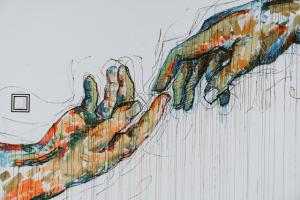
Photo by Claudio Schwarz on Unsplash
My ACT scores suggested not so much genius as dissociative identity disorder. There were two distinct personalities who took the test. One was almost gifted (my word, not the College Board’s) in English and reading. The other was… less so. Math and, to an even greater degree, science left me frequently confused. And my scores showed it.
Ironically though, I have gained an appreciation for and genuine interest in science over the last couple decades. I have enjoyed learning about the origins of the universe, the relative nature of spacetime, and the wacked-out, freakish behavior of subatomic particles. Science, it turns out, is a fascinating portal into ultimate meaning.
A Sacred Singularity
Some feel that science and religious faith are incompatible, but I disagree. I believe they are two languages used to talk about the same truths. Take the Big Bang, for example. I am captivated by the theory that the miracle of life today in all its complex diversity began as an initial singularity. The idea that a tiny spec of cosmic potential exploded and expanded into, well, everything is deliciously enchanting to me. And not at all inconsistent with the truth of the creation stories in the Book of Genesis. Each one – the world in seven days and Adam and Eve are two different stories – seeks to convey the truth that all life came from God and all of it is “good.” Two languages, one truth.
But we forget this original wholeness and unity though in favor the deceptively alluring belief that we are separate – from each other, the earth around us, all of life. This collective amnesia about our common lineage becomes the only reality we know. So, how do we find our way back from the pain of division and separation to the sacred oneness from which we came? The gospel readings for the Fifth Sunday of Ordinary Time point to a pretty good answer.
Mark’s gospel during Cycle B tells the story of Jesus visiting Simon’s house where his mother-in-law was sick with a fever. There’s a clean and simple formula Jesus uses to return her to health and make her whole again: “He approached, grasped her hand, and helped her up” (1:31). Fully restored, she hopped up and started serving the tea and cookies.
He Approached
The word “approach” comes from the Latin appropiare which means to “draw near.” The first step, then, in getting back to our factory setting is to draw near to that which we have previously understood as “other.” Pope Francis is fond of using the word, “encounter,” to describe this desire and responsibility we have to draw near.
As reported in L’Osservatore Romano, his homily on September 13, 2016 was an “’invitation to work for ‘the culture of encounter,’ in a simple way, ‘as Jesus did:’ not just seeing, but looking; not just hearing, but listening; not just passing people by, but stopping with them; not just saying “what a shame, poor people!”, but allowing yourself to be moved with compassion; ‘and then to draw near, to touch and to say: ‘Do not weep’ and to give at least a drop of life.’”
If wholeness is both our birthright and destiny, then such a ‘culture of encounter’ is simply enlightened self-interest. If you and I are really one, then it only makes sense for me to be concerned for you. Even if I hate everything you stand for. Even if you are cruel and selfish and have hurt me deeply. Even if you are my enemy. Paradoxically, it’s in caring for you that I take care of myself.
He Grasped Her Hand
But as hard as it is to feel for those who seem completely “other,” it’s far more challenging to take actually do something. It’s one thing to see the filthy person by the side of the road holding the cardboard sign that reads, “Homeless and Broke.” It’s quite another to stop and ask him how he is, especially if his own poor choices landed him there. It’s quite another still to offer him a blanket or a sandwich, especially when he makes it clear he’d prefer cash.
But this “grasping of the hand,” this skin-on-skin contact with others, seems pretty non-negotiable for Jesus. Is it merely coincidence that that the physical acts of “grasping” another in kindness – a shared smile, a warm handshake, a big bear hug – all feel so good? I don’t think so. They feel so good because they get us back to who we really are. It can’t be any accident that sex, the most intense form of physical union, gives us so much pleasure. We are not meant to be separate.
He Helped Her Up
The thing I love about the way Jesus heals Simon’s mother-in-law is the complete lack of special effects. There’s no booming James Earl Jones voice proclaiming victory over death. There are no fireworks set to music, no neon signs, no rabbits in hats, no burning bushes. The miracle happens when Jesus simply “helped her up.”
To me, the message is clear – do something that’s not nothing. I’m not going to cure cancer or eliminate food insecurity. But I can sit with someone during chemo and donate to a food bank. As Saint Theresa of Calcutta famously said, “Not all of us can do great things. But we can do small things with great love.” Those “small things” are the real miracle because they take us one step closer to the richness of our true selves.
A Simple Formula
The formula for remembering who we are and where we came from is clean and simple in this week’s Gospel reading. But as anyone who’s lived on earth more than a couple minutes knows, clean doesn’t mean uncomplicated, and simple doesn’t mean easy. Sometimes it’s crazy-hard to approach, grasp her hand, and help her up. It requires a commitment to doing small things with great love that makes us into the salt of the earth and the light of the world that Matthew describes in Cycle A. It takes the deep waters of a “culture of encounter” to be able to reel in the big fish like Luke describes in Cycle C. But you end up with tea and cookies.
Relationships and Religion
Previous Post

December 9, 2023
Confessions of an Avowed Stick-in-the-Mud
Recent Comments
"Not at all. Let me introduce to you St. Therese of Lisieux:https://www.amazon.com/Ligh..."
"Authentic listening requires a strong commitment to empathy. It seems likely that, for those willing ..."
"Thank you for an excellent and inspired vision of the ideal Church.The main obstacle to ..."
What Would a “Re-Churched” Church Look ..."
"well Christ said not to delay him leaving, the quicker He left the sooner the ..."
Gospel Reflection: Where is Jesus After ..."
Browse Our Archives
Select a Category Catholic Beliefs Church Faith and Doubt Gospel Jesus Justice Metaphor Pope Francis Relationships Science Society Suffering Uncategorized
Select a Month February 2024 December 2023 November 2023 October 2023 September 2023 August 2023 June 2023 May 2023 April 2023 March 2023 February 2023 November 2021 October 2021 September 2021 August 2021 July 2021 June 2021 May 2021 April 2021 March 2021 February 2021 January 2021
Follow Us!
TAKE THE
Religious Wisdom Quiz
What is the Bible's view of laziness?
Select your answer to see how you score.
Laziness is good Rest is forbidden A little sleep leads to poverty Only farmers can rest
Related posts from Frequently Faithful

Confessions of an Avowed Stick-in-the-Mud
Gospel Reflection: Cornerstone Calculus

Redeem vs. Rescue: A Sticky Showdown
TRENDING AT PATHEOS Catholic

In one sense walking into Westminster Abbey is like walking down the...

'Super Scam Me' Exposes AI Jon Bon Jovi...
Leslie Pickett believed she was in a relationship with Jon Bon Jovi....

The Brazilian Remake of Kendricks' 'Flywheel' Opens in...
“Flywheel,” the story that launched the Kendrick Brothers’ filmmaking career is getting...

The Dangers of Gradual Accommodation (Winking at Sin)
Recently, the “law of gradualness” resurfaced during the opening of a weeklong,...

The Iron Gates and the Lion of the...
Yesterday, I didn't finish my report about, well, yesterday. So I'll...

The Image: On the Horror of Capitalism and...
The Image Then went the Pharisees, and took counsel how they might...
view all Catholic blogs
Ad-Free & Subscriber Log-In Subscription Support
- About Us
- 2026 Calendar
- Videos
- Podcasts
- Library of World Religions
- Faith In Media Tracker
- Advertise With Us
- Write for Us
- Privacy Policy
- Terms of Service
- Do Not Sell My Data
- Contact Us
- Radiant Digital
- Manage Newsletter Subscriptions
- Unsubscribe From Notifications
- Sitemap
Copyright 2008-2026, Patheos. All rights reserved.
Subscription Support Ad-Free & Subscriber Log-In
Follow Patheos