
BuddhistCatholicContemplativeEvangelicalGeneral ChristianHinduJewishLatter-day SaintMuslimNew VisionsProgressive Christian
Beliefs
- Buddhist
- Catholic
- Contemplative
- Evangelical
- General Christian
- Hindu
- Jewish
- Latter-day Saint
- More Voices
- Muslim
- New Visions
- Pagan
- Progressive Christian
Topics
- Religion News
- Food and Religion
- Sports and Religion
- Religious Art
- Religious Music and Entertainment
- Religious Events
- History and Religion
- Style and Religion
- Politics and Religion
- Women in Religion
- Recreation Outdoors and Religion
- Business Finance and Religion
- Careers Workplace and Religion
- Education and Religion
- Family Parenting and Religion
- Health Fitness and Religion
- Home and Religion
- Relationships and Religion
- Technology and Religion
- Travel and Religion
Columnists
- Buddhist Columnists
- Business Finance and Religion Columnists
- Careers Workplace and Religion Columnists
- Catholic Columnists
- Contemplative Columnists
- Education and Religion Columnists
- Evangelists Columnists
- Family Parenting and Religion Columnists
- General Christian Columnists
- Health Fitness and Religion Columnists
- Hindu Columnists
- History and Religion Columnists
- Home and Religion Columnists
- Jewish Columnists
- More Voices Columnists
- Latter Day Columnists
- Muslim Columnists
- New Visions Columnists
- Nonreligious Columnists
- Pagan Columnists
- Politics and Religion Columnists
- Progressive Columnists
- Recreation Outdoors and Religion Columnists
- Relationships and Religion Columnists
- Religion News Columnists
- Religious Art Columnists
- Religious Events Columnists
- Religious Music and Entertainment Columnists
- Sports and Religion Columnists
- Style and Religion Columnists
- Technology and Religion Columnists
- Travel and Religion Columnists
- Women in Religion Columnists
Resource Library
- 2026 Calendar
- Library of World Religions
- The 100 Most Holy Places on Earth
- Patheos Answers
- Podcasts
- Videos
- Faith Leaders Database
- Anglican Episcopalian
- Bahai
- Baptist
- Buddhism
- Christianity
- Confucianism
- Eastern Orthodoxy
- Hinduism
- Holiness and Pentecostal
- ISKCON
- Islam
- Judaism
- Lutheran
- Methodist
- The Church of Jesus Christ of Latter-day Saints
- New Age
- Paganism
- Presbytarian and Reformed
- Protestantism
- Religion Behind the Scenes
- Roman Catholic
- Scientology
- Shia Islam
- Sikhism
- Sufism
- Sunni Islam
- Taoism
- Zen
- See all religions
Research Tools
 Ad-Free & Subscriber Log-In Subscription Support
Ad-Free & Subscriber Log-In Subscription Support
Follow Patheos 

- Trending:
- Forgiveness
- |
- Marriage
- |
- Consciousness
- |
- Death Penalty
- |
- Election
- |
- Halloween
 Frequently Faithful
- Home
- Catholic
- Religious Events
- Good Friday: Part 6 in the Limitations of Language Series
Good Friday: Part 6 in the Limitations of Language Series
Last updated on: May 4, 2023 at 3:59 pm by Mary Ann Steutermann
Good Friday: Part 6 in the Limitations of Language Series 2023-05-04T15:59:27-04:00 Mary Ann Steutermann
Patheos Explore the world's faith through different perspectives on religion and spirituality! Patheos has the views of the prevalent religions and spiritualities of the world.
Good Friday is far more about life than death. Three often overlooked elements of the gospel reading for Good Friday reveal more about the heart and soul of life than the grief and despair of death.
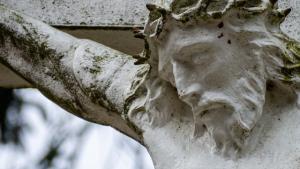
Wim Van T. Einde/Unsplash
I’ve enjoyed visiting my sister and her husband this week during Spring Break. We got our first pedicure of the season, ate out at great restaurants, played Pickleball, and laughed and laughed and laughed. But I’m back home now. In Jesus’ own words from the Good Friday narrative, “It is finished” (John 20:30).
Yeah, I know. Not funny.
But perhaps you can indulge the irreverent pun? I have thought of this week as something of a pilgrimage. My annual trip to visit my sister is filled with some meaningful everyday rituals for us, especially now that our parents are gone, but also some new adventures.
The Journey
This year’s trip coincided with Holy Week, so with more time to write, I posted each day about the limitations of language for religious faith. Although I didn’t have this intention, this week’s posts together have become a treatise on faith that seeks to translate parts of an ancient Catholic belief system into a worldview that makes sense in the modern world. Oddly perhaps, I feel a kind of synchronicity in the fact that my trip ends as the story of Jesus’ life at crucifixion ends.
So, let’s recap. On Palm Sunday, I raised the issue of language as a problem for religious faith today. On Monday, I suggested that “humanity” and “divinity” might not be the opposites we usually think they are. Then on Tuesday, I proposed a non-traditional way of understanding what we mean when we speak of “God.”
On Wednesday, I explored concepts like Satan, heaven, and hell in a contemporary context. Then yesterday, Holy Thursday, I suggested a way to think of sin and prayer in a way that aligns with these other updated terms.
In today’s Good Friday gospel passage, we encounter three critical elements that I believe support this more modern interpretation of religious language that aligns with our knowledge of established science and our own lived experience.
#1 – I AM
Jesus has a mind-blowingly awesome answer to the guards the chief priests had assembled to capture Jesus with the intel from Judas. Knowing what was about to go down, Jesus asked them, “‘ Whom are you looking for?’ They answered him, ‘Jesus the Nazorean.’ He said to them, ‘I AM.’ Judas, his betrayer was also with them. When he said to them, ‘I AM,’ they turned away and fell to the ground. So he again asked them, ‘Whom are you looking for?’ They said, ‘Jesus the Nazorean.’ Jesus answered, ‘I told you that I AM'” (18:4-8).
Sound familiar? The Book of Exodus includes a beautiful story in which God instructs Moses to lead the Israelites out of slavery in Egypt. Moses is wary and has lots of questions. One stands out. “‘ If I go to the Israelites and say to them, ‘The God of your ancestors has sent me to you,’ and they ask me, ‘What is his name?’ what do I tell them?’
God replied to Moses: ‘I am who I am.’ Then he added: ‘This is what you will tell the Israelites: I AM has sent me to you.’ God spoke further to Moses: ‘This is what you will say to the Israelites: The LORD, the God of your ancestors, the God of Abraham, the God of Isaac, and the God of Jacob, has sent me to you. This is my name forever; this is my title for all generations'” (3:13-15).
Isness
I AM. What a fascinating way to self-identify! And sure enough, Jesus identifies himself in the same way in today’s gospel – not once but TWICE.
I’ve written previously that I like Paul Tillich’s explanation of God as the “Ground of Being” rather than a supernatural “being.” God as “I AM” seems to fit.
#2 – The Rules
The passage in today’s gospel that describes Pilot’s questioning of Jesus and the crowd’s demand for blood speaks volumes. The irony in it is tragic but revelatory.
“Then they brought Jesus from Caiaphas to the praetorium. It was morning. And they themselves did not enter the praetorium in order not to be defiled so that they could eat the Passover.
So Pilate came out to them….” (John 18:28-29).
Seriously? This angry mob hell-bent on Jesus’ death didn’t want to break any Passover preparation rules. Really? Brutal, inhumane capital punishment is okay, but walking into the praetorium, the home of the Roman leader, against Passover prescriptions is unthinkable. Hmmm.
Pilot does not find Jesus guilty of anything, at least within his jurisdiction, so he tries multiple times to deliver him back to them without sentencing. “The Jews answered, ‘We have a law, and according to that law he ought to die because he made himself the Son of God'” (19:7). I must scratch my head on that one too. On the one hand, the crowds seem maniacally devoted to following the rules. But aren’t all the laws of Moses founded upon the ten commandments, one of which is “Thou shalt not kill?”
And More Rules
Then after Jesus had died, the Jews who insisted upon Jesus’ death asked Pilot to break the legs of all three who were crucified. Why? Despite the horrible physical torture those crucified endure, death is usually a result of suffocation. If someone crucified has the strength in his legs to push upward, he allows his lungs to take in air. Without this leg strength, the crucified person will suffocate quickly.
So, the blood-thirsty crowd wanted to accelerate their deaths because it was time to prepare for Passover, and they didn’t want the corpses still on their crosses on the Sabbath? That’s rich. You can brutally execute a man who even Pilot found innocent, as long as you don’t run afoul of the Passover regulations.
To be clear, this rule-based worldview isn’t particular to the Jews. In fact, the people of the Jewish faith I know today are far more enlightened than many Catholics. The obsession with rules isn’t a “Jewish thing.” It’s a “human thing.” And we Catholics are the worst of the rule-infatuated lot of them.
Good Friday and Bumper Guards
For me, these are some of the many passages in the gospels that question the importance of rules. Sure, they have a place. Bumper guards at the bowling alley have their place too when the bowlers are children who have never played before. But once you figure out the game and play a few times, there is no need for the bumpers.
It’s easy to fall in love with the bumpers. They’re straightforward and concrete. You know with certainty when your ball has hit them. But if you are really going to bowl, you don’t use them. Similarly, rules are helpful when you haven’t found your footing, but if you are really going to live, rules aren’t your best guide. Your sense of who you are, where you came from, and where you’re heading is all you need.
Language continues to limit our understanding. What is right or moral or ethical isn’t something that aligns with a code of conduct. For me, moral rectitude is simply acting in a way that aligns with my understanding that I am part of a larger, sacred whole. What is “good” promotes connection and unity because that aligns with our true essence. What is “bad” fosters separation and disconnection because that goes against our natural, holy grain.
#3 – I Thirst
There is something compelling to me about Jesus’ last words. “It is finished” is perfect in its simplicity. No lengthy Scripture recitations. No “Just wait! You guys will be soooooo sorry when all this shakes out.” Just a simple statement of what IS.
But just before that, Jesus says, “I thirst” (28). What more abjectly human statement could anyone make? I thirst. In other words, I am completely, totally human. I have endured incredible physical and emotional pain, and I don’t have anything left to give. I thirst.
For me, this is yet another “finger pointing to the moon” that blurs the false distinction between what it means to be “human” and what it means to be “divine.” I think that what was available to Jesus is also available to each of us.
We too are part of I AM. If only we could embrace that . . . and recognize that everyone else is too.
Bottom Line
Everything is one thing. I think that’s what Jesus figured out, taught about and lived out, and then died for.
For me, Good Friday is far more about life than death. It’s about what it means to be alive, to be part of the great I AM.
Religious Events
Relationships and Religion
Previous Post

April 6, 2023
Holy Thursday: Part 5 of the Language of Christianity Series
Next Post

April 9, 2023 Easter Sunday: The Last Installment in the Limitations of Language Series
Recent Comments
"Not at all. Let me introduce to you St. Therese of Lisieux:https://www.amazon.com/Ligh..."
"Authentic listening requires a strong commitment to empathy. It seems likely that, for those willing ..."
"Thank you for an excellent and inspired vision of the ideal Church.The main obstacle to ..."
What Would a “Re-Churched” Church Look ..."
"well Christ said not to delay him leaving, the quicker He left the sooner the ..."
Gospel Reflection: Where is Jesus After ..."
Browse Our Archives
Select a Category Catholic Beliefs Church Faith and Doubt Gospel Jesus Justice Metaphor Pope Francis Relationships Science Society Suffering Uncategorized
Select a Month February 2024 December 2023 November 2023 October 2023 September 2023 August 2023 June 2023 May 2023 April 2023 March 2023 February 2023 November 2021 October 2021 September 2021 August 2021 July 2021 June 2021 May 2021 April 2021 March 2021 February 2021 January 2021
Follow Us!
TAKE THE
Religious Wisdom Quiz
I was breathing out murderous threats, but a blinding light changed everything. I became the greatest missionary the church has known. Who am I?
Select your answer to see how you score.
Barnabas Stephen Peter Saul
Related posts from Frequently Faithful

Confessions of an Avowed Stick-in-the-Mud
Gospel Reflection: Cornerstone Calculus
TRENDING AT PATHEOS Catholic

Emotion in Early Christianity by Andrew Crislip
Andrew Crislip’s Emotion in Early Christianity examines an often overlooked dimension of...

16 Spiritual Touchstones for a More Grounded Life
After decades of spiritual study, here are 16 principles I try...

Catholic Evangelization: Sharing Your Faith Every Day
Welcome back to the Graceful Awakening mini-series called, “From Faith to Mission.” ...

The Pillar of the Boatmen: the Ancient Monument...
The Pillar of the Boatmen is a Romano-Gaulish sculpture that dates from...

In one sense walking into Westminster Abbey is like walking down the...

'Super Scam Me' Exposes AI Jon Bon Jovi...
Leslie Pickett believed she was in a relationship with Jon Bon Jovi....
view all Catholic blogs
Ad-Free & Subscriber Log-In Subscription Support
- About Us
- 2026 Calendar
- Videos
- Podcasts
- Library of World Religions
- Faith In Media Tracker
- Advertise With Us
- Write for Us
- Privacy Policy
- Terms of Service
- Do Not Sell My Data
- Contact Us
- Radiant Digital
- Manage Newsletter Subscriptions
- Unsubscribe From Notifications
- Sitemap
Copyright 2008-2026, Patheos. All rights reserved.
Subscription Support Ad-Free & Subscriber Log-In
Follow Patheos