
BuddhistCatholicContemplativeEvangelicalGeneral ChristianHinduJewishLatter-day SaintMuslimNew VisionsProgressive Christian
Beliefs
- Buddhist
- Catholic
- Contemplative
- Evangelical
- General Christian
- Hindu
- Jewish
- Latter-day Saint
- More Voices
- Muslim
- New Visions
- Pagan
- Progressive Christian
Topics
- Religion News
- Food and Religion
- Sports and Religion
- Religious Art
- Religious Music and Entertainment
- Religious Events
- History and Religion
- Style and Religion
- Politics and Religion
- Women in Religion
- Recreation Outdoors and Religion
- Business Finance and Religion
- Careers Workplace and Religion
- Education and Religion
- Family Parenting and Religion
- Health Fitness and Religion
- Home and Religion
- Relationships and Religion
- Technology and Religion
- Travel and Religion
Columnists
- Buddhist Columnists
- Business Finance and Religion Columnists
- Careers Workplace and Religion Columnists
- Catholic Columnists
- Contemplative Columnists
- Education and Religion Columnists
- Evangelists Columnists
- Family Parenting and Religion Columnists
- General Christian Columnists
- Health Fitness and Religion Columnists
- Hindu Columnists
- History and Religion Columnists
- Home and Religion Columnists
- Jewish Columnists
- More Voices Columnists
- Latter Day Columnists
- Muslim Columnists
- New Visions Columnists
- Nonreligious Columnists
- Pagan Columnists
- Politics and Religion Columnists
- Progressive Columnists
- Recreation Outdoors and Religion Columnists
- Relationships and Religion Columnists
- Religion News Columnists
- Religious Art Columnists
- Religious Events Columnists
- Religious Music and Entertainment Columnists
- Sports and Religion Columnists
- Style and Religion Columnists
- Technology and Religion Columnists
- Travel and Religion Columnists
- Women in Religion Columnists
Resource Library
- 2026 Calendar
- Library of World Religions
- The 100 Most Holy Places on Earth
- Patheos Answers
- Podcasts
- Videos
- Faith Leaders Database
- Anglican Episcopalian
- Bahai
- Baptist
- Buddhism
- Christianity
- Confucianism
- Eastern Orthodoxy
- Hinduism
- Holiness and Pentecostal
- ISKCON
- Islam
- Judaism
- Lutheran
- Methodist
- The Church of Jesus Christ of Latter-day Saints
- New Age
- Paganism
- Presbytarian and Reformed
- Protestantism
- Religion Behind the Scenes
- Roman Catholic
- Scientology
- Shia Islam
- Sikhism
- Sufism
- Sunni Islam
- Taoism
- Zen
- See all religions
Research Tools
 Ad-Free & Subscriber Log-In Subscription Support
Ad-Free & Subscriber Log-In Subscription Support
Follow Patheos 

- Trending:
- Forgiveness
- |
- Marriage
- |
- Consciousness
- |
- Death Penalty
- |
- Election
- |
- Halloween
 Frequently Faithful
- Home
- Catholic
- Why I Have a Crush on ‘Doubting Thomas’
Why I Have a Crush on ‘Doubting Thomas’
Last updated on: February 16, 2023 at 1:33 pm by Mary Ann Steutermann
Why I Have a Crush on ‘Doubting Thomas’ 2023-02-16T13:33:34-05:00 Mary Ann Steutermann
Patheos Explore the world's faith through different perspectives on religion and spirituality! Patheos has the views of the prevalent religions and spiritualities of the world.

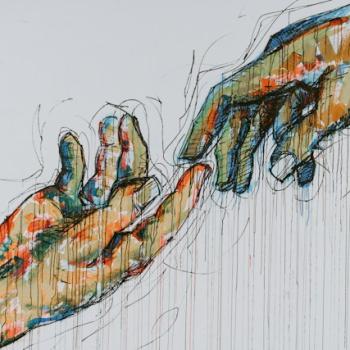
Photo by Sharon McCutcheon on Unsplash
Why all the hate for “Doubting Thomas?” A major player in last Sunday’s gospel reading, he’s commonly thought to be somewhere between Meryl Streep in The Devil Wears Prada and Angelina Jolie in Maleficent. In other words, no high marks. Personally, I’m a little bit in love with him. Here’s why.
In John’s gospel shortly after Jesus has risen, the disciples are huddled together in a room, and Jesus appears. Thomas wasn’t present then, so when he did return, he couldn’t be persuaded to believe such outrageous tales about Jesus’ appearance after death. “But he said to them, ‘Unless I see the mark of the nails in his hands and put my finger into the nail marks and put my hand into his side, I will not believe’” (John 20: 25).
Watch Me Pull a Rabbit Out of My Hat
Later, Jesus comes back to the same room with the same crew, but this time Thomas is present. Jesus allows Thomas to touch the gash in his side and trace the scars on his hands. And then there’s that line in the gospel story that – I’ll admit – I hate. “Jesus said to him, ‘Have you come to believe because you have seen me? Blessed are those who have not seen and have believed’” (20: 29).
So, Thomas is the antagonist here, right? He’s the anti-hero who lacks faith, the very epitome of whatever everyone else should seek to rise above, correct?
Sorry, no. I object. And here’s why.
First, the details of the story are . . . peculiar. The first time Jesus appears, the writer takes great care to note that the room was locked. And again, the second time the doors are locked again.
Really? So, we are supposed to be amazed by this? Let’s think about this for a minute. He endures betrayal, great suffering, and an excruciating death, but then in three days, his friends and disciples experience him as alive again. Rising from the dead? Well sure, that’s pretty cool . . . but what’s more, he got into a locked room! Twice, even! So the whole resurrection thing is nice but outmaneuvering a padlock is the real miracle? Seriously?
C’mon now!
That’s not the only part that’s strange. Let’s think about what we know of Jesus from the gospels. Do we really think he would intentionally shame Thomas in front of his friends? Personally, I find that unlikely.
Sure, sure, I can hear the rebuttal now: “He only said that because he was trying to teach a lesson.” Nope, I have to call foul. I’m a teacher myself, and I know that the good ones don’t make examples of the students who don’t ‘get it.’ The only explanation that makes sense to me is that the writer of John’s gospel put these words in Jesus’ mouth to make a point, which is perfectly fine with me.
John’s gospel – interestingly, the only one that contains this story – was written later than the other synoptic gospels, long after those who knew Jesus in the flesh had died. His audience likely included many people who were “Doubting Thomas’” themselves. After all, they didn’t have the first hand experiences of those who knew him personally. I think the “kudos to those who believe without seeing” speech was a rhetorical strategy the gospel writer used to convince those who were unsure, not a transcript of a historical conversation.
Worth Rethinking?
So for millennia, we have congratulated ourselves for our superior righteousness in believing things without asking for proof. We put this type of uncritical assent on a pedestal and made it the measuring stick of worthiness. And we gave it a name – “faith.” I find that just shy of tragic. I have to ask – what virtue is there is believing in things without evidence? If the principles we live by in other areas of our lives are forbidden when it comes to faith, then it seems to me there is either a problem with the principles . . . or the faith.
In my view, “Doubting Thomas” has gotten a profoundly bad wrap. He asked to see the scars and touch the wounds. But isn’t that what life as a human is? It’s seeing the scars and touching the wounds. It’s acknowledging the pain. And it’s recognizing that the timid, purple-ish canopy of shockingly new skin that slowly, slowly, slowly replaces a once-angry wound is proof positive that, eventually, life wins. Death is not the end of the story. Wounds heal.
I applaud Thomas’ practical side. I’m actually a fan of his “show me the proof” questions. We have to use our own fingers to trace the scars of our own hurts and vulnerabilities that crucified us at fist but, in time, grew into something soft and new. This is how we bear witness to the truth of the Resurrection in our own lives. So there it is. I’m a little bit in love with Thomas.
Previous Post

April 3, 2021
Easter and the Again Adventure
Next Post
April 25, 2021 Team Sports: When They Work and When It Don't
Browse Our Archives
Select a Category Catholic Beliefs Church Faith and Doubt Gospel Jesus Justice Metaphor Pope Francis Relationships Science Society Suffering Uncategorized
Select a Month February 2024 December 2023 November 2023 October 2023 September 2023 August 2023 June 2023 May 2023 April 2023 March 2023 February 2023 November 2021 October 2021 September 2021 August 2021 July 2021 June 2021 May 2021 April 2021 March 2021 February 2021 January 2021
Follow Us!
TAKE THE
Religious Wisdom Quiz
Who wasted his wealth and ended up feeding pigs?
Select your answer to see how you score.
The Pharisee The Good Samaritan The Prodigal Son The Sower
Related posts from Frequently Faithful

Confessions of an Avowed Stick-in-the-Mud

Gospel Reflection: Cornerstone Calculus
TRENDING AT PATHEOS Catholic

The Problem with False Prophets
Miller’s Station UMC| 10/18/26| Anchor Verse: Jeremiah 23: 1, 9-23 I...

Emotion in Early Christianity by Andrew Crislip
Andrew Crislip’s Emotion in Early Christianity examines an often overlooked dimension of...

16 Spiritual Touchstones for a More Grounded Life
After decades of spiritual study, here are 16 principles I try...

Catholic Evangelization: Sharing Your Faith Every Day
Welcome back to the Graceful Awakening mini-series called, “From Faith to Mission.” ...

The Pillar of the Boatmen: the Ancient Monument...
The Pillar of the Boatmen is a Romano-Gaulish sculpture that dates from...

In one sense walking into Westminster Abbey is like walking down the...
view all Catholic blogs
Ad-Free & Subscriber Log-In Subscription Support
- About Us
- 2026 Calendar
- Videos
- Podcasts
- Library of World Religions
- Faith In Media Tracker
- Advertise With Us
- Write for Us
- Privacy Policy
- Terms of Service
- Do Not Sell My Data
- Contact Us
- Radiant Digital
- Manage Newsletter Subscriptions
- Unsubscribe From Notifications
- Sitemap
Copyright 2008-2026, Patheos. All rights reserved.
Subscription Support Ad-Free & Subscriber Log-In
Follow Patheos