
BuddhistCatholicContemplativeEvangelicalGeneral ChristianHinduJewishLatter-day SaintMuslimNew VisionsProgressive Christian
Beliefs
- Buddhist
- Catholic
- Contemplative
- Evangelical
- General Christian
- Hindu
- Jewish
- Latter-day Saint
- More Voices
- Muslim
- New Visions
- Pagan
- Progressive Christian
Topics
- Religion News
- Food and Religion
- Sports and Religion
- Religious Art
- Religious Music and Entertainment
- Religious Events
- History and Religion
- Style and Religion
- Politics and Religion
- Women in Religion
- Recreation Outdoors and Religion
- Business Finance and Religion
- Careers Workplace and Religion
- Education and Religion
- Family Parenting and Religion
- Health Fitness and Religion
- Home and Religion
- Relationships and Religion
- Technology and Religion
- Travel and Religion
Columnists
- Buddhist Columnists
- Business Finance and Religion Columnists
- Careers Workplace and Religion Columnists
- Catholic Columnists
- Contemplative Columnists
- Education and Religion Columnists
- Evangelists Columnists
- Family Parenting and Religion Columnists
- General Christian Columnists
- Health Fitness and Religion Columnists
- Hindu Columnists
- History and Religion Columnists
- Home and Religion Columnists
- Jewish Columnists
- More Voices Columnists
- Latter Day Columnists
- Muslim Columnists
- New Visions Columnists
- Nonreligious Columnists
- Pagan Columnists
- Politics and Religion Columnists
- Progressive Columnists
- Recreation Outdoors and Religion Columnists
- Relationships and Religion Columnists
- Religion News Columnists
- Religious Art Columnists
- Religious Events Columnists
- Religious Music and Entertainment Columnists
- Sports and Religion Columnists
- Style and Religion Columnists
- Technology and Religion Columnists
- Travel and Religion Columnists
- Women in Religion Columnists
Resource Library
- 2026 Calendar
- Library of World Religions
- The 100 Most Holy Places on Earth
- Patheos Answers
- Podcasts
- Videos
- Faith Leaders Database
- Anglican Episcopalian
- Bahai
- Baptist
- Buddhism
- Christianity
- Confucianism
- Eastern Orthodoxy
- Hinduism
- Holiness and Pentecostal
- ISKCON
- Islam
- Judaism
- Lutheran
- Methodist
- The Church of Jesus Christ of Latter-day Saints
- New Age
- Paganism
- Presbytarian and Reformed
- Protestantism
- Religion Behind the Scenes
- Roman Catholic
- Scientology
- Shia Islam
- Sikhism
- Sufism
- Sunni Islam
- Taoism
- Zen
- See all religions
Research Tools
 Ad-Free & Subscriber Log-In Subscription Support
Ad-Free & Subscriber Log-In Subscription Support
Follow Patheos 

- Trending:
- Forgiveness
- |
- Marriage
- |
- Consciousness
- |
- Death Penalty
- |
- Election
- |
- Halloween
 Frequently Faithful
- Home
- Catholic
- Salvation at the Ballpark
Salvation at the Ballpark
Last updated on: February 16, 2023 at 1:31 pm by Mary Ann Steutermann
Salvation at the Ballpark 2023-02-16T13:31:54-05:00 Mary Ann Steutermann
Patheos Explore the world's faith through different perspectives on religion and spirituality! Patheos has the views of the prevalent religions and spiritualities of the world.

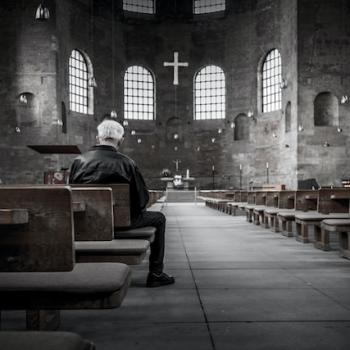
Photo by Leio McLaren (leiomclaren.com) on Unsplash
Growing up I loved watching Atlanta Braves baseball. During the early 80s the Turner Broadcasting System brought the boys of summer into my parents’ living room on a regular basis. My mother thought Dale Murphy hung the moon and actually sent him fan mail addressed to “Atlanta Fulton-County Stadium; Atlanta, GA.” I wonder if he ever got it.
My parents and I watched hundreds of Braves games summer after summer back in the days when they took the field in baby blue, pajama-looking attire, well before they became a franchise powerhouse in the late 90’s and graduated to adult uniforms.
At a young age I noticed that there was someone in the seats behind home plate at many games holding up a sign that read “John 3:16.” At first, I thought it was some sort of stat. Did a pitcher named John have a 3.16 ERA? My mom explained that it was a Bible verse and had me look it up: “For God so loved the world that he gave his only Son, so that everyone who believes in him might not perish but might have eternal life.” There it was – the crux of the Christian faith in one sentence held up by a guy with a foam finger and a ballpark hot dog.
Of course, that Braves fan wasn’t the only one to preach the gospel via placard at sporting events. Many others raised their own signs at football stadiums, on basketball courts, and in soccer arenas. John 3:16 signs became as ubiquitous as the overpriced nachos and beer flowing from the concession stands at any number of athletic events. When I was young, I thought it was cool to see a sign of religious faith alongside the French fries and peanuts as thousands of sports fans enjoyed a Saturday afternoon.
Striking Out
But that all changed as I got older. In college, I thought more about the verse itself and what it truly meant. So, a “loving” God sent his only Son so that he could be mocked, rejected, and brutally tortured until death? This all-knowing, all-powerful deity couldn’t solve the problem of sin without shedding the blood of his beloved child? And what was the problem with sin in the first place? Why would all humanity be damned because Adam and Eve couldn’t keep their hands to themselves around the forbidden fruit tree? This loving God chose to punish their disobedience by condemning all people to eternal suffering? Really?
I started reading up on theology and asking questions of those a lot smarter than me. But what I usually got were stiff rationalizations from the catechism, trite recitations of the party line. To me, the God of “atonement theory” seemed cruel, petty, and woefully lacking in problem-solving skills. I wanted no part of any such God.
I struggled with a real “crisis of faith” in college and eventually confided my doubts in my school’s campus minister, a person I’ve written about before. I told him I simply could not believe that God would send his Son to suffer and die, no matter what super-awesome outcome might have been the intended result. I said that the choices of Adam and Eve and anyone else from the dawn of time forward had no hold on me because I was in charge of my own decisions . . . and that I didn’t believe the biblical first humans existed as literal, historical figures anyway. I said that even if they were real, Jesus got a raw deal where they were concerned and that “salvation,” as I understood it then, was a crock.
To my surprise, he didn’t bat an eye. I don’t remember his exact words, but I’ll never forget how I felt when I left his office. He gave me a whole new way to look at “salvation.”
If the water is what you need,
does it really matter how the bucket gets full?
I’d give an arm or a leg to remember the exact words he used to draw me out of the cocky cynicism I was using to cover the heartbreak I felt as I questioned the faith of my childhood. He did not speak of water and buckets, but I will. It’s my own metaphorical spin on the life-altering truth he suggested in words I’d move heaven and earth to be able to recapture today.
A Different Way to Cross the Plate
Let’s say we need a bucket of water. One way to get it is to start with an empty bucket, stick it in the sink, then turn on the tap until it’s full. Ta da! We get a full bucket of water.
But there’s another way to arrive at the same outcome. We could have someone hand us a bucket full of water covered over by a piece of cloth to keep it hidden. All we’d need to do is remove the cloth, and ta da! We end up with the exact same thing – a full bucket of water.
In theology, the “atonement theory” is the “fill-‘er-up in the sink” explanation for a full bucket of redemption. It explains that God sent Jesus to die as the “sacrificial lamb” needed for our sins to be forgiven. God turns on the divine tap, so to speak, through the death of Jesus and heals the broken places in each of us until all the gaps are filled. In this interpretation, God directly applies the tourniquet and stops the bleeding. Full bucket salvation.
But there’s another way to understand the significance of Jesus’ death. Perhaps we could call it “the recovered sight theory.” What if we have all had the capacity for the fullness of life God originally intended for us? From the moment life began, we were completely whole in every possible way. But through our selfishness or cruelty, we just lost sight of the wholeness – and holiness – that was our birthright? What if our poor choices, not those of a mythical Adam and Eve, led us to see what really is an overflowing deluge as an dried up, empty wasteland?
What if we just didn’t have the eyes to see the tidal waves of love present all along, but the life and death of Jesus helps us “lift the veil” clearly see that we had been swimming in divine wholeness all along? This is the “hand me the full bucket” version of redemption. In this interpretation, God merely reminds us that despite the pain and brokenness, we were never actually bleeding to begin with. Full bucket salvation, just understood a little differently.
Yeah, it’s probably a bridge too far for many folks. And that’s fine. But if the water is what you need, does it really matter how the bucket gets full?
I need a faith that makes sense. I simply can’t believe in a God who is vindictive and small-minded. I cannot believe that the Jesus of the gospels was a divine pawn in some supernatural sleight of hand, a substitutionary gambit designed to placate an angry God.
But I’m not a non-believer. I am a person of faith, just not one that holds up John 3:16 signs at the ballpark. If it works for the Braves fan behind the plate or anyone else, more power to ’em I’ll just stick with my souvenir ball and Cracker Jacks instead. I’m a full-bucket believer who is learning to see differently.
Previous Post

March 6, 2021
Playing By the Rules...Or Not
Next Post
March 27, 2021 Reserved Powers in Real Life
Browse Our Archives
Select a Category Catholic Beliefs Church Faith and Doubt Gospel Jesus Justice Metaphor Pope Francis Relationships Science Society Suffering Uncategorized
Select a Month February 2024 December 2023 November 2023 October 2023 September 2023 August 2023 June 2023 May 2023 April 2023 March 2023 February 2023 November 2021 October 2021 September 2021 August 2021 July 2021 June 2021 May 2021 April 2021 March 2021 February 2021 January 2021
Follow Us!
TAKE THE
Religious Wisdom Quiz
What was the name of Saul's son who ruled Israel except Judah after Saul died?
Select your answer to see how you score.
Abner Mephibosheth Jonathan Ish-bosheth
Related posts from Frequently Faithful

Confessions of an Avowed Stick-in-the-Mud

Gospel Reflection: Cornerstone Calculus

Redeem vs. Rescue: A Sticky Showdown
What Would a "Re-Churched" Church Look Like?
TRENDING AT PATHEOS Catholic

In one sense walking into Westminster Abbey is like walking down the...

'Super Scam Me' Exposes AI Jon Bon Jovi...
Leslie Pickett believed she was in a relationship with Jon Bon Jovi....

The Brazilian Remake of Kendricks' 'Flywheel' Opens in...
“Flywheel,” the story that launched the Kendrick Brothers’ filmmaking career is getting...

The Dangers of Gradual Accommodation (Winking at Sin)
Recently, the “law of gradualness” resurfaced during the opening of a weeklong,...

The Iron Gates and the Lion of the...
Yesterday, I didn't finish my report about, well, yesterday. So I'll...

The Image: On the Horror of Capitalism and...
The Image Then went the Pharisees, and took counsel how they might...
view all Catholic blogs
Ad-Free & Subscriber Log-In Subscription Support
- About Us
- 2026 Calendar
- Videos
- Podcasts
- Library of World Religions
- Faith In Media Tracker
- Advertise With Us
- Write for Us
- Privacy Policy
- Terms of Service
- Do Not Sell My Data
- Contact Us
- Radiant Digital
- Manage Newsletter Subscriptions
- Unsubscribe From Notifications
- Sitemap
Copyright 2008-2026, Patheos. All rights reserved.
Subscription Support Ad-Free & Subscriber Log-In
Follow Patheos