
BuddhistCatholicContemplativeEvangelicalGeneral ChristianHinduJewishLatter-day SaintMuslimNew VisionsProgressive Christian
Beliefs
- Buddhist
- Catholic
- Contemplative
- Evangelical
- General Christian
- Hindu
- Jewish
- Latter-day Saint
- More Voices
- Muslim
- New Visions
- Pagan
- Progressive Christian
Topics
- Religion News
- Food and Religion
- Sports and Religion
- Religious Art
- Religious Music and Entertainment
- Religious Events
- History and Religion
- Style and Religion
- Politics and Religion
- Women in Religion
- Recreation Outdoors and Religion
- Business Finance and Religion
- Careers Workplace and Religion
- Education and Religion
- Family Parenting and Religion
- Health Fitness and Religion
- Home and Religion
- Relationships and Religion
- Technology and Religion
- Travel and Religion
Columnists
- Buddhist Columnists
- Business Finance and Religion Columnists
- Careers Workplace and Religion Columnists
- Catholic Columnists
- Contemplative Columnists
- Education and Religion Columnists
- Evangelists Columnists
- Family Parenting and Religion Columnists
- General Christian Columnists
- Health Fitness and Religion Columnists
- Hindu Columnists
- History and Religion Columnists
- Home and Religion Columnists
- Jewish Columnists
- More Voices Columnists
- Latter Day Columnists
- Muslim Columnists
- New Visions Columnists
- Nonreligious Columnists
- Pagan Columnists
- Politics and Religion Columnists
- Progressive Columnists
- Recreation Outdoors and Religion Columnists
- Relationships and Religion Columnists
- Religion News Columnists
- Religious Art Columnists
- Religious Events Columnists
- Religious Music and Entertainment Columnists
- Sports and Religion Columnists
- Style and Religion Columnists
- Technology and Religion Columnists
- Travel and Religion Columnists
- Women in Religion Columnists
Resource Library
- 2026 Calendar
- Library of World Religions
- The 100 Most Holy Places on Earth
- Patheos Answers
- Podcasts
- Videos
- Faith Leaders Database
- Anglican Episcopalian
- Bahai
- Baptist
- Buddhism
- Christianity
- Confucianism
- Eastern Orthodoxy
- Hinduism
- Holiness and Pentecostal
- ISKCON
- Islam
- Judaism
- Lutheran
- Methodist
- The Church of Jesus Christ of Latter-day Saints
- New Age
- Paganism
- Presbytarian and Reformed
- Protestantism
- Religion Behind the Scenes
- Roman Catholic
- Scientology
- Shia Islam
- Sikhism
- Sufism
- Sunni Islam
- Taoism
- Zen
- See all religions
Research Tools
 Ad-Free & Subscriber Log-In Subscription Support
Ad-Free & Subscriber Log-In Subscription Support
Follow Patheos 

- Trending:
- Forgiveness
- |
- Marriage
- |
- Consciousness
- |
- Death Penalty
- |
- Election
- |
- Halloween
 The French Revolution
- Home
- Politics and Religion
- Patheos Book Club: “The Lost World of Adam and Eve”
Patheos Book Club: “The Lost World of Adam and Eve”
Last updated on: March 6, 2015 at 11:54 am by Guest Contributor
Patheos Book Club: “The Lost World of Adam and Eve” 2015-03-06T11:54:19-05:00 Guest Contributor
Patheos Explore the world's faith through different perspectives on religion and spirituality! Patheos has the views of the prevalent religions and spiritualities of the world.
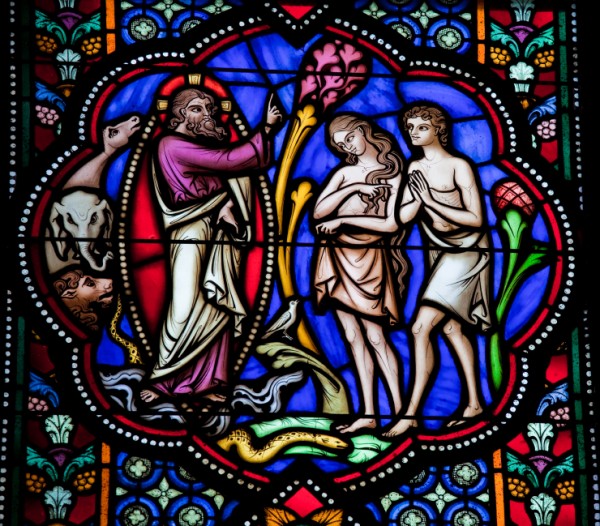 By Bob San Pascual Over the course of 210 weighty pages, Old Testament scholar John H. Walton has caused me to reconsider virtually everything I thought I knew about the first few chapters of the Bible. The Lost World of Adam and Eve: Genesis 2-3 and the Human Origins Debate isn’t an easy read. I found myself comparing each of his 21 propositions to what I’ve learned from other Old Testament commentators. (I even reviewed my seminary notes from a Pentateuch class I took!) It made for slow, but thoughtful, reading, but well worth it. I believe that many of his insights are groundbreaking.
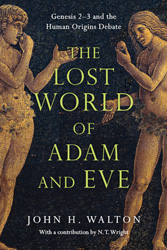
What this book is about and why it was written
“The most significant issue that we have been examining is whether the Bible and science make mutually exclusive claims about human origins” (p. 206). Walton’s answer is no. If we communicate to our young people that they don’t have to hold on to traditional beliefs about human origins, that they don’t have to choose between Christianity and science, then we can free them to continue to follow Christ (pp. 209-210).
Whom it’s for
It seems that Walton’s intended audience are educated laypeople, Bible college and seminary students, pastors, theologians, and other biblical scholars. This book isn’t technical, but most of us will need handy, in addition to the Bible, a dictionary. It isn’t for the casual reader.
What I can accept now
The Lost World of Adam and Eve is formatted according to 21 propositions in 21 chapters, one of which is written by N.T. Wright. I won’t go over each proposition, but here are just a few which I can accept at this time.
- In proposition two, Walton argues that Genesis chapter 1 is not so much concerned with God creating something out of nothing as it is with His ordering the world, that is, giving it a purpose and order, and everyone and everything in it a function.
- Proposition three asks us to look at Genesis chapter 1 as an ordering of the cosmos so that it becomes a home for human beings. The first chapter of the Bible isn’t so much about the creation of material things as it is about the arrangement of them so that humans may have a home with God.
- When we get to proposition eight, Walton leads me to change my thinking on what the phrase in Gen. 2:7, “Then the Lord God formed a man from the dust of the ground,” means. The dust isn’t literal; it’s a figure of speech for mortality (p. 73). Human beings are mortal; God alone is immortal (1 Tim. 6:16).
- The word translated in Gen. 2:21-22 as “rib” is better translated, “side” (pp. 77-79). When Adam falls asleep, he has a “visionary experience” in which he understands that woman is “ontologically related to the man” (p. 80). “Her identity is that she is his ally, his other half” (p. 81).
- Theological conservatives will like the fact that Walton states in proposition 11, and throughout, that Adam and Eve were real historical people.
- One of the more interesting points that Walton makes is that Adam and Eve failed to acquire life on our behalf. On the other hand, “Christ was able to achieve the desired result where Adam and Eve failed” (p. 145).
- “Genesis 3…is about how humanity lost access to the presence of God when its representatives tragically declared their independence from their creator” (p. 147).
What I’ll have to give more thought to
I’m not saying that Walton’s wrong, but I’m going to wait until there’s more of a consensus among Old Testament scholars about some of the ideas he’s proposing. The following aren’t criticisms as much as they are questions I have to ask before I can accept these propositions.
- Walton says that “the seven-day account…was a temple story” (p. 49). If true, why was there no ceremony as in the time when Solomon’s temple was dedicated?
- Walton claims that the word “good” when used by God to assess what He’d done in Genesis 1 doesn’t mean there was no “pain, suffering, predation or death” (p. 57). He says also that the word doesn’t mean that Adam and Eve “were perfect in every way” (p. 57).
- According to Walton, rest is not about “sleep, relaxation or leisure time…It refers to achieving a state of order in society” (p. 47). Why, then, in other parts of the Bible (e.g., Ex. 31:12-17) are the Israelites commanded to work six days and then rest on the seventh day, that is, to do no work?
- Walton’s seventh proposition is one of his most radical. He says that “Adam and Eve may well be included among the people created in Genesis 1, to think of them as the first couple or the only people in that time is not the only textual option” (p. 66).
- In proposition 14, Walton introduces us to the idea that the serpent of Genesis chapter 3 isn’t the devil or even animated by him, but a chaos or non-order creature, a being which is neither disorderly nor orderly. If that’s the case, then how was it able to talk?
- A question I have from proposition 16 is about Walton’s assertion that demons and at least some demonic activity “may be amoral and non-volitional spiritual forces that are part of the non-ordered world and bring non-order. This matches the profile that they have in the Gospels” (p. 151). Why, then, do the demons which I read about in the Gospels seem so evil?
Conclusion
Walton’s a biblical scholar who digs into the biblical text and the culture of the ancient Near East to interpret the Scriptures. He urges us to see Genesis as an ancient document and to read and understand it as the ancients would’ve. He explains his methodology in various parts of the book. Although some may raise concerns about his conclusions, I don’t think they can fault his hermeneutics. Walton’s propositions are radical, but not heretical. At some point, many of them may even become widely accepted. At any rate, these propositions are non-essentials and don’t affect our essential doctrines on the nature of God or of Christ, nor do they have to do with our salvation. They can, however, open doors for our having conversations with those who believe that Christians are ignorant people who oppose science.
Read more about this book on the Patheos Book Club.

Bob San Pascual was born in the Philippines, then grew up, and still lives, in New York City. He received his Bachelor of Science degree in Organizational Management from Nyack College and his Master of Divinity in Theological (and Biblical) Studies from Alliance Theological Seminary. He’s been in ministry since 1993 and has taught at Nyack College and at The New York School of the Bible. Currently, he serves as a part-time pastor at one church and as a regular speaker at another.
Bob’s passions are to study, teach, and write about God’s Word by His grace and for His glory. His spiritual gifts include teaching and administration and his aim is to minister so that, as His people, we may be transformed by the Holy Spirit into the image of Christ and make disciples of all nations. He also enjoys reading, watching movies and sitcoms, relaxing at the beach, and following the New York Mets.
Check out his book and author page, friend him on Facebook, connect with him on LinkedIn, see his pins on Pinterest, and follow him on Twitter
Previous Post

March 4, 2015
Our Military Must Do More to Teach about the True Nature of the Enemy
Next Post
March 6, 2015 Patheos Book Club: "Vulnerable Faith" by Jamie Arpin-Ricci
Browse Our Archives
Select a Category Christmas faith family ministry music Television Uncategorized
Select a Month June 2017 May 2017 April 2017 March 2017 February 2017 January 2017 December 2016 November 2016 October 2016 September 2016 August 2016 July 2016 June 2016 May 2016 April 2016 March 2016 February 2016 January 2016 December 2015 November 2015 October 2015 September 2015 August 2015 July 2015 June 2015 May 2015 April 2015 March 2015 February 2015 January 2015 December 2014 November 2014 October 2014 September 2014 August 2014 July 2014 June 2014 May 2014 April 2014 March 2014 February 2014 January 2014 December 2013 November 2013 October 2013 September 2013 August 2013 July 2013 June 2013 May 2013 April 2013 March 2013 February 2013 January 2013 December 2012 November 2012 October 2012 September 2012 August 2012 July 2012 June 2012 May 2012 April 2012 March 2012 February 2012 January 2012 December 2011 November 2011 October 2011 September 2011 August 2011 July 2011 March 2010
Follow Us!
TAKE THE
Religious Wisdom Quiz
What does Hebrews say is living and active?
Select your answer to see how you score.
The church Prayer Faith The word of God
Related posts from The French Revolution

Top 10 Tweets about Trump's Brutal Comments about...
David French: Why 'Transparency' is Not Always a...

Saturday Night Live Features 'Amazon Echo for Older...
Name the Fictional Tennessee Town in My New...
TRENDING AT PATHEOS Politics and Religion

Christians should care about politics. Here are 4...
How can Christians best engage with politics in a way that shows...

For Abortion "Rights" Advocates - a Compromise
For pro-life conservatives, it’s like a dream come true. For pro-choice feminazis...

Cornerstone Pastor Issues Apology - GOOD
The apology was warranted. The follow-up is essential. A week ago, the...

From a Conservative to Conservatives on President Trump...
I am a conservative, a Republican, and an evangelical Christian, and I...
view all Politics and Religion blogs
Ad-Free & Subscriber Log-In Subscription Support
- About Us
- 2026 Calendar
- Videos
- Podcasts
- Library of World Religions
- Faith In Media Tracker
- Advertise With Us
- Write for Us
- Privacy Policy
- Terms of Service
- Do Not Sell My Data
- Contact Us
- Radiant Digital
- Manage Newsletter Subscriptions
- Unsubscribe From Notifications
- Sitemap
Copyright 2008-2026, Patheos. All rights reserved.
Subscription Support Ad-Free & Subscriber Log-In
Follow Patheos