
BuddhistCatholicContemplativeEvangelicalGeneral ChristianHinduJewishLatter-day SaintMuslimNew VisionsProgressive Christian
Beliefs
- Buddhist
- Catholic
- Contemplative
- Evangelical
- General Christian
- Hindu
- Jewish
- Latter-day Saint
- More Voices
- Muslim
- New Visions
- Pagan
- Progressive Christian
Topics
- Religion News
- Food and Religion
- Sports and Religion
- Religious Art
- Religious Music and Entertainment
- Religious Events
- History and Religion
- Style and Religion
- Politics and Religion
- Women in Religion
- Recreation Outdoors and Religion
- Business Finance and Religion
- Careers Workplace and Religion
- Education and Religion
- Family Parenting and Religion
- Health Fitness and Religion
- Home and Religion
- Relationships and Religion
- Technology and Religion
- Travel and Religion
Columnists
- Buddhist Columnists
- Business Finance and Religion Columnists
- Careers Workplace and Religion Columnists
- Catholic Columnists
- Contemplative Columnists
- Education and Religion Columnists
- Evangelists Columnists
- Family Parenting and Religion Columnists
- General Christian Columnists
- Health Fitness and Religion Columnists
- Hindu Columnists
- History and Religion Columnists
- Home and Religion Columnists
- Jewish Columnists
- More Voices Columnists
- Latter Day Columnists
- Muslim Columnists
- New Visions Columnists
- Nonreligious Columnists
- Pagan Columnists
- Politics and Religion Columnists
- Progressive Columnists
- Recreation Outdoors and Religion Columnists
- Relationships and Religion Columnists
- Religion News Columnists
- Religious Art Columnists
- Religious Events Columnists
- Religious Music and Entertainment Columnists
- Sports and Religion Columnists
- Style and Religion Columnists
- Technology and Religion Columnists
- Travel and Religion Columnists
- Women in Religion Columnists
Resource Library
- 2026 Calendar
- Library of World Religions
- The 100 Most Holy Places on Earth
- Patheos Answers
- Podcasts
- Videos
- Faith Leaders Database
- Anglican Episcopalian
- Bahai
- Baptist
- Buddhism
- Christianity
- Confucianism
- Eastern Orthodoxy
- Hinduism
- Holiness and Pentecostal
- ISKCON
- Islam
- Judaism
- Lutheran
- Methodist
- The Church of Jesus Christ of Latter-day Saints
- New Age
- Paganism
- Presbytarian and Reformed
- Protestantism
- Religion Behind the Scenes
- Roman Catholic
- Scientology
- Shia Islam
- Sikhism
- Sufism
- Sunni Islam
- Taoism
- Zen
- See all religions
Research Tools
 Ad-Free & Subscriber Log-In Subscription Support
Ad-Free & Subscriber Log-In Subscription Support
Follow Patheos 

- Trending:
- Forgiveness
- |
- Marriage
- |
- Consciousness
- |
- Death Penalty
- |
- Election
- |
- Halloween
 The French Revolution
- Home
- Politics and Religion
- You Know What’s Racist? Calling Twerking ‘Black’
You Know What’s Racist? Calling Twerking ‘Black’
Last updated on: August 29, 2013 at 11:00 am by David French
You Know What’s Racist? Calling Twerking ‘Black’ 2013-08-29T11:00:28-05:00 David French
Patheos Explore the world's faith through different perspectives on religion and spirituality! Patheos has the views of the prevalent religions and spiritualities of the world.
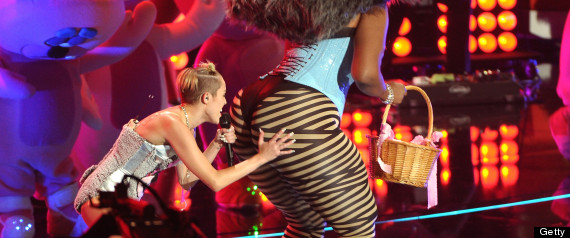
So, on the 50th anniversary of Martin Luther King’s “I have a dream” speech, we’re reduced to this: calling Miley Cyrus’s predictable, boring, and pathetic VMA dance routine “racist.” Yes, racist. Don’t believe me? Read this, this, this, and this. How did Miley offend the racial police? By dancing like a stripper. I kid you not:
Cyrus, though, twerked the formula as well as her body by adding in a racial element while she copied the dance moves of strippers and bellowed her love of drugs. (Billy Ray’s heart must be pretty achy breaky these days.) On stage as well as in her video she used the tedious trope of having black women as her backing singers, there only to be fondled by her and to admire her wiggling derriere. Cyrus is explicitly imitating crunk music videos and the sort of hip-hop she finds so edgy – she has said, bless her, that she feels she is Lil’ Kim inside and she loves “hood music” – and the effect was not of a homage but of a minstrel show, with a young wealthy woman from the south doing a garish imitation of black music and reducing black dancers to background fodder and black women to exaggerated sex objects.
Last night, as Cyrus stalked the stage, mugging and twerking, and paused to spank and simulate analingus upon the ass of a thickly set African-American backup dancer, her act tipped over into what we may as well just call racism: a minstrel show routine whose ghoulishness was heightened by Cyrus’s madcap charisma, and by the dark beauty of “We Can’t Stop” — by a good distance, the most powerful pop hit of 2013.

A doctoral dissertation could (and will) be written on the racial, class, and gender dynamics of Cyrus’s shtick. I’ll make just one historical note. For white performers, minstrelsy has always been a means to an end: a shortcut to self-actualization.
Let’s leave aside for the moment that these writers seem to deny the full moral agency and willing participation of the black backup dancers in Cyrus’s shameful spectacle and focus instead on the assumption that the trashy, stripper-inspired dance moves combined with the hyper-sexualized realm of hip-hop represents “black culture.”
News flash: It’s a subset of ghetto culture, not black culture. Plus, equating blackness with public exhibitionism and crude sexuality? Well, some could call that racist. It’s no secret to readers of this blog that our youngest daughter is black (African-American in the most literal sense; born in Ethiopia), and it will be a cold day in hell before she is even one percent “ratchet” or whatever other term-of-the-moment that ridiculous-sounding elitist liberals love to toss around like they have the foggiest idea what “the streets” are really like.
Looking across American (much less world) history, black Americans have no shortage of inspiring role models — including great musicians — and the idea that any black child should be taught that something so base as twerking is part of their culture because of the color of their skin is nothing short of outrageous. It’s dangerous as well, creating downward social pressures on young black kids as the wider pop culture tells them their authentic selves are to be found in the violent, hyper-sexual world of hip-hop rather than, say, Gospel music or other forms of expression.
In the Wall Street Journal, Juan Williams, powerfully expressed his displeasure with the ascendance of hip-hop, and in so doing he shows how there’s nothing inevitably or necessarily “black” about it. Contrasting the music of the march on Washington with music that dominates the airwaves today, he writes:
Curtis Mayfield—also openly inspired by the music of the march—wrote an even more hopeful song: “People Get Ready.” It, too, picked up on a frequent image of American folklore, the train of salvation.
Just as Woody Guthrie and Johnny Cash had sung “This Train’s Bound for Glory,” Mayfield, a black Chicago singer steeped in church gospel music and the blues, sang about faith in the American struggle for racial justice.
“People get ready, there’s a train a comin’; you don’t need no baggage you just get on board . . . there ain’t no room for the hopeless sinner who would hurt all mankind just to save his own. Have pity on those whose chances grow thinner. For there’s no hiding place against the Kingdom’s throne.”
The uplifting lyrics made “People Get Ready” one of the earliest hits on both black and white radio. Bob Marley later used some of the words in his poignant song “One Love.” Bruce Springsteen used the song as a healing anthem at concerts after the 9/11 terror attacks.
But now?
Now, half a century after the lyrical promise of that inspiring music and poetry, there is the inescapable and heartbreaking contrast with the malignant, self-aggrandizing rap songs that define today’s most popular music.
In Jay-Z’s current hit, “Holy Grail,” he sings about “psycho bitches” and uses the n-word seven times while bragging that he is “Living the life . . . Illest [n-word] alive.” Another top rapper, Lil Wayne, released a song in the spring with an obscenity in the title, using the n-word repeatedly and depicting himself as abusing “hoes” and “bitches.”
Miley Cyrus racist? No, she’s a foolish young girl on a sad and destructive downward spiral. It’s a movie we’ve seen too many times before. Soon her fifteen minutes will be up, and we’ll be chattering about the next wave of Disney starlets gone bad.
But mainstreaming stripper culture and even labeling it “black”? That’s far, far worse than any MTV performance.
Previous Post

August 27, 2013
The Sad, Boring Fall of Miley Cyrus
Next Post
August 29, 2013 If You Send Your Kid to Private School, Are You a Bad Person?
Browse Our Archives
Select a Category Christmas faith family ministry music Television Uncategorized
Select a Month June 2017 May 2017 April 2017 March 2017 February 2017 January 2017 December 2016 November 2016 October 2016 September 2016 August 2016 July 2016 June 2016 May 2016 April 2016 March 2016 February 2016 January 2016 December 2015 November 2015 October 2015 September 2015 August 2015 July 2015 June 2015 May 2015 April 2015 March 2015 February 2015 January 2015 December 2014 November 2014 October 2014 September 2014 August 2014 July 2014 June 2014 May 2014 April 2014 March 2014 February 2014 January 2014 December 2013 November 2013 October 2013 September 2013 August 2013 July 2013 June 2013 May 2013 April 2013 March 2013 February 2013 January 2013 December 2012 November 2012 October 2012 September 2012 August 2012 July 2012 June 2012 May 2012 April 2012 March 2012 February 2012 January 2012 December 2011 November 2011 October 2011 September 2011 August 2011 July 2011 March 2010
Follow Us!
TAKE THE
Religious Wisdom Quiz
What major prophet often used object lessons, such as a ruined loincloth?
Select your answer to see how you score.
Jeremiah Isaiah Habakkuk Malachi
Related posts from The French Revolution

Don’t Tell MTV, But It’s Been Boring for...

The Sad, Boring Fall of Miley Cyrus

Top 10 Tweets about Trump's Brutal Comments about...

David French: Why 'Transparency' is Not Always a...
TRENDING AT PATHEOS Politics and Religion

Christians should care about politics. Here are 4...
How can Christians best engage with politics in a way that shows...

For Abortion "Rights" Advocates - a Compromise
For pro-life conservatives, it’s like a dream come true. For pro-choice feminazis...

Cornerstone Pastor Issues Apology - GOOD
The apology was warranted. The follow-up is essential. A week ago, the...

From a Conservative to Conservatives on President Trump...
I am a conservative, a Republican, and an evangelical Christian, and I...
view all Politics and Religion blogs
Ad-Free & Subscriber Log-In Subscription Support
- About Us
- 2026 Calendar
- Videos
- Podcasts
- Library of World Religions
- Faith In Media Tracker
- Advertise With Us
- Write for Us
- Privacy Policy
- Terms of Service
- Do Not Sell My Data
- Contact Us
- Radiant Digital
- Manage Newsletter Subscriptions
- Unsubscribe From Notifications
- Sitemap
Copyright 2008-2026, Patheos. All rights reserved.
Subscription Support Ad-Free & Subscriber Log-In
Follow Patheos