
BuddhistCatholicContemplativeEvangelicalGeneral ChristianHinduJewishLatter-day SaintMuslimNew VisionsProgressive Christian
Beliefs
- Buddhist
- Catholic
- Contemplative
- Evangelical
- General Christian
- Hindu
- Jewish
- Latter-day Saint
- More Voices
- Muslim
- New Visions
- Pagan
- Progressive Christian
Topics
- Religion News
- Food and Religion
- Sports and Religion
- Religious Art
- Religious Music and Entertainment
- Religious Events
- History and Religion
- Style and Religion
- Politics and Religion
- Women in Religion
- Recreation Outdoors and Religion
- Business Finance and Religion
- Careers Workplace and Religion
- Education and Religion
- Family Parenting and Religion
- Health Fitness and Religion
- Home and Religion
- Relationships and Religion
- Technology and Religion
- Travel and Religion
Columnists
- Buddhist Columnists
- Business Finance and Religion Columnists
- Careers Workplace and Religion Columnists
- Catholic Columnists
- Contemplative Columnists
- Education and Religion Columnists
- Evangelists Columnists
- Family Parenting and Religion Columnists
- General Christian Columnists
- Health Fitness and Religion Columnists
- Hindu Columnists
- History and Religion Columnists
- Home and Religion Columnists
- Jewish Columnists
- More Voices Columnists
- Latter Day Columnists
- Muslim Columnists
- New Visions Columnists
- Nonreligious Columnists
- Pagan Columnists
- Politics and Religion Columnists
- Progressive Columnists
- Recreation Outdoors and Religion Columnists
- Relationships and Religion Columnists
- Religion News Columnists
- Religious Art Columnists
- Religious Events Columnists
- Religious Music and Entertainment Columnists
- Sports and Religion Columnists
- Style and Religion Columnists
- Technology and Religion Columnists
- Travel and Religion Columnists
- Women in Religion Columnists
Resource Library
- 2026 Calendar
- Library of World Religions
- The 100 Most Holy Places on Earth
- Patheos Answers
- Podcasts
- Videos
- Faith Leaders Database
- Anglican Episcopalian
- Bahai
- Baptist
- Buddhism
- Christianity
- Confucianism
- Eastern Orthodoxy
- Hinduism
- Holiness and Pentecostal
- ISKCON
- Islam
- Judaism
- Lutheran
- Methodist
- The Church of Jesus Christ of Latter-day Saints
- New Age
- Paganism
- Presbytarian and Reformed
- Protestantism
- Religion Behind the Scenes
- Roman Catholic
- Scientology
- Shia Islam
- Sikhism
- Sufism
- Sunni Islam
- Taoism
- Zen
- See all religions
Research Tools
 Ad-Free & Subscriber Log-In Subscription Support
Ad-Free & Subscriber Log-In Subscription Support
Follow Patheos 

- Trending:
- Forgiveness
- |
- Marriage
- |
- Consciousness
- |
- Death Penalty
- |
- Election
- |
- Halloween
 The French Revolution
- Home
- Politics and Religion
- The Nuclear Strikes on Hiroshima and Nagasaki Were Right and Necessary
The Nuclear Strikes on Hiroshima and Nagasaki Were Right and Necessary
Last updated on: August 8, 2013 at 1:24 pm by David French
The Nuclear Strikes on Hiroshima and Nagasaki Were Right and Necessary 2013-08-08T13:24:24-05:00 David French
Patheos Explore the world's faith through different perspectives on religion and spirituality! Patheos has the views of the prevalent religions and spiritualities of the world.
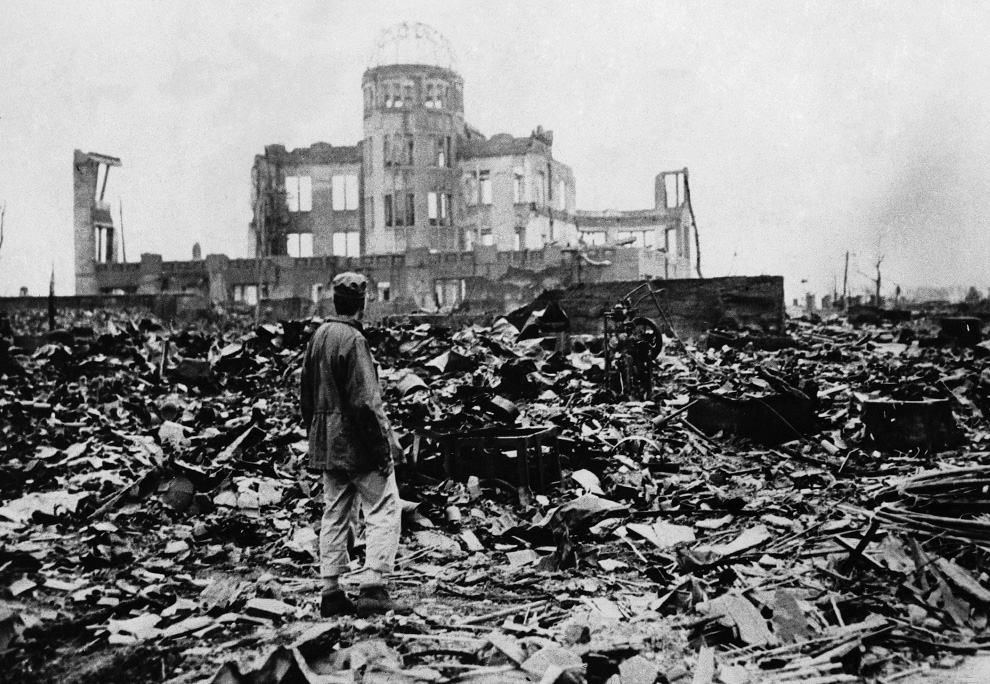
In a time when America lacks the strength of will to force an active-duty Army officer (and admitted terrorist) to shave his jihadist beard before appearing at a court-martial, when we wring our hands in guilt over the use of the most precise weapons ever devised against an enemy of unquestioned cruelty and malice, and when we respond to threats with weakness that merely encourages greater violence, it’s worth remembering a time when this nation understood the necessity — the moral necessity — of decisive force.
By July 26, 1945, Imperial Japan was well on its way to defeat, yet it was still capable of great harm. Our navy (with the able and courageous British assistance) had swept the once-fearsome Japanese navy from the seas, and we were slowly destroying Japan’s capacity to wage war. Allied forces were on the move in Southeast Asia, the Soviet Union was poised to enter the conflict with overwhelming force (1.5 million men massed on the border of Japanese-held mainland territory), and the American army was barely a month removed from a decisive victory in the months-long battle for Okinawa. Japan was going to lose the war. It was inevitable.
That was the good news. But that good news was more than tempered by the bad news of the cost of that ultimate victory. It’s tough for us to understand now, as many Americans have spent time in the new Japan, buy Japanese products, and rightly regard Japan as an indispensable ally, but in World War II the Japanese military fought with a ferocity that made al-Qaeda look casual and uncommitted. In Okinawa, the Japanese hurled more than 1,000 kamikaze suicide bombers at the American fleet, and tens of thousands more kamikazes readied to defend the Japanese home islands. Japan still held huge swathes of Chinese territory, where unrelenting war and mass-scale atrocities had already cost more than 10 million Chinese lives.
Just as disturbing, recent American experience in Saipan and Okinawa had illustrated the extent to which the Japanese civilian population would suffer in any further close combat. By some counts, up to one-third of the total civilian population of Okinawa died during the American invasion, many by suicide as parents killed children, then themselves, rather than fall into allied hands. At Saipan, Japanese civilians committed suicide by the hundreds — sometimes cutting their own children’s throats — persuaded by Japanese propaganda that Americans would commit unspeakable atrocities against civilians. Assuming similar behavior during an invasion, estimates of additional Japanese casualties ran into the millions — with American casualty estimates wildly varying but certainly no less than hundreds of thousands.
Faced with the twin realities of inevitable Japanese defeat and staggering civilian and military casualties, the allies did the right thing: On July 26, they issued a surrender demand, the Potsdam Declaration.
The Japanese rejected it, the atomic bombs followed roughly two weeks later, and the war ended.
It’s difficult to estimate the millions of lives those bombs saved, and the uncounted millions of descendants that live today as a result of America’s decisive application of force. But the benefits go beyond a mere calculus of lives saved, American total war didn’t just defeat Japanese militarism on the battlefield, it destroyed it as a credible world view, as a credible moral force in Japanese life. This rejection of aggressive militarism has yielded incalculable benefits not just for generations of Japanese but also for generations of Koreans and Chinese — nations that had suffered under Japanese oppression.
As we confront once again the anniversary of Hiroshima and Nagasaki, and as America’s critics decry our alleged barbarism, it’s worth remembering that weakness has terrible costs, and moral critics of decisive force should wrestle with that cost rather than utter platitudes like the U.N. did this week:
True security is based on people’s welfare and not on military annihilation, senior United Nations officials said today, marking the 68th anniversary of the atomic bombing of Hiroshima and later Nagasaki, and honouring the survivors of the bombings known as ‘hibakusha.’
“We are united in countering the erroneous view that security is achieved through the pursuit of military dominance and threats of mutual annihilation,”Secretary-GeneralBan Ki-moon said in his message to the Hiroshima Peace Memorial Ceremony.
He added that security is based on a thriving economy, strong public health and education programmes, and on fundamental respect for our common humanity, and not on military prowess.
Japan and Germany were, of course, industrially advanced countries — among the richest in the world — when they launched their wars of aggression. Today’s terrorists, though not nearly as formidable as Nazi Germany or Imperial Japan, hardly conform to the stereotype of the disenfranchised poor lashing out in desperation. Food stamps and single-payer health care aren’t firewalls against evil, and we’re fools if we entertain that belief.
As the horror of World War II begins to fade into distant memory, it’s imperative that we not let the Left control the narrative. Already in pacifist Christian circles, I’ve seen historically illiterate professors and pundits condemn the Hiroshima bombing with greater ferocity than they condemn the rape of Nanking, much less Japan’s years-long reign of terror in China. Our nation dialogues with (and funds) Holocaust-denying jihadists and displays little more than worried impotence as a hostile and hateful Iranian regime races towards an atomic bomb.
As a result, this generation or a generation to come may once again confront a series of terrible choices (I pray not involving nuclear weapons), but as they consider those choices, they should remember not just the Enola Gay, but the entire strength of this nation — fully at war — in 1945. Remember the lives we saved, and remember the far better societies that rose from the ashes.
In the fight against evil, there are times when the strong response is the right response.
Originally posted on National Review Online.
Previous Post

August 6, 2013
Celebrate Me - I'm Childless!
Next Post
August 9, 2013 This Ad Almost Makes Me Want to Buy a Mobile Home
Browse Our Archives
Select a Category Christmas faith family ministry music Television Uncategorized
Select a Month June 2017 May 2017 April 2017 March 2017 February 2017 January 2017 December 2016 November 2016 October 2016 September 2016 August 2016 July 2016 June 2016 May 2016 April 2016 March 2016 February 2016 January 2016 December 2015 November 2015 October 2015 September 2015 August 2015 July 2015 June 2015 May 2015 April 2015 March 2015 February 2015 January 2015 December 2014 November 2014 October 2014 September 2014 August 2014 July 2014 June 2014 May 2014 April 2014 March 2014 February 2014 January 2014 December 2013 November 2013 October 2013 September 2013 August 2013 July 2013 June 2013 May 2013 April 2013 March 2013 February 2013 January 2013 December 2012 November 2012 October 2012 September 2012 August 2012 July 2012 June 2012 May 2012 April 2012 March 2012 February 2012 January 2012 December 2011 November 2011 October 2011 September 2011 August 2011 July 2011 March 2010
Follow Us!
TAKE THE
Religious Wisdom Quiz
What did Hannah bring annually for Samuel when he lived at the Tabernacle?
Select your answer to see how you score.
A candle A staff A robe A crown
Related posts from The French Revolution

Yes, Drone Strikes are Legal and Moral

"Is the God of Calvinism a Moral Monster?"
Three Reasons Why Nobel Peace Prize Winners Are...

Should Anabaptists be in Afghanistan?
TRENDING AT PATHEOS Politics and Religion

Christians should care about politics. Here are 4...
How can Christians best engage with politics in a way that shows...

For Abortion "Rights" Advocates - a Compromise
For pro-life conservatives, it’s like a dream come true. For pro-choice feminazis...

Cornerstone Pastor Issues Apology - GOOD
The apology was warranted. The follow-up is essential. A week ago, the...

From a Conservative to Conservatives on President Trump...
I am a conservative, a Republican, and an evangelical Christian, and I...
view all Politics and Religion blogs
Ad-Free & Subscriber Log-In Subscription Support
- About Us
- 2026 Calendar
- Videos
- Podcasts
- Library of World Religions
- Faith In Media Tracker
- Advertise With Us
- Write for Us
- Privacy Policy
- Terms of Service
- Do Not Sell My Data
- Contact Us
- Radiant Digital
- Manage Newsletter Subscriptions
- Unsubscribe From Notifications
- Sitemap
Copyright 2008-2026, Patheos. All rights reserved.
Subscription Support Ad-Free & Subscriber Log-In
Follow Patheos