
BuddhistCatholicContemplativeEvangelicalGeneral ChristianHinduJewishLatter-day SaintMuslimNew VisionsProgressive Christian
Beliefs
- Buddhist
- Catholic
- Contemplative
- Evangelical
- General Christian
- Hindu
- Jewish
- Latter-day Saint
- More Voices
- Muslim
- New Visions
- Pagan
- Progressive Christian
Topics
- Religion News
- Food and Religion
- Sports and Religion
- Religious Art
- Religious Music and Entertainment
- Religious Events
- History and Religion
- Style and Religion
- Politics and Religion
- Women in Religion
- Recreation Outdoors and Religion
- Business Finance and Religion
- Careers Workplace and Religion
- Education and Religion
- Family Parenting and Religion
- Health Fitness and Religion
- Home and Religion
- Relationships and Religion
- Technology and Religion
- Travel and Religion
Columnists
- Buddhist Columnists
- Business Finance and Religion Columnists
- Careers Workplace and Religion Columnists
- Catholic Columnists
- Contemplative Columnists
- Education and Religion Columnists
- Evangelists Columnists
- Family Parenting and Religion Columnists
- General Christian Columnists
- Health Fitness and Religion Columnists
- Hindu Columnists
- History and Religion Columnists
- Home and Religion Columnists
- Jewish Columnists
- More Voices Columnists
- Latter Day Columnists
- Muslim Columnists
- New Visions Columnists
- Nonreligious Columnists
- Pagan Columnists
- Politics and Religion Columnists
- Progressive Columnists
- Recreation Outdoors and Religion Columnists
- Relationships and Religion Columnists
- Religion News Columnists
- Religious Art Columnists
- Religious Events Columnists
- Religious Music and Entertainment Columnists
- Sports and Religion Columnists
- Style and Religion Columnists
- Technology and Religion Columnists
- Travel and Religion Columnists
- Women in Religion Columnists
Resource Library
- 2026 Calendar
- Library of World Religions
- The 100 Most Holy Places on Earth
- Patheos Answers
- Podcasts
- Videos
- Faith Leaders Database
- Anglican Episcopalian
- Bahai
- Baptist
- Buddhism
- Christianity
- Confucianism
- Eastern Orthodoxy
- Hinduism
- Holiness and Pentecostal
- ISKCON
- Islam
- Judaism
- Lutheran
- Methodist
- The Church of Jesus Christ of Latter-day Saints
- New Age
- Paganism
- Presbytarian and Reformed
- Protestantism
- Religion Behind the Scenes
- Roman Catholic
- Scientology
- Shia Islam
- Sikhism
- Sufism
- Sunni Islam
- Taoism
- Zen
- See all religions
Research Tools
 Ad-Free & Subscriber Log-In Subscription Support
Ad-Free & Subscriber Log-In Subscription Support
Follow Patheos 

- Trending:
- Forgiveness
- |
- Marriage
- |
- Consciousness
- |
- Death Penalty
- |
- Election
- |
- Halloween

- Home
- Progressive Christian
- WTF Is This??–A story about change
WTF Is This??–A story about change
Last updated on: September 20, 2020 at 12:12 pm by Vance Morgan
WTF Is This??–A story about change 2020-09-20T12:12:53-04:00 Vance Morgan
Patheos Explore the world's faith through different perspectives on religion and spirituality! Patheos has the views of the prevalent religions and spiritualities of the world.
Organized religion often is a source of packaged answers and comfortable solutions to important questions about God and ourselves. Today’s lectionary reading from the Jewish scriptures is one of my favorites.. It suggests that eventually such answers and solutions must be left behind.
In Exodus, the Israelites (who were miraculously delivered from the pursuing Egyptian armies by the parting of the Red Sea a few chapters earlier), are complaining. And with good reason, because they are hungry in the middle of a desert with no food in sight—and as far as they are concerned, it’s God’s fault. “At least when we were slaves in Israel, we had enough food to eat,” they moan—which may be a case of selective memory.
God’s solution to their predicament is direct and, to me at least, somewhat amusing. “You want food?? I’ll drop so much meat on you in the evening and so much bread in the morning that you won’t be able to figure out what to do with it all!” The white material left on the bushes and ground after the dew evaporates is confusing to the Israelites—“WTF is this??” they ask. “Man hu” in Hebrew, from which we get the word “manna.”
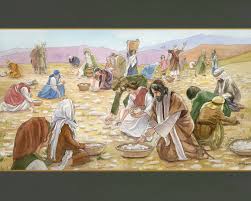
Manna turns out to be an Israelite culinary staple for the four decades of wandering in the wilderness. Not surprisingly, they get sick of eating the same damn thing for every meal—in Numbers, their dissatisfaction with their diet plays an important role in the development of a new leadership structure for the tribes. We find the liberated Israelites complaining—again. Everyone is pining for the wonderful variety of food they remember eating in Egypt. “We remember the fish we used to eat in Egypt for nothing, the cucumbers, the melons, the leeks, the onions, and the garlic; but now our strength is dried up, and there is nothing at all but this manna to look at.”
Of course, they have conveniently forgotten that when they were in Egypt, they were freaking slaves. God is understandably pissed (this is not the first time these complaints have arisen), and Moses is also annoyed. But Moses’ annoyance isn’t just with this rabble of complainers he is in charge of; he’s had it up to here with the Big Guy as well. He’s feeling overworked, overstressed, and unappreciated. After some negotiation with God and some creative input from Moses’ father-in-law Jethro, a new bureaucratic structure of authority is devised and everyone is happy—until the next time.
We discover in the Gospel of John that the Jews of Jesus’ day still took great pride in the fact that God loved their ancestors so much that they were fed for forty years with heavenly miracle food. But, as Jesus tells his Jewish brethren, eating manna apparently wasn’t that special. “Your fathers ate the manna in the wilderness, and they died.” Manna was a temporary stopgap to address an immediate need, not something to memorialize or interpret as proof that you are special.
If the Jews of Jesus’ day had been more familiar with their own scriptures, they would have known that God is no longer in the manna business. In the book of Joshua we learn that, at least with reference to the children of Israel, God went out of that business as soon as the Israelites crossed the Jordan River. Early in the book, the Israelites cross that river and enter the land that has been promised to them, even though it is already occupied by nomadic tribes and city dwellers who are under the apparently mistaken impression that since they already have been living there for generations, it belongs to them.
After forty years of wandering in the wilderness, a whole generation of Israelites has been born and grown to adulthood who are unfamiliar with the formative traditions underlying their heritage. First, the males of the new generation are all circumcised. After a short recovery period (recently circumcised guys aren’t going to be very good soldiers or anything else), everyone is wondering “What’s next?”
While the Israelites were camped . . . they kept the Passover in the plains of Jericho. On the day after the Passover, on the very day, they ate the produce of the land, unleavened bread and parched grain. The manna ceased on the day they ate the produce of the land, and the Israelites no longer had manna; they ate the crops of the land of Canaan that year.
It is worth noting that on the day after the Israelites celebrated Passover, the very day the manna dried up, “they ate the produce of the land.” In other words, they raided the fields of the people already living in Canaan—the Israelites had just shown up and had no grain-producing fields of their own yet. When the divine handouts and support systems dry up, one needs to get creative.
The story of manna is both a coming-of-age story and a cautionary tale about not holding on to the old when the new is right in front of us. It could also be required reading for people who for a time are deservedly dependent on various social support systems and might be tempted to stay on the dole indefinitely. But I am most interested in the story’s spiritual and psychological implications. My Baptist preacher father used to challenge his conservative listeners to “get out of the nursery” and spiritually grow up, noting that a thirty-five-year-old person still in diapers and sucking on a baby bottle would be a rather sad sight.
Yet that’s precisely what traditional religion often does for those it welcomes through its doors. It provides a lifetime of packaged answers and canned responses to important questions about what is greater than us when after a certain time individuals should be struggling with these questions without their hands being perpetually held. I remember being told as a kid in Sunday School that if the Israelites had taken the most natural direct route from Egypt to the Promised Land, it would have taken them no more than a few weeks. Instead it took them forty years, at least partially because they got used to living on divine handouts and the equivalent of nourishing baby food. The spiritual and psychological equivalent of manna is spooned out to the congregation in many churches every Sunday.
What is going to replace the reliable divine infusions that are no longer available? It could be anything, including what might seem to be “out of bounds.” In the following chapters of Joshua, the Israelites engage in their first skirmish among many in the extended occupation-of-Canaan campaign that takes up the rest of the book—they lay siege to the walled city of Jericho. With help from a prostitute (who turns out to be a direct ancestor of Jesus) and by marching around the city until the walls fall down, Jericho is taken. Apparently divine help is still available—it just isn’t going to come in the package that we have become accustomed to.
Previous Post

September 17, 2020
The Dangers of Cognitive Immorality
Next Post

September 22, 2020 Don't Be a One Issue Voter--even if that issue is abortion
Browse Our Archives
Select a Category abortion Advent AI Angels Artificial intelligence atheism attention baptism Baptists beauty belief Benedictines Bible bicycling Big Bird books Bovina Camaldoli hermitage Canada Catholicism cats certainty change Christianity Christmas Collegeville Covid-19 creativity Development of Western Civilization dogs doubt Easter Enneagram Epiphany Episcopal ethics Eucharist evil extroverts Facebook faith family fear flowers forgiveness freedom friends God goodness grace happiness heaven hell history Holy Spirit Holy Week hope human nature humility humor idolatry incarnation introverts irreverence Islam Jeanne Jesus Joe Biden joy Judaism justice Kamala Harris knowledge Lent listen literature liturgy love Marsue Memorial Day miracles movies music mystery mythology NPR Old Testament optimism paradox peace Penguins philosophy piano podcast politics power prayer Protestantism Providence College Religion Rhode Island sabbatical sacrament science seeing silence Simone Weil Socrates soul sports St. John's College stories suffering tattoo teaching technology television theology thinking time tolerance transcendence travel trees trust truth Uncategorized Vermont wisdom wonder writing
Select a Month May 2026 April 2026 March 2026 February 2026 January 2026 December 2025 November 2025 October 2025 September 2025 August 2025 July 2025 June 2025 May 2025 April 2025 March 2025 February 2025 January 2025 December 2024 November 2024 October 2024 September 2024 August 2024 July 2024 June 2024 May 2024 April 2024 March 2024 February 2024 January 2024 December 2023 November 2023 October 2023 September 2023 August 2023 July 2023 June 2023 May 2023 April 2023 March 2023 February 2023 January 2023 December 2022 November 2022 October 2022 September 2022 August 2022 July 2022 June 2022 May 2022 April 2022 March 2022 February 2022 January 2022 December 2021 November 2021 October 2021 September 2021 August 2021 July 2021 June 2021 May 2021 April 2021 March 2021 February 2021 January 2021 December 2020 November 2020 October 2020 September 2020 August 2020 July 2020 June 2020 May 2020 April 2020 March 2020 February 2020 January 2020 December 2019 November 2019 October 2019 September 2019 August 2019 July 2019 June 2019 May 2019 April 2019 March 2019 February 2019 January 2019 December 2018 November 2018 October 2018 September 2018 August 2018 July 2018 June 2018 May 2018 April 2018 March 2018 February 2018 January 2018 December 2017 November 2017 October 2017 September 2017 August 2017 July 2017 June 2017 May 2017 April 2017 March 2017 February 2017 January 2017 December 2016 November 2016 October 2016 September 2016 August 2016 July 2016 June 2016 May 2016 April 2016 March 2016 February 2016 January 2016 December 2015 November 2015 October 2015 September 2015 August 2015 July 2015 June 2015 May 2015 April 2015 March 2015 February 2015 January 2015 December 2014 November 2014 October 2014 September 2014 August 2014 July 2014 June 2014 May 2014 April 2014 March 2014 February 2014 January 2014 December 2013 November 2013 October 2013 September 2013 August 2013 July 2013 June 2013 May 2013 April 2013 March 2013 February 2013 January 2013 December 2012 November 2012 October 2012 September 2012
Follow Us!
TAKE THE
Religious Wisdom Quiz
I saw the Lord seated on a throne, high and exalted, while six-winged beings called out 'Holy, holy, holy.' What were these creatures?
Select your answer to see how you score.
Leviathan Cherubim Seraphim Angels
Books by This Author Books by Vance G. Morgan
Related posts from Freelance Christianity

The Lonely Pawn: On Faith, Doubt, and Meaning


AI and Love: When a Chatbot Becomes a...

TRENDING AT PATHEOS Progressive Christian

What Being a Modern-Day Apostle Means to Me
In my last column, I discussed the ins and outs of modern-day...

Did Ancient China Once Worship the God of...
Across human history, a common thread weaves through the origins of the...

Love Your Neighbor – Including Earth-Kin: Lev. 19,...
God’s command to love your neighbor means acting in an ethical and...

Lead a Church Study of “Jesus and Lao...
Guest writer Jack Thomas (The Irreverent Reverend) reflects on leading his church...

Pastoral Wisdom for Responding to Sermon Pushback
Getting sermon pushback on your social justice sermon? Learn practical, Proverbs-based strategies...

Principles for Understanding the Apostolic Ministry Today
Whenever people discover that my formal ministry title is "apostle," as in...
view all Progressive Christian blogs
Ad-Free & Subscriber Log-In Subscription Support
- About Us
- 2026 Calendar
- Videos
- Podcasts
- Library of World Religions
- Faith In Media Tracker
- Advertise With Us
- Write for Us
- Privacy Policy
- Terms of Service
- Do Not Sell My Data
- Contact Us
- Radiant Digital
- Manage Newsletter Subscriptions
- Unsubscribe From Notifications
- Sitemap
Copyright 2008-2026, Patheos. All rights reserved.
Subscription Support Ad-Free & Subscriber Log-In
Follow Patheos