
BuddhistCatholicContemplativeEvangelicalGeneral ChristianHinduJewishLatter-day SaintMuslimNew VisionsProgressive Christian
Beliefs
- Buddhist
- Catholic
- Contemplative
- Evangelical
- General Christian
- Hindu
- Jewish
- Latter-day Saint
- More Voices
- Muslim
- New Visions
- Pagan
- Progressive Christian
Topics
- Religion News
- Food and Religion
- Sports and Religion
- Religious Art
- Religious Music and Entertainment
- Religious Events
- History and Religion
- Style and Religion
- Politics and Religion
- Women in Religion
- Recreation Outdoors and Religion
- Business Finance and Religion
- Careers Workplace and Religion
- Education and Religion
- Family Parenting and Religion
- Health Fitness and Religion
- Home and Religion
- Relationships and Religion
- Technology and Religion
- Travel and Religion
Columnists
- Buddhist Columnists
- Business Finance and Religion Columnists
- Careers Workplace and Religion Columnists
- Catholic Columnists
- Contemplative Columnists
- Education and Religion Columnists
- Evangelists Columnists
- Family Parenting and Religion Columnists
- General Christian Columnists
- Health Fitness and Religion Columnists
- Hindu Columnists
- History and Religion Columnists
- Home and Religion Columnists
- Jewish Columnists
- More Voices Columnists
- Latter Day Columnists
- Muslim Columnists
- New Visions Columnists
- Nonreligious Columnists
- Pagan Columnists
- Politics and Religion Columnists
- Progressive Columnists
- Recreation Outdoors and Religion Columnists
- Relationships and Religion Columnists
- Religion News Columnists
- Religious Art Columnists
- Religious Events Columnists
- Religious Music and Entertainment Columnists
- Sports and Religion Columnists
- Style and Religion Columnists
- Technology and Religion Columnists
- Travel and Religion Columnists
- Women in Religion Columnists
Resource Library
- 2026 Calendar
- Library of World Religions
- The 100 Most Holy Places on Earth
- Patheos Answers
- Podcasts
- Videos
- Faith Leaders Database
- Anglican Episcopalian
- Bahai
- Baptist
- Buddhism
- Christianity
- Confucianism
- Eastern Orthodoxy
- Hinduism
- Holiness and Pentecostal
- ISKCON
- Islam
- Judaism
- Lutheran
- Methodist
- The Church of Jesus Christ of Latter-day Saints
- New Age
- Paganism
- Presbytarian and Reformed
- Protestantism
- Religion Behind the Scenes
- Roman Catholic
- Scientology
- Shia Islam
- Sikhism
- Sufism
- Sunni Islam
- Taoism
- Zen
- See all religions
Research Tools
 Ad-Free & Subscriber Log-In Subscription Support
Ad-Free & Subscriber Log-In Subscription Support
Follow Patheos 

- Trending:
- Forgiveness
- |
- Marriage
- |
- Consciousness
- |
- Death Penalty
- |
- Election
- |
- Halloween

- Home
- Progressive Christian
- Why Jesus was Obsessed with Outsiders
Why Jesus was Obsessed with Outsiders
Last updated on: January 24, 2022 at 4:00 pm by Vance Morgan
Why Jesus was Obsessed with Outsiders 2022-01-24T14:43:45-04:00 Vance Morgan
Patheos Explore the world's faith through different perspectives on religion and spirituality! Patheos has the views of the prevalent religions and spiritualities of the world.
The first text in the new “Faith and Doubt” colloquium that I am team-teaching this semester was Anne Lamott’s Plan B: Further Thoughts on Faith. Plan B is a sequel to Traveling Mercies: Some Thoughts on Faith; I remember clearly when, a number of years ago, I picked up Traveling Mercies from a table of new paperbacks in Borders (back when Borders still existed). I’m always drawn to any book outside the Religion, Theology, Spirituality, or New Age section of a bookstore with the F-word in it, so I took a look. It contained many of the things that I love when reading a book from the “Spirituality” section: irreverence, sarcasm, God-obsession, brutal honesty, social activism, a heart of gold . . . what’s not to like?
As I frequently do when I discover an author, I immediately purchased and read everything Lamott had ever published; over the subsequent years I have waited anxiously for her next publication. I can take or leave her fiction, but her non-fiction comes closer to what I’d like to be able to write myself of anything I’ve ever read. In fact, the best compliment I have ever received concerning my writing is when a colleague, as we were having a couple of afternoon libations at a local watering hole, told me that my essays reminded him of Anne Lamott’s work. I picked up the tab.
A while after discovering Anne Lamott, I came across an equally irreverent voice on the spiritual landscape when I read Pastrix, by Nadia Bolz-Weber. Nadia is what Anne Lamott would have been had she become an ordained Lutheran minister and started her own church. Bolz-Weber came to my attention when, as we were our way to the early show at church one Sunday, Jeanne and I caught a few minutes of Krista Tippett’s NPR show “On Being.”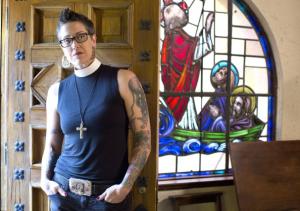
Nadia Bolz-Weber was the guest on this particular Sunday; she’s the tattoo-and-piercings covered, former addict and stand-up comedian Lutheran founder and pastor of the House for All Sinners and Saints (HFASS) church in Denver (a position which she resigned about a year ago in order to pursue new possibilities). She has a sleeve tattoo of the entire liturgical year on her right arm. Things work a bit differently at HFASS, including a blessing of the bicycles liturgy, a chocolate fountain in the baptismal font on Easter, and an occasional event called “Beer and Hymns.” The five or so minutes’ worth of the show we heard on the way to church prompted Jeanne and me to listen to the whole broadcast online once we returned home.
Pastrix is part memoir, part popular theology, and filled with truth that alternates between hilarious, penetratinkristag, and heart-breaking—often on the same page. How can you not love a book by a minister whose first sentence is “‘Shit,’ I thought to myself, ‘I’m going to be late to New Testament class’”? Put that together with an f-bomb or two in each chapter (Nadia’s vocabulary is a bit earthier than Anne Lamott’s, at last in print), and the book is a roller-coaster ride from beginning to end. There are portions that are surprising, jerked me up short, and caused me to think carefully about our natural human self-righteousness and smugness—something that I find myself afflicted by on a regular basis.
Bolz-Weber relates an amusing but telling story about how her open-armed and welcoming attitudes toward all comers to her church was seriously challenged once the word got out that Sunday at the House of All Saints and Sinners was something worth checking out. This church’s raison d’etre is to be a sanctuary and safe haven for persons who have been damaged and rejected by all sorts of churches of every imaginable denomination and description. Outsiders of every stripe—race, sexual orientation, gender, disability, drug addiction, alcoholism, you name it—these are the people who are the founding members of HFASS (as they call it). Creative liturgies and each parishioner having the opportunity to do whatever they feel led to do on a given Sunday (including delivering the sermon) create a dynamic atmosphere of inclusion that cannot help but attract attention. Bolz-Weber has become a rock star and a speaker in great demand (she has also written several more books since Pastrix).
Before long, different sorts of people started showing up for Sunday services—people in suits, soccer moms with well-scrubbed kids in tow, Denver’s equivalent of Wall Street executives—the sorts of folks that one might find in any church on any Sunday morning. And Bolz-Weber was pissed. “I don’t want these people here,” she thought. “My outsider congregation, the people for whom I started this ministry, are going to feel uncomfortable. The newcomers aren’t going to fit in with our free-wheeling, out-of-the-box liturgies.”
As she considered more fully, Nadia realized that she was struggling with a question at least as old as the church itself; as she writes, “Disagreements about ‘inclusion’—about who is in and who is out–began approximately twenty minutes after Christianity started.” Why? Because no matter how open-minded and loving we think we are, no one is comfortable with everyone being included in anything. As Nadia says, “I will always encounter people whom I don’t want in the tent with me.”
Yet we are admonished over and over again in the gospels to pay special attention to the outsider, the disenfranchised, those who fall through the cracks no matter what social or religious scheme is operative. Why? Is the outsider, the person radically different from those in my tent, better than me? With the help of Rowan Williams, former Archbishop of Canterbury, I’m beginning to suspect that something different is going on.
Williams suggests that Jesus’s apparent obsession with the outsider is a reminder of our human limitations and inability to create a world in which everyone is included, despite our best efforts and intentions. These limitations show us where the divine resides.
God appears in and through the fact that our ways of arranging the world always leave someone’s interest, welfare or reality out of account. We cannot organize our world so as to leave everyone a possible place. We are unavoidably bound to exclusion as we try to give form to our social and moral life.
Every time I organize my world in a way that makes sense to me, vast categories of human beings fall by the wayside. If I am willing to include those persons in my world only if they are willing to conform to my agenda for them, I am saying, or implying at least, that my peculiar and particular vision of what is right is the only possible vision. Williams writes that the greater and holier challenge is to forego any presumption that I know what is best and to realize instead that
The outsider’s very presence poses a question that reminds me that my account of things, my way of making the world all right and manageable, is an incomplete enterprise that is keeping out God because it lets in the subtle temptation to treat my perspective as if it were God’s.
Strangely enough, the best intended efforts to institutionalize or organize God’s will on earth are always doomed to failure precisely because the divine cannot be institutionalized. Our efforts to bring the gospel into the world must begin with recognizing our own human limitations. Rowan Williams once again:
God is in the connections we cannot make . . . The person who is ‘left over’ . . . reminds me of my own limits; and as I acknowledge the incomplete character of my world of reference and my understanding, I may at least see the seriousness of the question about the fate of those not catered for.
Previous Post
January 23, 2022
The Words of Our Mouths and the Meditation of Our Hearts
Next Post
January 27, 2022 Raised on Original Sin
Browse Our Archives
Select a Category abortion Advent AI Angels Artificial intelligence atheism attention baptism Baptists beauty belief Benedictines Bible bicycling Big Bird books Bovina Camaldoli hermitage Canada Catholicism cats certainty change Christianity Christmas Collegeville Covid-19 creativity Development of Western Civilization dogs doubt Easter Enneagram Epiphany Episcopal ethics Eucharist evil extroverts Facebook faith family fear flowers forgiveness freedom friends God goodness grace happiness heaven hell history Holy Spirit Holy Week hope human nature humility humor idolatry incarnation introverts irreverence Islam Jeanne Jesus Joe Biden joy Judaism justice Kamala Harris knowledge Lent listen literature liturgy love Marsue Memorial Day miracles movies music mystery mythology NPR Old Testament optimism paradox peace Penguins philosophy piano podcast politics power prayer Protestantism Providence College Religion Rhode Island sabbatical sacrament science seeing silence Simone Weil Socrates soul sports St. John's College stories suffering tattoo teaching technology television theology thinking time tolerance transcendence travel trees trust truth Uncategorized Vermont wisdom wonder writing
Select a Month May 2026 April 2026 March 2026 February 2026 January 2026 December 2025 November 2025 October 2025 September 2025 August 2025 July 2025 June 2025 May 2025 April 2025 March 2025 February 2025 January 2025 December 2024 November 2024 October 2024 September 2024 August 2024 July 2024 June 2024 May 2024 April 2024 March 2024 February 2024 January 2024 December 2023 November 2023 October 2023 September 2023 August 2023 July 2023 June 2023 May 2023 April 2023 March 2023 February 2023 January 2023 December 2022 November 2022 October 2022 September 2022 August 2022 July 2022 June 2022 May 2022 April 2022 March 2022 February 2022 January 2022 December 2021 November 2021 October 2021 September 2021 August 2021 July 2021 June 2021 May 2021 April 2021 March 2021 February 2021 January 2021 December 2020 November 2020 October 2020 September 2020 August 2020 July 2020 June 2020 May 2020 April 2020 March 2020 February 2020 January 2020 December 2019 November 2019 October 2019 September 2019 August 2019 July 2019 June 2019 May 2019 April 2019 March 2019 February 2019 January 2019 December 2018 November 2018 October 2018 September 2018 August 2018 July 2018 June 2018 May 2018 April 2018 March 2018 February 2018 January 2018 December 2017 November 2017 October 2017 September 2017 August 2017 July 2017 June 2017 May 2017 April 2017 March 2017 February 2017 January 2017 December 2016 November 2016 October 2016 September 2016 August 2016 July 2016 June 2016 May 2016 April 2016 March 2016 February 2016 January 2016 December 2015 November 2015 October 2015 September 2015 August 2015 July 2015 June 2015 May 2015 April 2015 March 2015 February 2015 January 2015 December 2014 November 2014 October 2014 September 2014 August 2014 July 2014 June 2014 May 2014 April 2014 March 2014 February 2014 January 2014 December 2013 November 2013 October 2013 September 2013 August 2013 July 2013 June 2013 May 2013 April 2013 March 2013 February 2013 January 2013 December 2012 November 2012 October 2012 September 2012
Follow Us!
TAKE THE
Religious Wisdom Quiz
Which Old Testament prophet called fire down from heaven?
Select your answer to see how you score.
Elisha Moses Elijah Isaiah
Books by This Author Books by Vance G. Morgan
Related posts from Freelance Christianity

The Lonely Pawn: On Faith, Doubt, and Meaning


AI and Love: When a Chatbot Becomes a...

TRENDING AT PATHEOS Progressive Christian

What Being a Modern-Day Apostle Means to Me
In my last column, I discussed the ins and outs of modern-day...

Did Ancient China Once Worship the God of...
Across human history, a common thread weaves through the origins of the...

Love Your Neighbor – Including Earth-Kin: Lev. 19,...
God’s command to love your neighbor means acting in an ethical and...

Lead a Church Study of “Jesus and Lao...
Guest writer Jack Thomas (The Irreverent Reverend) reflects on leading his church...

Pastoral Wisdom for Responding to Sermon Pushback
Getting sermon pushback on your social justice sermon? Learn practical, Proverbs-based strategies...

Principles for Understanding the Apostolic Ministry Today
Whenever people discover that my formal ministry title is "apostle," as in...
view all Progressive Christian blogs
Ad-Free & Subscriber Log-In Subscription Support
- About Us
- 2026 Calendar
- Videos
- Podcasts
- Library of World Religions
- Faith In Media Tracker
- Advertise With Us
- Write for Us
- Privacy Policy
- Terms of Service
- Do Not Sell My Data
- Contact Us
- Radiant Digital
- Manage Newsletter Subscriptions
- Unsubscribe From Notifications
- Sitemap
Copyright 2008-2026, Patheos. All rights reserved.
Subscription Support Ad-Free & Subscriber Log-In
Follow Patheos