
BuddhistCatholicContemplativeEvangelicalGeneral ChristianHinduJewishLatter-day SaintMuslimNew VisionsProgressive Christian
Beliefs
- Buddhist
- Catholic
- Contemplative
- Evangelical
- General Christian
- Hindu
- Jewish
- Latter-day Saint
- More Voices
- Muslim
- New Visions
- Pagan
- Progressive Christian
Topics
- Religion News
- Food and Religion
- Sports and Religion
- Religious Art
- Religious Music and Entertainment
- Religious Events
- History and Religion
- Style and Religion
- Politics and Religion
- Women in Religion
- Recreation Outdoors and Religion
- Business Finance and Religion
- Careers Workplace and Religion
- Education and Religion
- Family Parenting and Religion
- Health Fitness and Religion
- Home and Religion
- Relationships and Religion
- Technology and Religion
- Travel and Religion
Columnists
- Buddhist Columnists
- Business Finance and Religion Columnists
- Careers Workplace and Religion Columnists
- Catholic Columnists
- Contemplative Columnists
- Education and Religion Columnists
- Evangelists Columnists
- Family Parenting and Religion Columnists
- General Christian Columnists
- Health Fitness and Religion Columnists
- Hindu Columnists
- History and Religion Columnists
- Home and Religion Columnists
- Jewish Columnists
- More Voices Columnists
- Latter Day Columnists
- Muslim Columnists
- New Visions Columnists
- Nonreligious Columnists
- Pagan Columnists
- Politics and Religion Columnists
- Progressive Columnists
- Recreation Outdoors and Religion Columnists
- Relationships and Religion Columnists
- Religion News Columnists
- Religious Art Columnists
- Religious Events Columnists
- Religious Music and Entertainment Columnists
- Sports and Religion Columnists
- Style and Religion Columnists
- Technology and Religion Columnists
- Travel and Religion Columnists
- Women in Religion Columnists
Resource Library
- 2026 Calendar
- Library of World Religions
- The 100 Most Holy Places on Earth
- Patheos Answers
- Podcasts
- Videos
- Faith Leaders Database
- Anglican Episcopalian
- Bahai
- Baptist
- Buddhism
- Christianity
- Confucianism
- Eastern Orthodoxy
- Hinduism
- Holiness and Pentecostal
- ISKCON
- Islam
- Judaism
- Lutheran
- Methodist
- The Church of Jesus Christ of Latter-day Saints
- New Age
- Paganism
- Presbytarian and Reformed
- Protestantism
- Religion Behind the Scenes
- Roman Catholic
- Scientology
- Shia Islam
- Sikhism
- Sufism
- Sunni Islam
- Taoism
- Zen
- See all religions
Research Tools
 Ad-Free & Subscriber Log-In Subscription Support
Ad-Free & Subscriber Log-In Subscription Support
Follow Patheos 

- Trending:
- Forgiveness
- |
- Marriage
- |
- Consciousness
- |
- Death Penalty
- |
- Election
- |
- Halloween

- Home
- Progressive Christian
- Why Faith Can’t Avoid Being Political
Why Faith Can’t Avoid Being Political
Last updated on: December 15, 2024 at 7:00 am by Vance Morgan
Why Faith Can’t Avoid Being Political 2024-12-14T11:13:15-04:00 Vance Morgan
Patheos Explore the world's faith through different perspectives on religion and spirituality! Patheos has the views of the prevalent religions and spiritualities of the world.
I’ve been steering away from politics here ever since last month’s election and intend to continue doing so for the foreseeable future. Except for today. With the understanding that the incoming administration has put “doing something about immigration” at the top of its to do list, I am thinking today of a controversial nativity scene from five years ago.
When Claremont (California) United Methodist Church unveiled its annual outdoor Nativity during that Advent season, it caused a stir that made the news on virtually every national outlet and sparked a debate that raged on social media through Christmas. This was no traditional, baby-in-a-manger tableau. Instead, Joseph, Mary and the baby Jesus had been separated and locked up in individual chain-link pens, topped by barbed wire fencing.
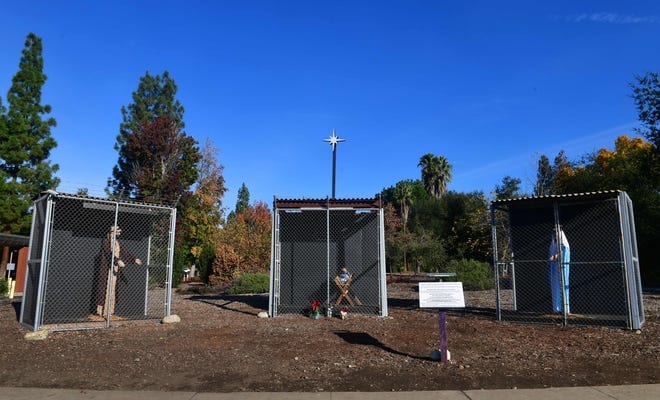
This Nativity scene was intended to reflect the plight of immigrants and asylum seekers whose families had been separated on our southern border; Rev. Karen Clark Ristine said that her congregation considered the point of the display to be theological rather than political. But as the LA Times reported,
The image has sparked a heated national debate about spiritual boundaries and moral commitments. Its caustic tenor online reflects the state of dialogue in this country today: warped by political divisions, riddled with gratuitous insults and sabotaged by self-righteousness.
It will come as no surprise that I found this Nativity scene to be entirely appropriate and well within the parameters of what my Christian faith commits me to challenging and pushing back against. But I am most interested, not in the political sides that were taken, but rather in those who were offended because of the Christmas story being used to make any political statement at all.
Many people, even those who are not Christian, want Christmas to be a season of respite from the demands of real life—our jobs, the 24-7 news screaming at us, and so on. These are not people for whom the holiday season is a time for capitalist gluttony at the mall; rather, it is a time to step back, try to breathe a bit deeper, watch Christmas movies, and plug in to the supposed message of the season: Peace on earth and good will toward all. Joy to the world and all of that.
I truly understand the sentiment and usually seek to live in the Advent zone of hopefulness and reflection. I get it. There is something about the classic, peaceful Nativity scene that evokes a sense of the sacred even in people who have little or no faith commitment. Jesus, Mary, and Joseph in cages disturbs all of that and makes us uncomfortable. Can’t we have at least one, tiny space in which we can have a few moments of peace? Is nothing sacred?
But such sentiments can easily turn into tuning out not only the distractions that threaten to consume us on a daily basis, but also the hard truths that stare us in our faces on a daily basis whether we want to see them or not. It is worth remembering that the sanitized, innocent, faux-reverent version of the Nativity story that we so badly want to preserve has little resemblance to the stories actually told in the Gospels, stories involving an unmarried pregnant teen, poverty, rejection, childbirth in a cave, fleeing persecution, and dead babies in the streets. If anything should make us uncomfortable, it is stories like that—as well as similar events in our own time. As the LA Times article notes, “It’s uncomfortable, but that’s what these Nativity scenes are intended to do: disturb us enough that we don’t let holiday trimmings obscure the need to act against the unjust and inhumane.”
Reading and hearing about the furor over this Nativity scene reminded me of one time when I listened to Krista Tippett interviewing Serene Jones for On Being. Serene Jones is the 16th president—the first female president—of Union Theological Seminary in New York City. Her conversation with Krista Tippett ranged over a number of important and fascinating issues, none more pressing than when the question was raised about whether faith and theology should ever intersect directly with public policy and politics. According to Serene Jones, faith and theology not only should be public, and hence political—they cannot help but be.
In the midst of a wide-ranging conversation, Jones speaks about the nature of theology—not the academic discipline, but the actual content of what one believes and is committed to about what is greater than us.
Good theology absolutely must be public theology. What is theology, if it’s not talking about our collective lives and the meaning and purpose of our lives and how we’re supposed to live together and who God is, in ways that are part of our conversation together? . . . Theology is always very personal . . . if you can’t make personal sense out of that, it doesn’t have any meaning. If it doesn’t weave into the story of your life, it’s just meaningless chatter.
In other words, your theology and faith, if they actually are more than simply a list of things to believe with little impact on your daily life, will shape and inform how you are in the public square. And this, Serene Jones continues, means that theology and faith are always political.
If you really believe this stuff about grace, if you really believe God loves everybody and the world, and forgives, ultimately, in mercy, everybody, it profoundly affects your politics . . . It’s thoroughly political, and in both the intimate and the political ways, it’s public.
If Jones is right about this, then the distinction that Rev. Ristine makes between theology and politics may be impossible to sustain. Theological commitments always shape our actions, which necessarily leads to social and political commitments.
Although I have written frequently in this blog about how my Christian faith leads directly to my liberal political and social commitments, that’s not my primary purpose today. Rather, my point is simply that our often-well-meaning attempts to make faith a “politics-free” zone are likely to fail, unless we are willing to sanitize and dilute faith to the point that it is little more than words. Instead of seeking to separate the sacred from the secular, persons of faith should be willing to demonstrate in various public ways how their theology informs their daily lives. I understand the discomfort some people feel when the innocent image of the Nativity is recast to spotlight troubling moral issues. But as I often tell my students when in the middle of discussing challenging issues, comfort is vastly overrated.
Previous Post
December 13, 2024
How to be Hopeful
Next Post

December 17, 2024 My Advent Wish for You
Recent Comments
"Mary did have a choice. And she was able to make it before the Holy ..."
"i cannot read beyond your recommendations for the books since i like to have a ..."
"AI will never be able to utter with honesty, feeling, or humility, the greeting: "Namaste".It ..."
"They do. I'm sure you could find discussions of the same topic from any of ..."
Browse Our Archives
Select a Category abortion Advent AI Angels Artificial intelligence atheism attention baptism Baptists beauty belief Benedictines Bible bicycling Big Bird books Bovina Camaldoli hermitage Canada Catholicism cats certainty change Christianity Christmas Collegeville Covid-19 creativity Development of Western Civilization dogs doubt Easter Enneagram Epiphany Episcopal ethics Eucharist evil extroverts Facebook faith family fear flowers forgiveness freedom friends God goodness grace happiness heaven hell history Holy Spirit Holy Week hope human nature humility humor idolatry incarnation introverts irreverence Islam Jeanne Jesus Joe Biden joy Judaism justice Kamala Harris knowledge Lent listen literature liturgy love Marsue Memorial Day miracles movies music mystery mythology NPR Old Testament optimism paradox peace Penguins philosophy piano podcast politics power prayer Protestantism Providence College Religion Rhode Island sabbatical sacrament science seeing silence Simone Weil Socrates soul sports St. John's College stories suffering tattoo teaching technology television theology thinking time tolerance transcendence travel trees trust truth Uncategorized Vermont wisdom wonder writing
Select a Month May 2026 April 2026 March 2026 February 2026 January 2026 December 2025 November 2025 October 2025 September 2025 August 2025 July 2025 June 2025 May 2025 April 2025 March 2025 February 2025 January 2025 December 2024 November 2024 October 2024 September 2024 August 2024 July 2024 June 2024 May 2024 April 2024 March 2024 February 2024 January 2024 December 2023 November 2023 October 2023 September 2023 August 2023 July 2023 June 2023 May 2023 April 2023 March 2023 February 2023 January 2023 December 2022 November 2022 October 2022 September 2022 August 2022 July 2022 June 2022 May 2022 April 2022 March 2022 February 2022 January 2022 December 2021 November 2021 October 2021 September 2021 August 2021 July 2021 June 2021 May 2021 April 2021 March 2021 February 2021 January 2021 December 2020 November 2020 October 2020 September 2020 August 2020 July 2020 June 2020 May 2020 April 2020 March 2020 February 2020 January 2020 December 2019 November 2019 October 2019 September 2019 August 2019 July 2019 June 2019 May 2019 April 2019 March 2019 February 2019 January 2019 December 2018 November 2018 October 2018 September 2018 August 2018 July 2018 June 2018 May 2018 April 2018 March 2018 February 2018 January 2018 December 2017 November 2017 October 2017 September 2017 August 2017 July 2017 June 2017 May 2017 April 2017 March 2017 February 2017 January 2017 December 2016 November 2016 October 2016 September 2016 August 2016 July 2016 June 2016 May 2016 April 2016 March 2016 February 2016 January 2016 December 2015 November 2015 October 2015 September 2015 August 2015 July 2015 June 2015 May 2015 April 2015 March 2015 February 2015 January 2015 December 2014 November 2014 October 2014 September 2014 August 2014 July 2014 June 2014 May 2014 April 2014 March 2014 February 2014 January 2014 December 2013 November 2013 October 2013 September 2013 August 2013 July 2013 June 2013 May 2013 April 2013 March 2013 February 2013 January 2013 December 2012 November 2012 October 2012 September 2012
Follow Us!
TAKE THE
Religious Wisdom Quiz
How did the people show honor when Jesus entered Jerusalem on a donkey?
Select your answer to see how you score.
Sounded trumpets Offered sacrifices Built an altar Laid down palm branches
Books by This Author Books by Vance G. Morgan
Related posts from Freelance Christianity

The Lonely Pawn: On Faith, Doubt, and Meaning


AI and Love: When a Chatbot Becomes a...

TRENDING AT PATHEOS Progressive Christian

What Being a Modern-Day Apostle Means to Me
In my last column, I discussed the ins and outs of modern-day...

Did Ancient China Once Worship the God of...
Across human history, a common thread weaves through the origins of the...

Love Your Neighbor – Including Earth-Kin: Lev. 19,...
God’s command to love your neighbor means acting in an ethical and...

Lead a Church Study of “Jesus and Lao...
Guest writer Jack Thomas (The Irreverent Reverend) reflects on leading his church...

Pastoral Wisdom for Responding to Sermon Pushback
Getting sermon pushback on your social justice sermon? Learn practical, Proverbs-based strategies...

Principles for Understanding the Apostolic Ministry Today
Whenever people discover that my formal ministry title is "apostle," as in...
view all Progressive Christian blogs
What Are Your Thoughts?leave a comment
Ad-Free & Subscriber Log-In Subscription Support
- About Us
- 2026 Calendar
- Videos
- Podcasts
- Library of World Religions
- Faith In Media Tracker
- Advertise With Us
- Write for Us
- Privacy Policy
- Terms of Service
- Do Not Sell My Data
- Contact Us
- Radiant Digital
- Manage Newsletter Subscriptions
- Unsubscribe From Notifications
- Sitemap
Copyright 2008-2026, Patheos. All rights reserved.
Subscription Support Ad-Free & Subscriber Log-In
Follow Patheos