
BuddhistCatholicContemplativeEvangelicalGeneral ChristianHinduJewishLatter-day SaintMuslimNew VisionsProgressive Christian
Beliefs
- Buddhist
- Catholic
- Contemplative
- Evangelical
- General Christian
- Hindu
- Jewish
- Latter-day Saint
- More Voices
- Muslim
- New Visions
- Pagan
- Progressive Christian
Topics
- Religion News
- Food and Religion
- Sports and Religion
- Religious Art
- Religious Music and Entertainment
- Religious Events
- History and Religion
- Style and Religion
- Politics and Religion
- Women in Religion
- Recreation Outdoors and Religion
- Business Finance and Religion
- Careers Workplace and Religion
- Education and Religion
- Family Parenting and Religion
- Health Fitness and Religion
- Home and Religion
- Relationships and Religion
- Technology and Religion
- Travel and Religion
Columnists
- Buddhist Columnists
- Business Finance and Religion Columnists
- Careers Workplace and Religion Columnists
- Catholic Columnists
- Contemplative Columnists
- Education and Religion Columnists
- Evangelists Columnists
- Family Parenting and Religion Columnists
- General Christian Columnists
- Health Fitness and Religion Columnists
- Hindu Columnists
- History and Religion Columnists
- Home and Religion Columnists
- Jewish Columnists
- More Voices Columnists
- Latter Day Columnists
- Muslim Columnists
- New Visions Columnists
- Nonreligious Columnists
- Pagan Columnists
- Politics and Religion Columnists
- Progressive Columnists
- Recreation Outdoors and Religion Columnists
- Relationships and Religion Columnists
- Religion News Columnists
- Religious Art Columnists
- Religious Events Columnists
- Religious Music and Entertainment Columnists
- Sports and Religion Columnists
- Style and Religion Columnists
- Technology and Religion Columnists
- Travel and Religion Columnists
- Women in Religion Columnists
Resource Library
- 2026 Calendar
- Library of World Religions
- The 100 Most Holy Places on Earth
- Patheos Answers
- Podcasts
- Videos
- Faith Leaders Database
- Anglican Episcopalian
- Bahai
- Baptist
- Buddhism
- Christianity
- Confucianism
- Eastern Orthodoxy
- Hinduism
- Holiness and Pentecostal
- ISKCON
- Islam
- Judaism
- Lutheran
- Methodist
- The Church of Jesus Christ of Latter-day Saints
- New Age
- Paganism
- Presbytarian and Reformed
- Protestantism
- Religion Behind the Scenes
- Roman Catholic
- Scientology
- Shia Islam
- Sikhism
- Sufism
- Sunni Islam
- Taoism
- Zen
- See all religions
Research Tools
 Ad-Free & Subscriber Log-In Subscription Support
Ad-Free & Subscriber Log-In Subscription Support
Follow Patheos 

- Trending:
- Forgiveness
- |
- Marriage
- |
- Consciousness
- |
- Death Penalty
- |
- Election
- |
- Halloween

- Home
- Progressive Christian
- Why Don’t You Just Admit that You’re a Heretic?
Why Don’t You Just Admit that You’re a Heretic?
Last updated on: June 27, 2023 at 6:00 am by Vance Morgan
Why Don’t You Just Admit that You’re a Heretic? 2023-06-26T12:51:03-04:00 Vance Morgan
Patheos Explore the world's faith through different perspectives on religion and spirituality! Patheos has the views of the prevalent religions and spiritualities of the world.
One of my favorite passages from the Gospels is when Jesus is asked “Which is the greatest commandment?” He memorably answers,
You shall hold correct beliefs about the Lord your God with all your heart, and with all your soul, and with all your mind. This is the greatest and first commandment. And a second is like it: You shall convert your neighbors who do not hold correct beliefs, and if they will not convert, you shall defeat them in a culture war. On these two commandments hang all the law and the prophets.
And remember the following from First John?
Beloved, let us hold to correct beliefs, because correctness is from God; everyone who believes the required statements is born of God and knows God. Whoever does not confess the right beliefs does not know God, for God is correctness.
And this?
Those who say, “I love God,” and hold incorrect beliefs are liars; for those who do not express correct beliefs that they can capture in words, cannot love God whom they cannot capture in words. The commandment we have from him is this: those who love God must have the correct beliefs about God.
“Wait a minute!” you say. That’s not what Jesus said! That’s not in First John! You’re right—but many Christians use doctrine and orthodoxy so rigorously as measures of each other’s faith that one might imagine that the above is actually in Scripture. The true passages misquoted above focus exclusively on the centrality of love to the life of faith, but you’d never know it when observing the ways in which many Christians judge and exclude each other.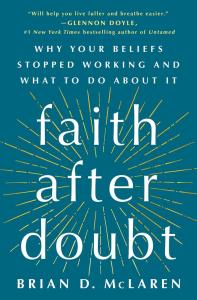
The creative misquotes of scripture above are from Brian McLaren’s 2021 book Faith After Doubt. This book had been sitting on the table by my reading chair for several months; at the last minute I threw it into my book bag along with a couple of others for reading on the plane as I travelled to Santa Fe and back last week. I had taken a shot at it when it first arrived from Amazon last year, but it didn’t seem to be the right time. The flight from Providence via Chicago to Santa Fe was the right time—I read the whole book from cover to cover, and it spoke to me in several important ways.
McLaren has been a pioneer in the process of deconstructing one’s faith, of dismantling aspects of one’s belief framework in the interest of making creating new wineskins to contain and shape the ever-changing features of a faith that never stops evolving, for several decades. McLaren reports that a few years ago, during the Q and A following one of the many talks that he has given across the globe, a clearly frustrated man stood up and angrily asked 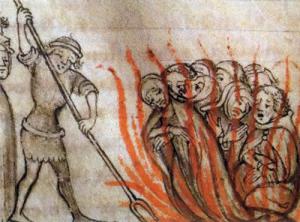 “Who do you think you are to make up your own doctrines and create your own version of Christianity? Why don’t you just admit you’re a heretic and stop calling yourself Christian?”
In my own small way I know what it’s like to be the receiver of pushback and vitriol such as this. The most negative and incensed comments I have received on this blog have come from those who don’t appreciate seeing their favored religious framework get questioned, challenged, or (most egregiously) poked fun at. I’d love to have a dollar for every time I’ve been condemned to hell, called a heretic, or worse because something I wrote didn’t fit into someone’s box very neatly.
Although I laughed it off at the time, a friend’s report the other day that one of our colleagues believes I have denied the resurrection in this blog clearly stuck with me. That’s probably why McLaren’s book was so timely for me on the plane ride. It was time to take a step back and think about why my spiritual journey, which I track in this blog, and which has been a story of continuing change, adjustment, and evolution, has so often been a source of challenge and outright scandal to many—particularly those who live in traditional frameworks of faith that I no longer inhabit.
Consider the Resurrection, for instance, since that’s what I have been accused of denying. As with any historical event in the past, we do not know exactly what happened on that day. Where I have gotten into trouble frequently is not by saying that Jesus did not rise from the dead (I believe that did happen) but rather by saying that the truth of the Resurrection is not locked into historical details that we cannot possibly confirm or deny. Rather, the truth of the Resurrection transcends historical facts, and the meaning of that truth expands and evolves.
Brian McLaren writes that as one’s faith grows and changes, “old beliefs begin to shine again, but in fresh ways.” The Resurrection becomes “not a single resuscitation alone, but the uprising of a whole new humanity, filled with the Spirit of the risen Christ to be the ongoing embodiment of God-with-us.” The Incarnation expands so that it is “not [just] a one-time exceptional event, but [is] as a window into God’s inter-being with all of us and even all of creation,” something that sounds very similar to my understanding of the Incarnation as the astounding truth that God chose to engage with the world in human form and continues to choose human beings as the way the divine gets into the world.
Toward the end of Faith After Doubt, McLaren reflects on the difference between insisting that the stories of the faith and scripture are factually true as he (and I) was taught to believe that they were in his youth, and what those stories mean to him now in his middle-sixties.
What mattered most was not that I believed the stories in a factual sense, but that I believed in the meaning they carried so I could act upon that meaning and embody it in my life., to let that meaning breathe in me, animate me, fill me. . . Whether I considered the stories factually accurate was never the point; what actually mattered all along was whether I lived a life pregnant with the meaning those stories contained. To my surprise, when I was given permission to doubt the factuality of my beliefs, I discovered their actual life-giving power.
Friedrich Nietzsche’s infamous claim that “God is dead” is an expression of his observation that there is a great difference between believing that God exists and believing in God. The former is an intellectual assent that frequently makes no difference in one’s lived experience. The latter is what McLaren is describing. Nietzsche further observed that in his late 19th century European world, many people both paid verbal assent to God’s existence and lived their lives as if it didn’t matter. The word “God,” in other words, had lost its meaning for such people. Hence for all intents and purposes, for those people “God is dead.”
A vibrant and life-changing faith does not depend on whether the details of the stories the faith is rooted in are literally or factually true. Such a faith depends on the ways in which the messages of those stories make a difference in one’s life, empowered by divine energy. As Paul writes, “the letter kills, but the Spirit gives life.”
Previous Post

June 24, 2023
How to Be the Resurrection
Next Post

June 29, 2023 The Burden of Light
Recent Comments
"Mary did have a choice. And she was able to make it before the Holy ..."
"i cannot read beyond your recommendations for the books since i like to have a ..."
"AI will never be able to utter with honesty, feeling, or humility, the greeting: "Namaste".It ..."
"They do. I'm sure you could find discussions of the same topic from any of ..."
Browse Our Archives
Select a Category abortion Advent AI Angels Artificial intelligence atheism attention baptism Baptists beauty belief Benedictines Bible bicycling Big Bird books Bovina Camaldoli hermitage Canada Catholicism cats certainty change Christianity Christmas Collegeville Covid-19 creativity Development of Western Civilization dogs doubt Easter Enneagram Epiphany Episcopal ethics Eucharist evil extroverts Facebook faith family fear flowers forgiveness freedom friends God goodness grace happiness heaven hell history Holy Spirit Holy Week hope human nature humility humor idolatry incarnation introverts irreverence Islam Jeanne Jesus Joe Biden joy Judaism justice Kamala Harris knowledge Lent listen literature liturgy love Marsue Memorial Day miracles movies music mystery mythology NPR Old Testament optimism paradox peace Penguins philosophy piano podcast politics power prayer Protestantism Providence College Religion Rhode Island sabbatical sacrament science seeing silence Simone Weil Socrates soul sports St. John's College stories suffering tattoo teaching technology television theology thinking time tolerance transcendence travel trees trust truth Uncategorized Vermont wisdom wonder writing
Select a Month May 2026 April 2026 March 2026 February 2026 January 2026 December 2025 November 2025 October 2025 September 2025 August 2025 July 2025 June 2025 May 2025 April 2025 March 2025 February 2025 January 2025 December 2024 November 2024 October 2024 September 2024 August 2024 July 2024 June 2024 May 2024 April 2024 March 2024 February 2024 January 2024 December 2023 November 2023 October 2023 September 2023 August 2023 July 2023 June 2023 May 2023 April 2023 March 2023 February 2023 January 2023 December 2022 November 2022 October 2022 September 2022 August 2022 July 2022 June 2022 May 2022 April 2022 March 2022 February 2022 January 2022 December 2021 November 2021 October 2021 September 2021 August 2021 July 2021 June 2021 May 2021 April 2021 March 2021 February 2021 January 2021 December 2020 November 2020 October 2020 September 2020 August 2020 July 2020 June 2020 May 2020 April 2020 March 2020 February 2020 January 2020 December 2019 November 2019 October 2019 September 2019 August 2019 July 2019 June 2019 May 2019 April 2019 March 2019 February 2019 January 2019 December 2018 November 2018 October 2018 September 2018 August 2018 July 2018 June 2018 May 2018 April 2018 March 2018 February 2018 January 2018 December 2017 November 2017 October 2017 September 2017 August 2017 July 2017 June 2017 May 2017 April 2017 March 2017 February 2017 January 2017 December 2016 November 2016 October 2016 September 2016 August 2016 July 2016 June 2016 May 2016 April 2016 March 2016 February 2016 January 2016 December 2015 November 2015 October 2015 September 2015 August 2015 July 2015 June 2015 May 2015 April 2015 March 2015 February 2015 January 2015 December 2014 November 2014 October 2014 September 2014 August 2014 July 2014 June 2014 May 2014 April 2014 March 2014 February 2014 January 2014 December 2013 November 2013 October 2013 September 2013 August 2013 July 2013 June 2013 May 2013 April 2013 March 2013 February 2013 January 2013 December 2012 November 2012 October 2012 September 2012
Follow Us!
TAKE THE
Religious Wisdom Quiz
Who said, "Let us build us a city and a tower, whose top may reach unto heaven"?
Select your answer to see how you score.
Chaldeans Egyptians People of Babel Israelites
Books by This Author Books by Vance G. Morgan
Related posts from Freelance Christianity

The Lonely Pawn: On Faith, Doubt, and Meaning


AI and Love: When a Chatbot Becomes a...

TRENDING AT PATHEOS Progressive Christian

Why Christians Have a Sacred Duty to Vote:...
The Bible offers strong support for the sacred duty to vote. Here...

What Being a Modern-Day Apostle Means to Me
In my last column, I discussed the ins and outs of modern-day...

Did Ancient China Once Worship the God of...
Across human history, a common thread weaves through the origins of the...

Love Your Neighbor – Including Earth-Kin: Lev. 19,...
God’s command to love your neighbor means acting in an ethical and...

Lead a Church Study of “Jesus and Lao...
Guest writer Jack Thomas (The Irreverent Reverend) reflects on leading his church...

Principles for Understanding the Apostolic Ministry Today
Whenever people discover that my formal ministry title is "apostle," as in...
view all Progressive Christian blogs
What Are Your Thoughts?leave a comment
Ad-Free & Subscriber Log-In Subscription Support
- About Us
- 2026 Calendar
- Videos
- Podcasts
- Library of World Religions
- Faith In Media Tracker
- Advertise With Us
- Write for Us
- Privacy Policy
- Terms of Service
- Do Not Sell My Data
- Contact Us
- Radiant Digital
- Manage Newsletter Subscriptions
- Unsubscribe From Notifications
- Sitemap
Copyright 2008-2026, Patheos. All rights reserved.
Subscription Support Ad-Free & Subscriber Log-In
Follow Patheos