
BuddhistCatholicContemplativeEvangelicalGeneral ChristianHinduJewishLatter-day SaintMuslimNew VisionsProgressive Christian
Beliefs
- Buddhist
- Catholic
- Contemplative
- Evangelical
- General Christian
- Hindu
- Jewish
- Latter-day Saint
- More Voices
- Muslim
- New Visions
- Pagan
- Progressive Christian
Topics
- Religion News
- Food and Religion
- Sports and Religion
- Religious Art
- Religious Music and Entertainment
- Religious Events
- History and Religion
- Style and Religion
- Politics and Religion
- Women in Religion
- Recreation Outdoors and Religion
- Business Finance and Religion
- Careers Workplace and Religion
- Education and Religion
- Family Parenting and Religion
- Health Fitness and Religion
- Home and Religion
- Relationships and Religion
- Technology and Religion
- Travel and Religion
Columnists
- Buddhist Columnists
- Business Finance and Religion Columnists
- Careers Workplace and Religion Columnists
- Catholic Columnists
- Contemplative Columnists
- Education and Religion Columnists
- Evangelists Columnists
- Family Parenting and Religion Columnists
- General Christian Columnists
- Health Fitness and Religion Columnists
- Hindu Columnists
- History and Religion Columnists
- Home and Religion Columnists
- Jewish Columnists
- More Voices Columnists
- Latter Day Columnists
- Muslim Columnists
- New Visions Columnists
- Nonreligious Columnists
- Pagan Columnists
- Politics and Religion Columnists
- Progressive Columnists
- Recreation Outdoors and Religion Columnists
- Relationships and Religion Columnists
- Religion News Columnists
- Religious Art Columnists
- Religious Events Columnists
- Religious Music and Entertainment Columnists
- Sports and Religion Columnists
- Style and Religion Columnists
- Technology and Religion Columnists
- Travel and Religion Columnists
- Women in Religion Columnists
Resource Library
- 2026 Calendar
- Library of World Religions
- The 100 Most Holy Places on Earth
- Patheos Answers
- Podcasts
- Videos
- Faith Leaders Database
- Anglican Episcopalian
- Bahai
- Baptist
- Buddhism
- Christianity
- Confucianism
- Eastern Orthodoxy
- Hinduism
- Holiness and Pentecostal
- ISKCON
- Islam
- Judaism
- Lutheran
- Methodist
- The Church of Jesus Christ of Latter-day Saints
- New Age
- Paganism
- Presbytarian and Reformed
- Protestantism
- Religion Behind the Scenes
- Roman Catholic
- Scientology
- Shia Islam
- Sikhism
- Sufism
- Sunni Islam
- Taoism
- Zen
- See all religions
Research Tools
 Ad-Free & Subscriber Log-In Subscription Support
Ad-Free & Subscriber Log-In Subscription Support
Follow Patheos 

- Trending:
- Forgiveness
- |
- Marriage
- |
- Consciousness
- |
- Death Penalty
- |
- Election
- |
- Halloween

- Home
- Progressive Christian
- Who Do You Think You Are?
Who Do You Think You Are?
Last updated on: January 4, 2018 at 3:45 pm by Vance Morgan
Who Do You Think You Are? 2018-01-04T15:45:37-04:00 Vance Morgan
Patheos Explore the world's faith through different perspectives on religion and spirituality! Patheos has the views of the prevalent religions and spiritualities of the world.
Discovering a new author is one of my favorite things–it frequently happens during the holiday season between semesters. My latest discovery is Rachel Held Evans. I received two of her books as part of my small library of Christmas presents; I’ve already finished Faith Unraveled and have started Searching for Sunday. Her work resonates with me because her story is somewhat similar to mine, an emergence from Protestant fundamentalism toward what one of my students once described as “a more nuanced and interesting faith.”
One of the theological sticking points for Evans that she carried from her youth is the exclusivity of a God who apparently had no problem with sending the vast majority of persons to hell for failing to follow the narrow path to salvation endorsed by the church in which she was raised. Evans refers to the “cosmic lottery,” in which by accident of birth, race, gender, and location some appears to be divinely favored and others divinely condemned from birth. The randomness of worshiping a God who favored some persons at the expense of others for obscure and frivolous reasons wore on her to the point of stepping away from faith altogether.
Then during a night of insomnia, Evans read a passage from the Gospel of Luke where Jesus indicates that those whom God chooses are not only restricted to our own selective criteria, but also are likely to include precisely those people who we would be quickest to exclude. In answer to the disciples’ question “Lord, are only a few people going to be saved?” Jesus says
People will come from east and west and north and south, and will take their places at the feast in the kingdom of God. Indeed there are those who are last who will be first, and first who will be last.
Sitting in her bathroom in the middle of the night, Rachel Held Evans began to imagine just what this expansive and motley crew of people might look like; her description reminded me of a similar vision provided by one of Christianity’s sharpest and most unusual apologists.
In Flannery O’Connor’s short story “Revelation,” Ruby Turpin, one of O’Connor’s most memorable characters, has a very bad day. Ruby and her husband Claud own a small farm in 1940s Georgia—their livelihood is made from the yield of their acres worked by hired black workers and the raising and sale of a few cows, pigs and chickens. The bulk of the story is set in the waiting room of a crowded doctor’s office where Ruby and Claud wait for the doctor to look at an infected area on Claud’s leg where he was kicked by a cow a few days ago.
Ruby is a chatty, pleasant, overweight, confident Christian woman in her forties with, as she frequently says, a “good disposition,” and tends to immediately strike up a conversation with whoever is willing. Other patients in the room include a well-dressed woman with a sullen, ugly teen-aged daughter, a grandmother, mother and son who are obviously “white trash,” and others who flit around the edge of the conversation.
It becomes immediately clear that Ruby has a strong sense of how things are supposed to work and of the proper hierarchy of persons in her world. She is thankful that God didn’t make her a “nigger, or white-trash, or an imbecile”—she is extraordinarily grateful that she was born with a good disposition, is blessed with enough food and money (although not too much), and is generally just thrilled to be herself. As she drops these tidbits into her conversation, as well as comments about why Negroes should perhaps go back to Africa, Ruby notices that the sullen young lady keeps shooting increasingly hostile glances in her direction.
The girl’s well-dressed mother eventually reveals that her daughter, a student at an exclusive college “up north,” has been given everything by her parents but is an “ungrateful person” with a bad attitude who never does anything but criticize and complain. Mrs. Turpin remarks that “it never hurts to smile,” concluding that “When I think who all I could have been besides myself and what all I’ve got, a little of everything and a good disposition besides, I just feel like shouting ‘Thank you Jesus, for making everything the way that it is!’” In response, the sullen college student throws the college textbook she has been reading across the room at Ruby, hitting her above the left eye, then leaps on top of Ruby and starts choking her.
Once Ruby is rescued by others and the young lady, “obviously insane,” is sedated, Ruby asks “Don’t you have something to say to me?” The girl responds in a vicious whisper “go back to hell where you came from, you old warthog!” As the day winds on, Ruby, despite her good disposition, can’t shake this comment from her consciousness. Back on the farm toward sunset, as she hoses mud off the pigs, Ruby’s mounting anger ignites in a direct and explosive tirade aimed at the very God she had been thanking earlier.
What do you send me a message like that for? . . . It’s not trash around here, black or white, that I haven’t given to. And break my back to the bone every day working. And do for the church. How am I a hog? Exactly how am I like them? There was plenty of trash there. It didn’t have to be me. If you like trash so much, go get yourself some trash then. You could have made me trash. Or a nigger. Go on! Call me a hog! Call me a hog again! CALL ME A WART HOG FROM HELL! . . . WHO DO YOU THINK YOU ARE??
When Ruby comes up for air, she raises her eyes to where the sun has just slipped below the horizon. And she suddenly sees–really sees–for the first time that day, perhaps for the first time in her life.
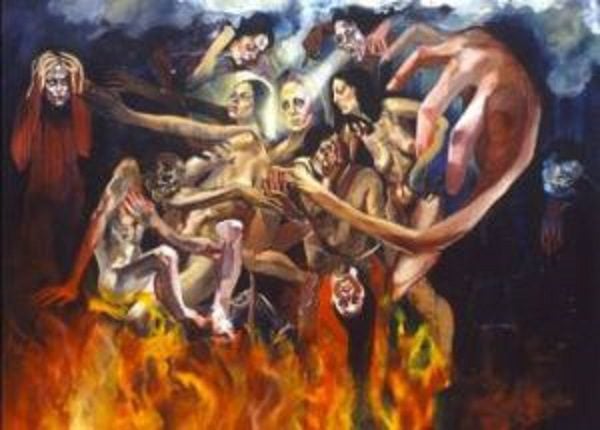
A visionary light settled in her eyes. She saw . . . a vast swinging bridge extending upward from the earth through a field of living fire. Upon it a vast horde of souls were rumbling toward heaven. There were whole companies of white-trash, clean for the first time in their lives, and bands of black niggers in white robes, and battalions of freaks and lunatics shouting and clapping and leaping like frogs. And bringing up the end of the procession was a tribe of people whom she recognized at once as those who, like herself and Claud, had always had a little of everything and the God-given wit to use it right . . . She could see by their shocked and altered faces that even their virtues were being burned away. . . . In the woods around her the invisible cricket choruses had struck up, but what she heard were the voices of the souls climbing upward into the starry field and shouting hallelujah.
And the story ends. Something has broken through Ruby’s safe and smug assumption that God’s behavior and expectations fit her comfortable world seamlessly. Did the vision change her life? Did she forget it in the next minute? O’Connor wisely leaves it to us to wonder.
God’s program is not ours—God’s priorities are upside down. But that’s the point. A transformed world requires transformed people. Only an entire rearranging of what is “natural” will suffice. Be on the lookout for moments of holiness, the small but persistent ways in which the faith we profess turns everything upside down.
Previous Post
January 3, 2018
Saints and Warthogs
Next Post

January 4, 2018 Technology and the Life of Faith
Browse Our Archives
Select a Category abortion Advent AI Angels Artificial intelligence atheism attention baptism Baptists beauty belief Benedictines Bible bicycling Big Bird books Bovina Camaldoli hermitage Canada Catholicism cats certainty change Christianity Christmas Collegeville Covid-19 creativity Development of Western Civilization dogs doubt Easter Enneagram Epiphany Episcopal ethics Eucharist evil extroverts Facebook faith family fear flowers forgiveness freedom friends God goodness grace happiness heaven hell history Holy Spirit Holy Week hope human nature humility humor idolatry incarnation introverts irreverence Islam Jeanne Jesus Joe Biden joy Judaism justice Kamala Harris knowledge Lent listen literature liturgy love Marsue Memorial Day miracles movies music mystery mythology NPR Old Testament optimism paradox peace Penguins philosophy piano podcast politics power prayer Protestantism Providence College Religion Rhode Island sabbatical sacrament science seeing silence Simone Weil Socrates soul sports St. John's College stories suffering tattoo teaching technology television theology thinking time tolerance transcendence travel trees trust truth Uncategorized Vermont wisdom wonder writing
Select a Month May 2026 April 2026 March 2026 February 2026 January 2026 December 2025 November 2025 October 2025 September 2025 August 2025 July 2025 June 2025 May 2025 April 2025 March 2025 February 2025 January 2025 December 2024 November 2024 October 2024 September 2024 August 2024 July 2024 June 2024 May 2024 April 2024 March 2024 February 2024 January 2024 December 2023 November 2023 October 2023 September 2023 August 2023 July 2023 June 2023 May 2023 April 2023 March 2023 February 2023 January 2023 December 2022 November 2022 October 2022 September 2022 August 2022 July 2022 June 2022 May 2022 April 2022 March 2022 February 2022 January 2022 December 2021 November 2021 October 2021 September 2021 August 2021 July 2021 June 2021 May 2021 April 2021 March 2021 February 2021 January 2021 December 2020 November 2020 October 2020 September 2020 August 2020 July 2020 June 2020 May 2020 April 2020 March 2020 February 2020 January 2020 December 2019 November 2019 October 2019 September 2019 August 2019 July 2019 June 2019 May 2019 April 2019 March 2019 February 2019 January 2019 December 2018 November 2018 October 2018 September 2018 August 2018 July 2018 June 2018 May 2018 April 2018 March 2018 February 2018 January 2018 December 2017 November 2017 October 2017 September 2017 August 2017 July 2017 June 2017 May 2017 April 2017 March 2017 February 2017 January 2017 December 2016 November 2016 October 2016 September 2016 August 2016 July 2016 June 2016 May 2016 April 2016 March 2016 February 2016 January 2016 December 2015 November 2015 October 2015 September 2015 August 2015 July 2015 June 2015 May 2015 April 2015 March 2015 February 2015 January 2015 December 2014 November 2014 October 2014 September 2014 August 2014 July 2014 June 2014 May 2014 April 2014 March 2014 February 2014 January 2014 December 2013 November 2013 October 2013 September 2013 August 2013 July 2013 June 2013 May 2013 April 2013 March 2013 February 2013 January 2013 December 2012 November 2012 October 2012 September 2012
Follow Us!
TAKE THE
Religious Wisdom Quiz
Which Christian holiday is celebrated on December 25th in most Western churches?
Select your answer to see how you score.
Pentecost Christmas Epiphany Advent
Books by This Author Books by Vance G. Morgan
Related posts from Freelance Christianity

The Lonely Pawn: On Faith, Doubt, and Meaning


AI and Love: When a Chatbot Becomes a...

TRENDING AT PATHEOS Progressive Christian

Why Christians Have a Sacred Duty to Vote:...
The Bible offers strong support for the sacred duty to vote. Here...

What Being a Modern-Day Apostle Means to Me
In my last column, I discussed the ins and outs of modern-day...

Did Ancient China Once Worship the God of...
Across human history, a common thread weaves through the origins of the...

Love Your Neighbor – Including Earth-Kin: Lev. 19,...
God’s command to love your neighbor means acting in an ethical and...

Lead a Church Study of “Jesus and Lao...
Guest writer Jack Thomas (The Irreverent Reverend) reflects on leading his church...

Principles for Understanding the Apostolic Ministry Today
Whenever people discover that my formal ministry title is "apostle," as in...
view all Progressive Christian blogs
Ad-Free & Subscriber Log-In Subscription Support
- About Us
- 2026 Calendar
- Videos
- Podcasts
- Library of World Religions
- Faith In Media Tracker
- Advertise With Us
- Write for Us
- Privacy Policy
- Terms of Service
- Do Not Sell My Data
- Contact Us
- Radiant Digital
- Manage Newsletter Subscriptions
- Unsubscribe From Notifications
- Sitemap
Copyright 2008-2026, Patheos. All rights reserved.
Subscription Support Ad-Free & Subscriber Log-In
Follow Patheos