
BuddhistCatholicContemplativeEvangelicalGeneral ChristianHinduJewishLatter-day SaintMuslimNew VisionsProgressive Christian
Beliefs
- Buddhist
- Catholic
- Contemplative
- Evangelical
- General Christian
- Hindu
- Jewish
- Latter-day Saint
- More Voices
- Muslim
- New Visions
- Pagan
- Progressive Christian
Topics
- Religion News
- Food and Religion
- Sports and Religion
- Religious Art
- Religious Music and Entertainment
- Religious Events
- History and Religion
- Style and Religion
- Politics and Religion
- Women in Religion
- Recreation Outdoors and Religion
- Business Finance and Religion
- Careers Workplace and Religion
- Education and Religion
- Family Parenting and Religion
- Health Fitness and Religion
- Home and Religion
- Relationships and Religion
- Technology and Religion
- Travel and Religion
Columnists
- Buddhist Columnists
- Business Finance and Religion Columnists
- Careers Workplace and Religion Columnists
- Catholic Columnists
- Contemplative Columnists
- Education and Religion Columnists
- Evangelists Columnists
- Family Parenting and Religion Columnists
- General Christian Columnists
- Health Fitness and Religion Columnists
- Hindu Columnists
- History and Religion Columnists
- Home and Religion Columnists
- Jewish Columnists
- More Voices Columnists
- Latter Day Columnists
- Muslim Columnists
- New Visions Columnists
- Nonreligious Columnists
- Pagan Columnists
- Politics and Religion Columnists
- Progressive Columnists
- Recreation Outdoors and Religion Columnists
- Relationships and Religion Columnists
- Religion News Columnists
- Religious Art Columnists
- Religious Events Columnists
- Religious Music and Entertainment Columnists
- Sports and Religion Columnists
- Style and Religion Columnists
- Technology and Religion Columnists
- Travel and Religion Columnists
- Women in Religion Columnists
Resource Library
- 2026 Calendar
- Library of World Religions
- The 100 Most Holy Places on Earth
- Patheos Answers
- Podcasts
- Videos
- Faith Leaders Database
- Anglican Episcopalian
- Bahai
- Baptist
- Buddhism
- Christianity
- Confucianism
- Eastern Orthodoxy
- Hinduism
- Holiness and Pentecostal
- ISKCON
- Islam
- Judaism
- Lutheran
- Methodist
- The Church of Jesus Christ of Latter-day Saints
- New Age
- Paganism
- Presbytarian and Reformed
- Protestantism
- Religion Behind the Scenes
- Roman Catholic
- Scientology
- Shia Islam
- Sikhism
- Sufism
- Sunni Islam
- Taoism
- Zen
- See all religions
Research Tools
 Ad-Free & Subscriber Log-In Subscription Support
Ad-Free & Subscriber Log-In Subscription Support
Follow Patheos 

- Trending:
- Forgiveness
- |
- Marriage
- |
- Consciousness
- |
- Death Penalty
- |
- Election
- |
- Halloween

- Home
- Progressive Christian
- Wherever You Go
Wherever You Go
Last updated on: October 27, 2017 at 8:27 am by Vance Morgan
Wherever You Go 2017-10-27T08:27:22-04:00 Vance Morgan
Patheos Explore the world's faith through different perspectives on religion and spirituality! Patheos has the views of the prevalent religions and spiritualities of the world.
The 8:00 show at church is for early morning people and those who prefer silence to typical church music. That means me—I’m a regular, and every once in a while I get to serve as lector. One Sunday I read from Proverbs, a selection that included the verses that I used to dedicate my first published book to my mother: “She opens her mouth with wisdom . . . her children rise up and call her blessed.” The assigned Psalm my next Sunday as lector was Psalm 127, which includes the passage I used when dedicating my second book to my sons: “Sons are indeed a heritage from the Lord . . . Like arrows in the hand of a warrior are the sons of one’s youth.” Such lovely, unexpected confluences are for me continuing proof that once in a while what’s greater than us takes notice of little old me. I stopped labeling events as “chance occurrences” a long time ago.
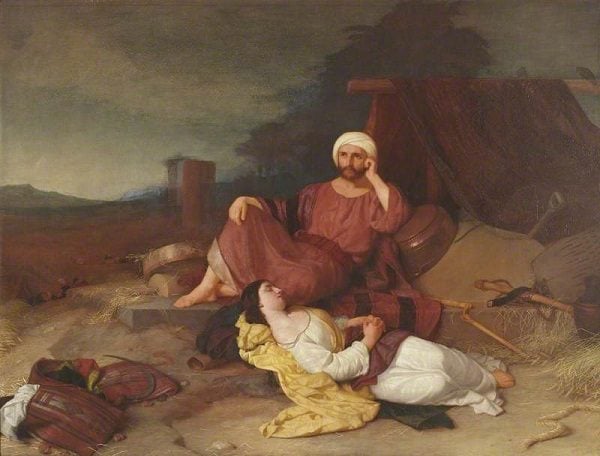
(c) Shipley Art Gallery; Supplied by The Public Catalogue Foundation
As if that wasn’t enough, the first reading of the day the last time I read was from one of my favorite books, a little, seldom read gem dropped into the Jewish Scriptures between the historical books of Judges and First Samuel. I always assign the Book of Ruth when we are in Old Testament week in the interdisciplinary program I teach in for several reasons. First, it is brief enough to be read in one setting and I can safely assume that the majority of students in the class will have read it. More importantly, it is unique among the books of the Old Testament in that women are the main characters and God never makes an appearance. No miracles, no divine insecurity or meddling with the lives of human beings. Ruth is a story of normal human beings trying to live their lives with integrity and care in a middle of a world that is both challenging and unfair. Sounds a lot like the world we live in.
The Book of Ruth is set during the decades between the children of Israel’s occupation of the Promised Land recounted in Joshua and the events leading up to the kingship of Saul and David recounted in First Samuel. The interim period described in Judges is a time of political fluidity during which the various tribes of Israel, in very loose confederation, stake out territory and frequently have to defend themselves against attacks from various indigenous groups they had displaced. One of these groups is Moab, to the southwest of the land occupied by the Israelite tribes. The Book of Ruth is set during the time covered in Judges, and tells a story that is contemporary in many ways—it’s a story of people migrating from their native land in search of better lives.
An Israelite family from the tribe of Benjamin during a time of famine migrates to Moab due to rumors that there is food there. At first things work out reasonably well for Naomi and her family; even though it is a violation of Jewish law described in the Pentateuch for an Israelite to marry a non-Israelite, Naomi’s sons marry Moabite women—Ruth and Orpah. But then disaster strikes—both of Naomi’s sons and her husband die of disease and she finds herself a widow with two widowed non-Jewish daughters-in-law. In a strongly patriarchal world, what options are available for a husband-less middle-aged woman?
Naomi advises her daughters-in-law to return to their families while she, her life in many respects over as an older woman with no male to protect her, will return to her own homeland. Orpah sadly does so, but Ruth refuses to leave. In the best-known passage from the book, Ruth tells Naomi “Where you go, I will go; where you lodge, I will lodge; your people shall be my people, and your God my God.” For many years, a musical setting of this text was standard fare at wedding ceremonies; very few were aware that these words are not about the love between a man and a woman committing themselves to each other, but rather are the expression of a young woman for an older woman whom she cannot bear to leave, even for the best of reasons.
Back in her homeland, Naomi relies on her considerable intelligence and powers of manipulation to worm her way into the orbit of Boaz, a relative of her deceased husband, on whose support she has a distant claim according to the law. Wisely she uses the youthful and beautiful foreigner Ruth to draw Boaz’s attention, first as Ruth works in his fields, then in the following passage that was the central portion of what I read as lector:
Naomi her mother-in-law said to her, “My daughter, I need to seek some security for you, so that it may be well with you. Now here is our kinsman Boaz, with whose young women you have been working. See, he is winnowing barley tonight at the threshing floor. Now wash and anoint yourself, and put on your best clothes and go down to the threshing floor; but do not make yourself known to the man until he has finished eating and drinking.When he lies down, observe the place where he lies; then, go and uncover his feet and lie down; and he will tell you what to do.”
An odd passage to read from a church lectern. I have heard many ministers fumble around with this portion of the story, but my eighteen year old freshmen know exactly what’s going on. Naomi is telling Ruth to seduce Boaz. And it works—Boaz does tell Ruth “what to do,” they soon marry, and their son, Jesse, is the father of David, the shepherd who becomes king and whose descendant will be Jesus himself.
A few takeaways from Ruth’s story:
- The divine likes to work outside the box. Including the foreigner Ruth and the prostitute Rahab from the Book of Joshua in the royal bloodline is a violation of God’s own law—and God doesn’t seem to care.
- Naomi never waited for a “word from God” to decide the best path forward. She relied instead on her own knowledge, intuitions, cunning, good nature, and ability to work the system to her advantage.
- God frequently doesn’t say anything—that does not get the person of faith off the hook of responsibility for her or his own life. As Bishop Desmond Tutu once said, “There is no shaft of light that comes from heaven and says to you ‘Okay, my son or my daughter, you are right.’ You have to hold on to it by the skin of your teeth and hope that there’s going to be vindication on the other side.”
- Women are better than men at working their way out of seemingly impossible situations.
Previous Post

October 24, 2017
Ordinary Miracles
Next Post

October 29, 2017 Why I Am Not an Atheist
Browse Our Archives
Select a Category abortion Advent AI Angels Artificial intelligence atheism attention baptism Baptists beauty belief Benedictines Bible bicycling Big Bird books Bovina Camaldoli hermitage Canada Catholicism cats certainty change Christianity Christmas Collegeville Covid-19 creativity Development of Western Civilization dogs doubt Easter Enneagram Epiphany Episcopal ethics Eucharist evil extroverts Facebook faith family fear flowers forgiveness freedom friends God goodness grace happiness heaven hell history Holy Spirit Holy Week hope human nature humility humor idolatry incarnation introverts irreverence Islam Jeanne Jesus Joe Biden joy Judaism justice Kamala Harris knowledge Lent listen literature liturgy love Marsue Memorial Day miracles movies music mystery mythology NPR Old Testament optimism paradox peace Penguins philosophy piano podcast politics power prayer Protestantism Providence College Religion Rhode Island sabbatical sacrament science seeing silence Simone Weil Socrates soul sports St. John's College stories suffering tattoo teaching technology television theology thinking time tolerance transcendence travel trees trust truth Uncategorized Vermont wisdom wonder writing
Select a Month May 2026 April 2026 March 2026 February 2026 January 2026 December 2025 November 2025 October 2025 September 2025 August 2025 July 2025 June 2025 May 2025 April 2025 March 2025 February 2025 January 2025 December 2024 November 2024 October 2024 September 2024 August 2024 July 2024 June 2024 May 2024 April 2024 March 2024 February 2024 January 2024 December 2023 November 2023 October 2023 September 2023 August 2023 July 2023 June 2023 May 2023 April 2023 March 2023 February 2023 January 2023 December 2022 November 2022 October 2022 September 2022 August 2022 July 2022 June 2022 May 2022 April 2022 March 2022 February 2022 January 2022 December 2021 November 2021 October 2021 September 2021 August 2021 July 2021 June 2021 May 2021 April 2021 March 2021 February 2021 January 2021 December 2020 November 2020 October 2020 September 2020 August 2020 July 2020 June 2020 May 2020 April 2020 March 2020 February 2020 January 2020 December 2019 November 2019 October 2019 September 2019 August 2019 July 2019 June 2019 May 2019 April 2019 March 2019 February 2019 January 2019 December 2018 November 2018 October 2018 September 2018 August 2018 July 2018 June 2018 May 2018 April 2018 March 2018 February 2018 January 2018 December 2017 November 2017 October 2017 September 2017 August 2017 July 2017 June 2017 May 2017 April 2017 March 2017 February 2017 January 2017 December 2016 November 2016 October 2016 September 2016 August 2016 July 2016 June 2016 May 2016 April 2016 March 2016 February 2016 January 2016 December 2015 November 2015 October 2015 September 2015 August 2015 July 2015 June 2015 May 2015 April 2015 March 2015 February 2015 January 2015 December 2014 November 2014 October 2014 September 2014 August 2014 July 2014 June 2014 May 2014 April 2014 March 2014 February 2014 January 2014 December 2013 November 2013 October 2013 September 2013 August 2013 July 2013 June 2013 May 2013 April 2013 March 2013 February 2013 January 2013 December 2012 November 2012 October 2012 September 2012
Follow Us!
TAKE THE
Religious Wisdom Quiz
What is the longest book in the Bible by chapters?
Select your answer to see how you score.
Matthew Psalms Romans Genesis
Books by This Author Books by Vance G. Morgan
Related posts from Freelance Christianity

The Lonely Pawn: On Faith, Doubt, and Meaning


AI and Love: When a Chatbot Becomes a...

TRENDING AT PATHEOS Progressive Christian

What Being a Modern-Day Apostle Means to Me
In my last column, I discussed the ins and outs of modern-day...

Did Ancient China Once Worship the God of...
Across human history, a common thread weaves through the origins of the...

Love Your Neighbor – Including Earth-Kin: Lev. 19,...
God’s command to love your neighbor means acting in an ethical and...

Lead a Church Study of “Jesus and Lao...
Guest writer Jack Thomas (The Irreverent Reverend) reflects on leading his church...

Pastoral Wisdom for Responding to Sermon Pushback
Getting sermon pushback on your social justice sermon? Learn practical, Proverbs-based strategies...

Principles for Understanding the Apostolic Ministry Today
Whenever people discover that my formal ministry title is "apostle," as in...
view all Progressive Christian blogs
Ad-Free & Subscriber Log-In Subscription Support
- About Us
- 2026 Calendar
- Videos
- Podcasts
- Library of World Religions
- Faith In Media Tracker
- Advertise With Us
- Write for Us
- Privacy Policy
- Terms of Service
- Do Not Sell My Data
- Contact Us
- Radiant Digital
- Manage Newsletter Subscriptions
- Unsubscribe From Notifications
- Sitemap
Copyright 2008-2026, Patheos. All rights reserved.
Subscription Support Ad-Free & Subscriber Log-In
Follow Patheos