
BuddhistCatholicContemplativeEvangelicalGeneral ChristianHinduJewishLatter-day SaintMuslimNew VisionsProgressive Christian
Beliefs
- Buddhist
- Catholic
- Contemplative
- Evangelical
- General Christian
- Hindu
- Jewish
- Latter-day Saint
- More Voices
- Muslim
- New Visions
- Pagan
- Progressive Christian
Topics
- Religion News
- Food and Religion
- Sports and Religion
- Religious Art
- Religious Music and Entertainment
- Religious Events
- History and Religion
- Style and Religion
- Politics and Religion
- Women in Religion
- Recreation Outdoors and Religion
- Business Finance and Religion
- Careers Workplace and Religion
- Education and Religion
- Family Parenting and Religion
- Health Fitness and Religion
- Home and Religion
- Relationships and Religion
- Technology and Religion
- Travel and Religion
Columnists
- Buddhist Columnists
- Business Finance and Religion Columnists
- Careers Workplace and Religion Columnists
- Catholic Columnists
- Contemplative Columnists
- Education and Religion Columnists
- Evangelists Columnists
- Family Parenting and Religion Columnists
- General Christian Columnists
- Health Fitness and Religion Columnists
- Hindu Columnists
- History and Religion Columnists
- Home and Religion Columnists
- Jewish Columnists
- More Voices Columnists
- Latter Day Columnists
- Muslim Columnists
- New Visions Columnists
- Nonreligious Columnists
- Pagan Columnists
- Politics and Religion Columnists
- Progressive Columnists
- Recreation Outdoors and Religion Columnists
- Relationships and Religion Columnists
- Religion News Columnists
- Religious Art Columnists
- Religious Events Columnists
- Religious Music and Entertainment Columnists
- Sports and Religion Columnists
- Style and Religion Columnists
- Technology and Religion Columnists
- Travel and Religion Columnists
- Women in Religion Columnists
Resource Library
- 2026 Calendar
- Library of World Religions
- The 100 Most Holy Places on Earth
- Patheos Answers
- Podcasts
- Videos
- Faith Leaders Database
- Anglican Episcopalian
- Bahai
- Baptist
- Buddhism
- Christianity
- Confucianism
- Eastern Orthodoxy
- Hinduism
- Holiness and Pentecostal
- ISKCON
- Islam
- Judaism
- Lutheran
- Methodist
- The Church of Jesus Christ of Latter-day Saints
- New Age
- Paganism
- Presbytarian and Reformed
- Protestantism
- Religion Behind the Scenes
- Roman Catholic
- Scientology
- Shia Islam
- Sikhism
- Sufism
- Sunni Islam
- Taoism
- Zen
- See all religions
Research Tools
 Ad-Free & Subscriber Log-In Subscription Support
Ad-Free & Subscriber Log-In Subscription Support
Follow Patheos 

- Trending:
- Forgiveness
- |
- Marriage
- |
- Consciousness
- |
- Death Penalty
- |
- Election
- |
- Halloween

- Home
- Progressive Christian
- When What I Want to Believe Isn’t True: Reflections on the latest indictment of Donald Trump
When What I Want to Believe Isn’t True: Reflections on the latest indictment of Donald Trump
Last updated on: August 5, 2023 at 12:00 pm by Vance Morgan
When What I Want to Believe Isn’t True: Reflections on the latest indictment of Donald Trump 2023-08-04T20:20:11-04:00 Vance Morgan
Patheos Explore the world's faith through different perspectives on religion and spirituality! Patheos has the views of the prevalent religions and spiritualities of the world.
What do you do when virtually all of the evidence relevant to an important matter points toward a specific conclusion, but you strongly believe that this conclusion is wrong? We live in a cultural climate in which, for many, intuitions and feelings regularly override even the most objective collection of facts. Still, it is worth considering whether there are times in which even those who still are willing to accept the authority of objective facts over individual feelings or intuitions are justified in favoring their intuitions.
I’ve reflected on these questions and issues before,
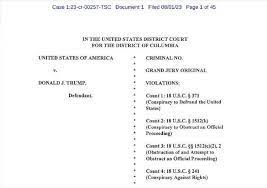 but was brought back to them anew as I read the indictment of Donald J. Trump on three counts of conspiracy and one count of obstruction that came down on August 1st. At the heart of the indictment is evidence of what former President Donald Trump was willing to do and the lengths to which he was willing to go between his defeat in the November 2020 presidential election and the beginning of Joe Biden’s presidency in January 2021 to stay in power and remain in the White House.
On virtually every page of the indictment, people in Trump’s circle ranging from the Vice President, senior leaders of the Justice Department, and the Director of National Intelligence to senior White House attorneys, the chief of staff, senior staffers on Trump’s 2020 re-election campaign, and dozens of federal courts told him both that he lost the 2020 election and that there was no evidence of widespread fraud in the election. The problem is that none of this lined up with what Trump wanted to believe. He believed that he had won, and he was unwilling to accept any facts or evidence that did not support his belief.
There is plenty of evidence that the former president did know that he had lost a free and fair election but chose to act otherwise in the interest of retaining power. But suppose for the sake of argument that, despite mountains of contrary facts and evidence, Donald Trump did truly believe that he had won the election and that his victory had been stolen from him because of rampant fraud. It has been suggested that this will be one of the strategies Trump’s legal team will use in court: he truly believed he had won the election and acted in ways consistent with that belief. Does such a defense have any chance of success?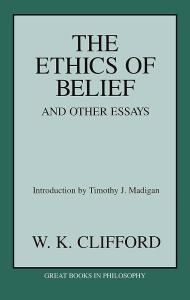
The philosopher in me immediately thinks of “The Ethics of Belief,” an influential essay published by mathematician and philosopher W. K. Clifford in 1877. In our contemporary world where we say that anyone can believe and say anything they want with impunity, Clifford’s essay makes an uncomfortable suggestion: each of us is fully responsible for what we believe and each of us is morally obligated to earn the right to our beliefs by ensuring that they are supported by sufficient evidence. Clifford concludes his essay with this: It is wrong always, everywhere, and for anyone, to believe anything upon insufficient evidence.
Clifford begins with a brief story. A shipowner is about to send an old, well-used ship with emigrants on board across the ocean. He has reason to think that the ship needs repairs, based on his own knowledge as well as reports from the captain and crew. Yet if he puts the ship in dry dock for repairs, it will be out of service for several months, “which would put him at great expense.” In the end he convinces himself that the ship will be safe for another voyage, “trusting in Providence” and “dismiss(ing) from his mind all ungenerous suspicions about the honesty of builders and contractors.” “He watched [the ship’s] departure with a light heart . . . and he got his insurance-money when she went down in mid-ocean and told no tales.”
Does the believing shipowner bear any responsibility for the loss of life caused by the ship’s sinking? Clifford pulls no punches.
He was verily guilty of the death of those people. It is admitted that he did sincerely believe in the soundness of his ship; but the sincerity of his conviction can in no wise help him, because he had no right to believe on such evidence as was before him. He had acquired his belief not by honestly earning it in patient investigation, but by stifling his doubts. And although in the end he may have felt so sure about it that he could not think otherwise, yet inasmuch as he had knowingly and willingly worked himself into that frame of mind, he must be held responsible for it.
Applying Clifford’s analysis to Donald Trump, there are clear parallels. Just as the shipowner wants to believe that his vessel will safely cross the ocean, so also the former president wants to believe that he won the November 2020 election. Just as the shipowner is presented with clear evidence contradictory to what he wants to believe, so Trump was continually presented with evidence that, despite his belief, he lost the election. And just as the shipbuilder is responsible for the deaths of those on the ship, so Donald Trump is responsible for the actions and events that flowed from his belief, actions and events for which he has been criminally indicted and may end up in prison. Why? “Because he had no right to believe on such evidence as was before him.”
I often tell my students that in philosophy, “you have to earn the right to have an opinion.” Clifford’s claim is far stronger—you have to earn the right to believe. Clifford’s position is called evidentialism, the view that you need to let your beliefs be guided and constrained by evidence. Many critics have argued that Clifford’s version of evidentialism is too strong, primarily because it is often necessary to choose to believe something before all possible evidence can be acquired. Weaker versions say that one should be willing to revise one’s beliefs in the face of contrary evidence, or that being open to evidence is excellent and admirable. Clearly both the shipowner and Donald Trump failed both versions of evidentialism.
One could argue that beliefs by themselves are benign—one can believe anything one wants as long as the belief does not lead to actions that harm others. Jack Smith’s indictment essentially says this on its second page, allowing that Donald Trump, like every American, has the right to believe and say whatever they want (thanks, First Amendment), even when that belief and speech is patently false. Where the former president ran afoul of the law is not with what he believed and said, but with what he did as well as with what he urged and authorized others to do based on his belief.
W. K. Clifford, however, does not think that beliefs are ever benign.
No one man’s belief is in any case a private matter which concerns himself alone. Our lives are guided by that general conception of the course of things which has been created by society for social purposes. Our words, our phrases, our forms and processes and modes of thought, are common property, fashioned and perfected from age to age; an heirloom which every succeeding generation inherits as a precious deposit and a sacred trust to be handled on to the next one, not unchanged but enlarged and purified, with some clear marks of its proper handiwork. Into this, for good or ill, is woven every belief of every man who has speech of his fellows. An awful privilege, and an awful responsibility, that we should help to create the world in which posterity will live.
As the old adage goes, “be careful what you say; someone might take you seriously.” Similarly, be careful what you believe. Beliefs shape the believer and should be treated as we treat sacred objects.
In an apt analogy for today, Clifford compares the spread of fake news, bullshit, and other untruths that we find alluring to the spread of a plague:
[Our] duty is to guard ourselves from such [false] beliefs as from pestilence, which may shortly master our own body and then spread to the rest of the town. What would be thought of one who, for the sake of a sweet fruit, should deliberately run the risk of bringing a plague upon his family and his neighbors?
Clifford’s words sound idealistic and quaint in our world where the very notions of facts and truth take a regular beating in the interest of promoting what one wants to be true. A theme throughout “The Ethics of Belief” is that a society which is based on true beliefs and where citizens hold truth in high regard is cohesive, while a society where people believe on whims and base their beliefs on what’s convenient while disregarding truth is in danger of fracturing and descending into echo chambers. Our society is living confirmation of Clifford’s analysis.
At the very least, the latest indictment of Donald Trump sets in motion a process that will put many of the things we claim to cherish to the acid test. Will our democracy survive? Will any coherent understanding of truth survive? Time will tell—in the meantime, remember that your beliefs are common property and that our society is built on the assumption that everyone is equally committed to believing things that are true. Once those assumptions evaporate, what remains?
Previous Post
August 3, 2023
Did He Walk On the Water or Didn't He?
Next Post
August 8, 2023 Dreamers Who Get Things Done
Recent Comments
"Mary did have a choice. And she was able to make it before the Holy ..."
"i cannot read beyond your recommendations for the books since i like to have a ..."
"AI will never be able to utter with honesty, feeling, or humility, the greeting: "Namaste".It ..."
"They do. I'm sure you could find discussions of the same topic from any of ..."
Browse Our Archives
Select a Category abortion Advent AI Angels Artificial intelligence atheism attention baptism Baptists beauty belief Benedictines Bible bicycling Big Bird books Bovina Camaldoli hermitage Canada Catholicism cats certainty change Christianity Christmas Collegeville Covid-19 creativity Development of Western Civilization dogs doubt Easter Enneagram Epiphany Episcopal ethics Eucharist evil extroverts Facebook faith family fear flowers forgiveness freedom friends God goodness grace happiness heaven hell history Holy Spirit Holy Week hope human nature humility humor idolatry incarnation introverts irreverence Islam Jeanne Jesus Joe Biden joy Judaism justice Kamala Harris knowledge Lent listen literature liturgy love Marsue Memorial Day miracles movies music mystery mythology NPR Old Testament optimism paradox peace Penguins philosophy piano podcast politics power prayer Protestantism Providence College Religion Rhode Island sabbatical sacrament science seeing silence Simone Weil Socrates soul sports St. John's College stories suffering tattoo teaching technology television theology thinking time tolerance transcendence travel trees trust truth Uncategorized Vermont wisdom wonder writing
Select a Month May 2026 April 2026 March 2026 February 2026 January 2026 December 2025 November 2025 October 2025 September 2025 August 2025 July 2025 June 2025 May 2025 April 2025 March 2025 February 2025 January 2025 December 2024 November 2024 October 2024 September 2024 August 2024 July 2024 June 2024 May 2024 April 2024 March 2024 February 2024 January 2024 December 2023 November 2023 October 2023 September 2023 August 2023 July 2023 June 2023 May 2023 April 2023 March 2023 February 2023 January 2023 December 2022 November 2022 October 2022 September 2022 August 2022 July 2022 June 2022 May 2022 April 2022 March 2022 February 2022 January 2022 December 2021 November 2021 October 2021 September 2021 August 2021 July 2021 June 2021 May 2021 April 2021 March 2021 February 2021 January 2021 December 2020 November 2020 October 2020 September 2020 August 2020 July 2020 June 2020 May 2020 April 2020 March 2020 February 2020 January 2020 December 2019 November 2019 October 2019 September 2019 August 2019 July 2019 June 2019 May 2019 April 2019 March 2019 February 2019 January 2019 December 2018 November 2018 October 2018 September 2018 August 2018 July 2018 June 2018 May 2018 April 2018 March 2018 February 2018 January 2018 December 2017 November 2017 October 2017 September 2017 August 2017 July 2017 June 2017 May 2017 April 2017 March 2017 February 2017 January 2017 December 2016 November 2016 October 2016 September 2016 August 2016 July 2016 June 2016 May 2016 April 2016 March 2016 February 2016 January 2016 December 2015 November 2015 October 2015 September 2015 August 2015 July 2015 June 2015 May 2015 April 2015 March 2015 February 2015 January 2015 December 2014 November 2014 October 2014 September 2014 August 2014 July 2014 June 2014 May 2014 April 2014 March 2014 February 2014 January 2014 December 2013 November 2013 October 2013 September 2013 August 2013 July 2013 June 2013 May 2013 April 2013 March 2013 February 2013 January 2013 December 2012 November 2012 October 2012 September 2012
Follow Us!
TAKE THE
Religious Wisdom Quiz
In which miracle did Jesus provide wine at a wedding?
Select your answer to see how you score.
Walking on water Healing a centurion's servant Feeding 4000 Turning water into wine at Cana
Books by This Author Books by Vance G. Morgan
Related posts from Freelance Christianity

The Lonely Pawn: On Faith, Doubt, and Meaning


AI and Love: When a Chatbot Becomes a...

TRENDING AT PATHEOS Progressive Christian

What Being a Modern-Day Apostle Means to Me
In my last column, I discussed the ins and outs of modern-day...

Did Ancient China Once Worship the God of...
Across human history, a common thread weaves through the origins of the...

Love Your Neighbor – Including Earth-Kin: Lev. 19,...
God’s command to love your neighbor means acting in an ethical and...

Lead a Church Study of “Jesus and Lao...
Guest writer Jack Thomas (The Irreverent Reverend) reflects on leading his church...

Pastoral Wisdom for Responding to Sermon Pushback
Getting sermon pushback on your social justice sermon? Learn practical, Proverbs-based strategies...

Principles for Understanding the Apostolic Ministry Today
Whenever people discover that my formal ministry title is "apostle," as in...
view all Progressive Christian blogs
What Are Your Thoughts?leave a comment
Ad-Free & Subscriber Log-In Subscription Support
- About Us
- 2026 Calendar
- Videos
- Podcasts
- Library of World Religions
- Faith In Media Tracker
- Advertise With Us
- Write for Us
- Privacy Policy
- Terms of Service
- Do Not Sell My Data
- Contact Us
- Radiant Digital
- Manage Newsletter Subscriptions
- Unsubscribe From Notifications
- Sitemap
Copyright 2008-2026, Patheos. All rights reserved.
Subscription Support Ad-Free & Subscriber Log-In
Follow Patheos