
BuddhistCatholicContemplativeEvangelicalGeneral ChristianHinduJewishLatter-day SaintMuslimNew VisionsProgressive Christian
Beliefs
- Buddhist
- Catholic
- Contemplative
- Evangelical
- General Christian
- Hindu
- Jewish
- Latter-day Saint
- More Voices
- Muslim
- New Visions
- Pagan
- Progressive Christian
Topics
- Religion News
- Food and Religion
- Sports and Religion
- Religious Art
- Religious Music and Entertainment
- Religious Events
- History and Religion
- Style and Religion
- Politics and Religion
- Women in Religion
- Recreation Outdoors and Religion
- Business Finance and Religion
- Careers Workplace and Religion
- Education and Religion
- Family Parenting and Religion
- Health Fitness and Religion
- Home and Religion
- Relationships and Religion
- Technology and Religion
- Travel and Religion
Columnists
- Buddhist Columnists
- Business Finance and Religion Columnists
- Careers Workplace and Religion Columnists
- Catholic Columnists
- Contemplative Columnists
- Education and Religion Columnists
- Evangelists Columnists
- Family Parenting and Religion Columnists
- General Christian Columnists
- Health Fitness and Religion Columnists
- Hindu Columnists
- History and Religion Columnists
- Home and Religion Columnists
- Jewish Columnists
- More Voices Columnists
- Latter Day Columnists
- Muslim Columnists
- New Visions Columnists
- Nonreligious Columnists
- Pagan Columnists
- Politics and Religion Columnists
- Progressive Columnists
- Recreation Outdoors and Religion Columnists
- Relationships and Religion Columnists
- Religion News Columnists
- Religious Art Columnists
- Religious Events Columnists
- Religious Music and Entertainment Columnists
- Sports and Religion Columnists
- Style and Religion Columnists
- Technology and Religion Columnists
- Travel and Religion Columnists
- Women in Religion Columnists
Resource Library
- 2026 Calendar
- Library of World Religions
- The 100 Most Holy Places on Earth
- Patheos Answers
- Podcasts
- Videos
- Faith Leaders Database
- Anglican Episcopalian
- Bahai
- Baptist
- Buddhism
- Christianity
- Confucianism
- Eastern Orthodoxy
- Hinduism
- Holiness and Pentecostal
- ISKCON
- Islam
- Judaism
- Lutheran
- Methodist
- The Church of Jesus Christ of Latter-day Saints
- New Age
- Paganism
- Presbytarian and Reformed
- Protestantism
- Religion Behind the Scenes
- Roman Catholic
- Scientology
- Shia Islam
- Sikhism
- Sufism
- Sunni Islam
- Taoism
- Zen
- See all religions
Research Tools
 Ad-Free & Subscriber Log-In Subscription Support
Ad-Free & Subscriber Log-In Subscription Support
Follow Patheos 

- Trending:
- Forgiveness
- |
- Marriage
- |
- Consciousness
- |
- Death Penalty
- |
- Election
- |
- Halloween

- Home
- Progressive Christian
- When We Say What We Don’t Believe
When We Say What We Don’t Believe
Last updated on: August 24, 2025 at 6:00 am by Vance Morgan
When We Say What We Don’t Believe 2025-08-21T14:34:28-04:00 Vance Morgan
Patheos Explore the world's faith through different perspectives on religion and spirituality! Patheos has the views of the prevalent religions and spiritualities of the world.
Today’s appointed lectionary Psalm is one of my two or three favorites of all of the psalms–#103. One of the many reasons I love this psalm is because of its musical setting in Godspell, one of my all time favorite musicals, a setting that captures an exuberance and joyfulness that can be easily missed if one just reads the text.
A few years ago, Jeanne and I had the opportunity to see a local community theater’s production of Godspell. We went because a friend was in the show; as it turned out, two other people that we know were also in the ensemble, one from church and one from the college. Godspell burst on the scene in the early seventies when I was in high school, around the same time as Jesus Christ Superstar. Both shows shocked and offended many of the conservative religious folks I was raised in the midst of, but I loved both for their irreverence, new insights into Jesus, and memorable tunes. Godspell has a special place in Jeanne’s and my life because, more than thirty-five years ago and just a few months into our relationship, we took my sons, then eight and six, to an off-Broadway performance of the show where I also met two of Jeanne’s closest friends for the first time.
Almost every song in Godspell can make a claim for being best in show; one of my favorites is “It’s All for the Best,” a soft shoe duet performed by Jesus and John the Baptist. It’s a parody of an attitude prevalent in many religious circles—no matter how horrible things appear to be, no matter how awful your life is working out, God knows what God is doing and things will work out for the best.
My Baptist minister father, who was also a big fan of Godspell, particularly enjoyed this song because it pokes fun at the sorts of platitudes many of us tend to send in the direction of people in pain or trouble: “Things tend to work out for the best,” “God knows what He’s doing,” “Everything happens for a reason,” “When God closes a door, He opens a window,” and so on. Kate Bowler hit the top of the NY Times chart with her book Everything Happens for a Reason . . . and other lies I have loved. Nadia Bolz-Weber writes that when someone says “When God closes a door, He opens a window” at the wrong time, the best response might be to say “Show me where that window is so I can push him the hell out of it!”
Of course, the tendency to fall back on platitudes and obvious falsehoods when difficulties afflict us is not exclusive to religious folks. In the early decades of the eighteenth century, the European Enlightenment was in full swing. Over the previous century and a half, spectacular scientific advances, the exploration of the New World, and the rise of enlightened rulers had given rise to a general optimism about human progress and our ability to improve the world around us. The breakthroughs of Galileo, Newton, and others led many to believe that we live in a rational universe, created and overseen by a rational God, a universe whose puzzles and riddles are there for the solving through the systematic and rigorous use of the human mind. 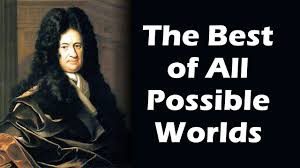
Leibniz, one of the greatest of the Enlightenment philosophers, summarized one aspect of this Enlightenment perspective in a memorable claim: “This is the best of all possible worlds.” A good and omnipotent creating God could do no other than create the best creation possible—the fact that it often appears otherwise from the human perspective is a result of our ignorance, an ignorance that Enlightenment progress promised to reduce and, perhaps, ultimately eliminate.
Then on November 1, 1755, one of the most powerful earthquakes in recorded history struck Lisbon, followed by three tsunamis. It was All Saint’s Day; the churches, filled with worshippers, simultaneously collapsed and burst into flames due to the hundreds of lit candles. Thousands of people fled the buildings and headed to the waterfront, just as a wall of water twenty-five feet high came ashore. Eighty-five percent of Lisbon was destroyed; tremors were felt as far away as Finland, North Africa, Greenland, and the Caribbean. Casualty estimates range widely, but it is clear that as many as 75,000 people died. 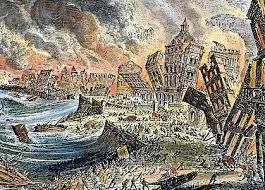
The earthquake had wide-ranging effects on the lives of the populace and intelligentsia. It had struck on an important religious holiday and had destroyed almost every important church in the city, causing anxiety and confusion amongst the citizens of a staunch and devout Roman Catholic country. Theologians and philosophers focused and speculated on the religious cause and message, seeing the earthquake as a possible manifestation of divine judgment. One of these intellectuals was François-Marie Arouet, better known by his nom de plume, Voltaire.
In 1759, a mere four years after the Lisbon earthquake, Voltaire published his masterpiece Candide: or, Optimism, one of the great works of satire in the Western tradition. Voltaire’s hero, Candide, goes through an outrageous and outlandish series of experiences in the novella, experiences that produce pain, suffering, destruction, and death in increasing frequency and intensity as the story unfolds. Candide is joined in his adventures by a small cadre of companions, including Dr. Pangloss (“all tongue” or “all words”), an intellectual who is the mouthpiece for Leibnizian optimism. After each catastrophe, including the Lisbon earthquake itself which occurs in a central chapter, Pangloss ties himself in logical and argumentative knots in his “proofs” that, despite all appearances, this is the best of all possible worlds and everything happens for the best. Pangloss himself is often the recipient of the worst experiences, something that Candide points out to him toward the end of the story:
Candide: Well, my dear Pangloss, when you had been hanged, dissected, whipped, and were tugging at the oar, did you always think that everything happens for the best?
Pangloss: I am still of my first opinion, for I am a philosopher and I cannot retract, especially as Leibniz could never be wrong . . .
Candide, a naïve youngster, is inclined to believe the authoritative Pangloss’ arguments early in the story, but he eventually changes his mind in the face of his experiences and comes to define Pangloss’ optimism as “the madness of believing that everything is right when it is wrong.”
Panglossian arguments infect our contemporary world everywhere one looks. Just listen for a few minutes (if you can) to politicians from all sides defending and arguing for their pre-established positions concerning literally anything, always in denial of clear facts to the contrary of their positions. Religious rigidity results from the insistence of faithful persons that a handful of doctrines must be true and are unrevisable, even when they explain nothing and do damage on a regular basis.
Toward the end of Candide, the remaining handful of Candide’s friends reflect on what they have learned. Pangloss’ admits to something that many of us fall prey to—paying lip service to commitments that one no longer believes are true. “Pangloss owned that had had always suffered horribly, but as he had once asserted that everything went wonderfully well, he asserted it still, though he no longer believed it.”
What is one to do when one finds out that what one professes to believe has become, as Macbeth said when reflecting on his wife’s suicide, “a tale told by an idiot, full of sound and fury, signifying nothing”? For those of us who are honest, even our most cherished beliefs and commitments sound exactly like that on some days. After one hundred pages of disaster, the final episode of Candide offers something both practical and optimistic. Candide and his friends meet an elderly Muslim who has spent his life cultivating twenty acres with his children, noting that “our labor preserves us from three great evils—weariness, vice, and want.” Candide is attracted to this and, as his friends make various suggestions as to how they might move forward, responds “we must cultivate our garden.”
Previous Post

August 22, 2025
The Punctuation of the Spirit
Next Post

August 28, 2025 Thirteen Years of Blogging, and remembering a friend
Recent Comments
"Mary did have a choice. And she was able to make it before the Holy ..."
"i cannot read beyond your recommendations for the books since i like to have a ..."
"AI will never be able to utter with honesty, feeling, or humility, the greeting: "Namaste".It ..."
"They do. I'm sure you could find discussions of the same topic from any of ..."
Browse Our Archives
Select a Category abortion Advent AI Angels Artificial intelligence atheism attention baptism Baptists beauty belief Benedictines Bible bicycling Big Bird books Bovina Camaldoli hermitage Canada Catholicism cats certainty change Christianity Christmas Collegeville Covid-19 creativity Development of Western Civilization dogs doubt Easter Enneagram Epiphany Episcopal ethics Eucharist evil extroverts Facebook faith family fear flowers forgiveness freedom friends God goodness grace happiness heaven hell history Holy Spirit Holy Week hope human nature humility humor idolatry incarnation introverts irreverence Islam Jeanne Jesus Joe Biden joy Judaism justice Kamala Harris knowledge Lent listen literature liturgy love Marsue Memorial Day miracles movies music mystery mythology NPR Old Testament optimism paradox peace Penguins philosophy piano podcast politics power prayer Protestantism Providence College Religion Rhode Island sabbatical sacrament science seeing silence Simone Weil Socrates soul sports St. John's College stories suffering tattoo teaching technology television theology thinking time tolerance transcendence travel trees trust truth Uncategorized Vermont wisdom wonder writing
Select a Month May 2026 April 2026 March 2026 February 2026 January 2026 December 2025 November 2025 October 2025 September 2025 August 2025 July 2025 June 2025 May 2025 April 2025 March 2025 February 2025 January 2025 December 2024 November 2024 October 2024 September 2024 August 2024 July 2024 June 2024 May 2024 April 2024 March 2024 February 2024 January 2024 December 2023 November 2023 October 2023 September 2023 August 2023 July 2023 June 2023 May 2023 April 2023 March 2023 February 2023 January 2023 December 2022 November 2022 October 2022 September 2022 August 2022 July 2022 June 2022 May 2022 April 2022 March 2022 February 2022 January 2022 December 2021 November 2021 October 2021 September 2021 August 2021 July 2021 June 2021 May 2021 April 2021 March 2021 February 2021 January 2021 December 2020 November 2020 October 2020 September 2020 August 2020 July 2020 June 2020 May 2020 April 2020 March 2020 February 2020 January 2020 December 2019 November 2019 October 2019 September 2019 August 2019 July 2019 June 2019 May 2019 April 2019 March 2019 February 2019 January 2019 December 2018 November 2018 October 2018 September 2018 August 2018 July 2018 June 2018 May 2018 April 2018 March 2018 February 2018 January 2018 December 2017 November 2017 October 2017 September 2017 August 2017 July 2017 June 2017 May 2017 April 2017 March 2017 February 2017 January 2017 December 2016 November 2016 October 2016 September 2016 August 2016 July 2016 June 2016 May 2016 April 2016 March 2016 February 2016 January 2016 December 2015 November 2015 October 2015 September 2015 August 2015 July 2015 June 2015 May 2015 April 2015 March 2015 February 2015 January 2015 December 2014 November 2014 October 2014 September 2014 August 2014 July 2014 June 2014 May 2014 April 2014 March 2014 February 2014 January 2014 December 2013 November 2013 October 2013 September 2013 August 2013 July 2013 June 2013 May 2013 April 2013 March 2013 February 2013 January 2013 December 2012 November 2012 October 2012 September 2012
Follow Us!
TAKE THE
Religious Wisdom Quiz
What does "Pentateuch" mean in Greek?
Select your answer to see how you score.
First law Book of peace Five scrolls Stories of heroes
Books by This Author Books by Vance G. Morgan
Related posts from Freelance Christianity

The Lonely Pawn: On Faith, Doubt, and Meaning


AI and Love: When a Chatbot Becomes a...

TRENDING AT PATHEOS Progressive Christian

What Being a Modern-Day Apostle Means to Me
In my last column, I discussed the ins and outs of modern-day...

Did Ancient China Once Worship the God of...
Across human history, a common thread weaves through the origins of the...

Love Your Neighbor – Including Earth-Kin: Lev. 19,...
God’s command to love your neighbor means acting in an ethical and...

Lead a Church Study of “Jesus and Lao...
Guest writer Jack Thomas (The Irreverent Reverend) reflects on leading his church...

Pastoral Wisdom for Responding to Sermon Pushback
Getting sermon pushback on your social justice sermon? Learn practical, Proverbs-based strategies...

Principles for Understanding the Apostolic Ministry Today
Whenever people discover that my formal ministry title is "apostle," as in...
view all Progressive Christian blogs
What Are Your Thoughts?leave a comment
Ad-Free & Subscriber Log-In Subscription Support
- About Us
- 2026 Calendar
- Videos
- Podcasts
- Library of World Religions
- Faith In Media Tracker
- Advertise With Us
- Write for Us
- Privacy Policy
- Terms of Service
- Do Not Sell My Data
- Contact Us
- Radiant Digital
- Manage Newsletter Subscriptions
- Unsubscribe From Notifications
- Sitemap
Copyright 2008-2026, Patheos. All rights reserved.
Subscription Support Ad-Free & Subscriber Log-In
Follow Patheos