
BuddhistCatholicContemplativeEvangelicalGeneral ChristianHinduJewishLatter-day SaintMuslimNew VisionsProgressive Christian
Beliefs
- Buddhist
- Catholic
- Contemplative
- Evangelical
- General Christian
- Hindu
- Jewish
- Latter-day Saint
- More Voices
- Muslim
- New Visions
- Pagan
- Progressive Christian
Topics
- Religion News
- Food and Religion
- Sports and Religion
- Religious Art
- Religious Music and Entertainment
- Religious Events
- History and Religion
- Style and Religion
- Politics and Religion
- Women in Religion
- Recreation Outdoors and Religion
- Business Finance and Religion
- Careers Workplace and Religion
- Education and Religion
- Family Parenting and Religion
- Health Fitness and Religion
- Home and Religion
- Relationships and Religion
- Technology and Religion
- Travel and Religion
Columnists
- Buddhist Columnists
- Business Finance and Religion Columnists
- Careers Workplace and Religion Columnists
- Catholic Columnists
- Contemplative Columnists
- Education and Religion Columnists
- Evangelists Columnists
- Family Parenting and Religion Columnists
- General Christian Columnists
- Health Fitness and Religion Columnists
- Hindu Columnists
- History and Religion Columnists
- Home and Religion Columnists
- Jewish Columnists
- More Voices Columnists
- Latter Day Columnists
- Muslim Columnists
- New Visions Columnists
- Nonreligious Columnists
- Pagan Columnists
- Politics and Religion Columnists
- Progressive Columnists
- Recreation Outdoors and Religion Columnists
- Relationships and Religion Columnists
- Religion News Columnists
- Religious Art Columnists
- Religious Events Columnists
- Religious Music and Entertainment Columnists
- Sports and Religion Columnists
- Style and Religion Columnists
- Technology and Religion Columnists
- Travel and Religion Columnists
- Women in Religion Columnists
Resource Library
- 2026 Calendar
- Library of World Religions
- The 100 Most Holy Places on Earth
- Patheos Answers
- Podcasts
- Videos
- Faith Leaders Database
- Anglican Episcopalian
- Bahai
- Baptist
- Buddhism
- Christianity
- Confucianism
- Eastern Orthodoxy
- Hinduism
- Holiness and Pentecostal
- ISKCON
- Islam
- Judaism
- Lutheran
- Methodist
- The Church of Jesus Christ of Latter-day Saints
- New Age
- Paganism
- Presbytarian and Reformed
- Protestantism
- Religion Behind the Scenes
- Roman Catholic
- Scientology
- Shia Islam
- Sikhism
- Sufism
- Sunni Islam
- Taoism
- Zen
- See all religions
Research Tools
 Ad-Free & Subscriber Log-In Subscription Support
Ad-Free & Subscriber Log-In Subscription Support
Follow Patheos 

- Trending:
- Forgiveness
- |
- Marriage
- |
- Consciousness
- |
- Death Penalty
- |
- Election
- |
- Halloween

- Home
- Progressive Christian
- When Jesus Takes a Walk
When Jesus Takes a Walk
Last updated on: July 24, 2021 at 6:00 am by Vance Morgan
When Jesus Takes a Walk 2021-07-23T19:10:16-04:00 Vance Morgan
Patheos Explore the world's faith through different perspectives on religion and spirituality! Patheos has the views of the prevalent religions and spiritualities of the world.
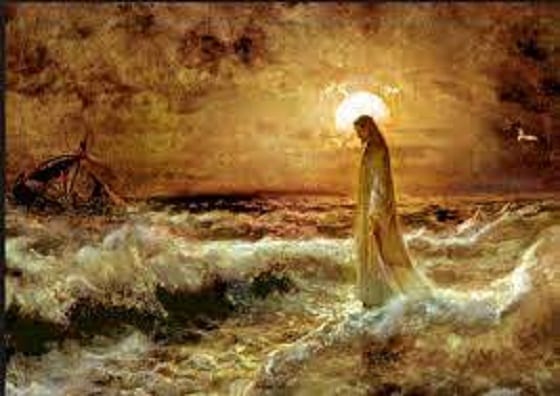
The summer Sunday gospel readings annually are full of Jesus’ greatest hits–this year is no exception. This Sunday’s reading contains John’s account of two of Jesus’ most notable miracles–feeding the five thousand and walking on water. The feeding of the five thousand is the only pre-resurrection miracle that is recorded in all four of the canonical gospels; Jesus walking on the Sea of Galilee is in all of the gospels except Luke (maybe Luke wasn’t there?). What makes the walking on water scene even more fascinating is that the three gospel accounts are very, very different.
I often get the opportunity to play theologian in the interdisciplinary program I am part of every year. In the first semester of the course, during “New Testament week,” I spend some time walking students through how the New Testament canon evolved over two or three centuries. Of the four canonical gospels, Mark is the earliest (around 65-70 CE), with Matthew and Luke coming along fifteen years or so later. It is clear from the texts that both Matthew and Luke used Mark as the spine of their own gospels, adding in various sayings of Jesus that scholars attribute to another early (undiscovered) source called “Q,” as well as other additional material.
To illustrate, I use a couple of comparative texts from Mark and Matthew, including the story of Jesus walking on the water from today’s gospel. Mark’s account is, as usual, straightforward, unvarnished, and open-ended in its implications.
Mark 6:45-52: When it was evening, the boat was far out on the sea and he was alone on shore. Then he saw that they were tossed about while rowing, for the wind was against them. About the fourth watch of the night, he came towards them walking on the sea. He meant to pass by them. But when they saw him walking on the sea, they thought it was a ghost and cried out. They had all seen him and were terrified. But at once he spoke with them, “Take courage, it is I, do not be afraid!” He got into the boat with them and the wind died down. They were completely astounded. They had not understood the incident of the loaves. On the contrary, their hearts were hardened.
As is often the case in Mark’s accounts, the disciples are unsure of what they are dealing with. They are still reeling from last week’s miracle—feeding the 5000 with five loaves and two fish—and now the guy walks on water and calms the storm. “Their hearts were hardened” is not so much a description of disbelief as of total disorientation and confusion.
Matthew’s account of the same event is so similar to Mark’s account at the beginning that Matthew would be accused of plagiarism if he was a contemporary academic.
Matthew 14:22-33: When it was evening, he was there alone. Meanwhile the boat, already a few miles offshore, was being tossed about by the waves, for the wind was against it. During the fourth watch of the night, he came toward them, walking on the sea. When the disciples saw him walking on the sea they were terrified. “It is a ghost,” they said, and they cried out in fear. At once Jesus spoke to them, “Take courage, it is I; do not be afraid.”
After the storm calms down as in Mark’s account, Matthew adds a new twist that is central to most retellings of the miracle.
Peter answered him, “Lord, if it is you, command me to come to you on the water.” He said, “come.” So Peter got out of the boat, started walking on the water, and came toward Jesus. But when he noticed the strong wind, he became frightened, and beginning to sink, he cried out, “Lord, save me!” Immediately Jesus stretched out his hand and caught him, and said to him, “O you of little faith, why did you doubt?” After they got into the boat, the wind died down. Those who were in the boat did him homage, saying, “Truly, you are the Son of God.”
Now wait a minute. Peter gets out of the boat and walks on the water, and Mark didn’t include it in his gospel? That seems like a kind of big thing to neglect or forget, doesn’t it? But even more important is Matthew’s account of how the disciples reacted to all of this. Mark’s disciples are afraid, astounded, clueless, and hard of heart. Matthew’s disciples are afraid at first, but after everything is over, they get it. They recognize who Jesus is and worship him.
As an aside, John’s account of this same event–on tap this coming Sunday–is much more like Mark’s than Matthew’s account. John says nothing about Peter’s joining Jesus out on the lake. To add to the confusion, John’s gospel is the last of the four to be written, as much as three or four decades after Mark’s and a couple of decades after Matthew’s.
So, what “really” happened? Did Peter walk on the water or not? Were the disciples’ hearts hardened or did they kneel down and worship Jesus? I have no idea, of course, and neither do you. Assuming that these gospels were written by the men whose names they bear, Mark was not even one of the original twelve disciples. Everything he reports is second-hand at best. Matthew was one of the twelve, but he’s writing as much as forty or fifty years after the fact as an older man. Our uncertainty about “what actually happened” is no different than similar uncertainty about any events that occurred before the advent of cameras, videotaping, and so on.
It’s worth remembering that, despite the protestations of many of its worshippers, the Bible was not written for us. The Bible is a library of various books written over many centuries, books originally intended for very specific audiences in very specific social and historical circumstances. One way of engaging with the differences between Mark’s and Matthew’s versions of Jesus walking on the water is to imagine what sorts of people or communities each version reflects.
Mark’s gospel, the earliest of the four gospels, frequently describes the uncertainty and disorientation of those who engaged with and followed Jesus. Sometimes Mark’s Jesus expresses uncertainty about who he is and what his mission is supposed to accomplish. The disciples in Mark’s account, just as undoubtedly many early followers of Jesus in the next generation after he was gone, knew that there was something unusual and special going on, but were not yet prepared to put a name to it.
By the time Matthew’s gospel is written fifteen or more years after Mark’s, there is clearly a confidence about who Jesus was and what he was about that is missing in earlier accounts. Matthew’s disciples are more definitive about Jesus’ identity than Mark’s, because collective decisions about who Jesus was have become more and more definitive and central in early Christian communities in the intervening years.
This should not be of the slightest concern to even the most conservative, Bible-centered person of Christian faith. We all know that faith evolves and grows over time, accounting for increased experiences and maturity. If your faith is the same now as it was when you first became a person of faith, you have chosen to remain in the nursery or kindergarten of faith. In the end, the details of what happened during the storm on that lake almost 2000 years ago are irrelevant. What matters is what people of faith do with the stories over the succeeding generations. That is what makes such stories continually and eternally new.
Development of Western Civilization
Previous Post

July 22, 2021
A Philosopher Who Happens to Be a Christian
Next Post

July 27, 2021 Of Marx and Vineyards
Browse Our Archives
Select a Category abortion Advent AI Angels Artificial intelligence atheism attention baptism Baptists beauty belief Benedictines Bible bicycling Big Bird books Bovina Camaldoli hermitage Canada Catholicism cats certainty change Christianity Christmas Collegeville Covid-19 creativity Development of Western Civilization dogs doubt Easter Enneagram Epiphany Episcopal ethics Eucharist evil extroverts Facebook faith family fear flowers forgiveness freedom friends God goodness grace happiness heaven hell history Holy Spirit Holy Week hope human nature humility humor idolatry incarnation introverts irreverence Islam Jeanne Jesus Joe Biden joy Judaism justice Kamala Harris knowledge Lent listen literature liturgy love Marsue Memorial Day miracles movies music mystery mythology NPR Old Testament optimism paradox peace Penguins philosophy piano podcast politics power prayer Protestantism Providence College Religion Rhode Island sabbatical sacrament science seeing silence Simone Weil Socrates soul sports St. John's College stories suffering tattoo teaching technology television theology thinking time tolerance transcendence travel trees trust truth Uncategorized Vermont wisdom wonder writing
Select a Month May 2026 April 2026 March 2026 February 2026 January 2026 December 2025 November 2025 October 2025 September 2025 August 2025 July 2025 June 2025 May 2025 April 2025 March 2025 February 2025 January 2025 December 2024 November 2024 October 2024 September 2024 August 2024 July 2024 June 2024 May 2024 April 2024 March 2024 February 2024 January 2024 December 2023 November 2023 October 2023 September 2023 August 2023 July 2023 June 2023 May 2023 April 2023 March 2023 February 2023 January 2023 December 2022 November 2022 October 2022 September 2022 August 2022 July 2022 June 2022 May 2022 April 2022 March 2022 February 2022 January 2022 December 2021 November 2021 October 2021 September 2021 August 2021 July 2021 June 2021 May 2021 April 2021 March 2021 February 2021 January 2021 December 2020 November 2020 October 2020 September 2020 August 2020 July 2020 June 2020 May 2020 April 2020 March 2020 February 2020 January 2020 December 2019 November 2019 October 2019 September 2019 August 2019 July 2019 June 2019 May 2019 April 2019 March 2019 February 2019 January 2019 December 2018 November 2018 October 2018 September 2018 August 2018 July 2018 June 2018 May 2018 April 2018 March 2018 February 2018 January 2018 December 2017 November 2017 October 2017 September 2017 August 2017 July 2017 June 2017 May 2017 April 2017 March 2017 February 2017 January 2017 December 2016 November 2016 October 2016 September 2016 August 2016 July 2016 June 2016 May 2016 April 2016 March 2016 February 2016 January 2016 December 2015 November 2015 October 2015 September 2015 August 2015 July 2015 June 2015 May 2015 April 2015 March 2015 February 2015 January 2015 December 2014 November 2014 October 2014 September 2014 August 2014 July 2014 June 2014 May 2014 April 2014 March 2014 February 2014 January 2014 December 2013 November 2013 October 2013 September 2013 August 2013 July 2013 June 2013 May 2013 April 2013 March 2013 February 2013 January 2013 December 2012 November 2012 October 2012 September 2012
Follow Us!
TAKE THE
Religious Wisdom Quiz
What was primary method of debt resolution in Biblical times?
Select your answer to see how you score.
Public trial Fine payment Community service Slavery
Books by This Author Books by Vance G. Morgan
Related posts from Freelance Christianity

The Lonely Pawn: On Faith, Doubt, and Meaning


AI and Love: When a Chatbot Becomes a...

TRENDING AT PATHEOS Progressive Christian

What Being a Modern-Day Apostle Means to Me
In my last column, I discussed the ins and outs of modern-day...

Did Ancient China Once Worship the God of...
Across human history, a common thread weaves through the origins of the...

Love Your Neighbor – Including Earth-Kin: Lev. 19,...
God’s command to love your neighbor means acting in an ethical and...

Lead a Church Study of “Jesus and Lao...
Guest writer Jack Thomas (The Irreverent Reverend) reflects on leading his church...

Pastoral Wisdom for Responding to Sermon Pushback
Getting sermon pushback on your social justice sermon? Learn practical, Proverbs-based strategies...

Principles for Understanding the Apostolic Ministry Today
Whenever people discover that my formal ministry title is "apostle," as in...
view all Progressive Christian blogs
Ad-Free & Subscriber Log-In Subscription Support
- About Us
- 2026 Calendar
- Videos
- Podcasts
- Library of World Religions
- Faith In Media Tracker
- Advertise With Us
- Write for Us
- Privacy Policy
- Terms of Service
- Do Not Sell My Data
- Contact Us
- Radiant Digital
- Manage Newsletter Subscriptions
- Unsubscribe From Notifications
- Sitemap
Copyright 2008-2026, Patheos. All rights reserved.
Subscription Support Ad-Free & Subscriber Log-In
Follow Patheos