
BuddhistCatholicContemplativeEvangelicalGeneral ChristianHinduJewishLatter-day SaintMuslimNew VisionsProgressive Christian
Beliefs
- Buddhist
- Catholic
- Contemplative
- Evangelical
- General Christian
- Hindu
- Jewish
- Latter-day Saint
- More Voices
- Muslim
- New Visions
- Pagan
- Progressive Christian
Topics
- Religion News
- Food and Religion
- Sports and Religion
- Religious Art
- Religious Music and Entertainment
- Religious Events
- History and Religion
- Style and Religion
- Politics and Religion
- Women in Religion
- Recreation Outdoors and Religion
- Business Finance and Religion
- Careers Workplace and Religion
- Education and Religion
- Family Parenting and Religion
- Health Fitness and Religion
- Home and Religion
- Relationships and Religion
- Technology and Religion
- Travel and Religion
Columnists
- Buddhist Columnists
- Business Finance and Religion Columnists
- Careers Workplace and Religion Columnists
- Catholic Columnists
- Contemplative Columnists
- Education and Religion Columnists
- Evangelists Columnists
- Family Parenting and Religion Columnists
- General Christian Columnists
- Health Fitness and Religion Columnists
- Hindu Columnists
- History and Religion Columnists
- Home and Religion Columnists
- Jewish Columnists
- More Voices Columnists
- Latter Day Columnists
- Muslim Columnists
- New Visions Columnists
- Nonreligious Columnists
- Pagan Columnists
- Politics and Religion Columnists
- Progressive Columnists
- Recreation Outdoors and Religion Columnists
- Relationships and Religion Columnists
- Religion News Columnists
- Religious Art Columnists
- Religious Events Columnists
- Religious Music and Entertainment Columnists
- Sports and Religion Columnists
- Style and Religion Columnists
- Technology and Religion Columnists
- Travel and Religion Columnists
- Women in Religion Columnists
Resource Library
- 2026 Calendar
- Library of World Religions
- The 100 Most Holy Places on Earth
- Patheos Answers
- Podcasts
- Videos
- Faith Leaders Database
- Anglican Episcopalian
- Bahai
- Baptist
- Buddhism
- Christianity
- Confucianism
- Eastern Orthodoxy
- Hinduism
- Holiness and Pentecostal
- ISKCON
- Islam
- Judaism
- Lutheran
- Methodist
- The Church of Jesus Christ of Latter-day Saints
- New Age
- Paganism
- Presbytarian and Reformed
- Protestantism
- Religion Behind the Scenes
- Roman Catholic
- Scientology
- Shia Islam
- Sikhism
- Sufism
- Sunni Islam
- Taoism
- Zen
- See all religions
Research Tools
 Ad-Free & Subscriber Log-In Subscription Support
Ad-Free & Subscriber Log-In Subscription Support
Follow Patheos 

- Trending:
- Forgiveness
- |
- Marriage
- |
- Consciousness
- |
- Death Penalty
- |
- Election
- |
- Halloween

- Home
- Progressive Christian
- What the Wounds on Jesus’ Resurrected Body Tell Us
What the Wounds on Jesus’ Resurrected Body Tell Us
Last updated on: August 27, 2022 at 12:00 pm by Vance Morgan
What the Wounds on Jesus’ Resurrected Body Tell Us 2022-08-27T07:47:45-04:00 Vance Morgan
Patheos Explore the world's faith through different perspectives on religion and spirituality! Patheos has the views of the prevalent religions and spiritualities of the world.
I consider myself to be well informed and well read, but every once in a while I read or hear something so new that I have to say, “I’ve never thought about that before!’ followed quickly by “This is really important. Why haven’t I ever thought about this before?” I’ve had this experience more than once this summer.
One of my favorite podcasts over the past few months has been “The Bible for Normal People” with Pete Enns and Jared Byas. I appreciate their perspective and their guests, particularly their willingness to treat the Bible as a special book but without kid gloves and the beginning warning that “this is the Word of God.” Perhaps I most appreciate Enns’ irreverent sense of humor, on display when each episode is introduced by his pronouncing “Welcome to ‘The Bible for Normal People’, the only God-ordained podcast on the Internet!”
Both Enns and Byas are theologians; one of the most interesting things that they say frequently is that there is always an adjective before theology. In other words, there is no such thing as theology in the abstract or per se. Theology is always shaped and formed through a lens or framework, such as “Protestant” or “Catholic” theology, “LGBTQ+” theology, or “Jewish” theology (and of course, there are many more fine-tuned and granular adjectives within those very broad frameworks).
I’ve learned a great deal from this podcast over the past months, but none more than from their episodes involving “disability” theology. Two episodes in particular were teaching moments for me. The first, “Disability Theology is for Everyone,” is with Stephanie Tait in May 2021. Tait is the author of the 2019 book The View from Rock Bottom: Discovering God’s Embrace in Our Pain. The second podcast is from this past May with Amy Kenney, with the same title as her 2022 book My Body is Not a Prayer Request: Disability Justice in the Church. I highly recommend both podcast episodes; I am currently in the process of reading the books.
Amy Kenny begins the first chapter of My Body is Not a Prayer Request with a personal story that, unfortunately, sounds very familiar. She is in church; she also happens to be in a wheelchair. A stranger approaches her and says “God told me to pray for you. God wants to heal you!” Amy Kenny has put up with this sort of invasion of her privacy many times in the past, thinking that “if I could just assume a veneer of piety, it would inoculate me against their patronizing prayers and invasive interrogations.” But this time she chose not to play the game, telling the woman that “I don’t need prayer for healing. My body has already been sanctified and redeemed.”
Not surprisingly, the woman is shocked, saying that “You need to hear that God wants to heal you. If you stopped resisting, you would be free already.” Reflecting on this experience, Kenny writes that
This woman is an echo of every prayerful perpetrator before her. They have many faces, but they always approach me with the same paternalistic confidence, eager to rid me of my wheelchair or cane. On repeat, they applaud the stories where Jesus healed a disabled outcast like me, without stopping to consider that curing bodies and healing lives are not the same thing.
Last Sunday’s gospel text from Luke 13 is a good introductory story for developing the distinction between curing and healing.
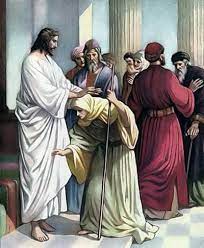 As Jesus is teaching in a synagogue, a disabled woman “bent over and . . . quite unable to stand up straight” shows up. Unlike many similar stories in the gospels, this woman doesn’t even ask Jesus for anything. Jesus notices her, lays his hands on her, and says a few words; “Immediately she stood up straight and began praising God,” followed by a tense conversation with the religious authorities about whether it is permissible to do such work on the Sabbath. From our contemporary Western perspective, Jesus’ miracles are a matter of seeing a person with a disability and “fixing” it. Problem solved. This is how I, along with millions of other Christians, have learned to interpret the stories of Jesus’ miracles. Jesus encountered someone who was less than a full human being due to disability and restored them to full humanity by curing them.
Both Amy Kenny and Stephanie Tait spend a good deal of time pushing back against this perspective, arguing that it is a result of conflating “curing/fixing” and “healing,” as well as a significant contributor to “ableism,” the belief that disabled people are less valuable or less human than their nondisabled counterparts. When Amy Kenny told the woman in church that she did not need prayer for healing, it is because, as she says on “The Bible for Normal People” podcast, “My disabled body bears the image of God and doesn’t need to be fixed or changed or cured.”
The Greek word often translated “healing” in the New Testament is sozo, which means “to make whole” or “to save.” Kenny points out that in Jesus’ world, healing meant a lot more than fixing a physical ailment.
They talked about healing as restoring relationships and integrating someone back into social and religious systems . . . Jesus’ healing is not purely about a physical alteration but about reestablishing right relationship between humanity and God and, hopefully, between individuals and community.
A person with a disability in Jesus’ culture was an outcast, someone considered unworthy to participate fully in community life. Sure, Jesus cured illnesses and disabilities, but primarily as a means to fully restoring the person to their community and social connections. A friend once told Jeanne and me about a horrific car accident that had left him close to dead with bones shattered and organs damaged several decades earlier. “Western medicine saved my life,” he said, “and Eastern medicine gave me my life back.” That’s the difference between curing/fixing and healing.
It is difficult for many nondisabled people, me included, to wrap their brains and imaginations around the possibility that being nondisabled is not necessarily “better” than being disabled. If as Christians we believe that human beings are made in the image of God, doesn’t it make sense that a disabled or damaged body is a distortion of that image? In her podcast interview, Stephanie Tait draws our attention to a familiar story from the gospels that is “hands down the most powerful story in scripture for me as a disabled woman,” a passage that also blew my mind when I saw it differently for the first time through her eyes.
Everyone knows the story of “Doubting Thomas,” the disciple who would not believe that Jesus was risen until he could put his finger in the holes in Jesus’ hands and put his hand in the wound in his side caused by a Roman spear. Artistic depictions of this event abound, almost always reducing the wounds to sanitized and tiny scars. Stephanie Tait continues
But when you read the text, it’s gruesomely clear that that’s not what we’re talking about. We’re talking about, like, he literally says, take your thumb and just jam it into this gaping, open wound in my hand. Take your hand and literally just plunge it into my insides in this gaping hole in my side. We’re not talking about I’m all better and there’s these little freckles now, we’re talking about unhealed wounds.
This was the resurrected Jesus . . . and he comes back in glorious perfection with a damaged body that most of us would cringe at or turn away from. For Stephanie Tait, that changed everything.
It was such a turning point for me to know that I serve a wounded savior that can be fully glory and also not healed, that there’s nothing broken or incomplete or anything less than the fullness of the image of God in an unhealed body like mine because he came back with an unhealed body. It was huge. Absolutely huge for me.
I’m in the early weeks of processing what I’ve read, heard, and learned about disability theology this summer. There will be more essays to come, including a comparison of white privilege and ableism, as well the various ways in which the church has institutionalized discrimination against persons with disabilities. As Amy Kenny writes,
Perhaps instead of trying to pray away the cane, prayerful perpetrators should ensure that buildings are accessible to me . . . Perhaps instead of immediately dismissing my body as less valuable, prayerful perpetrators should wonder how my disabled body displays the image of God to our community. Perhaps instead of always attempting to cure, prayerful perpetrators should yearn for holistic healing.
Next Post

August 30, 2022 It Is "The Best of Times" Once Again
Browse Our Archives
Select a Category abortion Advent AI Angels Artificial intelligence atheism attention baptism Baptists beauty belief Benedictines Bible bicycling Big Bird books Bovina Camaldoli hermitage Canada Catholicism cats certainty change Christianity Christmas Collegeville Covid-19 creativity Development of Western Civilization dogs doubt Easter Enneagram Epiphany Episcopal ethics Eucharist evil extroverts Facebook faith family fear flowers forgiveness freedom friends God goodness grace happiness heaven hell history Holy Spirit Holy Week hope human nature humility humor idolatry incarnation introverts irreverence Islam Jeanne Jesus Joe Biden joy Judaism justice Kamala Harris knowledge Lent listen literature liturgy love Marsue Memorial Day miracles movies music mystery mythology NPR Old Testament optimism paradox peace Penguins philosophy piano podcast politics power prayer Protestantism Providence College Religion Rhode Island sabbatical sacrament science seeing silence Simone Weil Socrates soul sports St. John's College stories suffering tattoo teaching technology television theology thinking time tolerance transcendence travel trees trust truth Uncategorized Vermont wisdom wonder writing
Select a Month May 2026 April 2026 March 2026 February 2026 January 2026 December 2025 November 2025 October 2025 September 2025 August 2025 July 2025 June 2025 May 2025 April 2025 March 2025 February 2025 January 2025 December 2024 November 2024 October 2024 September 2024 August 2024 July 2024 June 2024 May 2024 April 2024 March 2024 February 2024 January 2024 December 2023 November 2023 October 2023 September 2023 August 2023 July 2023 June 2023 May 2023 April 2023 March 2023 February 2023 January 2023 December 2022 November 2022 October 2022 September 2022 August 2022 July 2022 June 2022 May 2022 April 2022 March 2022 February 2022 January 2022 December 2021 November 2021 October 2021 September 2021 August 2021 July 2021 June 2021 May 2021 April 2021 March 2021 February 2021 January 2021 December 2020 November 2020 October 2020 September 2020 August 2020 July 2020 June 2020 May 2020 April 2020 March 2020 February 2020 January 2020 December 2019 November 2019 October 2019 September 2019 August 2019 July 2019 June 2019 May 2019 April 2019 March 2019 February 2019 January 2019 December 2018 November 2018 October 2018 September 2018 August 2018 July 2018 June 2018 May 2018 April 2018 March 2018 February 2018 January 2018 December 2017 November 2017 October 2017 September 2017 August 2017 July 2017 June 2017 May 2017 April 2017 March 2017 February 2017 January 2017 December 2016 November 2016 October 2016 September 2016 August 2016 July 2016 June 2016 May 2016 April 2016 March 2016 February 2016 January 2016 December 2015 November 2015 October 2015 September 2015 August 2015 July 2015 June 2015 May 2015 April 2015 March 2015 February 2015 January 2015 December 2014 November 2014 October 2014 September 2014 August 2014 July 2014 June 2014 May 2014 April 2014 March 2014 February 2014 January 2014 December 2013 November 2013 October 2013 September 2013 August 2013 July 2013 June 2013 May 2013 April 2013 March 2013 February 2013 January 2013 December 2012 November 2012 October 2012 September 2012
Follow Us!
TAKE THE
Religious Wisdom Quiz
I challenged 450 prophets to call down fire from heaven, and theirs failed while mine consumed everything. Who am I?
Select your answer to see how you score.
Elijah Samuel Elisha Moses
Books by This Author Books by Vance G. Morgan
Related posts from Freelance Christianity

The Lonely Pawn: On Faith, Doubt, and Meaning


AI and Love: When a Chatbot Becomes a...

TRENDING AT PATHEOS Progressive Christian

Why Christians Have a Sacred Duty to Vote:...
The Bible offers strong support for the sacred duty to vote. Here...

What Being a Modern-Day Apostle Means to Me
In my last column, I discussed the ins and outs of modern-day...

Did Ancient China Once Worship the God of...
Across human history, a common thread weaves through the origins of the...

Love Your Neighbor – Including Earth-Kin: Lev. 19,...
God’s command to love your neighbor means acting in an ethical and...

Lead a Church Study of “Jesus and Lao...
Guest writer Jack Thomas (The Irreverent Reverend) reflects on leading his church...

Principles for Understanding the Apostolic Ministry Today
Whenever people discover that my formal ministry title is "apostle," as in...
view all Progressive Christian blogs
Ad-Free & Subscriber Log-In Subscription Support
- About Us
- 2026 Calendar
- Videos
- Podcasts
- Library of World Religions
- Faith In Media Tracker
- Advertise With Us
- Write for Us
- Privacy Policy
- Terms of Service
- Do Not Sell My Data
- Contact Us
- Radiant Digital
- Manage Newsletter Subscriptions
- Unsubscribe From Notifications
- Sitemap
Copyright 2008-2026, Patheos. All rights reserved.
Subscription Support Ad-Free & Subscriber Log-In
Follow Patheos