
BuddhistCatholicContemplativeEvangelicalGeneral ChristianHinduJewishLatter-day SaintMuslimNew VisionsProgressive Christian
Beliefs
- Buddhist
- Catholic
- Contemplative
- Evangelical
- General Christian
- Hindu
- Jewish
- Latter-day Saint
- More Voices
- Muslim
- New Visions
- Pagan
- Progressive Christian
Topics
- Religion News
- Food and Religion
- Sports and Religion
- Religious Art
- Religious Music and Entertainment
- Religious Events
- History and Religion
- Style and Religion
- Politics and Religion
- Women in Religion
- Recreation Outdoors and Religion
- Business Finance and Religion
- Careers Workplace and Religion
- Education and Religion
- Family Parenting and Religion
- Health Fitness and Religion
- Home and Religion
- Relationships and Religion
- Technology and Religion
- Travel and Religion
Columnists
- Buddhist Columnists
- Business Finance and Religion Columnists
- Careers Workplace and Religion Columnists
- Catholic Columnists
- Contemplative Columnists
- Education and Religion Columnists
- Evangelists Columnists
- Family Parenting and Religion Columnists
- General Christian Columnists
- Health Fitness and Religion Columnists
- Hindu Columnists
- History and Religion Columnists
- Home and Religion Columnists
- Jewish Columnists
- More Voices Columnists
- Latter Day Columnists
- Muslim Columnists
- New Visions Columnists
- Nonreligious Columnists
- Pagan Columnists
- Politics and Religion Columnists
- Progressive Columnists
- Recreation Outdoors and Religion Columnists
- Relationships and Religion Columnists
- Religion News Columnists
- Religious Art Columnists
- Religious Events Columnists
- Religious Music and Entertainment Columnists
- Sports and Religion Columnists
- Style and Religion Columnists
- Technology and Religion Columnists
- Travel and Religion Columnists
- Women in Religion Columnists
Resource Library
- 2026 Calendar
- Library of World Religions
- The 100 Most Holy Places on Earth
- Patheos Answers
- Podcasts
- Videos
- Faith Leaders Database
- Anglican Episcopalian
- Bahai
- Baptist
- Buddhism
- Christianity
- Confucianism
- Eastern Orthodoxy
- Hinduism
- Holiness and Pentecostal
- ISKCON
- Islam
- Judaism
- Lutheran
- Methodist
- The Church of Jesus Christ of Latter-day Saints
- New Age
- Paganism
- Presbytarian and Reformed
- Protestantism
- Religion Behind the Scenes
- Roman Catholic
- Scientology
- Shia Islam
- Sikhism
- Sufism
- Sunni Islam
- Taoism
- Zen
- See all religions
Research Tools
 Ad-Free & Subscriber Log-In Subscription Support
Ad-Free & Subscriber Log-In Subscription Support
Follow Patheos 

- Trending:
- Forgiveness
- |
- Marriage
- |
- Consciousness
- |
- Death Penalty
- |
- Election
- |
- Halloween

- Home
- Progressive Christian
- What if God exists, but isn’t very nice?
What if God exists, but isn’t very nice?
Last updated on: September 23, 2021 at 6:00 am by Vance Morgan
What if God exists, but isn’t very nice? 2021-09-19T12:49:30-04:00 Vance Morgan
Patheos Explore the world's faith through different perspectives on religion and spirituality! Patheos has the views of the prevalent religions and spiritualities of the world.
Three weeks ago, I posted an essay that described a new course called “Faith and Doubt” that I will be teaching next spring with a Dominican priest colleague and friend from the Political Science department.
In the interest of moving the ball forward, we are meeting each week for lunch to discuss and plan. One of my proposed texts is The Time of the Angels, one of Iris Murdoch’s many thought-provoking and disturbing novels from the mid-20th century. I noticed the other day that although Murdoch was an honored novelist who won numerous awards with her fiction, The Time of the Angels is out of print and only available from used bookstores (at least according to Amazon). There’s a reason for this, since the novel asks questions and suggests possibilities that most of us would just as soon avoid.
In her beautiful and moving memoir Testament of Youth, Vera Brittain quotes the following excerpt from a letter she received from a friend, a man whom she would ultimately marry in middle age:
There is an abiding beauty . . . which may be appreciated by those who will see things as they are, and who will ask for no reward except to see. There is a high aesthetic pleasure in seeing the truth clear-eyed, and in not being afraid of things.
This expresses eloquently what many consider to be the ultimate driving force behind one of the highest of all human activities—the pursuit of truth. In many cases, such activities take on religious and spiritual significance—the search for transcendent Truth and God.
Yet such pursuits are fraught with dangers and pitfalls from the start. What if human beings do not possess tools adequate or appropriate for the search? What if transcendent truth does not exist at all, and there are only little, contingent truths that we construct for our utilitarian and pragmatic purposes, then baptize as Absolute Truth? Or worse, what if transcendent Truth does exist, but it is radically different than what we believe or expect it to be, different in some disturbing, frightening, or nightmarish way?
Enter The Time of the Angels, in which Iris Murdoch grapples directly with the possibility that we might want to think twice about pursuing ultimate truth. Marcus Fisher, one of the novel’s main characters, asks “Suppose the truth about human life were just something terrible, something appalling which one would be destroyed by contemplating?” The Time of the Angels is a complex novel whose central events are driven by one of the most dysfunctional families you’ll ever encounter. The various characters take very different approaches to what Murdoch elsewhere calls the most important question of the contemporary age: How is one to address human spiritual hunger and need in a post-theistic age?
Murdoch takes it for granted that the religious frameworks within which spiritual needs have been addressed and spiritual hungers have been satisfied traditionally are no longer meaningful for the vast majority of human beings. Through her characters, she provides a wide range of ways to cope with this situation.
The real philosophical interest and “heavy lifting” of the novel swirls around the Fisher brothers, Marcus and Carel. Marcus is an academic whose writing project is a book with the working title “Morality in a World without God”–his project is strikingly similar to what Iris Murdoch herself often attempted in her own philosophical essays and books. Marcus’s strategy is to accept the challenge of preserving a transcendent framework for morality, given the demise of the traditional religious frameworks that have previously provided such support for moral absolutes. He intends to argue that the religious myths and models of the transcendent are disposable so long as some other transcendent concept occupies the vacated space. His insight, in other words, is that morality requires rootedness in the transcendent, but perhaps almost any transcendent concept will do.
The energies and concerns underlying Marcus’s thinking come to light during a conversation with the local Anglican Bishop and Norah, a no-nonsense neighborhood woman. The three are having tea and discussing what to do about Marcus’s brother Carel, an Anglican priest who has lost his faith; Carel’s expressed atheism and erratic behavior have raised serious concerns in his new parish. For Norah, the problem has an easy solution—the crazy priest should be removed by the Bishop, since “it is highly dangerous for an unbalanced man to have that sort of power.”
The Bishop, surprisingly, disagrees, showing an unwillingness to make moral judgments of any sort (“let he who is without neurosis cast the first stone”), let alone one this specific. As the conversation progresses, the Bishop appears to be rather unconcerned about the imminent loss of traditional religious structures or even about conventional and traditional conceptions of morality. Marcus begins to perceive the dangers of divorcing morality from a belief in a good God or a benign transcendence and realizes that although in the post-modern world it might be “cutting edge” and “intelligent” to reject the idea of God, he surely doesn’t want to live in a world in which everyone has done so.
It occurred to him now how much it mattered to him that all that business should still go on in the old way. He did not believe in the redeeming blood of Jesus, he did not believe in the Father and the Son and the Holy Ghost, but he wanted other people to believe. He wanted the old structure to continue there beside him, nearby, something he could occasionally reach out and touch with his hand.
What if there truly is no God? Much worse than that, what if there is something transcendent, but it is dangerous, black, destructive? With no underlying guarantees, anything seems possible, including the worst.
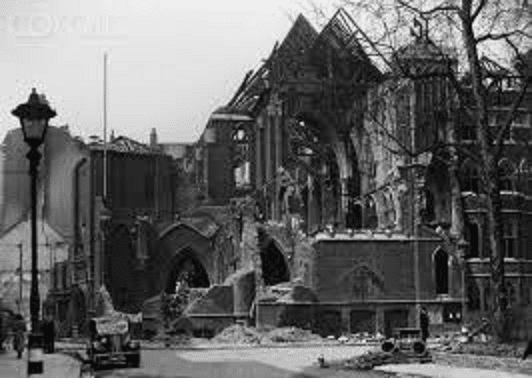
As noted above, Marcus’s brother Carel is an Anglican priest who, despite the fact that he has lost his faith (or worse), has been assigned to a parish in London whose church and parish house are in partial ruin, unrestored since being bombed during the blitz in World War II. He is a recluse, refusing to see anyone but the odd and eclectic handful of people living in his household. Marcus spends a good deal of the book trying to see him; when he finally succeeds, Carel’s soliloquy raises some of the most disturbing possibilities concerning transcendence that can be imagined.
Priests have lost their faith before—in Murdoch’s novels, most of them do—but Carel is unusual in pushing his “there is no God” hypothesis to its logical conclusions. Most non-theists are like Marcus, paying lip service to the loss of familiar structures, yet naively hoping that the moral “good stuff” can be preserved and packaged in a less simplistic way. As Carel suggests, however, the truth may be too terrible to even consider.
Suppose the truth were awful, suppose it was just a black pit, or like birds huddled in the dust in a dark cupboard? Suppose only evil were real, only it was not evil since it had lost even its name? Who could face this? The philosophers have not even tried . . . And if they did perhaps, through some crack, some fissure in the surface, catch sight of that, they ran straight back to their desks, they worked harder than ever late into the night to explain that it was not so, to prove that it could not be so. They suffered, they even died for this argument, and called it the truth.
When we believe we are searching for God, suppose we are just furiously constructing barriers between ourselves and a truth we suspect but cannot face? Perhaps the job of the philosopher and the theologian is not so much to pursue the truth as to construct better and better ways to protect us from it. This is not a matter of weakness or delusion—it’s a matter of survival. As Carel concludes:
With or without the illusion of God, goodness is impossible to us. We have been made too low in the order of things. God made it impossible that there should be true saints. But now he is gone we are not set free for sanctity. We are the prey of the angels.
Marcus has no answer for Carel. Perhaps consistent with the vision of reality he has presented, Carel ultimately commits suicide.
Iris Murdoch once said that the best question that anyone can ask is “What are you afraid of?” In an interview, the question was once turned back on her by the interviewer—in response she identified her greatest fear.
I think I’m afraid of somehow finding out that it doesn’t really matter how you behave, that morality is just a superficial phenomenon. I don’t think one could find this out, it’s just a bogey; the impossibility of finding it out is very deep in moral philosophy. I don’t believe in God, but I think morality is fundamental to human life.
In other words, she is most afraid that Carel is right and Marcus is wrong. Yet she implies that perhaps it is truly impossible for a human being to believe that.
I agree. The option is always available to deny the existence of anything greater than us—it is a logically coherent position. It is also possible that the inherent human hope for goodness and justice is a firewall we create against the intrinsic evil and horror of reality. But I’m not buying it. Although I am very hesitant to say anything with certainty about God, I agree with Magda Trocme:
If there weren’t somewhere a source of hope, justice, truth, and love, we would not have rooted in us the hope of justice, truth, and love that we find in every religion and every degree of civilization. It’s that source that I call God.
Previous Post

September 20, 2021
Is God More Like Ella Fitzgerald or Ludwig van Beethoven?
Next Post

September 26, 2021 Sometimes, it just doesn't matter
Browse Our Archives
Select a Category abortion Advent AI Angels Artificial intelligence atheism attention baptism Baptists beauty belief Benedictines Bible bicycling Big Bird books Bovina Camaldoli hermitage Canada Catholicism cats certainty change Christianity Christmas Collegeville Covid-19 creativity Development of Western Civilization dogs doubt Easter Enneagram Epiphany Episcopal ethics Eucharist evil extroverts Facebook faith family fear flowers forgiveness freedom friends God goodness grace happiness heaven hell history Holy Spirit Holy Week hope human nature humility humor idolatry incarnation introverts irreverence Islam Jeanne Jesus Joe Biden joy Judaism justice Kamala Harris knowledge Lent listen literature liturgy love Marsue Memorial Day miracles movies music mystery mythology NPR Old Testament optimism paradox peace Penguins philosophy piano podcast politics power prayer Protestantism Providence College Religion Rhode Island sabbatical sacrament science seeing silence Simone Weil Socrates soul sports St. John's College stories suffering tattoo teaching technology television theology thinking time tolerance transcendence travel trees trust truth Uncategorized Vermont wisdom wonder writing
Select a Month May 2026 April 2026 March 2026 February 2026 January 2026 December 2025 November 2025 October 2025 September 2025 August 2025 July 2025 June 2025 May 2025 April 2025 March 2025 February 2025 January 2025 December 2024 November 2024 October 2024 September 2024 August 2024 July 2024 June 2024 May 2024 April 2024 March 2024 February 2024 January 2024 December 2023 November 2023 October 2023 September 2023 August 2023 July 2023 June 2023 May 2023 April 2023 March 2023 February 2023 January 2023 December 2022 November 2022 October 2022 September 2022 August 2022 July 2022 June 2022 May 2022 April 2022 March 2022 February 2022 January 2022 December 2021 November 2021 October 2021 September 2021 August 2021 July 2021 June 2021 May 2021 April 2021 March 2021 February 2021 January 2021 December 2020 November 2020 October 2020 September 2020 August 2020 July 2020 June 2020 May 2020 April 2020 March 2020 February 2020 January 2020 December 2019 November 2019 October 2019 September 2019 August 2019 July 2019 June 2019 May 2019 April 2019 March 2019 February 2019 January 2019 December 2018 November 2018 October 2018 September 2018 August 2018 July 2018 June 2018 May 2018 April 2018 March 2018 February 2018 January 2018 December 2017 November 2017 October 2017 September 2017 August 2017 July 2017 June 2017 May 2017 April 2017 March 2017 February 2017 January 2017 December 2016 November 2016 October 2016 September 2016 August 2016 July 2016 June 2016 May 2016 April 2016 March 2016 February 2016 January 2016 December 2015 November 2015 October 2015 September 2015 August 2015 July 2015 June 2015 May 2015 April 2015 March 2015 February 2015 January 2015 December 2014 November 2014 October 2014 September 2014 August 2014 July 2014 June 2014 May 2014 April 2014 March 2014 February 2014 January 2014 December 2013 November 2013 October 2013 September 2013 August 2013 July 2013 June 2013 May 2013 April 2013 March 2013 February 2013 January 2013 December 2012 November 2012 October 2012 September 2012
Follow Us!
TAKE THE
Religious Wisdom Quiz
What was primary method of land transfer?
Select your answer to see how you score.
Verbal agreement Written deed Oath Witness testimony
Books by This Author Books by Vance G. Morgan
Related posts from Freelance Christianity

The Lonely Pawn: On Faith, Doubt, and Meaning


AI and Love: When a Chatbot Becomes a...

TRENDING AT PATHEOS Progressive Christian

Why Christians Have a Sacred Duty to Vote:...
The Bible offers strong support for the sacred duty to vote. Here...

What Being a Modern-Day Apostle Means to Me
In my last column, I discussed the ins and outs of modern-day...

Did Ancient China Once Worship the God of...
Across human history, a common thread weaves through the origins of the...

Love Your Neighbor – Including Earth-Kin: Lev. 19,...
God’s command to love your neighbor means acting in an ethical and...

Lead a Church Study of “Jesus and Lao...
Guest writer Jack Thomas (The Irreverent Reverend) reflects on leading his church...

Principles for Understanding the Apostolic Ministry Today
Whenever people discover that my formal ministry title is "apostle," as in...
view all Progressive Christian blogs
Ad-Free & Subscriber Log-In Subscription Support
- About Us
- 2026 Calendar
- Videos
- Podcasts
- Library of World Religions
- Faith In Media Tracker
- Advertise With Us
- Write for Us
- Privacy Policy
- Terms of Service
- Do Not Sell My Data
- Contact Us
- Radiant Digital
- Manage Newsletter Subscriptions
- Unsubscribe From Notifications
- Sitemap
Copyright 2008-2026, Patheos. All rights reserved.
Subscription Support Ad-Free & Subscriber Log-In
Follow Patheos