
BuddhistCatholicContemplativeEvangelicalGeneral ChristianHinduJewishLatter-day SaintMuslimNew VisionsProgressive Christian
Beliefs
- Buddhist
- Catholic
- Contemplative
- Evangelical
- General Christian
- Hindu
- Jewish
- Latter-day Saint
- More Voices
- Muslim
- New Visions
- Pagan
- Progressive Christian
Topics
- Religion News
- Food and Religion
- Sports and Religion
- Religious Art
- Religious Music and Entertainment
- Religious Events
- History and Religion
- Style and Religion
- Politics and Religion
- Women in Religion
- Recreation Outdoors and Religion
- Business Finance and Religion
- Careers Workplace and Religion
- Education and Religion
- Family Parenting and Religion
- Health Fitness and Religion
- Home and Religion
- Relationships and Religion
- Technology and Religion
- Travel and Religion
Columnists
- Buddhist Columnists
- Business Finance and Religion Columnists
- Careers Workplace and Religion Columnists
- Catholic Columnists
- Contemplative Columnists
- Education and Religion Columnists
- Evangelists Columnists
- Family Parenting and Religion Columnists
- General Christian Columnists
- Health Fitness and Religion Columnists
- Hindu Columnists
- History and Religion Columnists
- Home and Religion Columnists
- Jewish Columnists
- More Voices Columnists
- Latter Day Columnists
- Muslim Columnists
- New Visions Columnists
- Nonreligious Columnists
- Pagan Columnists
- Politics and Religion Columnists
- Progressive Columnists
- Recreation Outdoors and Religion Columnists
- Relationships and Religion Columnists
- Religion News Columnists
- Religious Art Columnists
- Religious Events Columnists
- Religious Music and Entertainment Columnists
- Sports and Religion Columnists
- Style and Religion Columnists
- Technology and Religion Columnists
- Travel and Religion Columnists
- Women in Religion Columnists
Resource Library
- 2026 Calendar
- Library of World Religions
- The 100 Most Holy Places on Earth
- Patheos Answers
- Podcasts
- Videos
- Faith Leaders Database
- Anglican Episcopalian
- Bahai
- Baptist
- Buddhism
- Christianity
- Confucianism
- Eastern Orthodoxy
- Hinduism
- Holiness and Pentecostal
- ISKCON
- Islam
- Judaism
- Lutheran
- Methodist
- The Church of Jesus Christ of Latter-day Saints
- New Age
- Paganism
- Presbytarian and Reformed
- Protestantism
- Religion Behind the Scenes
- Roman Catholic
- Scientology
- Shia Islam
- Sikhism
- Sufism
- Sunni Islam
- Taoism
- Zen
- See all religions
Research Tools
 Ad-Free & Subscriber Log-In Subscription Support
Ad-Free & Subscriber Log-In Subscription Support
Follow Patheos 

- Trending:
- Forgiveness
- |
- Marriage
- |
- Consciousness
- |
- Death Penalty
- |
- Election
- |
- Halloween

- Home
- Progressive Christian
- What Exactly is a Freelance Christian?
What Exactly is a Freelance Christian?
Last updated on: January 23, 2024 at 7:00 am by Vance Morgan
What Exactly is a Freelance Christian? 2024-01-21T17:40:45-04:00 Vance Morgan
Patheos Explore the world's faith through different perspectives on religion and spirituality! Patheos has the views of the prevalent religions and spiritualities of the world.
I have been told on occasion by readers of this blog that “Freelance Christianity” is an oxymoron. I don’t bother to tell such folks that the other contender for the name of this blog over a decade ago was “Agnostic Christianity” (which fortunately Jeanne talked me out of). Recently, though, a commenter who seemed sincere asked me to explain what the difference between freelance and traditional Christianity might be. My sense was that his question was not a bait-and-switch effort to get me to commit to something for which he wanted to condemn me to hell in his next comment (I get plenty of those). Rather, he was genuinely curious and actually wanted to know.
I told him that the Incarnation, God choosing out of love to become human, is the centerpiece of my faith; in fact, it was a fresh take on and approach to the Incarnation that, over a decade ago while on sabbatical, kept me within the Christian tent that I was at least subconsciously preparing to exit. And the Incarnation, of course, brings us to Jesus. God incarnated; God become human “meat.” It’s always good to return to the basics and ask, “What exactly do I believe?” In this case, who/what exactly was Jesus and what exactly was he up to?
I believe that Jesus was fully divine and fully human, as virtually all Christians claim. But that means little without digging deeper. My religious tradition focused almost exclusively on Jesus as God, the second member of the Trinity. Being a contrarian by nature, that immediately attracted me to Jesus the human being. 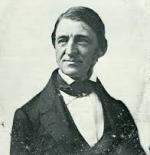 In 1838, Ralph Waldo Emerson gave his famous “Divinity School Address” at Harvard Divinity School’s commencement exercises, an address that caused such a stir and knotted so many people’s underwear uncomfortably that he was not invited back for decades. What did Ralph Waldo say in his address that was so problematic? He took the claim that Jesus was fully human seriously and drew some unorthodox conclusions.
Emerson begins with what he calls “the religious sentiment,” a recognition that the moral law is present equally in each individual and that I am, as are all human beings, a part of something greater and sublime. According to Emerson, “this sentiment is divine and deifying. showing the fountain of all good to be within . . . this sentiment is the essence of all religion.” The problem is that virtually every religion either ignores, dilutes, or denies that each person, through the natural religious sentiment, equally resonates with the divine. Christianity is no exception, Emerson claims, specifically because “it [Christianity] has dwelt, it dwells, with noxious exaggeration about the person of Jesus.”
Clearly Jesus is central to the Christian faith, so how could it be possible for the Christian religion to exaggerate anything about the person of Jesus? Emerson’s point is that to the extent that the divinity and “otherness” of Jesus is raised in importance compared to his humanity, Jesus becomes a “one-off” historical anomaly and the presence of the divine in each human being is ignored and ultimately denied.
So who was Jesus? Is Emerson one of those heretics who wants to sell Jesus to us as just another excellent teacher, a fine moral exemplar, an admirable human being but not divine? Hardly. Jesus’ greatness and uniqueness lie in recognizing who he truly was—and through this recognition each subsequent individual can find empowerment and inspiration.
Alone in history he estimated the greatness of man. One man was true to what is in you and me. He saw that God incarnates himself in man, and evermore goes forth anew to take possession of his World. He said, in this jubilee of sublime emotion, ‘I am divine. Through me, God acts; through me, speaks. Would you see God, see me; or see thee, when thou also thinkest as I now think’ . . . He was the only soul in history who has appreciated the worth of man.
Emerson does not deny the truth of the Incarnation, the seminal and central truth of Christianity. Jesus was truly both human and divine. But his greatness lies in his awareness that this was not unique to him. Humanity and divinity belong together and are fused in every human being. Jesus’ empowering gospel directive to his disciples was that they would do even greater works than his; his message to us is “Dare to love God without mediator or veil . . . Yourself a newborn bard of the Holy Ghost, cast behind you all conformity, and acquaint man with Deity.” We would do well to remember Catherine of Genoa’s insight: “My deepest me is God.”
Heavy (and perhaps heretical?) stuff, to be sure. But “heretic” simply means “someone who lost a very important high-stakes argument” or, more typically, “someone with whom I strongly disagree on an issue of great importance.” Interestingly, the final pages of Barbara Brown Taylor’s New York Times bestselling 2006 memoir Leaving Church considers Jesus’ divine/human tension and fusion in a way reminiscent of Emerson’s address close to two centuries ago. Taylor describes Leaving Church as a “memoir of faith”—I highly recommend it, as I do all of her many books.
After twenty years as an ordained Episcopal priest, Taylor left the active priesthood in the wake of an intensifying faith change that was less a crisis and more a natural evolution. After six months or so away from celebrating Eucharist weekly and being a pastor daily, Taylor takes stock in the final pages of her book of in what ways her faith has changed since she stepped down from her “front and center expert” role as a priest. Some of these changes have to do with the nature and ministry of Jesus.
It remains possible to see Jesus not as the founder of a new religion but as the exemplar of a new way of being human—a new Adam, in the language of the apostle Paul—who lived and died with such authentic faith in God that he gave his followers the courage to try to do the same thing.
While still an active priest, Taylor once had a conversation with a former parishioner whom she had not seen for several years. When she asked him where he was going to church, he responded that he was not attending church, no longer believing that it was an essential part of practicing his faith in the real world. When she asked him skeptically to say more, he said that
After a lot of listening, I think I finally heard the gospel. The good news of God in Christ is, “You have everything you need to be human.” There is nothing outside of you that you still need . . . In your life right now God has given you everything that you need to be human.
Ralph Waldo Emerson would have loved this, and Barbara Brown Taylor came to embrace it as well.
Taylor illustrates with an interesting interpretation of one of Jesus’ typical “hard sayings” from the Gospel of Luke: “Whoever comes to me and does not hate father and mother, wife and children, brothers and sisters, yes, and even life itself, cannot be my disciple” (Luke 14:26). Taylor comments that
I think it was his way of telling them to go home. He did not need people to go to Jerusalem to die with him. He needed people to go back where they came from and live the kinds of lives that he had risked his own life to show them: Lives of resisting the powers of death, of standing up for the little and the least, of turning cheeks and washing feet, of praying for enemies and loving the unlovable.
On the next-to-last page of Leaving Church, Taylor observes that “All these years later, there are still a few who believe that becoming fully human is the highest honor they can pay to the incarnate one who showed them how.” Emerson would definitely agree, and so do I.
Before the heresy police accuses me of Arianism, the early Christian heresy that claimed Jesus was fully human but not fully divine (the flipside of Docetism which claimed that Jesus was fully divine but only “apparently” human), think again. I believe that Jesus was both human-infused divinity and divinely-infused humanity—that’s what “fully God and fully human” means. Perhaps the heresy part comes in when I also claim that because of the Incarnation, this is true of all of us.
Several years ago, my long dormant and atrophying faith awakened when I embraced the Incarnation story in a new way. God not only became human, but we human beings remain the way in which God gets into the world. Jesus told his critics that “He who has seen me has seen the Father.” Both Ralph Waldo Emerson and Barbara Brown Taylor suggest that each of us, once we embrace who we truly are, can say the same thing. And as Barbara Brown Taylor said on the “Bible for Normal People” podcast recently, this should not surprise Christians in the least.
God decided long ago in Christian understanding to trust human beings with the gospel message. God decided to risk trusting the humans. This is the central claim of the incarnation—that God trusted flesh and blood to bring divine love to earth.
Previous Post

January 21, 2024
Is Your Life Going According to Plan?
Next Post

January 25, 2024 God Isn't Angry At Us
Recent Comments
"Mary did have a choice. And she was able to make it before the Holy ..."
"i cannot read beyond your recommendations for the books since i like to have a ..."
"AI will never be able to utter with honesty, feeling, or humility, the greeting: "Namaste".It ..."
"They do. I'm sure you could find discussions of the same topic from any of ..."
Browse Our Archives
Select a Category abortion Advent AI Angels Artificial intelligence atheism attention baptism Baptists beauty belief Benedictines Bible bicycling Big Bird books Bovina Camaldoli hermitage Canada Catholicism cats certainty change Christianity Christmas Collegeville Covid-19 creativity Development of Western Civilization dogs doubt Easter Enneagram Epiphany Episcopal ethics Eucharist evil extroverts Facebook faith family fear flowers forgiveness freedom friends God goodness grace happiness heaven hell history Holy Spirit Holy Week hope human nature humility humor idolatry incarnation introverts irreverence Islam Jeanne Jesus Joe Biden joy Judaism justice Kamala Harris knowledge Lent listen literature liturgy love Marsue Memorial Day miracles movies music mystery mythology NPR Old Testament optimism paradox peace Penguins philosophy piano podcast politics power prayer Protestantism Providence College Religion Rhode Island sabbatical sacrament science seeing silence Simone Weil Socrates soul sports St. John's College stories suffering tattoo teaching technology television theology thinking time tolerance transcendence travel trees trust truth Uncategorized Vermont wisdom wonder writing
Select a Month May 2026 April 2026 March 2026 February 2026 January 2026 December 2025 November 2025 October 2025 September 2025 August 2025 July 2025 June 2025 May 2025 April 2025 March 2025 February 2025 January 2025 December 2024 November 2024 October 2024 September 2024 August 2024 July 2024 June 2024 May 2024 April 2024 March 2024 February 2024 January 2024 December 2023 November 2023 October 2023 September 2023 August 2023 July 2023 June 2023 May 2023 April 2023 March 2023 February 2023 January 2023 December 2022 November 2022 October 2022 September 2022 August 2022 July 2022 June 2022 May 2022 April 2022 March 2022 February 2022 January 2022 December 2021 November 2021 October 2021 September 2021 August 2021 July 2021 June 2021 May 2021 April 2021 March 2021 February 2021 January 2021 December 2020 November 2020 October 2020 September 2020 August 2020 July 2020 June 2020 May 2020 April 2020 March 2020 February 2020 January 2020 December 2019 November 2019 October 2019 September 2019 August 2019 July 2019 June 2019 May 2019 April 2019 March 2019 February 2019 January 2019 December 2018 November 2018 October 2018 September 2018 August 2018 July 2018 June 2018 May 2018 April 2018 March 2018 February 2018 January 2018 December 2017 November 2017 October 2017 September 2017 August 2017 July 2017 June 2017 May 2017 April 2017 March 2017 February 2017 January 2017 December 2016 November 2016 October 2016 September 2016 August 2016 July 2016 June 2016 May 2016 April 2016 March 2016 February 2016 January 2016 December 2015 November 2015 October 2015 September 2015 August 2015 July 2015 June 2015 May 2015 April 2015 March 2015 February 2015 January 2015 December 2014 November 2014 October 2014 September 2014 August 2014 July 2014 June 2014 May 2014 April 2014 March 2014 February 2014 January 2014 December 2013 November 2013 October 2013 September 2013 August 2013 July 2013 June 2013 May 2013 April 2013 March 2013 February 2013 January 2013 December 2012 November 2012 October 2012 September 2012
Follow Us!
TAKE THE
Religious Wisdom Quiz
Who predicted Jesus' betrayal price?
Select your answer to see how you score.
Isaiah Daniel Jeremiah Zechariah
Books by This Author Books by Vance G. Morgan
Related posts from Freelance Christianity

The Lonely Pawn: On Faith, Doubt, and Meaning


AI and Love: When a Chatbot Becomes a...

TRENDING AT PATHEOS Progressive Christian

What Being a Modern-Day Apostle Means to Me
In my last column, I discussed the ins and outs of modern-day...

Did Ancient China Once Worship the God of...
Across human history, a common thread weaves through the origins of the...

Love Your Neighbor – Including Earth-Kin: Lev. 19,...
God’s command to love your neighbor means acting in an ethical and...

Lead a Church Study of “Jesus and Lao...
Guest writer Jack Thomas (The Irreverent Reverend) reflects on leading his church...

Pastoral Wisdom for Responding to Sermon Pushback
Getting sermon pushback on your social justice sermon? Learn practical, Proverbs-based strategies...

Principles for Understanding the Apostolic Ministry Today
Whenever people discover that my formal ministry title is "apostle," as in...
view all Progressive Christian blogs
What Are Your Thoughts?leave a comment
Ad-Free & Subscriber Log-In Subscription Support
- About Us
- 2026 Calendar
- Videos
- Podcasts
- Library of World Religions
- Faith In Media Tracker
- Advertise With Us
- Write for Us
- Privacy Policy
- Terms of Service
- Do Not Sell My Data
- Contact Us
- Radiant Digital
- Manage Newsletter Subscriptions
- Unsubscribe From Notifications
- Sitemap
Copyright 2008-2026, Patheos. All rights reserved.
Subscription Support Ad-Free & Subscriber Log-In
Follow Patheos