
BuddhistCatholicContemplativeEvangelicalGeneral ChristianHinduJewishLatter-day SaintMuslimNew VisionsProgressive Christian
Beliefs
- Buddhist
- Catholic
- Contemplative
- Evangelical
- General Christian
- Hindu
- Jewish
- Latter-day Saint
- More Voices
- Muslim
- New Visions
- Pagan
- Progressive Christian
Topics
- Religion News
- Food and Religion
- Sports and Religion
- Religious Art
- Religious Music and Entertainment
- Religious Events
- History and Religion
- Style and Religion
- Politics and Religion
- Women in Religion
- Recreation Outdoors and Religion
- Business Finance and Religion
- Careers Workplace and Religion
- Education and Religion
- Family Parenting and Religion
- Health Fitness and Religion
- Home and Religion
- Relationships and Religion
- Technology and Religion
- Travel and Religion
Columnists
- Buddhist Columnists
- Business Finance and Religion Columnists
- Careers Workplace and Religion Columnists
- Catholic Columnists
- Contemplative Columnists
- Education and Religion Columnists
- Evangelists Columnists
- Family Parenting and Religion Columnists
- General Christian Columnists
- Health Fitness and Religion Columnists
- Hindu Columnists
- History and Religion Columnists
- Home and Religion Columnists
- Jewish Columnists
- More Voices Columnists
- Latter Day Columnists
- Muslim Columnists
- New Visions Columnists
- Nonreligious Columnists
- Pagan Columnists
- Politics and Religion Columnists
- Progressive Columnists
- Recreation Outdoors and Religion Columnists
- Relationships and Religion Columnists
- Religion News Columnists
- Religious Art Columnists
- Religious Events Columnists
- Religious Music and Entertainment Columnists
- Sports and Religion Columnists
- Style and Religion Columnists
- Technology and Religion Columnists
- Travel and Religion Columnists
- Women in Religion Columnists
Resource Library
- 2026 Calendar
- Library of World Religions
- The 100 Most Holy Places on Earth
- Patheos Answers
- Podcasts
- Videos
- Faith Leaders Database
- Anglican Episcopalian
- Bahai
- Baptist
- Buddhism
- Christianity
- Confucianism
- Eastern Orthodoxy
- Hinduism
- Holiness and Pentecostal
- ISKCON
- Islam
- Judaism
- Lutheran
- Methodist
- The Church of Jesus Christ of Latter-day Saints
- New Age
- Paganism
- Presbytarian and Reformed
- Protestantism
- Religion Behind the Scenes
- Roman Catholic
- Scientology
- Shia Islam
- Sikhism
- Sufism
- Sunni Islam
- Taoism
- Zen
- See all religions
Research Tools
 Ad-Free & Subscriber Log-In Subscription Support
Ad-Free & Subscriber Log-In Subscription Support
Follow Patheos 

- Trending:
- Forgiveness
- |
- Marriage
- |
- Consciousness
- |
- Death Penalty
- |
- Election
- |
- Halloween

- Home
- Progressive Christian
- Look, Don’t Touch
Look, Don’t Touch
Last updated on: February 16, 2018 at 7:00 am by Vance Morgan
Look, Don’t Touch 2018-02-15T06:38:57-04:00 Vance Morgan
Patheos Explore the world's faith through different perspectives on religion and spirituality! Patheos has the views of the prevalent religions and spiritualities of the world.
Almost every Sunday during the months I spent on sabbatical a few years ago in Minnesota, I saw a canine in church—I didn’t know the dog’s name, but it looked like a Ralph. I learned several months later that the dog is a female named Caritas, but in my imagination she still is Ralph. Ralph was in church because she was a service dog—now enjoying retirement—for a regular parishioner who is profoundly deaf.

The woman sat at the end of the front row so she could read the lips of the celebrant, while Ralph laid next to her, usually with her back half hanging out into the aisle. Ralph is a mutt, with a good deal of some sort of terrier, weighing probably no more than twenty-five or thirty pounds. I’m not surprised that Ralph is now retired, given how she sighed and creaked a bit when she got up or laid down; the white hair around her eyes and mouth looked more like signs of age than normal markings.
A lifelong cat lover, I’ve gained a much greater appreciation for dogs over the past many years after marrying a dog fanatic and, more recently, being unexpectedly adopted by a dachshund as her pet human. Ralph looked as if she would love to have a pat on the head or a belly rub, but I know better—don’t mess with a service dog while she’s on the clock. But just in case I, or anyone else within range, happened to have a hard time resisting the dog-lover’s urge to touch every dog, Ralph was more in-your-face than most service dogs. She wore a vest that, on its back, said “Service dog on duty. Do not pet.”
“Look—don’t touch.” This used to be my mother’s automatic command every time we walked into a store of any sort, from grocery to hardware to department. Every parent worth the job description has this directive in her or his repertoire, knowing that pre-civilized human beings are inveterate grabbers. Hannah Arendt once wrote: “Every year the world is invaded by millions of tiny barbarians—they’re called children.”
Absolutely true, and “Look, don’t touch” is one of the earliest and best tools to use for domestication purposes. In truth, though, the temptation to look and grab, rather than simply to look, is one that none of us ever truly overcomes. As soon as we see something, we want to possess it, to make it ours, to wrap it up in what Iris Murdoch calls “the avaricious tentacles of the self.”
Exhibit A is last Sunday’s gospel, a strange story recorded in all three synoptic gospels. Jesus is worn out by the crowds and takes his best buddies, Peter, James, and John, with him to the top of a mountain for a break. While there, he is transfigured with Elijah and Moses, looking like a great laundry detergent ad. According to Mark’s version of this story this morning, “His clothes became dazzling white, whiter than anyone in the world could bleach them.” Peter blurts out, “Let us put up three dwellings—one for you, one for Moses and one for Elijah.”
Why does he make such a random suggestion? Luke tells us—“He did not know what he was saying.” Far be it from Peter to say nothing when he doesn’t know what to say, to look and attend to what’s going on in silence and awe, or simply to say “Whoa!” or “Holy shit!” or “Who does your laundry?” No, he has to nail it down, organize it, put walls around it, and either sell tickets or write up a doctrinal statement and confession of faith. The voice from heaven makes it clear what Peter should be doing. “This is my Son, my Chosen; Listen to him.”
Scripture makes it clear that there is a time to look and a time to touch—and don’t confuse the two. In II Samuel, the newly crowned King David leads the army of Israel against the Philistines and recaptures the Ark of the Covenant. They place the Ark on an oxen-drawn cart and head back to Jerusalem in a parade complete with singing and musical instruments, led by David dancing in his underwear. The oxen step in a pothole and stumble, the Ark starts tipping off of the cart, and some poor guy named Uzzah makes the horrible mistake of assuming that he should put his hand on the Ark to steady it, because maybe God would just as soon not see the Ark lying on its side in the mud.
God strikes Uzzah dead on the spot for his efforts. “Look, don’t touch.” As a kid I thought God’s treatment of Uzzah to be a disproportionate response and grossly unfair, and I still do, but as Jeanne would say, “it is what it is.” And in John 20, the resurrected Jesus says to Mary Magdalene “Touch me not,” exactly what Ralph’s vest would have said if she spoke in King James English.
As a native New Englander, one of my all-time favorite stories is Nathaniel Hawthorne’s “The Great Stone Face.” It’s the story of a boy named Ernest who lives in a New Hampshire valley; on the perpendicular side of a nearby mountain hang some immense rocks which, when viewed from the proper angle and distance, “precisely resembled the features of a human countenance.” The valley is Franconia Notch in the middle of the White Mountains, only forty miles or so from where I grew up, and was a regular point of destination for my family. 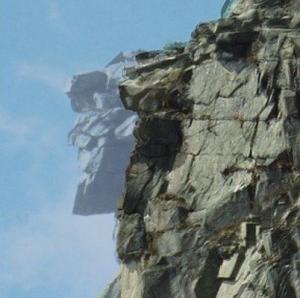 I was crushed when I heard ten years ago that despite the best human preserving efforts, it finally fell off the mountain.
According to Hawthorne’s story, there is a legend in the valley that someday “a child should be born hereabouts, who is destined to become the greatest and noblest personage of his time, and whose countenance, in manhood, should bear an exact resemblance to the Great Stone Face.” Ernest, who gazes daily with love and awe at the Great Stone Face, spends his whole life as a simple laborer in the valley. Occasionally a rumor would arise that the man resembling the Great Stone Face had appeared in town, but each candidate—a wealthy miser, a vain general, a pompous politician—turned out to be a fraud. As the years pass and Ernest becomes an old man, he is loved by his neighbors and family but sadly concludes that the legend will not come true in his lifetime.
Then one day as he talks simply and clearly on his front porch with a number of his friends about matters important to all of them, the setting sun strikes Ernest’s face and someone sitting next to him exclaims “Behold! Behold! Ernest is himself the likeness of the Great Stone Face!” He had become what he had spent his life lovingly looking at.
Iris Murdoch tells us that “man is a creature who makes pictures of himself and then comes to resemble the picture.” And the pictures we make will be fashioned from what we are looking at and what we see most clearly. In the book of Numbers, in response to yet another round of blatant disobedience, God sends snakes into the midst of the children of Israel; many of those bitten by the venomous serpents die.
In response to the people’s recognition of their rebellion and penitence, God instructs Moses to make a serpent of bronze and lift it up on a pole for everyone to see. “And so it was, if a serpent had bitten anyone, when he looked at the bronze serpent, he lived.” Simone Weil comments: “To look and to eat are two different things. The only people who have any hope of salvation are those who occasionally stop and look for a time, instead of eating. Looking is what saves us.” What are you looking at?
Previous Post

February 13, 2018
Lent is for Lovers
Next Post

February 18, 2018 So Much Good. So Much Evil. Just Add Water
Browse Our Archives
Select a Category abortion Advent AI Angels Artificial intelligence atheism attention baptism Baptists beauty belief Benedictines Bible bicycling Big Bird books Bovina Camaldoli hermitage Canada Catholicism cats certainty change Christianity Christmas Collegeville Covid-19 creativity Development of Western Civilization dogs doubt Easter Enneagram Epiphany Episcopal ethics Eucharist evil extroverts Facebook faith family fear flowers forgiveness freedom friends God goodness grace happiness heaven hell history Holy Spirit Holy Week hope human nature humility humor idolatry incarnation introverts irreverence Islam Jeanne Jesus Joe Biden joy Judaism justice Kamala Harris knowledge Lent listen literature liturgy love Marsue Memorial Day miracles movies music mystery mythology NPR Old Testament optimism paradox peace Penguins philosophy piano podcast politics power prayer Protestantism Providence College Religion Rhode Island sabbatical sacrament science seeing silence Simone Weil Socrates soul sports St. John's College stories suffering tattoo teaching technology television theology thinking time tolerance transcendence travel trees trust truth Uncategorized Vermont wisdom wonder writing
Select a Month May 2026 April 2026 March 2026 February 2026 January 2026 December 2025 November 2025 October 2025 September 2025 August 2025 July 2025 June 2025 May 2025 April 2025 March 2025 February 2025 January 2025 December 2024 November 2024 October 2024 September 2024 August 2024 July 2024 June 2024 May 2024 April 2024 March 2024 February 2024 January 2024 December 2023 November 2023 October 2023 September 2023 August 2023 July 2023 June 2023 May 2023 April 2023 March 2023 February 2023 January 2023 December 2022 November 2022 October 2022 September 2022 August 2022 July 2022 June 2022 May 2022 April 2022 March 2022 February 2022 January 2022 December 2021 November 2021 October 2021 September 2021 August 2021 July 2021 June 2021 May 2021 April 2021 March 2021 February 2021 January 2021 December 2020 November 2020 October 2020 September 2020 August 2020 July 2020 June 2020 May 2020 April 2020 March 2020 February 2020 January 2020 December 2019 November 2019 October 2019 September 2019 August 2019 July 2019 June 2019 May 2019 April 2019 March 2019 February 2019 January 2019 December 2018 November 2018 October 2018 September 2018 August 2018 July 2018 June 2018 May 2018 April 2018 March 2018 February 2018 January 2018 December 2017 November 2017 October 2017 September 2017 August 2017 July 2017 June 2017 May 2017 April 2017 March 2017 February 2017 January 2017 December 2016 November 2016 October 2016 September 2016 August 2016 July 2016 June 2016 May 2016 April 2016 March 2016 February 2016 January 2016 December 2015 November 2015 October 2015 September 2015 August 2015 July 2015 June 2015 May 2015 April 2015 March 2015 February 2015 January 2015 December 2014 November 2014 October 2014 September 2014 August 2014 July 2014 June 2014 May 2014 April 2014 March 2014 February 2014 January 2014 December 2013 November 2013 October 2013 September 2013 August 2013 July 2013 June 2013 May 2013 April 2013 March 2013 February 2013 January 2013 December 2012 November 2012 October 2012 September 2012
Follow Us!
TAKE THE
Religious Wisdom Quiz
Who wrote the Book of Acts?
Select your answer to see how you score.
Luke Peter Mark Paul
Books by This Author Books by Vance G. Morgan
Related posts from Freelance Christianity

The Lonely Pawn: On Faith, Doubt, and Meaning


AI and Love: When a Chatbot Becomes a...

TRENDING AT PATHEOS Progressive Christian

What Being a Modern-Day Apostle Means to Me
In my last column, I discussed the ins and outs of modern-day...

Did Ancient China Once Worship the God of...
Across human history, a common thread weaves through the origins of the...

Love Your Neighbor – Including Earth-Kin: Lev. 19,...
God’s command to love your neighbor means acting in an ethical and...

Lead a Church Study of “Jesus and Lao...
Guest writer Jack Thomas (The Irreverent Reverend) reflects on leading his church...

Pastoral Wisdom for Responding to Sermon Pushback
Getting sermon pushback on your social justice sermon? Learn practical, Proverbs-based strategies...

Principles for Understanding the Apostolic Ministry Today
Whenever people discover that my formal ministry title is "apostle," as in...
view all Progressive Christian blogs
Ad-Free & Subscriber Log-In Subscription Support
- About Us
- 2026 Calendar
- Videos
- Podcasts
- Library of World Religions
- Faith In Media Tracker
- Advertise With Us
- Write for Us
- Privacy Policy
- Terms of Service
- Do Not Sell My Data
- Contact Us
- Radiant Digital
- Manage Newsletter Subscriptions
- Unsubscribe From Notifications
- Sitemap
Copyright 2008-2026, Patheos. All rights reserved.
Subscription Support Ad-Free & Subscriber Log-In
Follow Patheos