
BuddhistCatholicContemplativeEvangelicalGeneral ChristianHinduJewishLatter-day SaintMuslimNew VisionsProgressive Christian
Beliefs
- Buddhist
- Catholic
- Contemplative
- Evangelical
- General Christian
- Hindu
- Jewish
- Latter-day Saint
- More Voices
- Muslim
- New Visions
- Pagan
- Progressive Christian
Topics
- Religion News
- Food and Religion
- Sports and Religion
- Religious Art
- Religious Music and Entertainment
- Religious Events
- History and Religion
- Style and Religion
- Politics and Religion
- Women in Religion
- Recreation Outdoors and Religion
- Business Finance and Religion
- Careers Workplace and Religion
- Education and Religion
- Family Parenting and Religion
- Health Fitness and Religion
- Home and Religion
- Relationships and Religion
- Technology and Religion
- Travel and Religion
Columnists
- Buddhist Columnists
- Business Finance and Religion Columnists
- Careers Workplace and Religion Columnists
- Catholic Columnists
- Contemplative Columnists
- Education and Religion Columnists
- Evangelists Columnists
- Family Parenting and Religion Columnists
- General Christian Columnists
- Health Fitness and Religion Columnists
- Hindu Columnists
- History and Religion Columnists
- Home and Religion Columnists
- Jewish Columnists
- More Voices Columnists
- Latter Day Columnists
- Muslim Columnists
- New Visions Columnists
- Nonreligious Columnists
- Pagan Columnists
- Politics and Religion Columnists
- Progressive Columnists
- Recreation Outdoors and Religion Columnists
- Relationships and Religion Columnists
- Religion News Columnists
- Religious Art Columnists
- Religious Events Columnists
- Religious Music and Entertainment Columnists
- Sports and Religion Columnists
- Style and Religion Columnists
- Technology and Religion Columnists
- Travel and Religion Columnists
- Women in Religion Columnists
Resource Library
- 2026 Calendar
- Library of World Religions
- The 100 Most Holy Places on Earth
- Patheos Answers
- Podcasts
- Videos
- Faith Leaders Database
- Anglican Episcopalian
- Bahai
- Baptist
- Buddhism
- Christianity
- Confucianism
- Eastern Orthodoxy
- Hinduism
- Holiness and Pentecostal
- ISKCON
- Islam
- Judaism
- Lutheran
- Methodist
- The Church of Jesus Christ of Latter-day Saints
- New Age
- Paganism
- Presbytarian and Reformed
- Protestantism
- Religion Behind the Scenes
- Roman Catholic
- Scientology
- Shia Islam
- Sikhism
- Sufism
- Sunni Islam
- Taoism
- Zen
- See all religions
Research Tools
 Ad-Free & Subscriber Log-In Subscription Support
Ad-Free & Subscriber Log-In Subscription Support
Follow Patheos 

- Trending:
- Forgiveness
- |
- Marriage
- |
- Consciousness
- |
- Death Penalty
- |
- Election
- |
- Halloween

- Home
- Progressive Christian
- What Are We Doing When We Pray?
What Are We Doing When We Pray?
Last updated on: July 7, 2019 at 6:00 am by Vance Morgan
What Are We Doing When We Pray? 2019-07-06T14:31:07-04:00 Vance Morgan
Patheos Explore the world's faith through different perspectives on religion and spirituality! Patheos has the views of the prevalent religions and spiritualities of the world.
I am currently in the middle of working through the proofs of my forthcoming book, the last time I have the opportunity to change anything. And, as my editor directly reminded me, my opportunity to change anything significant has passed. This final time through is only for punctuation, misspellings, and a few other minor matters. 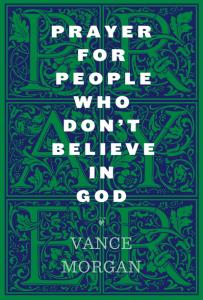
It’s an exciting time. For a writer, this point in the book process is what I imagine being 8.5 months pregnant is like–minus the discomfort, pain, and everything else about pregnancy that a man will never understand or experience. But I am the father of two children, and this is book number five. Waiting for the promised child does have a few parallels to waiting for your book.
The title of the new book is Prayer for People Who Don’t Believe in God,” forthcoming from Wood Lake Press. I’ll (obviously) be announcing its publication when it is out (looks like September or October). For the time being, and to whet your appetite, here’s the Introduction to the book.
Once upon a time two explorers came upon a clearing in the jungle. In the clearing were growing many flowers and weeds mixed together. The first explorer said, “Some gardener must tend this plot.” The other disagreed: “There is no gardener.” They pitched their tents set a watch. No gardener was ever seen. “But perhaps he is an invisible gardener,” thought the Believer. So they set up a barbed-wire fence, electrified it, and patrolled the area with bloodhounds. But no shrieks ever suggested that some intruder had received a shock. No movements of the wire ever betrayed an invisible climber. The bloodhounds never gave cry.
Yet the Believer was still not convinced. “But there is a gardener, invisible, intangible, insensitive to electric shocks, a gardener who has no scent and makes no sound, a gardener who comes secretly to look after the garden which he loves.” At last the Skeptic despaired: “But what remains of your original assertion? Just how is what you call an invisible, intangible, eternally elusive gardener any different from an imaginary gardener or even from no gardener at all?”
This story, or “parable,” was offered at the beginning of an academic symposium by British philosopher Anthony Flew several decades ago, as a way to get people thinking about their beliefs and the evidence that supposedly counts for or against those beliefs. The Believer in the story is bound and determined to believe that there is a gardener who takes care of the flowers in the clearing, even in the face of no supporting factual evidence. The Skeptic is only willing to believe in the gardener along with the Believer if shown relevant evidence. “I agree that there are flowers and that there are weeds here, but there are many possible explanations for this other than your gardener hypothesis,” the Skeptic might say. “Let’s test your hypothesis.”
When it turns out that the Believer doesn’t need evidence to support her belief, and that apparently contrary evidence does not count against her belief, the Skeptic knows that the conversation has come to an end.
When I was first approached to write about what prayer might mean to those for whom many or all of the traditional descriptions of prayer have failed, as well as to those for whom various traditional models of God are no longer meaningful, I thought of this story. For those raised in a traditional Christian framework of belief, as I was, prayer in its most basic sense is the human attempt to communicate with what is greater than us. Prayer was essential to our Baptist belief, but even though others seemed to take to prayer like ducks to water, it was a mystery to me. My mother suggested frequently that I should just talk to God the same way I talked to her. This never struck me as one of my mother’s better pieces of advice, since I clearly couldn’t talk to an invisible, far away, scary “something” in the same way I could talk to her. But I did learn, as all good Baptist kids learned, how to conjure up a convincing sounding prayer at the drop of a hat. It just never seemed to go past the ceiling.
In many ways, I have not advanced very far in the more than half century that has passed since I struggled with prayer as a child. I have been a college professor for 30 years, but this is not an academic book, nor is it a “how-to” document. No amount of education makes one an expert at prayer. I have read a great deal about prayer over the years, but it is a lot easier to read about prayer than to actually do it. Although I don’t claim to know what prayer is I do have a great deal of experience with various activities that others in my life have claimed to be prayer. Over the years I have been exposed to many styles of prayer, including unscripted petitions of essay length, poetic expressions read from a book, rote recitations that no one pays much attention to, pronouncements with physical accompaniment such as laying on of hands, communications in a “prayer language,” and more. Shouted, whispered, forceful, timid, begging, demanding. Each has been presented as the most or only effective way of praying.
The only common denominator is that, more often than not, nothing happened. Things kept bouncing off the ceiling. For the most part, my experience with and attitudes about prayer are similar to what Christian Wiman describes in My Bright Abyss:
I have never felt comfortable praying. I almost feel I should put the word in quotes, as I’m never quite sure that what I do deserves the name. I have a little litany of stations through which I move – thank you, help me, be with, forgive – but mostly I simply try to subject myself to the possibility of God. I address God as if.
And perhaps that’s where the life of faith, and its companion activities such as prayer, begins – with opening oneself to “the possibility of God.”
In my youth, I learned to interpret events, no matter what happened, as an “answer to prayer,” even though, just as the Skeptic suggests in the gardener story, virtually every answer to prayer could just as easily have been explained in ways that did not involve God. And God’s choice of which prayers to answer seemed random at best. People reported finding a convenient parking spot in a crowded supermarket lot in answer to their prayers, but others afflicted with cancer, who were the subject of fervent and regular prayers, died just as those who were not prayed for did. Good people suffered and bad people prospered whether prayers were offered or not. As Annie Dillard writes in For the Time Being, there comes a time in every believer’s life when the dark suspicions percolating below the surface become pressing.
Are we only talking to ourselves in an empty universe? The silence is often so emphatic. And we have prayed so much already…Who is like you, O Lord, among the silent, remaining silent through the suffering of His children?
Throughout my life, my attitudes about prayer have always been a direct reflection of my attitudes about what is greater than us. I suspect that I am not alone in this. Many contemporary Christians find themselves gripped by the power of the Christian faith but are unable or unwilling to endorse or engage with many of its traditional trappings, including prayer. One of these Christians asked me recently whether prayer still has any meaning for someone who is no longer sure about what, if anything, is on the receiving end. If God or the divine isn’t a “being” out there “listening,” what are we doing when we pray? If we’re not trying to connect with the kind of God who takes notes, answers “yes” or “no,” and grants and withholds favours, what or whom are we trying to connect with?
If you have ever asked these or similar questions, I invite you to keep reading. I don’t claim to know the answers to these questions, but perhaps we can make some progress together. The title of this short book, Prayer for People Who Don’t Believe in God, is a nod toward what I have told professed atheists in the past who, when discovering that (against their preconceptions) I am a person of faith, say something like, “I’m an atheist; I don’t believe in God.” After asking them to describe the God they don’t believe in, I invariably say that “I don’t believe in that God either.”
As I began getting my thoughts together for this book, I started by making a couple of lists, first of things that I do not believe prayer is, and second of things that prayer might be. I found that the first list was much easier to compile, because there are many gods in whom I no longer believe. Attempts to communicate with them are guaranteed to fail and produce frustration. The second list was more difficult to put together, and is far more tentative. In other words, I’m much more sure about what prayer is not (Chapters 1–5) than I am about what it might be (Chapters 6–10). Neither list is exhaustive; I’m sure you will have several items to add to each list. Working only with the assumption that prayer might have value even for those who are not sure what or who God is, let’s begin.
Previous Post

July 5, 2019
A Thankless and Glorious Assignment: Enter if You are Brave Enough
Next Post

July 9, 2019 Lessons from the Past About the "Other"
Browse Our Archives
Select a Category abortion Advent AI Angels Artificial intelligence atheism attention baptism Baptists beauty belief Benedictines Bible bicycling Big Bird books Bovina Camaldoli hermitage Canada Catholicism cats certainty change Christianity Christmas Collegeville Covid-19 creativity Development of Western Civilization dogs doubt Easter Enneagram Epiphany Episcopal ethics Eucharist evil extroverts Facebook faith family fear flowers forgiveness freedom friends God goodness grace happiness heaven hell history Holy Spirit Holy Week hope human nature humility humor idolatry incarnation introverts irreverence Islam Jeanne Jesus Joe Biden joy Judaism justice Kamala Harris knowledge Lent listen literature liturgy love Marsue Memorial Day miracles movies music mystery mythology NPR Old Testament optimism paradox peace Penguins philosophy piano podcast politics power prayer Protestantism Providence College Religion Rhode Island sabbatical sacrament science seeing silence Simone Weil Socrates soul sports St. John's College stories suffering tattoo teaching technology television theology thinking time tolerance transcendence travel trees trust truth Uncategorized Vermont wisdom wonder writing
Select a Month May 2026 April 2026 March 2026 February 2026 January 2026 December 2025 November 2025 October 2025 September 2025 August 2025 July 2025 June 2025 May 2025 April 2025 March 2025 February 2025 January 2025 December 2024 November 2024 October 2024 September 2024 August 2024 July 2024 June 2024 May 2024 April 2024 March 2024 February 2024 January 2024 December 2023 November 2023 October 2023 September 2023 August 2023 July 2023 June 2023 May 2023 April 2023 March 2023 February 2023 January 2023 December 2022 November 2022 October 2022 September 2022 August 2022 July 2022 June 2022 May 2022 April 2022 March 2022 February 2022 January 2022 December 2021 November 2021 October 2021 September 2021 August 2021 July 2021 June 2021 May 2021 April 2021 March 2021 February 2021 January 2021 December 2020 November 2020 October 2020 September 2020 August 2020 July 2020 June 2020 May 2020 April 2020 March 2020 February 2020 January 2020 December 2019 November 2019 October 2019 September 2019 August 2019 July 2019 June 2019 May 2019 April 2019 March 2019 February 2019 January 2019 December 2018 November 2018 October 2018 September 2018 August 2018 July 2018 June 2018 May 2018 April 2018 March 2018 February 2018 January 2018 December 2017 November 2017 October 2017 September 2017 August 2017 July 2017 June 2017 May 2017 April 2017 March 2017 February 2017 January 2017 December 2016 November 2016 October 2016 September 2016 August 2016 July 2016 June 2016 May 2016 April 2016 March 2016 February 2016 January 2016 December 2015 November 2015 October 2015 September 2015 August 2015 July 2015 June 2015 May 2015 April 2015 March 2015 February 2015 January 2015 December 2014 November 2014 October 2014 September 2014 August 2014 July 2014 June 2014 May 2014 April 2014 March 2014 February 2014 January 2014 December 2013 November 2013 October 2013 September 2013 August 2013 July 2013 June 2013 May 2013 April 2013 March 2013 February 2013 January 2013 December 2012 November 2012 October 2012 September 2012
Follow Us!
TAKE THE
Religious Wisdom Quiz
Who said, "Vanity of vanities, all is vanity"?
Select your answer to see how you score.
David Isaiah Solomon Job
Books by This Author Books by Vance G. Morgan
Related posts from Freelance Christianity

The Lonely Pawn: On Faith, Doubt, and Meaning


AI and Love: When a Chatbot Becomes a...

TRENDING AT PATHEOS Progressive Christian

What Being a Modern-Day Apostle Means to Me
In my last column, I discussed the ins and outs of modern-day...

Did Ancient China Once Worship the God of...
Across human history, a common thread weaves through the origins of the...

Love Your Neighbor – Including Earth-Kin: Lev. 19,...
God’s command to love your neighbor means acting in an ethical and...

Lead a Church Study of “Jesus and Lao...
Guest writer Jack Thomas (The Irreverent Reverend) reflects on leading his church...

Pastoral Wisdom for Responding to Sermon Pushback
Getting sermon pushback on your social justice sermon? Learn practical, Proverbs-based strategies...

Principles for Understanding the Apostolic Ministry Today
Whenever people discover that my formal ministry title is "apostle," as in...
view all Progressive Christian blogs
Ad-Free & Subscriber Log-In Subscription Support
- About Us
- 2026 Calendar
- Videos
- Podcasts
- Library of World Religions
- Faith In Media Tracker
- Advertise With Us
- Write for Us
- Privacy Policy
- Terms of Service
- Do Not Sell My Data
- Contact Us
- Radiant Digital
- Manage Newsletter Subscriptions
- Unsubscribe From Notifications
- Sitemap
Copyright 2008-2026, Patheos. All rights reserved.
Subscription Support Ad-Free & Subscriber Log-In
Follow Patheos