
BuddhistCatholicContemplativeEvangelicalGeneral ChristianHinduJewishLatter-day SaintMuslimNew VisionsProgressive Christian
Beliefs
- Buddhist
- Catholic
- Contemplative
- Evangelical
- General Christian
- Hindu
- Jewish
- Latter-day Saint
- More Voices
- Muslim
- New Visions
- Pagan
- Progressive Christian
Topics
- Religion News
- Food and Religion
- Sports and Religion
- Religious Art
- Religious Music and Entertainment
- Religious Events
- History and Religion
- Style and Religion
- Politics and Religion
- Women in Religion
- Recreation Outdoors and Religion
- Business Finance and Religion
- Careers Workplace and Religion
- Education and Religion
- Family Parenting and Religion
- Health Fitness and Religion
- Home and Religion
- Relationships and Religion
- Technology and Religion
- Travel and Religion
Columnists
- Buddhist Columnists
- Business Finance and Religion Columnists
- Careers Workplace and Religion Columnists
- Catholic Columnists
- Contemplative Columnists
- Education and Religion Columnists
- Evangelists Columnists
- Family Parenting and Religion Columnists
- General Christian Columnists
- Health Fitness and Religion Columnists
- Hindu Columnists
- History and Religion Columnists
- Home and Religion Columnists
- Jewish Columnists
- More Voices Columnists
- Latter Day Columnists
- Muslim Columnists
- New Visions Columnists
- Nonreligious Columnists
- Pagan Columnists
- Politics and Religion Columnists
- Progressive Columnists
- Recreation Outdoors and Religion Columnists
- Relationships and Religion Columnists
- Religion News Columnists
- Religious Art Columnists
- Religious Events Columnists
- Religious Music and Entertainment Columnists
- Sports and Religion Columnists
- Style and Religion Columnists
- Technology and Religion Columnists
- Travel and Religion Columnists
- Women in Religion Columnists
Resource Library
- 2026 Calendar
- Library of World Religions
- The 100 Most Holy Places on Earth
- Patheos Answers
- Podcasts
- Videos
- Faith Leaders Database
- Anglican Episcopalian
- Bahai
- Baptist
- Buddhism
- Christianity
- Confucianism
- Eastern Orthodoxy
- Hinduism
- Holiness and Pentecostal
- ISKCON
- Islam
- Judaism
- Lutheran
- Methodist
- The Church of Jesus Christ of Latter-day Saints
- New Age
- Paganism
- Presbytarian and Reformed
- Protestantism
- Religion Behind the Scenes
- Roman Catholic
- Scientology
- Shia Islam
- Sikhism
- Sufism
- Sunni Islam
- Taoism
- Zen
- See all religions
Research Tools
 Ad-Free & Subscriber Log-In Subscription Support
Ad-Free & Subscriber Log-In Subscription Support
Follow Patheos 

- Trending:
- Forgiveness
- |
- Marriage
- |
- Consciousness
- |
- Death Penalty
- |
- Election
- |
- Halloween

- Home
- Progressive Christian
- We Have Met the Nazis, and They are Us
We Have Met the Nazis, and They are Us
Last updated on: January 15, 2019 at 12:00 pm by Vance Morgan
We Have Met the Nazis, and They are Us 2019-01-15T11:58:56-04:00 Vance Morgan
Patheos Explore the world's faith through different perspectives on religion and spirituality! Patheos has the views of the prevalent religions and spiritualities of the world.
We ought not to hide from ourselves that Nazi Germany is a mirror for all of us. What looks to us so hideous is our own features, but magnified. Simone Weil in 1937
Yesterday was the Spring 2019 semester’s first day of classes on my campus. Tomorrow will be the first meeting of one of my favorite courses, an interdisciplinary colloquium that I team-teach with a colleague from the history department: “‘Love Never Fails’: Grace, Truth, and Freedom in the Nazi Era.” I wrote a bit about this course in my post on Sunday:
This is the fourth time in the past six years that Ray and I have offered this colloquium; it is the most wildly popular course I have ever taught, filling up immediately on registration day with a list of dozens of students on a waiting list hoping to get in.
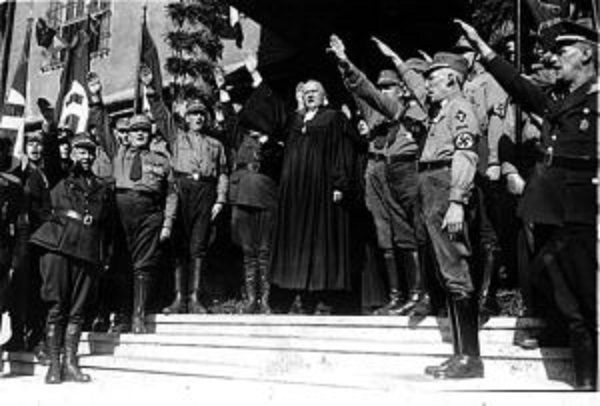
I would love to think that the colloquium’s popularity is due to Ray’s and my teaching excellence, but the real reason everyone wants to take this course is simple: Nazis sell. Put the adjective “Nazi” together with any course content—Nazi Accounting, Nazi Calculus, Nazi Basket Weaving—and the class will fill up immediately. Like the worst train wreck ever, people can’t look away from the Nazis. Just about everyone agrees that they represent the worst that human beings can be, but still—or perhaps because of this—no one can look away.
This is not just the case in the educational world. Mention the Nazis in any public conversation and people’s ears prick up. Describing someone’s activities or attitudes as Nazi-like is the third rail of public discourse, a bridge too far even in the most vigorous debate. And yet it happens on a remarkably regular basis. The Nazi card has been played frequently by all sides during the Trump political era, including a bit over two years ago when the then President-elect criticized the intelligence community for not prohibiting an unsubstantiated document containing damaging allegations from being published. “Are we living in Nazi Germany?” Trump tweeted, a question that immediately met with outrage from many quarters, while at the same time attracting prurient interest because the Nazis had been invoked.
Playing the Nazi card has actually been a popular activity on all sides of political arguments for the past fifty years. Not long ago, I read Stephen Prothero’s Why Liberals Win (Even When They Lose Elections); in his final chapter on culture wars in this country from the 1970s to the present, he mentions at least a half-dozen different times when one side of a given squabble has accused the other side of Nazi-like behavior or beliefs.
Why do we do this? I’m sure that many articles, books, and dissertations have been written on the psychology and politics of Nazi-shaming, but on one level the attraction is obvious. If X accuses Y of Nazi-like behavior, X is intending to either derail the conversation entirely or deflect it in an entirely new direction. Except for skinheads, no one takes Nazi attributions lying down. To accuse someone of being or acting like a Nazi is to accuse her or him of being on the very outer fringes of humanity, perhaps having even crossed the line into non-humanity. But my impression is that people seldom mean it when they play the Nazi card—it’s just the worst thing the person can think of to say in the moment. Accusing someone of Nazi-like behavior is like accusing them of being an evil alien—and that’s a problem. Because the Nazis were people, no different at their core than the rest of us. We forget this at our peril.
One of the most important tasks Ray and I will seek to accomplish early this semester is to convince the students that the Nazis were not aliens, monsters, or mutants. To consider them as such is to remove the possibility, at least theoretically, that we share anything in common with them. We assign significant portions of Mein Kampf, study the NSDAP’s “Twenty-Five Point Program” (the Nazis’ socio-political “platform”), and consider the lengthy chapter on Hitler’s tortured childhood from Alice Miller’s For Your Own Good, because understanding the Nazis requires first understanding that they were human beings just as we are. Human beings with histories, experiences, commitments, worries, fears, desires, hopes and dreams. Human beings who hoped for a better world than the one they believed had been unjustly imposed on them by outside forces. Studying the Nazis is remarkably relevant to studying our present political and social situation, because in both cases we are studying the same thing–ourselves.
The policies and actions of the Nazis flowed logically from clearly stated premises and assumptions; the fact that these premises and assumptions differ sharply from those that most of us profess to be committed to does not prove them to be wrong. Ray and I urge our students to realize that dismissing the Nazis simply because they believed so differently than we do spares us from doing the difficult and important work of identifying exactly why we are committed to our beliefs and assumptions. Only if we recognize that the Nazis were human beings with whom we share a host of things in common can we truly begin to consider carefully what went so monstrously wrong. As Alice Miller writes, “all that it took was a committed Fuhrer and several million well-raised Germans to extinguish the lives of countless innocent human beings in a few short years.”
For those who believe that their religious faith provides them with a firewall against the elements of human nature regularly on display during the Nazi era, think again. The story of the Christian churches, both Protestant and Catholic, in Germany during the time of the Nazis is both sobering and disturbing. People like Lutheran minister Dietrich Bonhoeffer and Franciscan priest Maximillian Kolbe are examples in our colloquium of persons who exhibited grace and truth during the Nazi era, but they were voices and persons of resistance. A significant majority of Christian pastors and priests, ministers and bishops, as well as the majority of the good citizens in their their German Christian congregations, not only supported the policies of Hitler and the Nazis but also truly believed that this support was sanctioned and supported by their commitment to their Christian faith. It did not turn out to be that difficult for millions of good Germans to find a way to be both believers in Christianity and supporters of Nazism.
I spent a great deal of time on this blog over the past three years wondering how evangelical Christians, millions of Catholics, and many others with whom I share my Christian faith could square their faith with their political commitments and how they voted in the 2016 Presidential election, as well as their continuing support of Donald Trump. I’m still wondering, but returning to the Nazis reminds me that human beings can convince themselves that absolutely anything is true, and can readily believe that incompatible commitments and values are actually compatible, if they are sufficiently motivated by their experiences, circumstances, fears, and anger to do so.
That includes me. The next time the Nazi card get played publicly, we would do well to not treat it as twisted entertainment or the tweetings of uninformed people with too much time on their hands. As offensive as it may sound, each of us has a Nazi inside of us—only regular vigilance and a constant refusal to be duped or complacent can silence it. As Pogo told us many years ago, we have met the enemy—and he is us.
Previous Post

January 14, 2019
Best of 2019 #3: When Christianity Becomes an Angry and Fearful Faith
Next Post

January 17, 2019 Know Your Bible, and Know Your Greek Mythology
Browse Our Archives
Select a Category abortion Advent AI Angels Artificial intelligence atheism attention baptism Baptists beauty belief Benedictines Bible bicycling Big Bird books Bovina Camaldoli hermitage Canada Catholicism cats certainty change Christianity Christmas Collegeville Covid-19 creativity Development of Western Civilization dogs doubt Easter Enneagram Epiphany Episcopal ethics Eucharist evil extroverts Facebook faith family fear flowers forgiveness freedom friends God goodness grace happiness heaven hell history Holy Spirit Holy Week hope human nature humility humor idolatry incarnation introverts irreverence Islam Jeanne Jesus Joe Biden joy Judaism justice Kamala Harris knowledge Lent listen literature liturgy love Marsue Memorial Day miracles movies music mystery mythology NPR Old Testament optimism paradox peace Penguins philosophy piano podcast politics power prayer Protestantism Providence College Religion Rhode Island sabbatical sacrament science seeing silence Simone Weil Socrates soul sports St. John's College stories suffering tattoo teaching technology television theology thinking time tolerance transcendence travel trees trust truth Uncategorized Vermont wisdom wonder writing
Select a Month May 2026 April 2026 March 2026 February 2026 January 2026 December 2025 November 2025 October 2025 September 2025 August 2025 July 2025 June 2025 May 2025 April 2025 March 2025 February 2025 January 2025 December 2024 November 2024 October 2024 September 2024 August 2024 July 2024 June 2024 May 2024 April 2024 March 2024 February 2024 January 2024 December 2023 November 2023 October 2023 September 2023 August 2023 July 2023 June 2023 May 2023 April 2023 March 2023 February 2023 January 2023 December 2022 November 2022 October 2022 September 2022 August 2022 July 2022 June 2022 May 2022 April 2022 March 2022 February 2022 January 2022 December 2021 November 2021 October 2021 September 2021 August 2021 July 2021 June 2021 May 2021 April 2021 March 2021 February 2021 January 2021 December 2020 November 2020 October 2020 September 2020 August 2020 July 2020 June 2020 May 2020 April 2020 March 2020 February 2020 January 2020 December 2019 November 2019 October 2019 September 2019 August 2019 July 2019 June 2019 May 2019 April 2019 March 2019 February 2019 January 2019 December 2018 November 2018 October 2018 September 2018 August 2018 July 2018 June 2018 May 2018 April 2018 March 2018 February 2018 January 2018 December 2017 November 2017 October 2017 September 2017 August 2017 July 2017 June 2017 May 2017 April 2017 March 2017 February 2017 January 2017 December 2016 November 2016 October 2016 September 2016 August 2016 July 2016 June 2016 May 2016 April 2016 March 2016 February 2016 January 2016 December 2015 November 2015 October 2015 September 2015 August 2015 July 2015 June 2015 May 2015 April 2015 March 2015 February 2015 January 2015 December 2014 November 2014 October 2014 September 2014 August 2014 July 2014 June 2014 May 2014 April 2014 March 2014 February 2014 January 2014 December 2013 November 2013 October 2013 September 2013 August 2013 July 2013 June 2013 May 2013 April 2013 March 2013 February 2013 January 2013 December 2012 November 2012 October 2012 September 2012
Follow Us!
TAKE THE
Religious Wisdom Quiz
Who saw a vision of wheels within wheels by the Kebar River?
Select your answer to see how you score.
Daniel Ezekiel Micah Jonah
Books by This Author Books by Vance G. Morgan
Related posts from Freelance Christianity

The Lonely Pawn: On Faith, Doubt, and Meaning


AI and Love: When a Chatbot Becomes a...

TRENDING AT PATHEOS Progressive Christian

What Being a Modern-Day Apostle Means to Me
In my last column, I discussed the ins and outs of modern-day...

Did Ancient China Once Worship the God of...
Across human history, a common thread weaves through the origins of the...

Love Your Neighbor – Including Earth-Kin: Lev. 19,...
God’s command to love your neighbor means acting in an ethical and...

Lead a Church Study of “Jesus and Lao...
Guest writer Jack Thomas (The Irreverent Reverend) reflects on leading his church...

Pastoral Wisdom for Responding to Sermon Pushback
Getting sermon pushback on your social justice sermon? Learn practical, Proverbs-based strategies...

Principles for Understanding the Apostolic Ministry Today
Whenever people discover that my formal ministry title is "apostle," as in...
view all Progressive Christian blogs
Ad-Free & Subscriber Log-In Subscription Support
- About Us
- 2026 Calendar
- Videos
- Podcasts
- Library of World Religions
- Faith In Media Tracker
- Advertise With Us
- Write for Us
- Privacy Policy
- Terms of Service
- Do Not Sell My Data
- Contact Us
- Radiant Digital
- Manage Newsletter Subscriptions
- Unsubscribe From Notifications
- Sitemap
Copyright 2008-2026, Patheos. All rights reserved.
Subscription Support Ad-Free & Subscriber Log-In
Follow Patheos