
BuddhistCatholicContemplativeEvangelicalGeneral ChristianHinduJewishLatter-day SaintMuslimNew VisionsProgressive Christian
Beliefs
- Buddhist
- Catholic
- Contemplative
- Evangelical
- General Christian
- Hindu
- Jewish
- Latter-day Saint
- More Voices
- Muslim
- New Visions
- Pagan
- Progressive Christian
Topics
- Religion News
- Food and Religion
- Sports and Religion
- Religious Art
- Religious Music and Entertainment
- Religious Events
- History and Religion
- Style and Religion
- Politics and Religion
- Women in Religion
- Recreation Outdoors and Religion
- Business Finance and Religion
- Careers Workplace and Religion
- Education and Religion
- Family Parenting and Religion
- Health Fitness and Religion
- Home and Religion
- Relationships and Religion
- Technology and Religion
- Travel and Religion
Columnists
- Buddhist Columnists
- Business Finance and Religion Columnists
- Careers Workplace and Religion Columnists
- Catholic Columnists
- Contemplative Columnists
- Education and Religion Columnists
- Evangelists Columnists
- Family Parenting and Religion Columnists
- General Christian Columnists
- Health Fitness and Religion Columnists
- Hindu Columnists
- History and Religion Columnists
- Home and Religion Columnists
- Jewish Columnists
- More Voices Columnists
- Latter Day Columnists
- Muslim Columnists
- New Visions Columnists
- Nonreligious Columnists
- Pagan Columnists
- Politics and Religion Columnists
- Progressive Columnists
- Recreation Outdoors and Religion Columnists
- Relationships and Religion Columnists
- Religion News Columnists
- Religious Art Columnists
- Religious Events Columnists
- Religious Music and Entertainment Columnists
- Sports and Religion Columnists
- Style and Religion Columnists
- Technology and Religion Columnists
- Travel and Religion Columnists
- Women in Religion Columnists
Resource Library
- 2026 Calendar
- Library of World Religions
- The 100 Most Holy Places on Earth
- Patheos Answers
- Podcasts
- Videos
- Faith Leaders Database
- Anglican Episcopalian
- Bahai
- Baptist
- Buddhism
- Christianity
- Confucianism
- Eastern Orthodoxy
- Hinduism
- Holiness and Pentecostal
- ISKCON
- Islam
- Judaism
- Lutheran
- Methodist
- The Church of Jesus Christ of Latter-day Saints
- New Age
- Paganism
- Presbytarian and Reformed
- Protestantism
- Religion Behind the Scenes
- Roman Catholic
- Scientology
- Shia Islam
- Sikhism
- Sufism
- Sunni Islam
- Taoism
- Zen
- See all religions
Research Tools
 Ad-Free & Subscriber Log-In Subscription Support
Ad-Free & Subscriber Log-In Subscription Support
Follow Patheos 

- Trending:
- Forgiveness
- |
- Marriage
- |
- Consciousness
- |
- Death Penalty
- |
- Election
- |
- Halloween

- Home
- Progressive Christian
- We are Nothing but Wind
We are Nothing but Wind
Last updated on: April 30, 2020 at 6:00 am by Vance Morgan
We are Nothing but Wind 2020-04-29T13:33:21-04:00 Vance Morgan
Patheos Explore the world's faith through different perspectives on religion and spirituality! Patheos has the views of the prevalent religions and spiritualities of the world.
I am not a complainer by nature. My wife, my family, and my friends would attest to this (I think). I’m an optimist at heart, a glass-half-full sort of guy. I’m like the kid from the joke who explains why he is digging through a pile of horseshit by saying that “there must be a pony in here somewhere.” I will admit that my native optimism has been challenged more seriously than usual over the past several weeks—but most of the time I’m attitudinally on top of things. When my colleagues at virtual Happy Hour on Zoom compete for the title of “Person who had the shittiest week,” I don’t participate. Because I’m healthy, I’m sheltered in place with my best friend and the love of my life (who happen to be the same person), we are both working, and things are good. I have little to complain about.
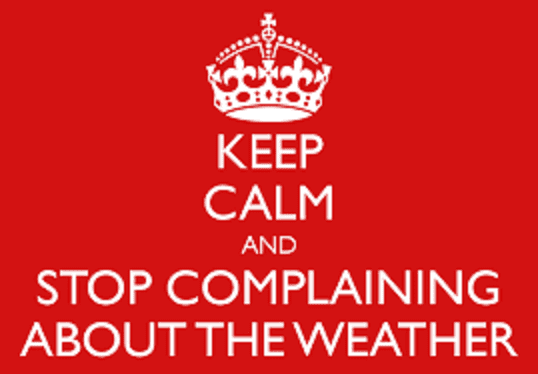
Except for the weather. I moan, complain, and bitch about the weather regularly, whenever it is behaving contrary to my plans and expectations. After a generally mild and almost entirely snow-free winter, spring arrived—along with coronavirus seclusion—determined to tease rather than to kick in. The occasional promisingly beautiful day has been followed by several days of London-esque cold and damp. Very unwelcome, given my desire to get out on my bicycle and ride—and ride. Riding is further hindered by the wind which, if memory serves, has been stronger and more consistent than usual for a Rhode Island spring. A 30-mile-per-hour “breeze” (as weather.com calls it) makes at least 25% of my usual bike riding circuit difficult. And as every serious biker knows, it’s worse than that, since no matter what direction you are riding a bike in, the wind is always in your face.
I know something about wind. I spent four years of my life during the 1980s in Laramie, Wyoming, which is pretty much the same as spending four years living on a large table top, with large mountains in the distance, at 7500-foot elevation with 30-50 mph winds blowing 365 24/7. Good times. So, my interest was piqued when I read the following passage from Montaigne’s “Of experience,” the final essay of his Essais that was the reading assignment for the last Zoom meeting of the semester in my Honors colloquium last Monday.
I, who boast of embracing the pleasures of life so assiduously and so particularly, find in them, when I look at them minutely, virtually nothing but wind.
That hardly sounds like good news. No one wants to be a windbag, and it’s possible that Montaigne is being even more critical—as in “breaking wind” or flatulence—toward the end of his life as he compiles his unique list of “my favorite things.” But he continues the thought:
But what of it? We are all wind. And even the wind, more wisely than we, loves to make a noise and move about, and is content with its own functions, without wishing for stability and solidity, qualities that do not belong to it.
This is a creative expression of one of Montaigne’s most consistent and important insights: Human beings are not made for certainty, nor even for stability. Every fixed point that we seek to establish in our lives, whether intellectual or emotional, relational or solitary, turns out to be provisional. And that, Montaigne insists, is a good thing. He recommends that we embrace our windy essence and our provisional, ever-changing nature rather than fighting against it.
We currently find ourselves surrounded by uncertainty and open-endedness, a reality in which virtually everything we thought we could depend on has been shaken to its core. Despite Montaigne’s advice, many are seeking stability and certainty wherever they think it might be found. Faith and religion are likely sources—or are they? A brief foray into the scriptures provides evidence that the divine is, at least on occasion, as variable and “windy” as we are.
Consider for instance, the second verse of Genesis in the Jewish scriptures, where we are told that when God created the heavens and the earth, “the Spirit of God (ruach) was hovering (brooding, sweeping) over the face of the waters.” Ruach means “spirit,” “breath,” or “wind”—when applied to God, it means divinely creative activity. Creativity always involves change, unpredictability, and mystery; as the author of Ecclesiastes tells us, “As you do not know what is the way of the wind . . . so you do not know the works of God who makes all things.”
In the New Testament, wind appears frequently—sometimes threatening, other times as a sign of things to come, and frequently as evidence of divine creative activity and power. In each of the synoptic gospels, the disciples are astounded by Jesus’ ability to still the winds of a storm that threatens to drown them. Jesus notes in Luke that his agrarian listeners are able to predict the weather by the direction the wind is blowing from, and he memorably tells Nicodemus in John 3 that
The wind blows where it wants to, and you hear the sound of it, but cannot tell where it comes from and where it goes. So is everyone who is born of the Spirit.
And perhaps the most memorable appearance of the wind in the Bible is in Acts 2, when, as the disciples are gathered together on the Day of Pentecost waiting for coming of the Spirit that the ascending Jesus had promised,
Suddenly there came a sound from heaven, as of a rushing mighty wind, and it filled the whole house where they were sitting . . . and they were all filled with the Holy Spirit.
And, arguably, the world was never again the same.
Returning to Montaigne, apparently the divine also “loves to make noise and move about.” This is disturbing news for those who seek to put the divine into straitjackets of dogma, doctrine, ritual, and creed. But it is great news for those dedicated to adventuring with the very idea of what is greater than us. It doesn’t take much to remind us we are ephemeral, uncertain, and unstable in fundamental ways. Imagining that we are created this way deliberately, intended to creatively change and adventure, rather than to insist on stability and certainty, helps to replace anxiety with expectation, as well as fear with confidence and courage. For, as Montaigne tells us, we are neither stable nor solid. We are nothing but wind—and that’s a good thing.
Previous Post
April 28, 2020
Why Certainty and Faith Don't Belong Together
Next Post

May 2, 2020 Sheep in the Streets: A Reflection for Good Shepherd Sunday
Browse Our Archives
Select a Category abortion Advent AI Angels Artificial intelligence atheism attention baptism Baptists beauty belief Benedictines Bible bicycling Big Bird books Bovina Camaldoli hermitage Canada Catholicism cats certainty change Christianity Christmas Collegeville Covid-19 creativity Development of Western Civilization dogs doubt Easter Enneagram Epiphany Episcopal ethics Eucharist evil extroverts Facebook faith family fear flowers forgiveness freedom friends God goodness grace happiness heaven hell history Holy Spirit Holy Week hope human nature humility humor idolatry incarnation introverts irreverence Islam Jeanne Jesus Joe Biden joy Judaism justice Kamala Harris knowledge Lent listen literature liturgy love Marsue Memorial Day miracles movies music mystery mythology NPR Old Testament optimism paradox peace Penguins philosophy piano podcast politics power prayer Protestantism Providence College Religion Rhode Island sabbatical sacrament science seeing silence Simone Weil Socrates soul sports St. John's College stories suffering tattoo teaching technology television theology thinking time tolerance transcendence travel trees trust truth Uncategorized Vermont wisdom wonder writing
Select a Month May 2026 April 2026 March 2026 February 2026 January 2026 December 2025 November 2025 October 2025 September 2025 August 2025 July 2025 June 2025 May 2025 April 2025 March 2025 February 2025 January 2025 December 2024 November 2024 October 2024 September 2024 August 2024 July 2024 June 2024 May 2024 April 2024 March 2024 February 2024 January 2024 December 2023 November 2023 October 2023 September 2023 August 2023 July 2023 June 2023 May 2023 April 2023 March 2023 February 2023 January 2023 December 2022 November 2022 October 2022 September 2022 August 2022 July 2022 June 2022 May 2022 April 2022 March 2022 February 2022 January 2022 December 2021 November 2021 October 2021 September 2021 August 2021 July 2021 June 2021 May 2021 April 2021 March 2021 February 2021 January 2021 December 2020 November 2020 October 2020 September 2020 August 2020 July 2020 June 2020 May 2020 April 2020 March 2020 February 2020 January 2020 December 2019 November 2019 October 2019 September 2019 August 2019 July 2019 June 2019 May 2019 April 2019 March 2019 February 2019 January 2019 December 2018 November 2018 October 2018 September 2018 August 2018 July 2018 June 2018 May 2018 April 2018 March 2018 February 2018 January 2018 December 2017 November 2017 October 2017 September 2017 August 2017 July 2017 June 2017 May 2017 April 2017 March 2017 February 2017 January 2017 December 2016 November 2016 October 2016 September 2016 August 2016 July 2016 June 2016 May 2016 April 2016 March 2016 February 2016 January 2016 December 2015 November 2015 October 2015 September 2015 August 2015 July 2015 June 2015 May 2015 April 2015 March 2015 February 2015 January 2015 December 2014 November 2014 October 2014 September 2014 August 2014 July 2014 June 2014 May 2014 April 2014 March 2014 February 2014 January 2014 December 2013 November 2013 October 2013 September 2013 August 2013 July 2013 June 2013 May 2013 April 2013 March 2013 February 2013 January 2013 December 2012 November 2012 October 2012 September 2012
Follow Us!
TAKE THE
Religious Wisdom Quiz
What did Jesus cast into a herd of pigs?
Select your answer to see how you score.
Demons Water Coins Leprosy
Books by This Author Books by Vance G. Morgan
Related posts from Freelance Christianity

The Lonely Pawn: On Faith, Doubt, and Meaning


AI and Love: When a Chatbot Becomes a...

TRENDING AT PATHEOS Progressive Christian

What Being a Modern-Day Apostle Means to Me
In my last column, I discussed the ins and outs of modern-day...

Did Ancient China Once Worship the God of...
Across human history, a common thread weaves through the origins of the...

Love Your Neighbor – Including Earth-Kin: Lev. 19,...
God’s command to love your neighbor means acting in an ethical and...

Lead a Church Study of “Jesus and Lao...
Guest writer Jack Thomas (The Irreverent Reverend) reflects on leading his church...

Pastoral Wisdom for Responding to Sermon Pushback
Getting sermon pushback on your social justice sermon? Learn practical, Proverbs-based strategies...

Principles for Understanding the Apostolic Ministry Today
Whenever people discover that my formal ministry title is "apostle," as in...
view all Progressive Christian blogs
Ad-Free & Subscriber Log-In Subscription Support
- About Us
- 2026 Calendar
- Videos
- Podcasts
- Library of World Religions
- Faith In Media Tracker
- Advertise With Us
- Write for Us
- Privacy Policy
- Terms of Service
- Do Not Sell My Data
- Contact Us
- Radiant Digital
- Manage Newsletter Subscriptions
- Unsubscribe From Notifications
- Sitemap
Copyright 2008-2026, Patheos. All rights reserved.
Subscription Support Ad-Free & Subscriber Log-In
Follow Patheos