
BuddhistCatholicContemplativeEvangelicalGeneral ChristianHinduJewishLatter-day SaintMuslimNew VisionsProgressive Christian
Beliefs
- Buddhist
- Catholic
- Contemplative
- Evangelical
- General Christian
- Hindu
- Jewish
- Latter-day Saint
- More Voices
- Muslim
- New Visions
- Pagan
- Progressive Christian
Topics
- Religion News
- Food and Religion
- Sports and Religion
- Religious Art
- Religious Music and Entertainment
- Religious Events
- History and Religion
- Style and Religion
- Politics and Religion
- Women in Religion
- Recreation Outdoors and Religion
- Business Finance and Religion
- Careers Workplace and Religion
- Education and Religion
- Family Parenting and Religion
- Health Fitness and Religion
- Home and Religion
- Relationships and Religion
- Technology and Religion
- Travel and Religion
Columnists
- Buddhist Columnists
- Business Finance and Religion Columnists
- Careers Workplace and Religion Columnists
- Catholic Columnists
- Contemplative Columnists
- Education and Religion Columnists
- Evangelists Columnists
- Family Parenting and Religion Columnists
- General Christian Columnists
- Health Fitness and Religion Columnists
- Hindu Columnists
- History and Religion Columnists
- Home and Religion Columnists
- Jewish Columnists
- More Voices Columnists
- Latter Day Columnists
- Muslim Columnists
- New Visions Columnists
- Nonreligious Columnists
- Pagan Columnists
- Politics and Religion Columnists
- Progressive Columnists
- Recreation Outdoors and Religion Columnists
- Relationships and Religion Columnists
- Religion News Columnists
- Religious Art Columnists
- Religious Events Columnists
- Religious Music and Entertainment Columnists
- Sports and Religion Columnists
- Style and Religion Columnists
- Technology and Religion Columnists
- Travel and Religion Columnists
- Women in Religion Columnists
Resource Library
- 2026 Calendar
- Library of World Religions
- The 100 Most Holy Places on Earth
- Patheos Answers
- Podcasts
- Videos
- Faith Leaders Database
- Anglican Episcopalian
- Bahai
- Baptist
- Buddhism
- Christianity
- Confucianism
- Eastern Orthodoxy
- Hinduism
- Holiness and Pentecostal
- ISKCON
- Islam
- Judaism
- Lutheran
- Methodist
- The Church of Jesus Christ of Latter-day Saints
- New Age
- Paganism
- Presbytarian and Reformed
- Protestantism
- Religion Behind the Scenes
- Roman Catholic
- Scientology
- Shia Islam
- Sikhism
- Sufism
- Sunni Islam
- Taoism
- Zen
- See all religions
Research Tools
 Ad-Free & Subscriber Log-In Subscription Support
Ad-Free & Subscriber Log-In Subscription Support
Follow Patheos 

- Trending:
- Forgiveness
- |
- Marriage
- |
- Consciousness
- |
- Death Penalty
- |
- Election
- |
- Halloween

- Home
- Progressive Christian
- Trump at Liberty University
Trump at Liberty University
Last updated on: May 22, 2017 at 7:00 am by Vance Morgan
Trump at Liberty University 2017-05-19T16:57:51-04:00 Vance Morgan
Patheos Explore the world's faith through different perspectives on religion and spirituality! Patheos has the views of the prevalent religions and spiritualities of the world.
But understand this, that in the last days terrible times will come. For people will be lovers of self, lovers of money, proud, arrogant, abusive, disobedient to their parents, ungrateful, unholy, heartless, unappeasable, slanderous, without self-control, brutal, not loving good, treacherous, reckless, swollen with conceit, lovers of pleasure rather than lovers of God, having the appearance of godliness, but denying its power. Avoid such people. II Timothy 3:1-5
Hardly the description of a person one would expect to be giving the commencement address at the largest evangelical Christian university in the world. 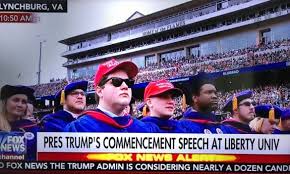 And yet there was Donald Trump—who could arguably use the Apostle Paul’s words on his resume as a self-description—a bit over a week ago on Mother’ Day eve, speaking to the graduates at Liberty University, the Lynchburg, VA creation of Moral Majority founder Jerry Falwell, who established the school as Liberty Baptist College almost fifty years ago. The university now has over 15,000 residential undergraduate and more than 100,000 online students. The reaction of the more than 50,000 people in attendance at the commencement held in the university’s football stadium when the President walked on stage sounded like the Beatles had just arrived. They cheered when, in his summary of Trump’s accomplishments in his first four months as President, Chancellor Jerry Falwell, Jr. praised Trump for bombing “those in the Middle East who were persecuting Christians” (even though the expressed reason for the bombing was Syrian president Assad’s use of chemical weapons on his own citizens).
 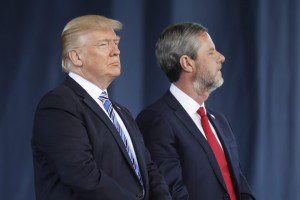 If anyone in the crowd disagreed with Falwell when he said that “I do not believe that any President in our lifetimes has done so much that has benefitted the Christian community in such a short time span than Donald Trump,” they kept their mouths shut.
In some ways, the President’s address was boilerplate Trump—he seldom went more than three sentences without mentioning himself, remained committed to a sixth-grade vocabulary (using his favorite adjectives “amazing” seven times and “great” twenty-seven times), spent the middle third of his talk praising Liberty’s beefed up football program, and more than once mispronounced the name of Fr. Theodore Hesburgh (calling him “Hesper”), who was the President of the University of Notre Dame for thirty-five years. His usual obsession with size was on display as he marveled at the size of the crowd, the number of graduating seniors seated on the field, that Liberty is bigger than Notre Dame, and the size of his upset victory last November. It was also a boilerplate commencement speech, complete with invitations for the graduates to applaud their thanks to their parents, appeals to patriotism, the perfunctory thanks to those in the military for their sacrifice and service, 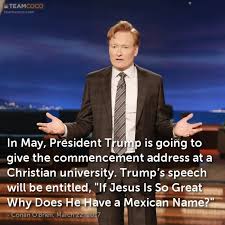 phrases such as “the greatest adventure of your life” and “demand the best from yourself,” stories of people overcoming obstacles to achieve success, and no warnings about the fact that the lives the graduates were undoubtedly imagining for themselves going forward almost certainly will not turn out as they expect. In many ways, the President’s address was exactly like ninety-nine percent of all commencement addresses—completely forgettable.
But woven into Trump’s rambling remarks were regular references to something that has been a conservative Christian theme for some time—the perception that Christians are under attack. This was not Trump’s first visit to Liberty University. When speaking at the university’s convocation in January 2016, then candidate Trump was clearly still searching for his sea legs trying to speak the language of the conservative Christian. He referred to his favorite Bible verse in “Two Corinthians,” for instance; critics suggested that someone might have wanted to tell him that the proper reference is  “Second Corinthians” in preparation for speaking before a crowd of Bible-toting evangelicals. Trump’s commencement address showed that the President can learn a few new tricks—his speech was filled with the code words and phrases that evangelical Christians recognize as marking one of their own. Predicting that the graduates would be “warriors for truth . . . for our country, and for your family,” Trump frequently challenged the graduates to be “true champions,” suggesting that Liberty University’s creed is “to be, really, champions for Christ” (the banner behind the podium said “Liberty University: Training Champions for Christ since 1971”). Over and over the President challenged the graduates to embrace the role of “Outsider,” an odd role to assign to evangelical Christians, since the latest Pew Research data reveals that 25.4% of Americans are evangelical Protestant Christian, the single largest religious group in the nation. Trump promised the graduates that as long as he is president, “no one is ever going to stop you from practicing your faith or from preaching what’s in your heart.
 We will always stand up for the right of all Americans to pray to God and to follow his teachings”—as if the thousands of evangelical Christians in the audience were regularly being denied any of those things.
Evangelical Christians voted for Trump in November in massive numbers, as responsible for his electoral college victory as any other single demographic. There were undoubtedly many reasons why they voted for a man who has regularly and publicly said and done things that are a disgrace and affront to even the most basic Christian principles throughout his adult life; one of these reasons is that Trump’s packaging of reality in an aggressively “Us vs. Them,” “Winners and Losers” framework fits the evangelical’s natural disposition to imagine faith as something to be defended and protected against all manner of perceived threats. I am very familiar with this version of Christianity—it is the one in which I was raised. I learned at a very early age that Christians are involved in a cosmic war between the forces of good and those of darkness—we talked a lot about “spiritual warfare.” 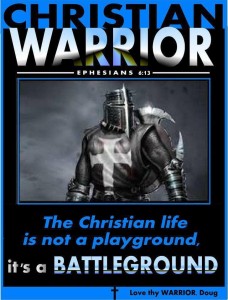 Many of the hymns of my childhood shared a common theme—we Christian believers are at war and must be prepared to do battle at any moment. From “Lead On, O King Eternal” and “Onward Christian Soldiers” through “Soldiers of Christ, Arise,” to “Who is On the Lord’s Side?” I learned a spiritual vocabulary of aggression, violence and warfare. I was never clear about exactly who we were supposed to be fighting or how to recognize the enemy, but I knew I had been drafted into an army, whether I liked it or not. Almost five centuries ago, as he observed his fellow French Catholic and Protestant citizens regularly kill each other in the wake of the Protestant Reformation,
  Michel de Montaigne wrote that “there is no hostility so extreme as that of the Christian.” To which a contemporary evangelical Christian might respond by asking “And what’s your point? When one is at war, hostility is to be expected.”
To be fair, there are enough New Testament texts—particularly in Paul’s epistles—using such aggressive language to describe the life of following Jesus to perhaps justify framing the Christian life in a manner at the same time both combative and defensive. But in the words attributed to Jesus in the gospels, one finds something very different. The kingdom of heaven that Jesus describes is radically inclusive—all are welcome—and this kingdom is our business to establish now, not to hope for at some future post-apocalyptic date. Jesus regularly turns his closest followers away from defensiveness and aggression toward acceptance and welcome. In two of my classes this semester, I more than once had the opportunity to explore with my students how Jesus describes the kingdom of heaven in his parables and stories. The kingdom of heaven is like a mustard seed , like salt, like leaven—in other words, like things so tiny and apparently insignificant that one might entirely overlook them. Most importantly, these things do their slow and transformative work embedded in what they are working on, not by protecting themselves from it or aggressively attacking it. By becoming part of the mixture of flour, water, and other ingredients, yeast transforms them into something more than the sum of its parts. The kingdom of heaven, in other words, is not a zero sum game. It is a both/and kingdom.
I have no idea whether Donald Trump takes any of the religious-sounding rhetoric in his Liberty University commencement address seriously—I must say that if “by your deeds you shall know them,” his deeds have not been very promising. For those who do take their Christian faith seriously and have convinced themselves that their faith led them both to vote for and continue to support Donald Trump, remember that no one can serve two masters. Will it be the kingdom of Trump or the kingdom of heaven?
Previous Post
May 19, 2017
A Message to the Graduates: How to be Good
Next Post

May 24, 2017 All Dogs Go To Heaven
Browse Our Archives
Select a Category abortion Advent AI Angels Artificial intelligence atheism attention baptism Baptists beauty belief Benedictines Bible bicycling Big Bird books Bovina Camaldoli hermitage Canada Catholicism cats certainty change Christianity Christmas Collegeville Covid-19 creativity Development of Western Civilization dogs doubt Easter Enneagram Epiphany Episcopal ethics Eucharist evil extroverts Facebook faith family fear flowers forgiveness freedom friends God goodness grace happiness heaven hell history Holy Spirit Holy Week hope human nature humility humor idolatry incarnation introverts irreverence Islam Jeanne Jesus Joe Biden joy Judaism justice Kamala Harris knowledge Lent listen literature liturgy love Marsue Memorial Day miracles movies music mystery mythology NPR Old Testament optimism paradox peace Penguins philosophy piano podcast politics power prayer Protestantism Providence College Religion Rhode Island sabbatical sacrament science seeing silence Simone Weil Socrates soul sports St. John's College stories suffering tattoo teaching technology television theology thinking time tolerance transcendence travel trees trust truth Uncategorized Vermont wisdom wonder writing
Select a Month May 2026 April 2026 March 2026 February 2026 January 2026 December 2025 November 2025 October 2025 September 2025 August 2025 July 2025 June 2025 May 2025 April 2025 March 2025 February 2025 January 2025 December 2024 November 2024 October 2024 September 2024 August 2024 July 2024 June 2024 May 2024 April 2024 March 2024 February 2024 January 2024 December 2023 November 2023 October 2023 September 2023 August 2023 July 2023 June 2023 May 2023 April 2023 March 2023 February 2023 January 2023 December 2022 November 2022 October 2022 September 2022 August 2022 July 2022 June 2022 May 2022 April 2022 March 2022 February 2022 January 2022 December 2021 November 2021 October 2021 September 2021 August 2021 July 2021 June 2021 May 2021 April 2021 March 2021 February 2021 January 2021 December 2020 November 2020 October 2020 September 2020 August 2020 July 2020 June 2020 May 2020 April 2020 March 2020 February 2020 January 2020 December 2019 November 2019 October 2019 September 2019 August 2019 July 2019 June 2019 May 2019 April 2019 March 2019 February 2019 January 2019 December 2018 November 2018 October 2018 September 2018 August 2018 July 2018 June 2018 May 2018 April 2018 March 2018 February 2018 January 2018 December 2017 November 2017 October 2017 September 2017 August 2017 July 2017 June 2017 May 2017 April 2017 March 2017 February 2017 January 2017 December 2016 November 2016 October 2016 September 2016 August 2016 July 2016 June 2016 May 2016 April 2016 March 2016 February 2016 January 2016 December 2015 November 2015 October 2015 September 2015 August 2015 July 2015 June 2015 May 2015 April 2015 March 2015 February 2015 January 2015 December 2014 November 2014 October 2014 September 2014 August 2014 July 2014 June 2014 May 2014 April 2014 March 2014 February 2014 January 2014 December 2013 November 2013 October 2013 September 2013 August 2013 July 2013 June 2013 May 2013 April 2013 March 2013 February 2013 January 2013 December 2012 November 2012 October 2012 September 2012
Follow Us!
TAKE THE
Religious Wisdom Quiz
After healing a leper, Jesus sternly warned him to tell no one but show himself to the priest. Did the man obey?
Select your answer to see how you score.
No, he spread the news widely Yes, he remained silent Yes, he told only the priest Partially, he told his family only
Books by This Author Books by Vance G. Morgan
Related posts from Freelance Christianity

The Lonely Pawn: On Faith, Doubt, and Meaning


AI and Love: When a Chatbot Becomes a...

TRENDING AT PATHEOS Progressive Christian

Why Christians Have a Sacred Duty to Vote:...
The Bible offers strong support for the sacred duty to vote. Here...

What Being a Modern-Day Apostle Means to Me
In my last column, I discussed the ins and outs of modern-day...

Did Ancient China Once Worship the God of...
Across human history, a common thread weaves through the origins of the...

Love Your Neighbor – Including Earth-Kin: Lev. 19,...
God’s command to love your neighbor means acting in an ethical and...

Lead a Church Study of “Jesus and Lao...
Guest writer Jack Thomas (The Irreverent Reverend) reflects on leading his church...

Principles for Understanding the Apostolic Ministry Today
Whenever people discover that my formal ministry title is "apostle," as in...
view all Progressive Christian blogs
Ad-Free & Subscriber Log-In Subscription Support
- About Us
- 2026 Calendar
- Videos
- Podcasts
- Library of World Religions
- Faith In Media Tracker
- Advertise With Us
- Write for Us
- Privacy Policy
- Terms of Service
- Do Not Sell My Data
- Contact Us
- Radiant Digital
- Manage Newsletter Subscriptions
- Unsubscribe From Notifications
- Sitemap
Copyright 2008-2026, Patheos. All rights reserved.
Subscription Support Ad-Free & Subscriber Log-In
Follow Patheos