
BuddhistCatholicContemplativeEvangelicalGeneral ChristianHinduJewishLatter-day SaintMuslimNew VisionsProgressive Christian
Beliefs
- Buddhist
- Catholic
- Contemplative
- Evangelical
- General Christian
- Hindu
- Jewish
- Latter-day Saint
- More Voices
- Muslim
- New Visions
- Pagan
- Progressive Christian
Topics
- Religion News
- Food and Religion
- Sports and Religion
- Religious Art
- Religious Music and Entertainment
- Religious Events
- History and Religion
- Style and Religion
- Politics and Religion
- Women in Religion
- Recreation Outdoors and Religion
- Business Finance and Religion
- Careers Workplace and Religion
- Education and Religion
- Family Parenting and Religion
- Health Fitness and Religion
- Home and Religion
- Relationships and Religion
- Technology and Religion
- Travel and Religion
Columnists
- Buddhist Columnists
- Business Finance and Religion Columnists
- Careers Workplace and Religion Columnists
- Catholic Columnists
- Contemplative Columnists
- Education and Religion Columnists
- Evangelists Columnists
- Family Parenting and Religion Columnists
- General Christian Columnists
- Health Fitness and Religion Columnists
- Hindu Columnists
- History and Religion Columnists
- Home and Religion Columnists
- Jewish Columnists
- More Voices Columnists
- Latter Day Columnists
- Muslim Columnists
- New Visions Columnists
- Nonreligious Columnists
- Pagan Columnists
- Politics and Religion Columnists
- Progressive Columnists
- Recreation Outdoors and Religion Columnists
- Relationships and Religion Columnists
- Religion News Columnists
- Religious Art Columnists
- Religious Events Columnists
- Religious Music and Entertainment Columnists
- Sports and Religion Columnists
- Style and Religion Columnists
- Technology and Religion Columnists
- Travel and Religion Columnists
- Women in Religion Columnists
Resource Library
- 2026 Calendar
- Library of World Religions
- The 100 Most Holy Places on Earth
- Patheos Answers
- Podcasts
- Videos
- Faith Leaders Database
- Anglican Episcopalian
- Bahai
- Baptist
- Buddhism
- Christianity
- Confucianism
- Eastern Orthodoxy
- Hinduism
- Holiness and Pentecostal
- ISKCON
- Islam
- Judaism
- Lutheran
- Methodist
- The Church of Jesus Christ of Latter-day Saints
- New Age
- Paganism
- Presbytarian and Reformed
- Protestantism
- Religion Behind the Scenes
- Roman Catholic
- Scientology
- Shia Islam
- Sikhism
- Sufism
- Sunni Islam
- Taoism
- Zen
- See all religions
Research Tools
 Ad-Free & Subscriber Log-In Subscription Support
Ad-Free & Subscriber Log-In Subscription Support
Follow Patheos 

- Trending:
- Forgiveness
- |
- Marriage
- |
- Consciousness
- |
- Death Penalty
- |
- Election
- |
- Halloween

- Home
- Progressive Christian
- To Whom Shall I Bow Down?
To Whom Shall I Bow Down?
Last updated on: February 26, 2023 at 7:00 am by Vance Morgan
To Whom Shall I Bow Down? 2023-02-25T23:42:38-04:00 Vance Morgan
Patheos Explore the world's faith through different perspectives on religion and spirituality! Patheos has the views of the prevalent religions and spiritualities of the world.
Today is the first Sunday of Lent; the gospel reading is Matthew’s account of Jesus’ forty days of temptation in the wilderness. This story happens also to be the centerpiece of one of the great passages in all of literature, Dostoevsky’s tale of the Grand Inquisitor in The Brothers Karamazov. The Grand Inquisitor story is on our “Faith and Doubt” syllabus next week. What if, the Inquisitor asks, Jesus had succumbed to one of the temptations? Wouldn’t things have been better in the long run?
Imagine that Jesus unexpectedly shows up in sixteenth-century Seville during the height of the Spanish Inquisition. Although “He appeared quietly, inconspicuously,” everyone recognizes him and immediately starts bringing those who are sick and disabled to be healed. The Grand Inquisitor, an old and severe man “almost ninety . . . with a gaunt face and sunken eyes from which a glitter shines like a fiery spark” watches from the sidelines. When Jesus raises a young girl from the dead as her funeral procession passes by, the Inquisitor has had enough. He motions to his guards, the crowd parts, and Jesus is taken into custody.
What follows is an extraordinary monologue in which the Inquisitor rails against a silent Jesus for having returned to mess up everything that future generations of his claimed followers have accomplished in the fifteen hundred years since Jesus’ ascension. From the perspective of the Church which the Inquisitor represents, Jesus’ original message that human beings have the freedom to choose to follow and be in relationship with God was both elitist and misguided.
As it turns out, the Inquisitor continues, the vast majority of human beings do not want to be free. Rather, they will predictably turn their freedom over to the nearest authority who promises security and safety in exchange for that freedom. Jesus’ message, in other words, is based on a misreading of human nature. We are by nature too weak to handle freedom and the responsibility that goes with it. All we really want is for someone to take care of us.
The Inquisitor uses the three temptations in Sunday’s gospel from Matthew to frame his monologue. In his estimation, the three challenges thrown by the devil at Jesus “express in three words, in three human phrases only, the entire future history of the world and mankind.”
Do you think that all the combined wisdom of the earth could think up anything faintly resembling in force and depth these three questions that were actually presented to you then by the powerful and intelligent spirit in the wilderness?
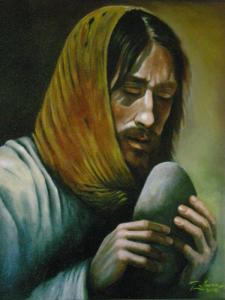 Consider, for instance, what really is contained in the first temptation, which the Inquisitor expansively rephrases as follows:
You want to go into the world, and you are going empty-handed, with some promise of freedom, which they in their simplicity and innate lawlessness cannot even comprehend, which they dread and fear . . . But do you see these stones? Turn them into bread and mankind will run after you like sheep, grateful and obedient.
The Inquisitor fully understands that obedience bought with bread is not obedience freely given, but so what? Human beings not only are incapable of handling freedom, they don’t want it in the first place.
Man has no more tormenting care than to find someone to whom he can hand over as quickly as possible that gift of freedom with which the miserable creature is born.
What do human beings want more, freedom or security? Choice or to be taken care of? I often frame this question with my students by telling a story from the month after 9/11, before any of my current students were born. I was scheduled to present a paper at an academic conference in October 2001 in Fort Lauderdale, Florida; my paper had been accepted for presentation several months prior to the devastating events of 9/11/01. Now, six weeks or so after that devastating day, Jeanne and I had to decide whether to fly from Providence to Fort Lauderdale in a world that seemed far from safe. We chose to do so, although as it turned out close to half of the conference’s scheduled presenters chose otherwise.
At the airport in Providence, and particularly at the larger Fort Lauderdale airport, security was tighter than we had ever seen. Lines snaked out the front doors of the terminal; it took three or four hours to make it through security. Throughout the terminals were dozens of military personnel armed to the teeth and ready to act. Americans had seen things like this on television from other countries, but now it had come to our doorstep. Given the general impatience and entitlement of Americans, it was remarkable that I heard not a single complaint. Rather, would-be-travelers thanked the soldiers for their service and for “keeping us safe.” Our freedoms were significantly restricted and hindered those days in the interest of perceived security, and no one complained. Everyone was thankful.
“Many of you are flying home or somewhere with a beach for Spring Break in a week,” I say to my students. “What would your reaction be if you had to wait three or four hours to get through security?” “I’d be pissed!” one said. “People would very upset!” another imagined. Why? What’s the difference between the compliant airport crowd twenty years ago and the imagined angry crowd today? Twenty years ago, we were willing to give up a lot of our freedoms in exchange for perceived security. Since there has not been another 9/11-style terrorist attack on American soil since then, we now feel secure enough to insist on as unlimited freedom as possible. Until we start feeling unsafe again, that is.
Jesus’ answer to the devil’s first temptation, of course, is “man does not live by bread alone.” There are more important things, in other words, than having your needs being taken care of and feeling secure. Freedom, for instance. My, my, the Inquisitor responds. Who would have thought that the Son of God could have misread human nature so badly?
You objected that man does not live by bread alone, but do you know that in the name of this very earthly bread, the spirit of the earth will rise against you and fight with you and defeat you, and everyone will follow him exclaiming, “Who can compare to this beast, for he has given us fire from heaven! . . . Feed them first, then ask virtue of them.
According to the Inquisitor, the work of religious authorities for the past fifteen centuries (and arguably for the next six since the Inquisitor) has been to reshape and retool the gospel into something more in tune with what human beings actually are rather than some hopeful and stylized vision of what they might be. The Inquisitor tells Jesus that
Had you accepted the “loaves,” you would have answered the universal and everlasting anguish of man as an individual being . . . namely “before whom shall I bow down?” There is no more ceaseless or tormenting care for man, as long as he remains free, than to find someone to bow down to as soon as possible.
The Inquisitor’s challenge is a powerful one that raises important questions for every person who claims to be a follower of Jesus. Do I really understand how radical and challenging the call of the gospel is? Am I truly capable of accepting the responsibility that goes along with freely seeking to live out a life of faith in real time? Wouldn’t it be much better simply to turn that freedom and accompanying responsibility over to someone or something else—a church, political party, authority figure, or social construct that will break the life of faith down into manageable proportions in exchange for my obedience and submission to their demands? What, ultimately, am I looking for? Freedom or security? Radical open-endedness or certainty? Risk or safety?
From his prison cell just weeks before his execution by the Nazis, Dietrich Bonhoeffer wrote that “When Christ calls a man, he bids him come and die.” That’s the sort of thing that the Grand Inquisitor says is far too demanding and difficult for human beings. Was he right?
Previous Post
February 24, 2023
Why Did Jesus Turn Water Into Wine?
Next Post

February 28, 2023 Riding the Tricycle of Faith
Recent Comments
"Mary did have a choice. And she was able to make it before the Holy ..."
"i cannot read beyond your recommendations for the books since i like to have a ..."
"AI will never be able to utter with honesty, feeling, or humility, the greeting: "Namaste".It ..."
"They do. I'm sure you could find discussions of the same topic from any of ..."
Browse Our Archives
Select a Category abortion Advent AI Angels Artificial intelligence atheism attention baptism Baptists beauty belief Benedictines Bible bicycling Big Bird books Bovina Camaldoli hermitage Canada Catholicism cats certainty change Christianity Christmas Collegeville Covid-19 creativity Development of Western Civilization dogs doubt Easter Enneagram Epiphany Episcopal ethics Eucharist evil extroverts Facebook faith family fear flowers forgiveness freedom friends God goodness grace happiness heaven hell history Holy Spirit Holy Week hope human nature humility humor idolatry incarnation introverts irreverence Islam Jeanne Jesus Joe Biden joy Judaism justice Kamala Harris knowledge Lent listen literature liturgy love Marsue Memorial Day miracles movies music mystery mythology NPR Old Testament optimism paradox peace Penguins philosophy piano podcast politics power prayer Protestantism Providence College Religion Rhode Island sabbatical sacrament science seeing silence Simone Weil Socrates soul sports St. John's College stories suffering tattoo teaching technology television theology thinking time tolerance transcendence travel trees trust truth Uncategorized Vermont wisdom wonder writing
Select a Month May 2026 April 2026 March 2026 February 2026 January 2026 December 2025 November 2025 October 2025 September 2025 August 2025 July 2025 June 2025 May 2025 April 2025 March 2025 February 2025 January 2025 December 2024 November 2024 October 2024 September 2024 August 2024 July 2024 June 2024 May 2024 April 2024 March 2024 February 2024 January 2024 December 2023 November 2023 October 2023 September 2023 August 2023 July 2023 June 2023 May 2023 April 2023 March 2023 February 2023 January 2023 December 2022 November 2022 October 2022 September 2022 August 2022 July 2022 June 2022 May 2022 April 2022 March 2022 February 2022 January 2022 December 2021 November 2021 October 2021 September 2021 August 2021 July 2021 June 2021 May 2021 April 2021 March 2021 February 2021 January 2021 December 2020 November 2020 October 2020 September 2020 August 2020 July 2020 June 2020 May 2020 April 2020 March 2020 February 2020 January 2020 December 2019 November 2019 October 2019 September 2019 August 2019 July 2019 June 2019 May 2019 April 2019 March 2019 February 2019 January 2019 December 2018 November 2018 October 2018 September 2018 August 2018 July 2018 June 2018 May 2018 April 2018 March 2018 February 2018 January 2018 December 2017 November 2017 October 2017 September 2017 August 2017 July 2017 June 2017 May 2017 April 2017 March 2017 February 2017 January 2017 December 2016 November 2016 October 2016 September 2016 August 2016 July 2016 June 2016 May 2016 April 2016 March 2016 February 2016 January 2016 December 2015 November 2015 October 2015 September 2015 August 2015 July 2015 June 2015 May 2015 April 2015 March 2015 February 2015 January 2015 December 2014 November 2014 October 2014 September 2014 August 2014 July 2014 June 2014 May 2014 April 2014 March 2014 February 2014 January 2014 December 2013 November 2013 October 2013 September 2013 August 2013 July 2013 June 2013 May 2013 April 2013 March 2013 February 2013 January 2013 December 2012 November 2012 October 2012 September 2012
Follow Us!
TAKE THE
Religious Wisdom Quiz
Who killed his brother: Cain or Abel?
Select your answer to see how you score.
Seth Adam Abel Cain
Books by This Author Books by Vance G. Morgan
Related posts from Freelance Christianity

The Lonely Pawn: On Faith, Doubt, and Meaning


AI and Love: When a Chatbot Becomes a...

TRENDING AT PATHEOS Progressive Christian

What Being a Modern-Day Apostle Means to Me
In my last column, I discussed the ins and outs of modern-day...

Did Ancient China Once Worship the God of...
Across human history, a common thread weaves through the origins of the...

Love Your Neighbor – Including Earth-Kin: Lev. 19,...
God’s command to love your neighbor means acting in an ethical and...

Lead a Church Study of “Jesus and Lao...
Guest writer Jack Thomas (The Irreverent Reverend) reflects on leading his church...

Pastoral Wisdom for Responding to Sermon Pushback
Getting sermon pushback on your social justice sermon? Learn practical, Proverbs-based strategies...

Principles for Understanding the Apostolic Ministry Today
Whenever people discover that my formal ministry title is "apostle," as in...
view all Progressive Christian blogs
What Are Your Thoughts?leave a comment
Ad-Free & Subscriber Log-In Subscription Support
- About Us
- 2026 Calendar
- Videos
- Podcasts
- Library of World Religions
- Faith In Media Tracker
- Advertise With Us
- Write for Us
- Privacy Policy
- Terms of Service
- Do Not Sell My Data
- Contact Us
- Radiant Digital
- Manage Newsletter Subscriptions
- Unsubscribe From Notifications
- Sitemap
Copyright 2008-2026, Patheos. All rights reserved.
Subscription Support Ad-Free & Subscriber Log-In
Follow Patheos