
BuddhistCatholicContemplativeEvangelicalGeneral ChristianHinduJewishLatter-day SaintMuslimNew VisionsProgressive Christian
Beliefs
- Buddhist
- Catholic
- Contemplative
- Evangelical
- General Christian
- Hindu
- Jewish
- Latter-day Saint
- More Voices
- Muslim
- New Visions
- Pagan
- Progressive Christian
Topics
- Religion News
- Food and Religion
- Sports and Religion
- Religious Art
- Religious Music and Entertainment
- Religious Events
- History and Religion
- Style and Religion
- Politics and Religion
- Women in Religion
- Recreation Outdoors and Religion
- Business Finance and Religion
- Careers Workplace and Religion
- Education and Religion
- Family Parenting and Religion
- Health Fitness and Religion
- Home and Religion
- Relationships and Religion
- Technology and Religion
- Travel and Religion
Columnists
- Buddhist Columnists
- Business Finance and Religion Columnists
- Careers Workplace and Religion Columnists
- Catholic Columnists
- Contemplative Columnists
- Education and Religion Columnists
- Evangelists Columnists
- Family Parenting and Religion Columnists
- General Christian Columnists
- Health Fitness and Religion Columnists
- Hindu Columnists
- History and Religion Columnists
- Home and Religion Columnists
- Jewish Columnists
- More Voices Columnists
- Latter Day Columnists
- Muslim Columnists
- New Visions Columnists
- Nonreligious Columnists
- Pagan Columnists
- Politics and Religion Columnists
- Progressive Columnists
- Recreation Outdoors and Religion Columnists
- Relationships and Religion Columnists
- Religion News Columnists
- Religious Art Columnists
- Religious Events Columnists
- Religious Music and Entertainment Columnists
- Sports and Religion Columnists
- Style and Religion Columnists
- Technology and Religion Columnists
- Travel and Religion Columnists
- Women in Religion Columnists
Resource Library
- 2026 Calendar
- Library of World Religions
- The 100 Most Holy Places on Earth
- Patheos Answers
- Podcasts
- Videos
- Faith Leaders Database
- Anglican Episcopalian
- Bahai
- Baptist
- Buddhism
- Christianity
- Confucianism
- Eastern Orthodoxy
- Hinduism
- Holiness and Pentecostal
- ISKCON
- Islam
- Judaism
- Lutheran
- Methodist
- The Church of Jesus Christ of Latter-day Saints
- New Age
- Paganism
- Presbytarian and Reformed
- Protestantism
- Religion Behind the Scenes
- Roman Catholic
- Scientology
- Shia Islam
- Sikhism
- Sufism
- Sunni Islam
- Taoism
- Zen
- See all religions
Research Tools
 Ad-Free & Subscriber Log-In Subscription Support
Ad-Free & Subscriber Log-In Subscription Support
Follow Patheos 

- Trending:
- Forgiveness
- |
- Marriage
- |
- Consciousness
- |
- Death Penalty
- |
- Election
- |
- Halloween

- Home
- Progressive Christian
- To Whom Do You Belong?
To Whom Do You Belong?
Last updated on: November 28, 2016 at 6:30 am by Vance Morgan
To Whom Do You Belong? 2016-11-28T06:30:43-04:00 Vance Morgan
Patheos Explore the world's faith through different perspectives on religion and spirituality! Patheos has the views of the prevalent religions and spiritualities of the world.
 During this academic year, my college is celebrating its centennial. For Jeanne and me, the highlight so far of a series of events scheduled to mark the anniversary has been a lecture by Doris Kearns Goodwin in October. We arrived early enough to sit in the second row, twenty feet or so from the podium, and along with a packed house were held spellbound for over an hour as our favorite historian used examples from the lives of Presidents about whom she has written best sellers—LBJ, FDR, Kennedy, and Lincoln—as the anchors of her discussion of leadership qualities. In the midst of her talk she mentioned her newest book,
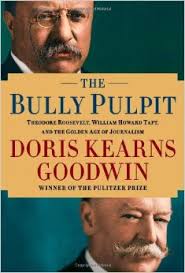 The Bully Pulpit: Theodore Roosevelt, William Howard Taft, and the Golden Age of Journalism. Although the book was published three years ago and apparently spent several weeks at the top of the NY Times bestseller list, Jeanne and I were unaware of its existence. I ordered it from Amazon the next day, expecting that I would have to wait until Christmas break to dive into its 750 pages. But I’ve managed to sneak in the first chapter already—and it doesn’t disappoint.
I’m looking forward to reading this book because it touches on a part of American history with which I am not particularly familiar, the turn from the nineteenth to twentieth centuries described on the back cover as “the first decade of the Progressive era, that tumultuous time when the nation was coming unseamed and reform was in the air.” As I learned about the childhood and adolescence of William Howard Taft, I also learned about his father, Alphonso, a judge on the Cincinnati Superior Court bench who, from a life filled with accomplishments, picked his dissenting opinion in a case concerning prayer and the reading of the Bible in public schools as the achievement of which he was most proud. 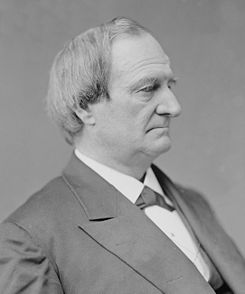 The court ruled that such prayer and reading could not be prohibited; in his dissent, Judge Taft wrote that “the Constitution of the State did not recognize the Christian religion any more than it recognized the religions of any other citizens of the state . . . the school board had an obligation as well as a right to keep religious partisanship out of the public schools.” Several decades later, of course, this position became the law of the land.
Judge Taft’s position reminded me of a reader’s comment posted on my blog in response to what I wrote the day before the election three weeks ago.
The commenter wrote that
I am unclear to how a liberal Christian votes . . . if you vote according to your faith that would be voting against abortion and those things that take God out of our government, am I correct?
To which I responded:
This liberal Christian votes according to policies that seek to facilitate assistance to the poor, the homeless, the needy, the disenfranchised–exactly the persons Jesus told us that we must be most concerned about. Given the nature of separation of church and state, God does not belong in our government, but in the lives of those who profess the Christian faith. As to abortion, I describe myself as intelligently pro-life or conservatively pro-choice. Take your pick.
Never missing an opportunity to generate further blog activity, I concluded:
I must admit that I am equally unclear about how a conservative Christian votes. I’ve written about this on occasion–take a look:
There is an important difference between Christian political advocacy and Political advocacy by persons of Christian faith. I highly recommend the latter and advise strongly against the former. But this is a very difficult tightrope to walk, especially these days.
I received by far more views, shares, and comments on my post a week ago—“Who Is Their God?—than any of the several hundred I’ve written over the past four-and-a-half years.
In response to my wondering why 81% of white evangelicals voted for Donald Trump, the vast majority of the hundreds of comments on Facebook and my blog itself shared my own consternation and confusion. Many of these comments were eloquent and sobering. But there was some welcome push back, including a comment from a woman who said she believes that “being a Christian is compatible with just about any political position.” I briefly expressed my complete disagreement with her claim, but she got me to thinking—always a good thing. Why exactly do I believe that my Christian faith draws me to embrace some social/political positions and reject others out of hand?
The text that I most often consider when wondering about what is required in real-time of a person seeking to live a life of faith is the prophet Micah’s directive: “What does the Lord require of you? To do justice, love mercy, and walk humbly with your God.” This is from the Jewish scriptures, and Jesus may have had it in mind frequently during his years of ministry, if the gospel accounts are the least bit accurate. He regularly made it clear to those who wanted to follow him that doing so would be a life changer.  “Sell all you have, give it to the poor, and come follow me,” he said to the rich young ruler (who couldn’t do it). “Go, and sin no more,” he told the woman caught in adultery. His disciples walked away from their lives as they knew them—and except for a few brief lapses, never returned to those lives.
  The life of faith is not something that can be layered on top of what one already has in place, making no significant changes to what lies beneath. Instead, such a life is like what Daniel Dennett once called “universal acid”—eating through everything one believes and transforming the ways one looks at the world.
Uncertainty, doubt, and faith are constant companions—no person of faith is ever “all set” with any collection of beliefs and commitments. But the requirements of justice, mercy, and humility are a constant litmus test for the beliefs and actions of any person who claims to be a follower of Christ. All Christians—from self-described conservative evangelicals to the most dedicated liberal progressives—should regularly apply this litmus test to their political and social commitments. A commenter on “Who Is Their God?” put it succinctly:
The upcoming events will be the opportunity for Christians to think carefully about what has happened. They will surely be confronted daily with decisions and statements that fly in the face of the gospel . . . Let’s see how long it takes for people to decide where they are on the most important question they will ever have to answer. This is an opportunity for people to answer the question, “To whom do you belong?” As Robert Jones in “The End of Christian America” has suggested, this may be the time for church members to understand whether they love their baggage more than they love Jesus.
Previous Post

November 25, 2016
Fixing and Healing
Next Post
November 30, 2016 What Goes Down Must Come Up
Browse Our Archives
Select a Category abortion Advent AI Angels Artificial intelligence atheism attention baptism Baptists beauty belief Benedictines Bible bicycling Big Bird books Bovina Camaldoli hermitage Canada Catholicism cats certainty change Christianity Christmas Collegeville Covid-19 creativity Development of Western Civilization dogs doubt Easter Enneagram Epiphany Episcopal ethics Eucharist evil extroverts Facebook faith family fear flowers forgiveness freedom friends God goodness grace happiness heaven hell history Holy Spirit Holy Week hope human nature humility humor idolatry incarnation introverts irreverence Islam Jeanne Jesus Joe Biden joy Judaism justice Kamala Harris knowledge Lent listen literature liturgy love Marsue Memorial Day miracles movies music mystery mythology NPR Old Testament optimism paradox peace Penguins philosophy piano podcast politics power prayer Protestantism Providence College Religion Rhode Island sabbatical sacrament science seeing silence Simone Weil Socrates soul sports St. John's College stories suffering tattoo teaching technology television theology thinking time tolerance transcendence travel trees trust truth Uncategorized Vermont wisdom wonder writing
Select a Month May 2026 April 2026 March 2026 February 2026 January 2026 December 2025 November 2025 October 2025 September 2025 August 2025 July 2025 June 2025 May 2025 April 2025 March 2025 February 2025 January 2025 December 2024 November 2024 October 2024 September 2024 August 2024 July 2024 June 2024 May 2024 April 2024 March 2024 February 2024 January 2024 December 2023 November 2023 October 2023 September 2023 August 2023 July 2023 June 2023 May 2023 April 2023 March 2023 February 2023 January 2023 December 2022 November 2022 October 2022 September 2022 August 2022 July 2022 June 2022 May 2022 April 2022 March 2022 February 2022 January 2022 December 2021 November 2021 October 2021 September 2021 August 2021 July 2021 June 2021 May 2021 April 2021 March 2021 February 2021 January 2021 December 2020 November 2020 October 2020 September 2020 August 2020 July 2020 June 2020 May 2020 April 2020 March 2020 February 2020 January 2020 December 2019 November 2019 October 2019 September 2019 August 2019 July 2019 June 2019 May 2019 April 2019 March 2019 February 2019 January 2019 December 2018 November 2018 October 2018 September 2018 August 2018 July 2018 June 2018 May 2018 April 2018 March 2018 February 2018 January 2018 December 2017 November 2017 October 2017 September 2017 August 2017 July 2017 June 2017 May 2017 April 2017 March 2017 February 2017 January 2017 December 2016 November 2016 October 2016 September 2016 August 2016 July 2016 June 2016 May 2016 April 2016 March 2016 February 2016 January 2016 December 2015 November 2015 October 2015 September 2015 August 2015 July 2015 June 2015 May 2015 April 2015 March 2015 February 2015 January 2015 December 2014 November 2014 October 2014 September 2014 August 2014 July 2014 June 2014 May 2014 April 2014 March 2014 February 2014 January 2014 December 2013 November 2013 October 2013 September 2013 August 2013 July 2013 June 2013 May 2013 April 2013 March 2013 February 2013 January 2013 December 2012 November 2012 October 2012 September 2012
Follow Us!
TAKE THE
Religious Wisdom Quiz
What city did the wise men visit to see King Herod before finding Jesus?
Select your answer to see how you score.
Jerusalem Hebron Nazareth Bethlehem
Books by This Author Books by Vance G. Morgan
Related posts from Freelance Christianity

The Lonely Pawn: On Faith, Doubt, and Meaning


AI and Love: When a Chatbot Becomes a...

TRENDING AT PATHEOS Progressive Christian

What Being a Modern-Day Apostle Means to Me
In my last column, I discussed the ins and outs of modern-day...

Did Ancient China Once Worship the God of...
Across human history, a common thread weaves through the origins of the...

Love Your Neighbor – Including Earth-Kin: Lev. 19,...
God’s command to love your neighbor means acting in an ethical and...

Lead a Church Study of “Jesus and Lao...
Guest writer Jack Thomas (The Irreverent Reverend) reflects on leading his church...

Pastoral Wisdom for Responding to Sermon Pushback
Getting sermon pushback on your social justice sermon? Learn practical, Proverbs-based strategies...

Principles for Understanding the Apostolic Ministry Today
Whenever people discover that my formal ministry title is "apostle," as in...
view all Progressive Christian blogs
Ad-Free & Subscriber Log-In Subscription Support
- About Us
- 2026 Calendar
- Videos
- Podcasts
- Library of World Religions
- Faith In Media Tracker
- Advertise With Us
- Write for Us
- Privacy Policy
- Terms of Service
- Do Not Sell My Data
- Contact Us
- Radiant Digital
- Manage Newsletter Subscriptions
- Unsubscribe From Notifications
- Sitemap
Copyright 2008-2026, Patheos. All rights reserved.
Subscription Support Ad-Free & Subscriber Log-In
Follow Patheos